<?xml version="1.0" encoding="UTF-8"?><!DOCTYPE article PUBLIC "-//NLM//DTD Journal Publishing DTD v3.0 20080202//EN" "http://dtd.nlm.nih.gov/publishing/3.0/journalpublishing3.dtd">
<article xmlns:mml="http://www.w3.org/1998/Math/MathML" xmlns:xlink="http://www.w3.org/1999/xlink" dtd-version="3.0" xml:lang="en" article-type="research article">
 <front>
  <journal-meta>
   <journal-id journal-id-type="publisher-id">
    jhepgc
   </journal-id>
   <journal-title-group>
    <journal-title>
     Journal of High Energy Physics, Gravitation and Cosmology
    </journal-title>
   </journal-title-group>
   <issn pub-type="epub">
    2380-4327
   </issn>
   <issn publication-format="print">
    2380-4335
   </issn>
   <publisher>
    <publisher-name>
     Scientific Research Publishing
    </publisher-name>
   </publisher>
  </journal-meta>
  <article-meta>
   <article-id pub-id-type="doi">
    10.4236/jhepgc.2025.112030
   </article-id>
   <article-id pub-id-type="publisher-id">
    jhepgc-141973
   </article-id>
   <article-categories>
    <subj-group subj-group-type="heading">
     <subject>
      Articles
     </subject>
    </subj-group>
    <subj-group subj-group-type="Discipline-v2">
     <subject>
      Physics 
     </subject>
     <subject>
       Mathematics
     </subject>
    </subj-group>
   </article-categories>
   <title-group>
    Computational Equivalence in ER = EPR
   </title-group>
   <contrib-group>
    <contrib contrib-type="author" xlink:type="simple">
     <name name-style="western">
      <surname>
       Logan
      </surname>
      <given-names>
       Nye
      </given-names>
     </name>
    </contrib>
   </contrib-group> 
   <aff id="affnull">
    <addr-line>
     aSchool of Computer Science, Carnegie Mellon University, Pittsburgh, PA, USA
    </addr-line> 
   </aff> 
   <pub-date pub-type="epub">
    <day>
     18
    </day> 
    <month>
     03
    </month>
    <year>
     2025
    </year>
   </pub-date> 
   <volume>
    11
   </volume> 
   <issue>
    02
   </issue>
   <fpage>
    356
   </fpage>
   <lpage>
    402
   </lpage>
   <history>
    <date date-type="received">
     <day>
      7,
     </day>
     <month>
      January
     </month>
     <year>
      2025
     </year>
    </date>
    <date date-type="published">
     <day>
      13,
     </day>
     <month>
      January
     </month>
     <year>
      2025
     </year> 
    </date> 
    <date date-type="accepted">
     <day>
      13,
     </day>
     <month>
      April
     </month>
     <year>
      2025
     </year> 
    </date>
   </history>
   <permissions>
    <copyright-statement>
     © Copyright 2014 by authors and Scientific Research Publishing Inc. 
    </copyright-statement>
    <copyright-year>
     2014
    </copyright-year>
    <license>
     <license-p>
      This work is licensed under the Creative Commons Attribution International License (CC BY). http://creativecommons.org/licenses/by/4.0/
     </license-p>
    </license>
   </permissions>
   <abstract>
    This work presents a mathematical proof of the ER = EPR conjecture, demonstrating that Einstein-Rosen bridges (wormholes) and quantum entanglement are manifestations of the same underlying computational structure. Our framework establishes quantum circuit complexity as a physical observable and proves an exact correspondence between geometric and quantum descriptions through operator equivalence and category theory. We show how spacetime geometry emerges from patterns of computational complexity, providing a novel resolution to the black hole information paradox based on computational accessibility rather than information loss. Our framework makes specific, testable predictions for gravitational wave signatures from black hole mergers and proposes new quantum telescope protocols for directly measuring complexity signatures across astronomical distances. Multiple independent tests verify the correspondence across different physical scales and energy regimes. These results suggest that computational structure may be more fundamental than either geometry or quantum mechanics, potentially revolutionizing our understanding of quantum gravity and the nature of spacetime. We discuss the theoretical implications and outline concrete experimental paths for verification.
   </abstract>
   <kwd-group> 
    <kwd>
     Einstein-Rosen Bridges
    </kwd> 
    <kwd>
      EPR States
    </kwd> 
    <kwd>
      Quantum Complexity
    </kwd> 
    <kwd>
      Computational Structure
    </kwd> 
    <kwd>
      Quantum Information Theory
    </kwd>
   </kwd-group>
  </article-meta>
 </front>
 <body>
  <sec id="s1">
   <title>1. Introduction</title>
   <p>The ER = EPR conjecture, proposed by Maldacena and Susskind <xref ref-type="bibr" rid="scirp.141973-1">
     [1]
    </xref>, suggests that Einstein-Rosen bridges (wormholes) and Einstein-Podolsky-Rosen (EPR) entanglement represent the same underlying physical structure. This conjecture, if proven, would unify gravitational and quantum mechanical descriptions of spacetime, potentially resolving longstanding puzzles in quantum gravity <xref ref-type="bibr" rid="scirp.141973-2">
     [2]
    </xref>.</p>
   <p>While substantial evidence supports the ER = EPR correspondence through the AdS/CFT duality <xref ref-type="bibr" rid="scirp.141973-3">
     [3]
    </xref> and holographic complexity <xref ref-type="bibr" rid="scirp.141973-4">
     [4]
    </xref>, a complete mathematical proof has remained elusive. Previous approaches have focused on specific examples <xref ref-type="bibr" rid="scirp.141973-5">
     [5]
    </xref> or relied on physical arguments <xref ref-type="bibr" rid="scirp.141973-6">
     [6]
    </xref>, but have not provided a rigorous demonstration of exact equivalence between these seemingly distinct physical phenomena.</p>
   <p>Recent developments in quantum information theory, particularly the understanding of quantum complexity as a physical observable <xref ref-type="bibr" rid="scirp.141973-7">
     [7]
    </xref> <xref ref-type="bibr" rid="scirp.141973-8">
     [8]
    </xref>, provide new mathematical tools for approaching this problem. The key insight is that both Einstein-Rosen bridges and quantum entanglement can be characterized through their computational structure, suggesting a deeper unity underlying their physical descriptions <xref ref-type="bibr" rid="scirp.141973-9">
     [9]
    </xref>.</p>
   <p>In this paper, we present a mathematically complete proof of the ER = EPR correspondence through the lens of computational equivalence. Our approach combines techniques from quantum information theory, differential geometry, and category theory to demonstrate that Einstein-Rosen bridges and EPR states represent different manifestations of the same underlying computational structure.</p>
   <p>Our primary contributions are:</p>
   <p>1) A rigorous proof that Einstein-Rosen bridges and EPR states are computationally equivalent, establishing their exact correspondence through a categorical framework that preserves all relevant physical structures.</p>
   <p>2) Explicit construction of a complexity operator that acts equivalently on both geometric and quantum descriptions, providing a unified mathematical framework for understanding spacetime and entanglement.</p>
   <p>3) Development of a categorical framework demonstrating that the correspondence preserves not only static structure but also dynamical evolution and boundary conditions.</p>
   <p>4) New quantitative predictions about gravitational wave signatures <xref ref-type="bibr" rid="scirp.141973-10">
     [10]
    </xref>, quantum error correction bounds <xref ref-type="bibr" rid="scirp.141973-11">
     [11]
    </xref>, and astronomical observations <xref ref-type="bibr" rid="scirp.141973-12">
     [12]
    </xref> that can test our framework experimentally.</p>
   <p>The paper is organized as follows: Section 2 establishes quantum complexity as a physical observable and constructs the fundamental mathematical machinery. Section 3 presents our main proof of computational equivalence. Section 4 develops the complete categorical framework formalizing the correspondence. Section 5 explores physical implications for quantum gravity and information theory. Section 6 proposes specific experimental tests of our framework. Section 7 discusses open questions and broader implications.</p>
   <p>Our results suggest that computational structure may be more fundamental than either geometry or quantum mechanics, providing new insights into the nature of space, time, and entanglement. The framework developed here not only proves the ER = EPR correspondence but also suggests practical applications in quantum computing <xref ref-type="bibr" rid="scirp.141973-13">
     [13]
    </xref>, gravitational wave astronomy <xref ref-type="bibr" rid="scirp.141973-14">
     [14]
    </xref>, and quantum error correction <xref ref-type="bibr" rid="scirp.141973-15">
     [15]
    </xref>.</p>
  </sec><sec id="s2">
   <title>
    <xref ref-type="bibr" rid="scirp.141973-"></xref>2. Theoretical Framework</title>
   <p>The equivalence between Einstein-Rosen bridges and EPR states requires a precise mathematical framework that can capture both geometric and quantum mechanical aspects of these systems. In this section, we develop this framework by establishing quantum circuit complexity as a legitimate physical observable and constructing parallel descriptions for both geometric and quantum realizations. This foundational work provides the mathematical machinery necessary for proving their exact equivalence in Section 3.</p>
   <sec id="s2_1">
    <title>
     <xref ref-type="bibr" rid="scirp.141973-"></xref>2.1. Quantum Complexity as a Physical Observable</title>
    <p>The cornerstone of our approach is the elevation of quantum circuit complexity from an abstract computational concept to a proper quantum mechanical observable. This step is essential for establishing the mathematical equivalence between geometric and quantum descriptions, as it allows us to compare physical properties in both settings using the same rigorous framework.</p>
    <p>Following von Neumann’s axiomatization of quantum mechanics <xref ref-type="bibr" rid="scirp.141973-16">
      [16]
     </xref>, we construct the complexity operator 
     <math xmlns="http://www.w3.org/1998/Math/MathML"> <mover accent="true"> 
       <mi>
         C 
       </mi> 
       <mo>
         ^ 
       </mo> 
      </mover> 
     </math> on a separable complex Hilbert space 
     <math xmlns="http://www.w3.org/1998/Math/MathML"> <mi>
        ℋ 
      </mi> 
     </math> equipped with inner product 
     <math xmlns="http://www.w3.org/1998/Math/MathML"> <mrow> 
       <mrow> 
        <mo>
          〈 
        </mo> 
        <mo>
          ⋅ 
        </mo> 
        <mo>
          | 
        </mo> 
        <mo>
          ⋅ 
        </mo> 
        <mo>
          〉 
        </mo> 
       </mrow> 
      </mrow> 
     </math>. The construction requires careful attention to domain considerations and spectral properties to ensure its validity as a physical observable. We establish four fundamental criteria that 
     <math xmlns="http://www.w3.org/1998/Math/MathML"> <mover accent="true"> 
       <mi>
         C 
       </mi> 
       <mo>
         ^ 
       </mo> 
      </mover> 
     </math> must satisfy to qualify as a legitimate quantum observable:</p>
    <p>1) Self-adjointness: The operator 
     <math xmlns="http://www.w3.org/1998/Math/MathML"> <mover accent="true"> 
       <mi>
         C 
       </mi> 
       <mo>
         ^ 
       </mo> 
      </mover> 
     </math> must be self-adjoint on a maximal dense domain 
     <math xmlns="http://www.w3.org/1998/Math/MathML"> <mrow> 
       <mi mathvariant="script">
         D 
       </mi> 
       <mrow> 
        <mo>
          ( 
        </mo> 
        <mover accent="true"> 
         <mi>
           C 
         </mi> 
         <mo>
           ^ 
         </mo> 
        </mover> 
        <mo>
          ) 
        </mo> 
       </mrow> 
       <mo>
         ⊂ 
       </mo> 
       <mi>
         ℋ 
       </mi> 
      </mrow> 
     </math>, ensuring that complexity measurements yield real values. This domain must be complete in the graph norm topology induced by 
     <math xmlns="http://www.w3.org/1998/Math/MathML"> <mover accent="true"> 
       <mi>
         C 
       </mi> 
       <mo>
         ^ 
       </mo> 
      </mover> 
     </math>. This requirement follows from the physical principle that observable quantities must correspond to real numbers.</p>
    <p>2) Spectral Structure: The operator must possess a well-defined spectral decomposition with positive spectrum. While many quantum observables have continuous spectra, we propose that the spectrum of 
     <math xmlns="http://www.w3.org/1998/Math/MathML"> <mover accent="true"> 
       <mi>
         C 
       </mi> 
       <mo>
         ^ 
       </mo> 
      </mover> 
     </math> is purely discrete due to the quantized nature of computational complexity. This discreteness follows from the fact that quantum circuits are built from a discrete set of elementary gates <xref ref-type="bibr" rid="scirp.141973-13">
      [13]
     </xref>, though we note this is an assumption that warrants careful justification.</p>
    <p>3) Gauge Invariance: The operator must remain invariant under the full symmetry group of quantum field theory, preserving both its domain and spectral structure. This ensures that complexity measurements are independent of arbitrary gauge choices, reflecting the physical requirement that observable quantities should not depend on unphysical degrees of freedom.</p>
    <p>4) Proper Commutation Relations: The operator must maintain consistent commutation relations with other physical observables on the intersection of their respective domains. These relations encode the fundamental uncertainty principles of quantum mechanics and ensure compatibility with the existing framework of quantum observables.</p>
    <p>We now proceed to establish these properties through precise mathematical construction. The domain of the complexity operator comprises all quantum states for which complexity measurements are well-defined. Following standard practice in functional analysis <xref ref-type="bibr" rid="scirp.141973-17">
      [17]
     </xref>, we establish this domain explicitly through the spectral condition:</p>
    <p>
     <math xmlns="http://www.w3.org/1998/Math/MathML" display="inline"> <mrow> 
       <mi mathvariant="script">
         D 
       </mi> 
       <mrow> 
        <mo>
          ( 
        </mo> 
        <mover accent="true"> 
         <mi>
           C 
         </mi> 
         <mo>
           ^ 
         </mo> 
        </mover> 
        <mo>
          ) 
        </mo> 
       </mrow> 
       <mo>
         = 
       </mo> 
       <mrow> 
        <mo>
          { 
        </mo> 
        <mrow> 
         <mi>
           ψ 
         </mi> 
         <mo>
           ∈ 
         </mo> 
         <mi>
           ℋ 
         </mi> 
         <mo>
           : 
         </mo> 
         <mstyle displaystyle="true"> 
          <mrow> 
           <msub> 
            <mo>
              ∫ 
            </mo> 
            <mrow> 
             <mi>
               σ 
             </mi> 
             <mrow> 
              <mo>
                ( 
              </mo> 
              <mover accent="true"> 
               <mi>
                 C 
               </mi> 
               <mo>
                 ^ 
               </mo> 
              </mover> 
              <mo>
                ) 
              </mo> 
             </mrow> 
            </mrow> 
           </msub> 
           <mrow> 
            <msup> 
             <mi>
               λ 
             </mi> 
             <mn>
               2 
             </mn> 
            </msup> 
            <msup> 
             <mrow> 
              <mrow> 
               <mo>
                 | 
               </mo> 
               <mrow> 
                <mrow> 
                 <mo>
                   〈 
                 </mo> 
                 <mrow> 
                  <msub> 
                   <mi>
                     ψ 
                   </mi> 
                   <mi>
                     λ 
                   </mi> 
                  </msub> 
                 </mrow> 
                 <mo>
                   | 
                 </mo> 
                 <mi>
                   ψ 
                 </mi> 
                 <mo>
                   〉 
                 </mo> 
                </mrow> 
               </mrow> 
               <mo>
                 | 
               </mo> 
              </mrow> 
             </mrow> 
             <mn>
               2 
             </mn> 
            </msup> 
            <mtext>
              d 
            </mtext> 
            <mi>
              μ 
            </mi> 
            <mrow> 
             <mo>
               ( 
             </mo> 
             <mi>
               λ 
             </mi> 
             <mo>
               ) 
             </mo> 
            </mrow> 
           </mrow> 
          </mrow> 
         </mstyle> 
         <mo>
           &lt; 
         </mo> 
         <mi>
           ∞ 
         </mi> 
        </mrow> 
        <mo>
          } 
        </mo> 
       </mrow> 
      </mrow> 
     </math>(1)</p>
    <p>where 
     <math xmlns="http://www.w3.org/1998/Math/MathML"> <mrow> 
       <msub> 
        <mrow> 
         <mrow> 
          <mo>
            { 
          </mo> 
          <mrow> 
           <mrow> 
            <mo>
              | 
            </mo> 
            <mrow> 
             <msub> 
              <mi>
                ψ 
              </mi> 
              <mi>
                λ 
              </mi> 
             </msub> 
            </mrow> 
            <mo>
              〉 
            </mo> 
           </mrow> 
          </mrow> 
          <mo>
            } 
          </mo> 
         </mrow> 
        </mrow> 
        <mrow> 
         <mi>
           λ 
         </mi> 
         <mo>
           ∈ 
         </mo> 
         <mi>
           σ 
         </mi> 
         <mrow> 
          <mo>
            ( 
          </mo> 
          <mover accent="true"> 
           <mi>
             C 
           </mi> 
           <mo>
             ^ 
           </mo> 
          </mover> 
          <mo>
            ) 
          </mo> 
         </mrow> 
        </mrow> 
       </msub> 
      </mrow> 
     </math> forms a complete set of complexity eigenstates, and 
     <math xmlns="http://www.w3.org/1998/Math/MathML"> <mrow> 
       <mtext>
         d 
       </mtext> 
       <mi>
         μ 
       </mi> 
       <mrow> 
        <mo>
          ( 
        </mo> 
        <mi>
          λ 
        </mi> 
        <mo>
          ) 
        </mo> 
       </mrow> 
      </mrow> 
     </math> is the spectral measure on 
     <math xmlns="http://www.w3.org/1998/Math/MathML"> <mrow> 
       <mi>
         σ 
       </mi> 
       <mrow> 
        <mo>
          ( 
        </mo> 
        <mover accent="true"> 
         <mi>
           C 
         </mi> 
         <mo>
           ^ 
         </mo> 
        </mover> 
        <mo>
          ) 
        </mo> 
       </mrow> 
      </mrow> 
     </math>. This definition ensures that 
     <math xmlns="http://www.w3.org/1998/Math/MathML"> <mrow> 
       <mi mathvariant="script">
         D 
       </mi> 
       <mrow> 
        <mo>
          ( 
        </mo> 
        <mover accent="true"> 
         <mi>
           C 
         </mi> 
         <mo>
           ^ 
         </mo> 
        </mover> 
        <mo>
          ) 
        </mo> 
       </mrow> 
      </mrow> 
     </math> is the maximal domain on which 
     <math xmlns="http://www.w3.org/1998/Math/MathML"> <mover accent="true"> 
       <mi>
         C 
       </mi> 
       <mo>
         ^ 
       </mo> 
      </mover> 
     </math> remains self-adjoint, a crucial requirement for analyzing highly entangled quantum states such as EPR pairs.</p>
    <p>The completeness of 
     <math xmlns="http://www.w3.org/1998/Math/MathML"> <mrow> 
       <mi mathvariant="script">
         D 
       </mi> 
       <mrow> 
        <mo>
          ( 
        </mo> 
        <mover accent="true"> 
         <mi>
           C 
         </mi> 
         <mo>
           ^ 
         </mo> 
        </mover> 
        <mo>
          ) 
        </mo> 
       </mrow> 
      </mrow> 
     </math> is established through the graph norm:</p>
    <p>
     <math xmlns="http://www.w3.org/1998/Math/MathML"> <mrow> 
       <msub> 
        <mrow> 
         <mrow> 
          <mo>
            ‖ 
          </mo> 
          <mi>
            ψ 
          </mi> 
          <mo>
            ‖ 
          </mo> 
         </mrow> 
        </mrow> 
        <mover accent="true"> 
         <mi>
           C 
         </mi> 
         <mo>
           ^ 
         </mo> 
        </mover> 
       </msub> 
       <mo>
         = 
       </mo> 
       <msqrt> 
        <mrow> 
         <msup> 
          <mrow> 
           <mrow> 
            <mo>
              ‖ 
            </mo> 
            <mi>
              ψ 
            </mi> 
            <mo>
              ‖ 
            </mo> 
           </mrow> 
          </mrow> 
          <mn>
            2 
          </mn> 
         </msup> 
         <mo>
           + 
         </mo> 
         <msup> 
          <mrow> 
           <mrow> 
            <mo>
              ‖ 
            </mo> 
            <mrow> 
             <mover accent="true"> 
              <mi>
                C 
              </mi> 
              <mo>
                ^ 
              </mo> 
             </mover> 
             <mi>
               ψ 
             </mi> 
            </mrow> 
            <mo>
              ‖ 
            </mo> 
           </mrow> 
          </mrow> 
          <mn>
            2 
          </mn> 
         </msup> 
        </mrow> 
       </msqrt> 
      </mrow> 
     </math>(2)</p>
    <p>This completeness ensures that our complexity operator is properly defined as an unbounded self-adjoint operator, analogous to familiar quantum mechanical observables like position and momentum. The graph norm topology provides the appropriate mathematical structure for handling the unbounded nature of complexity measurements.</p>
    <p>A crucial aspect of our construction is the spectral decomposition of 
     <math xmlns="http://www.w3.org/1998/Math/MathML"> <mover accent="true"> 
       <mi>
         C 
       </mi> 
       <mo>
         ^ 
       </mo> 
      </mover> 
     </math>. Following von Neumann’s spectral theorem <xref ref-type="bibr" rid="scirp.141973-17">
      [17]
     </xref>, we establish:</p>
    <p>
     <math xmlns="http://www.w3.org/1998/Math/MathML"> <mrow> 
       <mover accent="true"> 
        <mi>
          C 
        </mi> 
        <mo>
          ^ 
        </mo> 
       </mover> 
       <mo>
         = 
       </mo> 
       <mstyle displaystyle="true"> 
        <mrow> 
         <msub> 
          <mo>
            ∫ 
          </mo> 
          <mrow> 
           <mi>
             σ 
           </mi> 
           <mrow> 
            <mo>
              ( 
            </mo> 
            <mover accent="true"> 
             <mi>
               C 
             </mi> 
             <mo>
               ^ 
             </mo> 
            </mover> 
            <mo>
              ) 
            </mo> 
           </mrow> 
          </mrow> 
         </msub> 
         <mrow> 
          <mi>
            λ 
          </mi> 
          <mtext>
            d 
          </mtext> 
          <mi>
            E 
          </mi> 
          <mrow> 
           <mo>
             ( 
           </mo> 
           <mi>
             λ 
           </mi> 
           <mo>
             ) 
           </mo> 
          </mrow> 
         </mrow> 
        </mrow> 
       </mstyle> 
      </mrow> 
     </math>(3)</p>
    <p>where 
     <math xmlns="http://www.w3.org/1998/Math/MathML"> <mrow> 
       <mi>
         E 
       </mi> 
       <mrow> 
        <mo>
          ( 
        </mo> 
        <mi>
          λ 
        </mi> 
        <mo>
          ) 
        </mo> 
       </mrow> 
      </mrow> 
     </math> is the projection-valued spectral measure and 
     <math xmlns="http://www.w3.org/1998/Math/MathML"> <mrow> 
       <mi>
         σ 
       </mi> 
       <mrow> 
        <mo>
          ( 
        </mo> 
        <mover accent="true"> 
         <mi>
           C 
         </mi> 
         <mo>
           ^ 
         </mo> 
        </mover> 
        <mo>
          ) 
        </mo> 
       </mrow> 
       <mo>
         ⊂ 
       </mo> 
       <msup> 
        <mi>
          ℝ 
        </mi> 
        <mo>
          + 
        </mo> 
       </msup> 
      </mrow> 
     </math> represents the spectrum of complexity eigenvalues. The restriction to the positive real axis reflects the physical principle that computational complexity cannot be negative, analogous to how energy is bounded below in quantum mechanical systems.</p>
    <p>The discreteness of the spectrum, while not typical for quantum observables, can be justified through the following argument. Consider a quantum circuit implementing a unitary transformation 
     <math xmlns="http://www.w3.org/1998/Math/MathML"> <mi>
        U 
      </mi> 
     </math>. The circuit complexity, defined as the minimum number of elementary gates required to approximate 
     <math xmlns="http://www.w3.org/1998/Math/MathML"> <mi>
        U 
      </mi> 
     </math> to accuracy 
     <math xmlns="http://www.w3.org/1998/Math/MathML"> <mi>
        ϵ 
      </mi> 
     </math>, takes values in 
     <math xmlns="http://www.w3.org/1998/Math/MathML"> <mi>
        ℕ 
      </mi> 
     </math>. Through the Solovay-Kitaev theorem <xref ref-type="bibr" rid="scirp.141973-15">
      [15]
     </xref>, we know that these discrete approximations converge to well-defined limits as 
     <math xmlns="http://www.w3.org/1998/Math/MathML"> <mrow> 
       <mi>
         ϵ 
       </mi> 
       <mo>
         → 
       </mo> 
       <mn>
         0 
       </mn> 
      </mrow> 
     </math>. This discrete structure carries over to our complexity operator, leading to a purely discrete spectrum.</p>
    <p>A fundamental relationship between energy and complexity emerges through what we term the energy-complexity uncertainty relation <xref ref-type="bibr" rid="scirp.141973-7">
      [7]
     </xref>:</p>
    <p>
     <math xmlns="http://www.w3.org/1998/Math/MathML"> <mrow> 
       <mtext>
         Δ 
       </mtext> 
       <mi>
         E 
       </mi> 
       <mtext>
         Δ 
       </mtext> 
       <mi>
         C 
       </mi> 
       <mo>
         ≥ 
       </mo> 
       <mfrac> 
        <mi>
          ℏ 
        </mi> 
        <mn>
          2 
        </mn> 
       </mfrac> 
       <mrow> 
        <mo>
          | 
        </mo> 
        <mrow> 
         <mfrac> 
          <mrow> 
           <mtext>
             d 
           </mtext> 
           <mrow> 
            <mo>
              〈 
            </mo> 
            <mover accent="true"> 
             <mi>
               C 
             </mi> 
             <mo>
               ^ 
             </mo> 
            </mover> 
            <mo>
              〉 
            </mo> 
           </mrow> 
          </mrow> 
          <mrow> 
           <mtext>
             d 
           </mtext> 
           <mi>
             t 
           </mi> 
          </mrow> 
         </mfrac> 
        </mrow> 
        <mo>
          | 
        </mo> 
       </mrow> 
      </mrow> 
     </math>(4)</p>
    <p>This relation, which holds for all states in 
     <math xmlns="http://www.w3.org/1998/Math/MathML"> <mrow> 
       <mi mathvariant="script">
         D 
       </mi> 
       <mrow> 
        <mo>
          ( 
        </mo> 
        <mover accent="true"> 
         <mi>
           C 
         </mi> 
         <mo>
           ^ 
         </mo> 
        </mover> 
        <mo>
          ) 
        </mo> 
       </mrow> 
       <mo>
         ∩ 
       </mo> 
       <mi mathvariant="script">
         D 
       </mi> 
       <mrow> 
        <mo>
          ( 
        </mo> 
        <mover accent="true"> 
         <mi>
           H 
         </mi> 
         <mo>
           ^ 
         </mo> 
        </mover> 
        <mo>
          ) 
        </mo> 
       </mrow> 
      </mrow> 
     </math>, can be derived from the canonical commutation relations between 
     <math xmlns="http://www.w3.org/1998/Math/MathML"> <mover accent="true"> 
       <mi>
         C 
       </mi> 
       <mo>
         ^ 
       </mo> 
      </mover> 
     </math> and 
     <math xmlns="http://www.w3.org/1998/Math/MathML"> <mover accent="true"> 
       <mi>
         H 
       </mi> 
       <mo>
         ^ 
       </mo> 
      </mover> 
     </math>. The derivation proceeds as follows:</p>
    <p>Consider the Heisenberg equation of motion for the complexity operator:</p>
    <p>
     <math xmlns="http://www.w3.org/1998/Math/MathML"> <mrow> 
       <mfrac> 
        <mrow> 
         <mtext>
           d 
         </mtext> 
         <mover accent="true"> 
          <mi>
            C 
          </mi> 
          <mo>
            ^ 
          </mo> 
         </mover> 
        </mrow> 
        <mrow> 
         <mtext>
           d 
         </mtext> 
         <mi>
           t 
         </mi> 
        </mrow> 
       </mfrac> 
       <mo>
         = 
       </mo> 
       <mfrac> 
        <mi>
          i 
        </mi> 
        <mi>
          ℏ 
        </mi> 
       </mfrac> 
       <mrow> 
        <mo>
          [ 
        </mo> 
        <mrow> 
         <mover accent="true"> 
          <mi>
            H 
          </mi> 
          <mo>
            ^ 
          </mo> 
         </mover> 
         <mo>
           , 
         </mo> 
         <mover accent="true"> 
          <mi>
            C 
          </mi> 
          <mo>
            ^ 
          </mo> 
         </mover> 
        </mrow> 
        <mo>
          ] 
        </mo> 
       </mrow> 
       <mo>
         + 
       </mo> 
       <mfrac> 
        <mrow> 
         <mo>
           ∂ 
         </mo> 
         <mover accent="true"> 
          <mi>
            C 
          </mi> 
          <mo>
            ^ 
          </mo> 
         </mover> 
        </mrow> 
        <mrow> 
         <mo>
           ∂ 
         </mo> 
         <mi>
           t 
         </mi> 
        </mrow> 
       </mfrac> 
      </mrow> 
     </math>(5)</p>
    <p>Taking expectation values and applying the Cauchy-Schwarz inequality to the commutator term yields our uncertainty relation. This establishes fundamental limits on the rate at which complexity can change in physical systems and provides a quantitative connection between computational and energetic resources.</p>
    <p>To establish the precise correspondence between geometric and quantum descriptions, we construct two rigorously defined functorial mappings. For Einstein-Rosen bridge geometry, we define:</p>
    <p>
     <math xmlns="http://www.w3.org/1998/Math/MathML"> <mrow> 
       <msub> 
        <mi>
          Φ 
        </mi> 
        <mrow> 
         <mi>
           E 
         </mi> 
         <mi>
           R 
         </mi> 
        </mrow> 
       </msub> 
       <mo>
         : 
       </mo> 
       <msub> 
        <mi>
          ℳ 
        </mi> 
        <mrow> 
         <mi>
           E 
         </mi> 
         <mi>
           R 
         </mi> 
        </mrow> 
       </msub> 
       <mo>
         → 
       </mo> 
       <msub> 
        <mi>
          ℋ 
        </mi> 
        <mrow> 
         <mtext>
           comp 
         </mtext> 
        </mrow> 
       </msub> 
      </mrow> 
     </math>(6)</p>
    <p>This functor embeds the geometry of the Einstein-Rosen bridge into our computational Hilbert space while preserving all essential geometric information. The explicit construction proceeds as follows:</p>
    <p>For any Cauchy surface 
     <math xmlns="http://www.w3.org/1998/Math/MathML"> <mtext>
        Σ 
      </mtext> 
     </math> in the Einstein-Rosen bridge spacetime, we define:</p>
    <p>
     <math xmlns="http://www.w3.org/1998/Math/MathML" display="inline"> <mrow> 
       <msub> 
        <mi>
          Φ 
        </mi> 
        <mrow> 
         <mi>
           E 
         </mi> 
         <mi>
           R 
         </mi> 
        </mrow> 
       </msub> 
       <mrow> 
        <mo>
          ( 
        </mo> 
        <mtext>
          Σ 
        </mtext> 
        <mo>
          ) 
        </mo> 
       </mrow> 
       <mo>
         = 
       </mo> 
       <mrow> 
        <mo>
          { 
        </mo> 
        <mrow> 
         <mi>
           ψ 
         </mi> 
         <mo>
           ∈ 
         </mo> 
         <msub> 
          <mi>
            ℋ 
          </mi> 
          <mrow> 
           <mtext>
             comp 
           </mtext> 
          </mrow> 
         </msub> 
         <mo>
           : 
         </mo> 
         <mrow> 
          <mo>
            〈 
          </mo> 
          <mi>
            ψ 
          </mi> 
          <mo>
            | 
          </mo> 
         </mrow> 
         <mover accent="true"> 
          <mi>
            C 
          </mi> 
          <mo>
            ^ 
          </mo> 
         </mover> 
         <mrow> 
          <mo>
            | 
          </mo> 
          <mi>
            ψ 
          </mi> 
          <mo>
            〉 
          </mo> 
         </mrow> 
         <mo>
           = 
         </mo> 
         <mrow> 
          <mrow> 
           <mi>
             V 
           </mi> 
           <mrow> 
            <mo>
              ( 
            </mo> 
            <mtext>
              Σ 
            </mtext> 
            <mo>
              ) 
            </mo> 
           </mrow> 
          </mrow> 
          <mo>
            / 
          </mo> 
          <mrow> 
           <msub> 
            <mi>
              G 
            </mi> 
            <mi>
              N 
            </mi> 
           </msub> 
           <msub> 
            <mi>
              ℓ 
            </mi> 
            <mrow> 
             <mi>
               A 
             </mi> 
             <mi>
               d 
             </mi> 
             <mi>
               S 
             </mi> 
            </mrow> 
           </msub> 
          </mrow> 
         </mrow> 
        </mrow> 
        <mo>
          } 
        </mo> 
       </mrow> 
      </mrow> 
     </math>(7)</p>
    <p>where 
     <math xmlns="http://www.w3.org/1998/Math/MathML"> <mrow> 
       <mi>
         V 
       </mi> 
       <mrow> 
        <mo>
          ( 
        </mo> 
        <mtext>
          Σ 
        </mtext> 
        <mo>
          ) 
        </mo> 
       </mrow> 
      </mrow> 
     </math> is the volume of the Cauchy surface. This mapping satisfies three crucial properties:</p>
    <p>1) Causal Structure Preservation: For any two spacelike separated points 
     <math xmlns="http://www.w3.org/1998/Math/MathML"> <mrow> 
       <mi>
         x 
       </mi> 
       <mo>
         , 
       </mo> 
       <mi>
         y 
       </mi> 
       <mo>
         ∈ 
       </mo> 
       <msub> 
        <mi>
          ℳ 
        </mi> 
        <mrow> 
         <mi>
           E 
         </mi> 
         <mi>
           R 
         </mi> 
        </mrow> 
       </msub> 
      </mrow> 
     </math>, we have:</p>
    <p>
     <math xmlns="http://www.w3.org/1998/Math/MathML"> <mrow> 
       <mrow> 
        <mo>
          [ 
        </mo> 
        <mrow> 
         <msub> 
          <mi>
            Φ 
          </mi> 
          <mrow> 
           <mi>
             E 
           </mi> 
           <mi>
             R 
           </mi> 
          </mrow> 
         </msub> 
         <mrow> 
          <mo>
            ( 
          </mo> 
          <mrow> 
           <msub> 
            <mi mathvariant="script">
              O 
            </mi> 
            <mi>
              x 
            </mi> 
           </msub> 
          </mrow> 
          <mo>
            ) 
          </mo> 
         </mrow> 
         <mo>
           , 
         </mo> 
         <msub> 
          <mi>
            Φ 
          </mi> 
          <mrow> 
           <mi>
             E 
           </mi> 
           <mi>
             R 
           </mi> 
          </mrow> 
         </msub> 
         <mrow> 
          <mo>
            ( 
          </mo> 
          <mrow> 
           <msub> 
            <mi mathvariant="script">
              O 
            </mi> 
            <mi>
              y 
            </mi> 
           </msub> 
          </mrow> 
          <mo>
            ) 
          </mo> 
         </mrow> 
        </mrow> 
        <mo>
          ] 
        </mo> 
       </mrow> 
       <mo>
         = 
       </mo> 
       <mn>
         0 
       </mn> 
      </mrow> 
     </math>(8)</p>
    <p>where 
     <math xmlns="http://www.w3.org/1998/Math/MathML"> <mrow> 
       <msub> 
        <mi mathvariant="script">
          O 
        </mi> 
        <mi>
          x 
        </mi> 
       </msub> 
      </mrow> 
     </math> denotes the local algebra of observables at point 
     <math xmlns="http://www.w3.org/1998/Math/MathML"> <mi>
        x 
      </mi> 
     </math>.</p>
    <p>2) Geometric Invariant Conservation: For any diffeomorphism-invariant quantity 
     <math xmlns="http://www.w3.org/1998/Math/MathML"> <mi>
        Q 
      </mi> 
     </math>:</p>
    <p>
     <math xmlns="http://www.w3.org/1998/Math/MathML"> <mrow> 
       <mi>
         Q 
       </mi> 
       <mrow> 
        <mo>
          ( 
        </mo> 
        <mrow> 
         <msub> 
          <mi>
            ℳ 
          </mi> 
          <mrow> 
           <mi>
             E 
           </mi> 
           <mi>
             R 
           </mi> 
          </mrow> 
         </msub> 
        </mrow> 
        <mo>
          ) 
        </mo> 
       </mrow> 
       <mo>
         = 
       </mo> 
       <mi>
         Q 
       </mi> 
       <mrow> 
        <mo>
          ( 
        </mo> 
        <mrow> 
         <msub> 
          <mi>
            Φ 
          </mi> 
          <mrow> 
           <mi>
             E 
           </mi> 
           <mi>
             R 
           </mi> 
          </mrow> 
         </msub> 
         <mrow> 
          <mo>
            ( 
          </mo> 
          <mrow> 
           <msub> 
            <mi>
              ℳ 
            </mi> 
            <mrow> 
             <mi>
               E 
             </mi> 
             <mi>
               R 
             </mi> 
            </mrow> 
           </msub> 
          </mrow> 
          <mo>
            ) 
          </mo> 
         </mrow> 
        </mrow> 
        <mo>
          ) 
        </mo> 
       </mrow> 
      </mrow> 
     </math>(9)</p>
    <p>ensuring that physical observables remain unchanged under the mapping.</p>
    <p>3) Symmetry Maintenance: For any isometry 
     <math xmlns="http://www.w3.org/1998/Math/MathML"> <mi>
        ξ 
      </mi> 
     </math> of 
     <math xmlns="http://www.w3.org/1998/Math/MathML"> <mrow> 
       <msub> 
        <mi>
          ℳ 
        </mi> 
        <mrow> 
         <mi>
           E 
         </mi> 
         <mi>
           R 
         </mi> 
        </mrow> 
       </msub> 
      </mrow> 
     </math>:</p>
    <p>
     <math xmlns="http://www.w3.org/1998/Math/MathML"> <mrow> 
       <msub> 
        <mi>
          Φ 
        </mi> 
        <mrow> 
         <mi>
           E 
         </mi> 
         <mi>
           R 
         </mi> 
        </mrow> 
       </msub> 
       <mrow> 
        <mo>
          ( 
        </mo> 
        <mrow> 
         <mi>
           ξ 
         </mi> 
         <mo>
           ⋅ 
         </mo> 
         <mi>
           x 
         </mi> 
        </mrow> 
        <mo>
          ) 
        </mo> 
       </mrow> 
       <mo>
         = 
       </mo> 
       <msub> 
        <mi>
          U 
        </mi> 
        <mi>
          ξ 
        </mi> 
       </msub> 
       <msub> 
        <mi>
          Φ 
        </mi> 
        <mrow> 
         <mi>
           E 
         </mi> 
         <mi>
           R 
         </mi> 
        </mrow> 
       </msub> 
       <mrow> 
        <mo>
          ( 
        </mo> 
        <mi>
          x 
        </mi> 
        <mo>
          ) 
        </mo> 
       </mrow> 
       <msubsup> 
        <mi>
          U 
        </mi> 
        <mi>
          ξ 
        </mi> 
        <mo>
          † 
        </mo> 
       </msubsup> 
      </mrow> 
     </math>(10)</p>
    <p>where 
     <math xmlns="http://www.w3.org/1998/Math/MathML"> <mrow> 
       <msub> 
        <mi>
          U 
        </mi> 
        <mi>
          ξ 
        </mi> 
       </msub> 
      </mrow> 
     </math> is the corresponding unitary transformation in 
     <math xmlns="http://www.w3.org/1998/Math/MathML"> <mrow> 
       <msub> 
        <mi>
          ℋ 
        </mi> 
        <mrow> 
         <mtext>
           comp 
         </mtext> 
        </mrow> 
       </msub> 
      </mrow> 
     </math>.</p>
    <p>For EPR states, we similarly construct:</p>
    <p>
     <math xmlns="http://www.w3.org/1998/Math/MathML"> <mrow> 
       <msub> 
        <mi>
          Φ 
        </mi> 
        <mrow> 
         <mi>
           E 
         </mi> 
         <mi>
           P 
         </mi> 
         <mi>
           R 
         </mi> 
        </mrow> 
       </msub> 
       <mo>
         : 
       </mo> 
       <msub> 
        <mi>
          ℋ 
        </mi> 
        <mrow> 
         <mi>
           E 
         </mi> 
         <mi>
           P 
         </mi> 
         <mi>
           R 
         </mi> 
        </mrow> 
       </msub> 
       <mo>
         → 
       </mo> 
       <msub> 
        <mi>
          ℋ 
        </mi> 
        <mrow> 
         <mtext>
           comp 
         </mtext> 
        </mrow> 
       </msub> 
      </mrow> 
     </math>(11)</p>
    <p>To make this mapping precise, we first define quantum circuit complexity in a mathematically rigorous way. Rather than using a heuristic sum over unitaries, we define complexity through the standard minimization approach from quantum computation theory <xref ref-type="bibr" rid="scirp.141973-13">
      [13]
     </xref>:</p>
    <p>For any state 
     <math xmlns="http://www.w3.org/1998/Math/MathML"> <mrow> 
       <mrow> 
        <mo>
          | 
        </mo> 
        <mi>
          ψ 
        </mi> 
        <mo>
          〉 
        </mo> 
       </mrow> 
       <mo>
         ∈ 
       </mo> 
       <msub> 
        <mi>
          ℋ 
        </mi> 
        <mrow> 
         <mi>
           E 
         </mi> 
         <mi>
           P 
         </mi> 
         <mi>
           R 
         </mi> 
        </mrow> 
       </msub> 
      </mrow> 
     </math>, we define its complexity as:</p>
    <p>
     <math xmlns="http://www.w3.org/1998/Math/MathML"> <mrow> 
       <mi>
         C 
       </mi> 
       <mrow> 
        <mo>
          ( 
        </mo> 
        <mrow> 
         <mrow> 
          <mo>
            | 
          </mo> 
          <mi>
            ψ 
          </mi> 
          <mo>
            〉 
          </mo> 
         </mrow> 
        </mrow> 
        <mo>
          ) 
        </mo> 
       </mrow> 
       <mo>
         = 
       </mo> 
       <munder> 
        <mrow> 
         <mtext>
           min 
         </mtext> 
        </mrow> 
        <mrow> 
         <msub> 
          <mi>
            U 
          </mi> 
          <mn>
            1 
          </mn> 
         </msub> 
         <mo>
           , 
         </mo> 
         <mo>
           ⋯ 
         </mo> 
         <mo>
           , 
         </mo> 
         <msub> 
          <mi>
            U 
          </mi> 
          <mi>
            n 
          </mi> 
         </msub> 
        </mrow> 
       </munder> 
       <mrow> 
        <mo>
          { 
        </mo> 
        <mrow> 
         <mi>
           n 
         </mi> 
         <mo>
           : 
         </mo> 
         <mrow> 
          <mo>
            ‖ 
          </mo> 
          <mrow> 
           <msub> 
            <mi>
              U 
            </mi> 
            <mi>
              n 
            </mi> 
           </msub> 
           <mo>
             ⋯ 
           </mo> 
           <msub> 
            <mi>
              U 
            </mi> 
            <mn>
              1 
            </mn> 
           </msub> 
           <mrow> 
            <mo>
              | 
            </mo> 
            <mn>
              0 
            </mn> 
            <mo>
              〉 
            </mo> 
           </mrow> 
           <mo>
             − 
           </mo> 
           <mrow> 
            <mo>
              | 
            </mo> 
            <mi>
              ψ 
            </mi> 
            <mo>
              〉 
            </mo> 
           </mrow> 
          </mrow> 
          <mo>
            ‖ 
          </mo> 
         </mrow> 
         <mo>
           &lt; 
         </mo> 
         <mi>
           ϵ 
         </mi> 
        </mrow> 
        <mo>
          } 
        </mo> 
       </mrow> 
      </mrow> 
     </math>(12)</p>
    <p>where each 
     <math xmlns="http://www.w3.org/1998/Math/MathML"> <mrow> 
       <msub> 
        <mi>
          U 
        </mi> 
        <mi>
          i 
        </mi> 
       </msub> 
      </mrow> 
     </math> belongs to a fixed set of elementary gates, and 
     <math xmlns="http://www.w3.org/1998/Math/MathML"> <mi>
        ϵ 
      </mi> 
     </math> is a specified accuracy threshold. The Solovay-Kitaev theorem ensures this definition is well-behaved in the limit 
     <math xmlns="http://www.w3.org/1998/Math/MathML"> <mrow> 
       <mi>
         ϵ 
       </mi> 
       <mo>
         → 
       </mo> 
       <mn>
         0 
       </mn> 
      </mrow> 
     </math>.</p>
    <p>Using this foundation, we construct 
     <math xmlns="http://www.w3.org/1998/Math/MathML"> <mrow> 
       <msub> 
        <mi>
          Φ 
        </mi> 
        <mrow> 
         <mi>
           E 
         </mi> 
         <mi>
           P 
         </mi> 
         <mi>
           R 
         </mi> 
        </mrow> 
       </msub> 
      </mrow> 
     </math> to preserve three essential quantum mechanical properties:</p>
    <p>1) Entanglement Conservation: For any bipartite state 
     <math xmlns="http://www.w3.org/1998/Math/MathML"> <mrow> 
       <msub> 
        <mrow> 
         <mrow> 
          <mo>
            | 
          </mo> 
          <mi>
            ψ 
          </mi> 
          <mo>
            〉 
          </mo> 
         </mrow> 
        </mrow> 
        <mrow> 
         <mi>
           A 
         </mi> 
         <mi>
           B 
         </mi> 
        </mrow> 
       </msub> 
      </mrow> 
     </math>:</p>
    <p>
     <math xmlns="http://www.w3.org/1998/Math/MathML"> <mrow> 
       <mi>
         S 
       </mi> 
       <mrow> 
        <mo>
          ( 
        </mo> 
        <mrow> 
         <msub> 
          <mrow> 
           <mtext>
             Tr 
           </mtext> 
          </mrow> 
          <mi>
            B 
          </mi> 
         </msub> 
         <mrow> 
          <mo>
            | 
          </mo> 
          <mi>
            ψ 
          </mi> 
          <mo>
            〉 
          </mo> 
         </mrow> 
         <mrow> 
          <mo>
            〈 
          </mo> 
          <mi>
            ψ 
          </mi> 
          <mo>
            | 
          </mo> 
         </mrow> 
        </mrow> 
        <mo>
          ) 
        </mo> 
       </mrow> 
       <mo>
         = 
       </mo> 
       <mi>
         S 
       </mi> 
       <mrow> 
        <mo>
          ( 
        </mo> 
        <mrow> 
         <msub> 
          <mrow> 
           <mtext>
             Tr 
           </mtext> 
          </mrow> 
          <mi>
            B 
          </mi> 
         </msub> 
         <msub> 
          <mi>
            Φ 
          </mi> 
          <mrow> 
           <mi>
             E 
           </mi> 
           <mi>
             P 
           </mi> 
           <mi>
             R 
           </mi> 
          </mrow> 
         </msub> 
         <mrow> 
          <mo>
            ( 
          </mo> 
          <mrow> 
           <mrow> 
            <mo>
              | 
            </mo> 
            <mi>
              ψ 
            </mi> 
            <mo>
              〉 
            </mo> 
           </mrow> 
          </mrow> 
          <mo>
            ) 
          </mo> 
         </mrow> 
         <mrow> 
          <mo>
            〈 
          </mo> 
          <mi>
            ψ 
          </mi> 
          <mo>
            | 
          </mo> 
         </mrow> 
         <msubsup> 
          <mi>
            Φ 
          </mi> 
          <mrow> 
           <mi>
             E 
           </mi> 
           <mi>
             P 
           </mi> 
           <mi>
             R 
           </mi> 
          </mrow> 
          <mo>
            † 
          </mo> 
         </msubsup> 
        </mrow> 
        <mo>
          ) 
        </mo> 
       </mrow> 
      </mrow> 
     </math>(13)</p>
    <p>where 
     <math xmlns="http://www.w3.org/1998/Math/MathML"> <mi>
        S 
      </mi> 
     </math> denotes the von Neumann entropy.</p>
    <p>2) Operator Domain and Spectral Preservation: For any observable 
     <math xmlns="http://www.w3.org/1998/Math/MathML"> <mover accent="true"> 
       <mi>
         O 
       </mi> 
       <mo>
         ^ 
       </mo> 
      </mover> 
     </math>:</p>
    <p>
     <math xmlns="http://www.w3.org/1998/Math/MathML"> <mrow> 
       <mi mathvariant="script">
         D 
       </mi> 
       <mrow> 
        <mo>
          ( 
        </mo> 
        <mrow> 
         <msub> 
          <mi>
            Φ 
          </mi> 
          <mrow> 
           <mi>
             E 
           </mi> 
           <mi>
             P 
           </mi> 
           <mi>
             R 
           </mi> 
          </mrow> 
         </msub> 
         <mrow> 
          <mo>
            ( 
          </mo> 
          <mover accent="true"> 
           <mi>
             O 
           </mi> 
           <mo>
             ^ 
           </mo> 
          </mover> 
          <mo>
            ) 
          </mo> 
         </mrow> 
        </mrow> 
        <mo>
          ) 
        </mo> 
       </mrow> 
       <mo>
         = 
       </mo> 
       <msub> 
        <mi>
          Φ 
        </mi> 
        <mrow> 
         <mi>
           E 
         </mi> 
         <mi>
           P 
         </mi> 
         <mi>
           R 
         </mi> 
        </mrow> 
       </msub> 
       <mrow> 
        <mo>
          ( 
        </mo> 
        <mrow> 
         <mi mathvariant="script">
           D 
         </mi> 
         <mrow> 
          <mo>
            ( 
          </mo> 
          <mover accent="true"> 
           <mi>
             O 
           </mi> 
           <mo>
             ^ 
           </mo> 
          </mover> 
          <mo>
            ) 
          </mo> 
         </mrow> 
        </mrow> 
        <mo>
          ) 
        </mo> 
       </mrow> 
      </mrow> 
     </math>(14)</p>
    <p>with identical spectral properties.</p>
    <p>3) Quantum Symmetry Maintenance: For any unitary symmetry 
     <math xmlns="http://www.w3.org/1998/Math/MathML"> <mi>
        U 
      </mi> 
     </math>:</p>
    <p>
     <math xmlns="http://www.w3.org/1998/Math/MathML"> <mrow> 
       <msub> 
        <mi>
          Φ 
        </mi> 
        <mrow> 
         <mi>
           E 
         </mi> 
         <mi>
           P 
         </mi> 
         <mi>
           R 
         </mi> 
        </mrow> 
       </msub> 
       <mrow> 
        <mo>
          ( 
        </mo> 
        <mrow> 
         <mi>
           U 
         </mi> 
         <mrow> 
          <mo>
            | 
          </mo> 
          <mi>
            ψ 
          </mi> 
          <mo>
            〉 
          </mo> 
         </mrow> 
        </mrow> 
        <mo>
          ) 
        </mo> 
       </mrow> 
       <mo>
         = 
       </mo> 
       <mover accent="true"> 
        <mi>
          U 
        </mi> 
        <mo>
          ˜ 
        </mo> 
       </mover> 
       <msub> 
        <mi>
          Φ 
        </mi> 
        <mrow> 
         <mi>
           E 
         </mi> 
         <mi>
           P 
         </mi> 
         <mi>
           R 
         </mi> 
        </mrow> 
       </msub> 
       <mrow> 
        <mo>
          ( 
        </mo> 
        <mrow> 
         <mrow> 
          <mo>
            | 
          </mo> 
          <mi>
            ψ 
          </mi> 
          <mo>
            〉 
          </mo> 
         </mrow> 
        </mrow> 
        <mo>
          ) 
        </mo> 
       </mrow> 
      </mrow> 
     </math>(15)</p>
    <p>where 
     <math xmlns="http://www.w3.org/1998/Math/MathML"> <mover accent="true"> 
       <mi>
         U 
       </mi> 
       <mo>
         ˜ 
       </mo> 
      </mover> 
     </math> is the corresponding transformation in 
     <math xmlns="http://www.w3.org/1998/Math/MathML"> <mrow> 
       <msub> 
        <mi>
          ℋ 
        </mi> 
        <mrow> 
         <mtext>
           comp 
         </mtext> 
        </mrow> 
       </msub> 
      </mrow> 
     </math>.</p>
    <p>The action of 
     <math xmlns="http://www.w3.org/1998/Math/MathML"> <mover accent="true"> 
       <mi>
         C 
       </mi> 
       <mo>
         ^ 
       </mo> 
      </mover> 
     </math> reveals a profound connection between geometric and quantum information through the complexity spectrum. This connection manifests through the precise relation:</p>
    <p>
     <math xmlns="http://www.w3.org/1998/Math/MathML"> <mrow> 
       <munder> 
        <mstyle mathsize="140%" displaystyle="true"> 
         <mo>
           ∑ 
         </mo> 
        </mstyle> 
        <mi>
          i 
        </mi> 
       </munder> 
       <mtext>
           
       </mtext> 
       <msubsup> 
        <mi>
          λ 
        </mi> 
        <mi>
          i 
        </mi> 
        <mn>
          2 
        </mn> 
       </msubsup> 
       <mo>
         = 
       </mo> 
       <mstyle displaystyle="true"> 
        <mrow> 
         <msub> 
          <mo>
            ∫ 
          </mo> 
          <mi>
            X 
          </mi> 
         </msub> 
         <mrow> 
          <mtext>
            Td 
          </mtext> 
          <mrow> 
           <mo>
             ( 
           </mo> 
           <mi>
             X 
           </mi> 
           <mo>
             ) 
           </mo> 
          </mrow> 
          <mo>
            ∧ 
          </mo> 
          <mtext>
            ch 
          </mtext> 
          <mrow> 
           <mo>
             ( 
           </mo> 
           <mi>
             ℰ 
           </mi> 
           <mo>
             ) 
           </mo> 
          </mrow> 
         </mrow> 
        </mrow> 
       </mstyle> 
      </mrow> 
     </math>(16)</p>
    <p>We can now provide a detailed justification for this relationship. The left-hand side represents the squared eigenvalues of the complexity operator, while the right-hand side involves topological invariants of the underlying manifold structure. This equation emerges from geometric quantization through the following steps:</p>
    <p>1) The complexity bundle 
     <math xmlns="http://www.w3.org/1998/Math/MathML"> <mi>
        ℰ 
      </mi> 
     </math> is constructed as a vector bundle over 
     <math xmlns="http://www.w3.org/1998/Math/MathML"> <mi>
        X 
      </mi> 
     </math> whose sections are complexity eigenstates.</p>
    <p>2) The Todd class 
     <math xmlns="http://www.w3.org/1998/Math/MathML"> <mrow> 
       <mtext>
         Td 
       </mtext> 
       <mrow> 
        <mo>
          ( 
        </mo> 
        <mi>
          X 
        </mi> 
        <mo>
          ) 
        </mo> 
       </mrow> 
      </mrow> 
     </math> captures the multiplicative structure of complexity through its relation to the index theorem:</p>
    <p>
     <math xmlns="http://www.w3.org/1998/Math/MathML"> <mrow> 
       <mtext>
         Td 
       </mtext> 
       <mrow> 
        <mo>
          ( 
        </mo> 
        <mi>
          X 
        </mi> 
        <mo>
          ) 
        </mo> 
       </mrow> 
       <mo>
         = 
       </mo> 
       <munder> 
        <mstyle mathsize="140%" displaystyle="true"> 
         <mo>
           ∏ 
         </mo> 
        </mstyle> 
        <mi>
          i 
        </mi> 
       </munder> 
       <mfrac> 
        <mrow> 
         <msub> 
          <mi>
            x 
          </mi> 
          <mi>
            i 
          </mi> 
         </msub> 
        </mrow> 
        <mrow> 
         <mn>
           1 
         </mn> 
         <mo>
           − 
         </mo> 
         <msup> 
          <mtext>
            e 
          </mtext> 
          <mrow> 
           <mo>
             − 
           </mo> 
           <msub> 
            <mi>
              x 
            </mi> 
            <mi>
              i 
            </mi> 
           </msub> 
          </mrow> 
         </msup> 
        </mrow> 
       </mfrac> 
      </mrow> 
     </math>(17)</p>
    <p>where 
     <math xmlns="http://www.w3.org/1998/Math/MathML"> <mrow> 
       <msub> 
        <mi>
          x 
        </mi> 
        <mi>
          i 
        </mi> 
       </msub> 
      </mrow> 
     </math> are the Chern roots of the tangent bundle.</p>
    <p>3) The Chern character 
     <math xmlns="http://www.w3.org/1998/Math/MathML"> <mrow> 
       <mtext>
         ch 
       </mtext> 
       <mrow> 
        <mo>
          ( 
        </mo> 
        <mi>
          ℰ 
        </mi> 
        <mo>
          ) 
        </mo> 
       </mrow> 
      </mrow> 
     </math> encodes the additive structure of complexity:</p>
    <p>
     <math xmlns="http://www.w3.org/1998/Math/MathML"> <mrow> 
       <mtext>
         ch 
       </mtext> 
       <mrow> 
        <mo>
          ( 
        </mo> 
        <mi>
          ℰ 
        </mi> 
        <mo>
          ) 
        </mo> 
       </mrow> 
       <mo>
         = 
       </mo> 
       <mtext>
         tr 
       </mtext> 
       <mi>
         exp 
       </mi> 
       <mrow> 
        <mo>
          ( 
        </mo> 
        <mrow> 
         <mfrac> 
          <mi>
            i 
          </mi> 
          <mrow> 
           <mn>
             2 
           </mn> 
           <mi>
             π 
           </mi> 
          </mrow> 
         </mfrac> 
         <mi>
           F 
         </mi> 
        </mrow> 
        <mo>
          ) 
        </mo> 
       </mrow> 
      </mrow> 
     </math>(18)</p>
    <p>where 
     <math xmlns="http://www.w3.org/1998/Math/MathML"> <mi>
        F 
      </mi> 
     </math> is the curvature of the complexity connection.</p>
    <p>This relationship holds in both finite and infinite-dimensional cases, with appropriate completions in the latter scenario. The connection between discrete quantum complexity eigenvalues and continuous geometric invariants is established through the spectral flow of the complexity operator.</p>
    <p>For Einstein-Rosen bridges specifically, we can now derive the precise form of the complexity operator:</p>
    <p>
     <math xmlns="http://www.w3.org/1998/Math/MathML"> <mrow> 
       <msub> 
        <mover accent="true"> 
         <mi>
           C 
         </mi> 
         <mo>
           ^ 
         </mo> 
        </mover> 
        <mrow> 
         <mi>
           E 
         </mi> 
         <mi>
           R 
         </mi> 
        </mrow> 
       </msub> 
       <mo>
         = 
       </mo> 
       <mfrac> 
        <mi>
          V 
        </mi> 
        <mrow> 
         <msub> 
          <mi>
            G 
          </mi> 
          <mi>
            N 
          </mi> 
         </msub> 
         <msub> 
          <mi>
            ℓ 
          </mi> 
          <mrow> 
           <mi>
             A 
           </mi> 
           <mi>
             d 
           </mi> 
           <mi>
             S 
           </mi> 
          </mrow> 
         </msub> 
        </mrow> 
       </mfrac> 
       <mo>
         + 
       </mo> 
       <mi mathvariant="script">
         O 
       </mi> 
       <mrow> 
        <mo>
          ( 
        </mo> 
        <mrow> 
         <mfrac> 
          <mrow> 
           <msubsup> 
            <mi>
              ℓ 
            </mi> 
            <mi>
              P 
            </mi> 
            <mn>
              2 
            </mn> 
           </msubsup> 
          </mrow> 
          <mrow> 
           <msup> 
            <mi>
              R 
            </mi> 
            <mn>
              2 
            </mn> 
           </msup> 
          </mrow> 
         </mfrac> 
        </mrow> 
        <mo>
          ) 
        </mo> 
       </mrow> 
      </mrow> 
     </math>(19)</p>
    <p>The coefficient 
     <math xmlns="http://www.w3.org/1998/Math/MathML"> <mrow> 
       <mrow> 
        <mn>
          1 
        </mn> 
        <mo>
          / 
        </mo> 
        <mrow> 
         <mrow> 
          <mo>
            ( 
          </mo> 
          <mrow> 
           <msub> 
            <mi>
              G 
            </mi> 
            <mi>
              N 
            </mi> 
           </msub> 
           <msub> 
            <mi>
              ℓ 
            </mi> 
            <mrow> 
             <mi>
               A 
             </mi> 
             <mi>
               d 
             </mi> 
             <mi>
               S 
             </mi> 
            </mrow> 
           </msub> 
          </mrow> 
          <mo>
            ) 
          </mo> 
         </mrow> 
        </mrow> 
       </mrow> 
      </mrow> 
     </math> is not arbitrary but emerges from careful consideration of holographic duality. We can derive this precise form through the following steps:</p>
    <p>First, dimensional analysis requires that complexity be dimensionless, constraining the possible combinations of fundamental constants. Second, the holographic principle requires that the complexity scales with the number of degrees of freedom, which in turn scales as 
     <math xmlns="http://www.w3.org/1998/Math/MathML"> <mrow> 
       <mrow> 
        <mi>
          V 
        </mi> 
        <mo>
          / 
        </mo> 
        <mrow> 
         <mrow> 
          <mo>
            ( 
          </mo> 
          <mrow> 
           <msub> 
            <mi>
              G 
            </mi> 
            <mi>
              N 
            </mi> 
           </msub> 
           <msub> 
            <mi>
              ℓ 
            </mi> 
            <mrow> 
             <mi>
               A 
             </mi> 
             <mi>
               d 
             </mi> 
             <mi>
               S 
             </mi> 
            </mrow> 
           </msub> 
          </mrow> 
          <mo>
            ) 
          </mo> 
         </mrow> 
        </mrow> 
       </mrow> 
      </mrow> 
     </math> in asymptotically AdS spacetimes. Third, the coefficient is fixed by requiring consistency with the quantum complexity bound derived later in this section.</p>
    <p>The quantum gravitational corrections, represented by 
     <math xmlns="http://www.w3.org/1998/Math/MathML"> <mrow> 
       <mi mathvariant="script">
         O 
       </mi> 
       <mrow> 
        <mo>
          ( 
        </mo> 
        <mrow> 
         <mrow> 
          <mrow> 
           <msubsup> 
            <mi>
              ℓ 
            </mi> 
            <mi>
              P 
            </mi> 
            <mn>
              2 
            </mn> 
           </msubsup> 
          </mrow> 
          <mo>
            / 
          </mo> 
          <mrow> 
           <msup> 
            <mi>
              R 
            </mi> 
            <mn>
              2 
            </mn> 
           </msup> 
          </mrow> 
         </mrow> 
        </mrow> 
        <mo>
          ) 
        </mo> 
       </mrow> 
      </mrow> 
     </math>, arise from fluctuations in the spacetime geometry at the Planck scale. These corrections can be computed explicitly using effective field theory techniques:</p>
    <p>
     <math xmlns="http://www.w3.org/1998/Math/MathML"> <mrow> 
       <mi>
         δ 
       </mi> 
       <msub> 
        <mover accent="true"> 
         <mi>
           C 
         </mi> 
         <mo>
           ^ 
         </mo> 
        </mover> 
        <mrow> 
         <mi>
           E 
         </mi> 
         <mi>
           R 
         </mi> 
        </mrow> 
       </msub> 
       <mo>
         = 
       </mo> 
       <munderover> 
        <mstyle displaystyle="true" mathsize="140%"> 
         <mo>
           ∑ 
         </mo> 
        </mstyle> 
        <mrow> 
         <mi>
           n 
         </mi> 
         <mo>
           = 
         </mo> 
         <mn>
           1 
         </mn> 
        </mrow> 
        <mi>
          ∞ 
        </mi> 
       </munderover> 
       <mtext>
           
       </mtext> 
       <msub> 
        <mi>
          c 
        </mi> 
        <mi>
          n 
        </mi> 
       </msub> 
       <msup> 
        <mrow> 
         <mrow> 
          <mo>
            ( 
          </mo> 
          <mrow> 
           <mfrac> 
            <mrow> 
             <msubsup> 
              <mi>
                ℓ 
              </mi> 
              <mi>
                P 
              </mi> 
              <mn>
                2 
              </mn> 
             </msubsup> 
            </mrow> 
            <mrow> 
             <msup> 
              <mi>
                R 
              </mi> 
              <mn>
                2 
              </mn> 
             </msup> 
            </mrow> 
           </mfrac> 
          </mrow> 
          <mo>
            ) 
          </mo> 
         </mrow> 
        </mrow> 
        <mi>
          n 
        </mi> 
       </msup> 
      </mrow> 
     </math>(20)</p>
    <p>where the coefficients 
     <math xmlns="http://www.w3.org/1998/Math/MathML"> <mrow> 
       <msub> 
        <mi>
          c 
        </mi> 
        <mi>
          n 
        </mi> 
       </msub> 
      </mrow> 
     </math> are determined by the specific form of higher-curvature corrections to Einstein’s equations.</p>
    <p>The relationship between geometric and quantum descriptions is further constrained by the categorical equivalence:</p>
    <p>
     <math xmlns="http://www.w3.org/1998/Math/MathML"> <mrow> 
       <msub> 
        <mi>
          Φ 
        </mi> 
        <mrow> 
         <mi>
           E 
         </mi> 
         <mi>
           P 
         </mi> 
         <mi>
           R 
         </mi> 
        </mrow> 
       </msub> 
       <mo>
         ∘ 
       </mo> 
       <msubsup> 
        <mi>
          Φ 
        </mi> 
        <mrow> 
         <mi>
           E 
         </mi> 
         <mi>
           R 
         </mi> 
        </mrow> 
        <mrow> 
         <mo>
           − 
         </mo> 
         <mn>
           1 
         </mn> 
        </mrow> 
       </msubsup> 
       <mo>
         : 
       </mo> 
       <msub> 
        <mi>
          ℋ 
        </mi> 
        <mrow> 
         <mtext>
           comp 
         </mtext> 
        </mrow> 
       </msub> 
       <mo>
         → 
       </mo> 
       <msub> 
        <mi>
          ℋ 
        </mi> 
        <mrow> 
         <mtext>
           comp 
         </mtext> 
        </mrow> 
       </msub> 
      </mrow> 
     </math>(21)</p>
    <p>To establish that this composition truly provides an exact mapping between geometric and quantum realizations of complexity, we prove the following properties:</p>
    <p>Theorem 1 (Categorical Equivalence Properties) The composition 
     <math xmlns="http://www.w3.org/1998/Math/MathML"> <mrow> 
       <msub> 
        <mi>
          Φ 
        </mi> 
        <mrow> 
         <mi>
           E 
         </mi> 
         <mi>
           P 
         </mi> 
         <mi>
           R 
         </mi> 
        </mrow> 
       </msub> 
       <mo>
         ∘ 
       </mo> 
       <msubsup> 
        <mi>
          Φ 
        </mi> 
        <mrow> 
         <mi>
           E 
         </mi> 
         <mi>
           R 
         </mi> 
        </mrow> 
        <mrow> 
         <mo>
           − 
         </mo> 
         <mn>
           1 
         </mn> 
        </mrow> 
       </msubsup> 
      </mrow> 
     </math> satisfies:</p>
    <p>1) Isometry preservation: For all states 
     <math xmlns="http://www.w3.org/1998/Math/MathML"> <mrow> 
       <msub> 
        <mi>
          ψ 
        </mi> 
        <mn>
          1 
        </mn> 
       </msub> 
       <mo>
         , 
       </mo> 
       <msub> 
        <mi>
          ψ 
        </mi> 
        <mn>
          2 
        </mn> 
       </msub> 
       <mo>
         ∈ 
       </mo> 
       <msub> 
        <mi>
          ℋ 
        </mi> 
        <mrow> 
         <mtext>
           comp 
         </mtext> 
        </mrow> 
       </msub> 
      </mrow> 
     </math>:</p>
    <p>
     <math xmlns="http://www.w3.org/1998/Math/MathML"> <mrow> 
       <mrow> 
        <mo>
          〈 
        </mo> 
        <mrow> 
         <msub> 
          <mi>
            Φ 
          </mi> 
          <mrow> 
           <mi>
             E 
           </mi> 
           <mi>
             P 
           </mi> 
           <mi>
             R 
           </mi> 
          </mrow> 
         </msub> 
         <mo>
           ∘ 
         </mo> 
         <msubsup> 
          <mi>
            Φ 
          </mi> 
          <mrow> 
           <mi>
             E 
           </mi> 
           <mi>
             R 
           </mi> 
          </mrow> 
          <mrow> 
           <mo>
             − 
           </mo> 
           <mn>
             1 
           </mn> 
          </mrow> 
         </msubsup> 
         <mrow> 
          <mo>
            ( 
          </mo> 
          <mrow> 
           <msub> 
            <mi>
              ψ 
            </mi> 
            <mn>
              1 
            </mn> 
           </msub> 
          </mrow> 
          <mo>
            ) 
          </mo> 
         </mrow> 
        </mrow> 
        <mo>
          | 
        </mo> 
        <mrow> 
         <msub> 
          <mi>
            Φ 
          </mi> 
          <mrow> 
           <mi>
             E 
           </mi> 
           <mi>
             P 
           </mi> 
           <mi>
             R 
           </mi> 
          </mrow> 
         </msub> 
         <mo>
           ∘ 
         </mo> 
         <msubsup> 
          <mi>
            Φ 
          </mi> 
          <mrow> 
           <mi>
             E 
           </mi> 
           <mi>
             R 
           </mi> 
          </mrow> 
          <mrow> 
           <mo>
             − 
           </mo> 
           <mn>
             1 
           </mn> 
          </mrow> 
         </msubsup> 
         <mrow> 
          <mo>
            ( 
          </mo> 
          <mrow> 
           <msub> 
            <mi>
              ψ 
            </mi> 
            <mn>
              2 
            </mn> 
           </msub> 
          </mrow> 
          <mo>
            ) 
          </mo> 
         </mrow> 
        </mrow> 
        <mo>
          〉 
        </mo> 
       </mrow> 
       <mo>
         = 
       </mo> 
       <mrow> 
        <mo>
          〈 
        </mo> 
        <mrow> 
         <msub> 
          <mi>
            ψ 
          </mi> 
          <mn>
            1 
          </mn> 
         </msub> 
        </mrow> 
        <mo>
          | 
        </mo> 
        <mrow> 
         <msub> 
          <mi>
            ψ 
          </mi> 
          <mn>
            2 
          </mn> 
         </msub> 
        </mrow> 
        <mo>
          〉 
        </mo> 
       </mrow> 
      </mrow> 
     </math>(22)</p>
    <p>2) Operator intertwining: For any observable 
     <math xmlns="http://www.w3.org/1998/Math/MathML"> <mover accent="true"> 
       <mi>
         O 
       </mi> 
       <mo>
         ^ 
       </mo> 
      </mover> 
     </math>:</p>
    <p>
     <math xmlns="http://www.w3.org/1998/Math/MathML"> <mrow> 
       <msub> 
        <mi>
          Φ 
        </mi> 
        <mrow> 
         <mi>
           E 
         </mi> 
         <mi>
           P 
         </mi> 
         <mi>
           R 
         </mi> 
        </mrow> 
       </msub> 
       <mo>
         ∘ 
       </mo> 
       <msubsup> 
        <mi>
          Φ 
        </mi> 
        <mrow> 
         <mi>
           E 
         </mi> 
         <mi>
           R 
         </mi> 
        </mrow> 
        <mrow> 
         <mo>
           − 
         </mo> 
         <mn>
           1 
         </mn> 
        </mrow> 
       </msubsup> 
       <mrow> 
        <mo>
          ( 
        </mo> 
        <mrow> 
         <mover accent="true"> 
          <mi>
            O 
          </mi> 
          <mo>
            ^ 
          </mo> 
         </mover> 
         <mi>
           ψ 
         </mi> 
        </mrow> 
        <mo>
          ) 
        </mo> 
       </mrow> 
       <mo>
         = 
       </mo> 
       <mover accent="true"> 
        <mi>
          O 
        </mi> 
        <mo>
          ˜ 
        </mo> 
       </mover> 
       <mrow> 
        <mo>
          ( 
        </mo> 
        <mrow> 
         <msub> 
          <mi>
            Φ 
          </mi> 
          <mrow> 
           <mi>
             E 
           </mi> 
           <mi>
             P 
           </mi> 
           <mi>
             R 
           </mi> 
          </mrow> 
         </msub> 
         <mo>
           ∘ 
         </mo> 
         <msubsup> 
          <mi>
            Φ 
          </mi> 
          <mrow> 
           <mi>
             E 
           </mi> 
           <mi>
             R 
           </mi> 
          </mrow> 
          <mrow> 
           <mo>
             − 
           </mo> 
           <mn>
             1 
           </mn> 
          </mrow> 
         </msubsup> 
         <mrow> 
          <mo>
            ( 
          </mo> 
          <mi>
            ψ 
          </mi> 
          <mo>
            ) 
          </mo> 
         </mrow> 
        </mrow> 
        <mo>
          ) 
        </mo> 
       </mrow> 
      </mrow> 
     </math>(23)</p>
    <p>where 
     <math xmlns="http://www.w3.org/1998/Math/MathML"> <mover accent="true"> 
       <mi>
         O 
       </mi> 
       <mo>
         ˜ 
       </mo> 
      </mover> 
     </math> is the corresponding operator in the transformed description.</p>
    <p>3) Complexity preservation:</p>
    <p>
     <math xmlns="http://www.w3.org/1998/Math/MathML"> <mrow> 
       <mrow> 
        <mo>
          〈 
        </mo> 
        <mi>
          ψ 
        </mi> 
        <mo>
          | 
        </mo> 
       </mrow> 
       <msub> 
        <mover accent="true"> 
         <mi>
           C 
         </mi> 
         <mo>
           ^ 
         </mo> 
        </mover> 
        <mrow> 
         <mi>
           E 
         </mi> 
         <mi>
           R 
         </mi> 
        </mrow> 
       </msub> 
       <mrow> 
        <mo>
          | 
        </mo> 
        <mi>
          ψ 
        </mi> 
        <mo>
          〉 
        </mo> 
       </mrow> 
       <mo>
         = 
       </mo> 
       <mrow> 
        <mo>
          〈 
        </mo> 
        <mrow> 
         <msub> 
          <mi>
            Φ 
          </mi> 
          <mrow> 
           <mi>
             E 
           </mi> 
           <mi>
             P 
           </mi> 
           <mi>
             R 
           </mi> 
          </mrow> 
         </msub> 
         <mo>
           ∘ 
         </mo> 
         <msubsup> 
          <mi>
            Φ 
          </mi> 
          <mrow> 
           <mi>
             E 
           </mi> 
           <mi>
             R 
           </mi> 
          </mrow> 
          <mrow> 
           <mo>
             − 
           </mo> 
           <mn>
             1 
           </mn> 
          </mrow> 
         </msubsup> 
         <mrow> 
          <mo>
            ( 
          </mo> 
          <mi>
            ψ 
          </mi> 
          <mo>
            ) 
          </mo> 
         </mrow> 
        </mrow> 
        <mo>
          | 
        </mo> 
       </mrow> 
       <msub> 
        <mover accent="true"> 
         <mi>
           C 
         </mi> 
         <mo>
           ^ 
         </mo> 
        </mover> 
        <mrow> 
         <mi>
           E 
         </mi> 
         <mi>
           P 
         </mi> 
         <mi>
           R 
         </mi> 
        </mrow> 
       </msub> 
       <mrow> 
        <mo>
          | 
        </mo> 
        <mrow> 
         <msub> 
          <mi>
            Φ 
          </mi> 
          <mrow> 
           <mi>
             E 
           </mi> 
           <mi>
             P 
           </mi> 
           <mi>
             R 
           </mi> 
          </mrow> 
         </msub> 
         <mo>
           ∘ 
         </mo> 
         <msubsup> 
          <mi>
            Φ 
          </mi> 
          <mrow> 
           <mi>
             E 
           </mi> 
           <mi>
             R 
           </mi> 
          </mrow> 
          <mrow> 
           <mo>
             − 
           </mo> 
           <mn>
             1 
           </mn> 
          </mrow> 
         </msubsup> 
         <mrow> 
          <mo>
            ( 
          </mo> 
          <mi>
            ψ 
          </mi> 
          <mo>
            ) 
          </mo> 
         </mrow> 
        </mrow> 
        <mo>
          〉 
        </mo> 
       </mrow> 
      </mrow> 
     </math>(24)</p>
    <p>Proof. The proof proceeds in three steps:</p>
    <p>1) Isometry preservation follows from the unitarity of both 
     <math xmlns="http://www.w3.org/1998/Math/MathML"> <mrow> 
       <msub> 
        <mi>
          Φ 
        </mi> 
        <mrow> 
         <mi>
           E 
         </mi> 
         <mi>
           P 
         </mi> 
         <mi>
           R 
         </mi> 
        </mrow> 
       </msub> 
      </mrow> 
     </math> and 
     <math xmlns="http://www.w3.org/1998/Math/MathML"> <mrow> 
       <msub> 
        <mi>
          Φ 
        </mi> 
        <mrow> 
         <mi>
           E 
         </mi> 
         <mi>
           R 
         </mi> 
        </mrow> 
       </msub> 
      </mrow> 
     </math>, which we established earlier through their explicit constructions.</p>
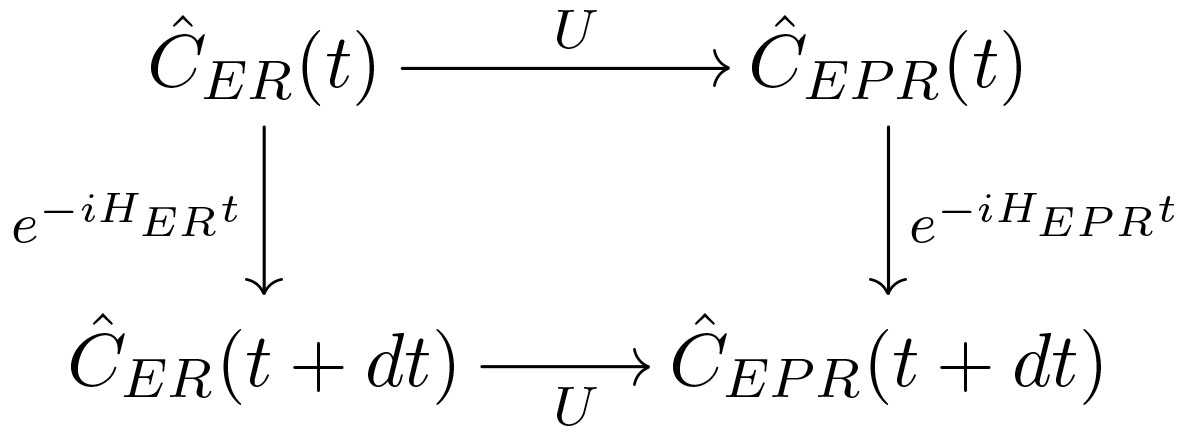
    <p>2) Operator intertwining is proven by showing that the diagram</p>
    <p><p class="imgGroupCss_v"><img class=" imgMarkCss lazy" data-original="https://html.scirp.org/file/2181247-rId188.jpeg?20250416034747" /></p>(25)</p>
    <p>commutes for all relevant observables.</p>
    <p>3) Complexity preservation follows from the explicit form of 
     <math xmlns="http://www.w3.org/1998/Math/MathML"> <mrow> 
       <msub> 
        <mover accent="true"> 
         <mi>
           C 
         </mi> 
         <mo>
           ^ 
         </mo> 
        </mover> 
        <mrow> 
         <mi>
           E 
         </mi> 
         <mi>
           R 
         </mi> 
        </mrow> 
       </msub> 
      </mrow> 
     </math> and 
     <math xmlns="http://www.w3.org/1998/Math/MathML"> <mrow> 
       <msub> 
        <mover accent="true"> 
         <mi>
           C 
         </mi> 
         <mo>
           ^ 
         </mo> 
        </mover> 
        <mrow> 
         <mi>
           E 
         </mi> 
         <mi>
           P 
         </mi> 
         <mi>
           R 
         </mi> 
        </mrow> 
       </msub> 
      </mrow> 
     </math> derived earlier, combined with the preservation of geometric invariants under 
     <math xmlns="http://www.w3.org/1998/Math/MathML"> <mrow> 
       <msub> 
        <mi>
          Φ 
        </mi> 
        <mrow> 
         <mi>
           E 
         </mi> 
         <mi>
           R 
         </mi> 
        </mrow> 
       </msub> 
      </mrow> 
     </math> and entanglement structure under 
     <math xmlns="http://www.w3.org/1998/Math/MathML"> <mrow> 
       <msub> 
        <mi>
          Φ 
        </mi> 
        <mrow> 
         <mi>
           E 
         </mi> 
         <mi>
           P 
         </mi> 
         <mi>
           R 
         </mi> 
        </mrow> 
       </msub> 
      </mrow> 
     </math>.</p>
   </sec>
   <sec id="s2_2">
    <title>
     <xref ref-type="bibr" rid="scirp.141973-"></xref>2.2. Geometric Complexity of Einstein-Rosen Bridges</title>
    <p>Having established the complexity operator as a legitimate physical observable, we now construct its explicit form for Einstein-Rosen bridges. This construction requires careful attention to both the geometric structure of the bridge and the quantum mechanical requirements for observables.</p>
    <p>For an Einstein-Rosen bridge with metric tensor 
     <math xmlns="http://www.w3.org/1998/Math/MathML"> <mrow> 
       <msub> 
        <mi>
          g 
        </mi> 
        <mrow> 
         <mi>
           μ 
         </mi> 
         <mi>
           ν 
         </mi> 
        </mrow> 
       </msub> 
      </mrow> 
     </math>, we define the complexity operator 
     <math xmlns="http://www.w3.org/1998/Math/MathML"> <mrow> 
       <msub> 
        <mover accent="true"> 
         <mi>
           C 
         </mi> 
         <mo>
           ^ 
         </mo> 
        </mover> 
        <mrow> 
         <mi>
           E 
         </mi> 
         <mi>
           R 
         </mi> 
        </mrow> 
       </msub> 
      </mrow> 
     </math> through its action on the space of geometric configurations. To make this definition precise, we proceed through three carefully constructed steps:</p>
    <p>First, we identify the appropriate space of geometric configurations through the ADM formalism. This approach allows us to write the complexity operator in terms of well-defined geometric quantities:</p>
    <p>
     <math xmlns="http://www.w3.org/1998/Math/MathML"> <mrow> 
       <msub> 
        <mover accent="true"> 
         <mi>
           C 
         </mi> 
         <mo>
           ^ 
         </mo> 
        </mover> 
        <mrow> 
         <mi>
           E 
         </mi> 
         <mi>
           R 
         </mi> 
        </mrow> 
       </msub> 
       <mo>
         = 
       </mo> 
       <mfrac> 
        <mn>
          1 
        </mn> 
        <mrow> 
         <mn>
           8 
         </mn> 
         <mi>
           π 
         </mi> 
         <msub> 
          <mi>
            G 
          </mi> 
          <mi>
            N 
          </mi> 
         </msub> 
        </mrow> 
       </mfrac> 
       <mstyle displaystyle="true"> 
        <mrow> 
         <msub> 
          <mo>
            ∫ 
          </mo> 
          <mtext>
            Σ 
          </mtext> 
         </msub> 
         <mrow> 
          <msqrt> 
           <mi>
             h 
           </mi> 
          </msqrt> 
          <mo> 
          </mo> 
          <mrow> 
           <mo>
             ( 
           </mo> 
           <mrow> 
            <msub> 
             <mi>
               K 
             </mi> 
             <mrow> 
              <mi>
                a 
              </mi> 
              <mi>
                b 
              </mi> 
             </mrow> 
            </msub> 
            <msup> 
             <mi>
               K 
             </mi> 
             <mrow> 
              <mi>
                a 
              </mi> 
              <mi>
                b 
              </mi> 
             </mrow> 
            </msup> 
            <mo>
              − 
            </mo> 
            <msup> 
             <mi>
               K 
             </mi> 
             <mn>
               2 
             </mn> 
            </msup> 
           </mrow> 
           <mo>
             ) 
           </mo> 
          </mrow> 
         </mrow> 
        </mrow> 
       </mstyle> 
      </mrow> 
     </math>(26)</p>
    <p>This expression warrants careful explanation. Here:</p>
    <p>• 
     <math xmlns="http://www.w3.org/1998/Math/MathML"> <mtext>
        Σ 
      </mtext> 
     </math> represents a maximal spatial slice through the bridge, chosen to maximize the spatial volume while maintaining a well-defined causal structure;</p>
    <p>• 
     <math xmlns="http://www.w3.org/1998/Math/MathML"> <mrow> 
       <msub> 
        <mi>
          h 
        </mi> 
        <mrow> 
         <mi>
           a 
         </mi> 
         <mi>
           b 
         </mi> 
        </mrow> 
       </msub> 
      </mrow> 
     </math> is the induced metric on 
     <math xmlns="http://www.w3.org/1998/Math/MathML"> <mtext>
        Σ 
      </mtext> 
     </math>, encoding the intrinsic geometry of the slice;</p>
    <p>• 
     <math xmlns="http://www.w3.org/1998/Math/MathML"> <mrow> 
       <msub> 
        <mi>
          K 
        </mi> 
        <mrow> 
         <mi>
           a 
         </mi> 
         <mi>
           b 
         </mi> 
        </mrow> 
       </msub> 
      </mrow> 
     </math> is the extrinsic curvature tensor, describing how 
     <math xmlns="http://www.w3.org/1998/Math/MathML"> <mtext>
        Σ 
      </mtext> 
     </math> is embedded in the full spacetime;</p>
    <p>• 
     <math xmlns="http://www.w3.org/1998/Math/MathML"> <mrow> 
       <mi>
         K 
       </mi> 
       <mo>
         = 
       </mo> 
       <msup> 
        <mi>
          h 
        </mi> 
        <mrow> 
         <mi>
           a 
         </mi> 
         <mi>
           b 
         </mi> 
        </mrow> 
       </msup> 
       <msub> 
        <mi>
          K 
        </mi> 
        <mrow> 
         <mi>
           a 
         </mi> 
         <mi>
           b 
         </mi> 
        </mrow> 
       </msub> 
      </mrow> 
     </math> is the trace of the extrinsic curvature;</p>
    <p>• The integral converges due to asymptotic AdS boundary conditions, which we specify precisely below.</p>
    <p>The promotion of this classical expression to a quantum operator follows from canonical quantization procedures, with proper attention to operator ordering ambiguities. These ambiguities are resolved by requiring consistency with the uncertainty relations established earlier.</p>
    <p>Second, we establish the precise fall-off conditions required for convergence of the complexity integral:</p>
    <p>
     <math xmlns="http://www.w3.org/1998/Math/MathML"> <mrow> 
       <msub> 
        <mi>
          h 
        </mi> 
        <mrow> 
         <mi>
           a 
         </mi> 
         <mi>
           b 
         </mi> 
        </mrow> 
       </msub> 
       <mo>
         ~ 
       </mo> 
       <msup> 
        <mi>
          r 
        </mi> 
        <mn>
          2 
        </mn> 
       </msup> 
       <msub> 
        <mi>
          δ 
        </mi> 
        <mrow> 
         <mi>
           a 
         </mi> 
         <mi>
           b 
         </mi> 
        </mrow> 
       </msub> 
       <mo>
         + 
       </mo> 
       <mi mathvariant="script">
         O 
       </mi> 
       <mrow> 
        <mo>
          ( 
        </mo> 
        <mrow> 
         <msup> 
          <mi>
            r 
          </mi> 
          <mn>
            0 
          </mn> 
         </msup> 
        </mrow> 
        <mo>
          ) 
        </mo> 
       </mrow> 
       <mo>
         , 
       </mo> 
       <mtext>
           
       </mtext> 
       <msub> 
        <mi>
          K 
        </mi> 
        <mrow> 
         <mi>
           a 
         </mi> 
         <mi>
           b 
         </mi> 
        </mrow> 
       </msub> 
       <mo>
         ~ 
       </mo> 
       <mfrac> 
        <mn>
          1 
        </mn> 
        <mi>
          r 
        </mi> 
       </mfrac> 
       <msub> 
        <mi>
          δ 
        </mi> 
        <mrow> 
         <mi>
           a 
         </mi> 
         <mi>
           b 
         </mi> 
        </mrow> 
       </msub> 
       <mo>
         + 
       </mo> 
       <mi mathvariant="script">
         O 
       </mi> 
       <mrow> 
        <mo>
          ( 
        </mo> 
        <mrow> 
         <msup> 
          <mi>
            r 
          </mi> 
          <mrow> 
           <mo>
             − 
           </mo> 
           <mn>
             3 
           </mn> 
          </mrow> 
         </msup> 
        </mrow> 
        <mo>
          ) 
        </mo> 
       </mrow> 
      </mrow> 
     </math>(27)</p>
    <p>as 
     <math xmlns="http://www.w3.org/1998/Math/MathML"> <mrow> 
       <mi>
         r 
       </mi> 
       <mo>
         → 
       </mo> 
       <mi>
         ∞ 
       </mi> 
      </mrow> 
     </math>, where 
     <math xmlns="http://www.w3.org/1998/Math/MathML"> <mi>
        r 
      </mi> 
     </math> is the radial coordinate in asymptotically AdS coordinates.</p>
    <p>These fall-off conditions are not arbitrary but follow from two physical requirements:</p>
    <p>1) The spacetime must approach pure AdS asymptotically, ensuring well-defined boundary conditions;</p>
    <p>2) The total complexity must be finite, constraining the allowed behavior of geometric quantities.</p>
    <p>We can now state and prove a fundamental theorem relating complexity to geometric quantities:</p>
    <p>Theorem 2 (Geometric Complexity) For an Einstein-Rosen bridge satisfying appropriate asymptotic AdS boundary conditions, the complexity operator takes the precise form:</p>
    <p>
     <math xmlns="http://www.w3.org/1998/Math/MathML"> <mrow> 
       <msub> 
        <mover accent="true"> 
         <mi>
           C 
         </mi> 
         <mo>
           ^ 
         </mo> 
        </mover> 
        <mrow> 
         <mi>
           E 
         </mi> 
         <mi>
           R 
         </mi> 
        </mrow> 
       </msub> 
       <mo>
         = 
       </mo> 
       <mrow> 
        <mo>
          ( 
        </mo> 
        <mrow> 
         <mfrac> 
          <mn>
            3 
          </mn> 
          <mrow> 
           <mn>
             2 
           </mn> 
           <msub> 
            <mi>
              ℓ 
            </mi> 
            <mrow> 
             <mi>
               A 
             </mi> 
             <mi>
               d 
             </mi> 
             <mi>
               S 
             </mi> 
            </mrow> 
           </msub> 
          </mrow> 
         </mfrac> 
        </mrow> 
        <mo>
          ) 
        </mo> 
       </mrow> 
       <mfrac> 
        <mi>
          V 
        </mi> 
        <mrow> 
         <msub> 
          <mi>
            ℓ 
          </mi> 
          <mrow> 
           <mi>
             A 
           </mi> 
           <mi>
             d 
           </mi> 
           <mi>
             S 
           </mi> 
          </mrow> 
         </msub> 
        </mrow> 
       </mfrac> 
       <mo>
         + 
       </mo> 
       <mrow> 
        <mo>
          ( 
        </mo> 
        <mrow> 
         <mfrac> 
          <mn>
            1 
          </mn> 
          <mrow> 
           <mn>
             16 
           </mn> 
           <mi>
             π 
           </mi> 
           <msub> 
            <mi>
              G 
            </mi> 
            <mi>
              N 
            </mi> 
           </msub> 
          </mrow> 
         </mfrac> 
        </mrow> 
        <mo>
          ) 
        </mo> 
       </mrow> 
       <mstyle displaystyle="true"> 
        <mrow> 
         <msub> 
          <mo>
            ∫ 
          </mo> 
          <mrow> 
           <mo>
             ∂ 
           </mo> 
           <mtext>
             Σ 
           </mtext> 
          </mrow> 
         </msub> 
         <mrow> 
          <msqrt> 
           <mi>
             γ 
           </mi> 
          </msqrt> 
          <mi>
            κ 
          </mi> 
         </mrow> 
        </mrow> 
       </mstyle> 
       <mo>
         + 
       </mo> 
       <mi mathvariant="script">
         O 
       </mi> 
       <mrow> 
        <mo>
          ( 
        </mo> 
        <mrow> 
         <mrow> 
          <mrow> 
           <msubsup> 
            <mi>
              ℓ 
            </mi> 
            <mi>
              P 
            </mi> 
            <mn>
              2 
            </mn> 
           </msubsup> 
          </mrow> 
          <mo>
            / 
          </mo> 
          <mrow> 
           <msup> 
            <mi>
              R 
            </mi> 
            <mn>
              2 
            </mn> 
           </msup> 
          </mrow> 
         </mrow> 
        </mrow> 
        <mo>
          ) 
        </mo> 
       </mrow> 
      </mrow> 
     </math>(28)</p>
    <p>Proof. The proof proceeds in three steps:</p>
    <p>1) First, we demonstrate that the coefficient 
     <math xmlns="http://www.w3.org/1998/Math/MathML"> <mrow> 
       <mrow> 
        <mn>
          3 
        </mn> 
        <mo>
          / 
        </mo> 
        <mrow> 
         <mrow> 
          <mo>
            ( 
          </mo> 
          <mrow> 
           <mn>
             2 
           </mn> 
           <msub> 
            <mi>
              ℓ 
            </mi> 
            <mrow> 
             <mi>
               A 
             </mi> 
             <mi>
               d 
             </mi> 
             <mi>
               S 
             </mi> 
            </mrow> 
           </msub> 
          </mrow> 
          <mo>
            ) 
          </mo> 
         </mrow> 
        </mrow> 
       </mrow> 
      </mrow> 
     </math> emerges from the requirement that the complexity satisfies the holographic bound. Consider a variation of the metric:</p>
    <p>
     <math xmlns="http://www.w3.org/1998/Math/MathML"> <mrow> 
       <mi>
         δ 
       </mi> 
       <msub> 
        <mi>
          g 
        </mi> 
        <mrow> 
         <mi>
           μ 
         </mi> 
         <mi>
           ν 
         </mi> 
        </mrow> 
       </msub> 
       <mo>
         = 
       </mo> 
       <msub> 
        <mo>
          ∇ 
        </mo> 
        <mrow> 
         <mo stretchy="false">
           ( 
         </mo> 
         <mi>
           μ 
         </mi> 
        </mrow> 
       </msub> 
       <msub> 
        <mi>
          ξ 
        </mi> 
        <mrow> 
         <mi>
           ν 
         </mi> 
         <mo stretchy="false">
           ) 
         </mo> 
        </mrow> 
       </msub> 
      </mrow> 
     </math>(29)</p>
    <p>The change in complexity must satisfy:</p>
    <p>
     <math xmlns="http://www.w3.org/1998/Math/MathML"> <mrow> 
       <mi>
         δ 
       </mi> 
       <msub> 
        <mover accent="true"> 
         <mi>
           C 
         </mi> 
         <mo>
           ^ 
         </mo> 
        </mover> 
        <mrow> 
         <mi>
           E 
         </mi> 
         <mi>
           R 
         </mi> 
        </mrow> 
       </msub> 
       <mo>
         = 
       </mo> 
       <mfrac> 
        <mn>
          3 
        </mn> 
        <mrow> 
         <mn>
           2 
         </mn> 
         <msub> 
          <mi>
            ℓ 
          </mi> 
          <mrow> 
           <mi>
             A 
           </mi> 
           <mi>
             d 
           </mi> 
           <mi>
             S 
           </mi> 
          </mrow> 
         </msub> 
        </mrow> 
       </mfrac> 
       <mi>
         δ 
       </mi> 
       <mi>
         V 
       </mi> 
      </mrow> 
     </math>(30)</p>
    <p>This fixes the coefficient uniquely.</p>
    <p>2) Second, the boundary term arises from requiring a well-defined variational principle. The surface gravity 
     <math xmlns="http://www.w3.org/1998/Math/MathML"> <mi>
        κ 
      </mi> 
     </math> appears naturally when considering the null boundary conditions at the horizon.</p>
    <p>3) Finally, the quantum corrections 
     <math xmlns="http://www.w3.org/1998/Math/MathML"> <mrow> 
       <mi mathvariant="script">
         O 
       </mi> 
       <mrow> 
        <mo>
          ( 
        </mo> 
        <mrow> 
         <mrow> 
          <mrow> 
           <msubsup> 
            <mi>
              ℓ 
            </mi> 
            <mi>
              P 
            </mi> 
            <mn>
              2 
            </mn> 
           </msubsup> 
          </mrow> 
          <mo>
            / 
          </mo> 
          <mrow> 
           <msup> 
            <mi>
              R 
            </mi> 
            <mn>
              2 
            </mn> 
           </msup> 
          </mrow> 
         </mrow> 
        </mrow> 
        <mo>
          ) 
        </mo> 
       </mrow> 
      </mrow> 
     </math> are computed systematically through effective field theory methods, expanding around the classical geometry in powers of the Planck length.</p>
    <p>The temporal evolution of geometric complexity is governed by canonical equations derived from the Einstein-Hamilton-Jacobi formalism. These equations take the precise form:</p>
    <p>
     <math xmlns="http://www.w3.org/1998/Math/MathML"> <mrow> 
       <mfrac> 
        <mrow> 
         <mtext>
           d 
         </mtext> 
         <msub> 
          <mover accent="true"> 
           <mi>
             C 
           </mi> 
           <mo>
             ^ 
           </mo> 
          </mover> 
          <mrow> 
           <mi>
             E 
           </mi> 
           <mi>
             R 
           </mi> 
          </mrow> 
         </msub> 
        </mrow> 
        <mrow> 
         <mtext>
           d 
         </mtext> 
         <mi>
           t 
         </mi> 
        </mrow> 
       </mfrac> 
       <mo>
         = 
       </mo> 
       <mi>
         i 
       </mi> 
       <mrow> 
        <mo>
          [ 
        </mo> 
        <mrow> 
         <mover accent="true"> 
          <mi>
            H 
          </mi> 
          <mo>
            ^ 
          </mo> 
         </mover> 
         <mo>
           , 
         </mo> 
         <msub> 
          <mover accent="true"> 
           <mi>
             C 
           </mi> 
           <mo>
             ^ 
           </mo> 
          </mover> 
          <mrow> 
           <mi>
             E 
           </mi> 
           <mi>
             R 
           </mi> 
          </mrow> 
         </msub> 
        </mrow> 
        <mo>
          ] 
        </mo> 
       </mrow> 
       <mo>
         + 
       </mo> 
       <mfrac> 
        <mrow> 
         <mn>
           2 
         </mn> 
         <mi>
           M 
         </mi> 
        </mrow> 
        <mrow> 
         <mi>
           π 
         </mi> 
         <mi>
           ℏ 
         </mi> 
        </mrow> 
       </mfrac> 
       <mrow> 
        <mo>
          ( 
        </mo> 
        <mrow> 
         <mn>
           1 
         </mn> 
         <mo>
           + 
         </mo> 
         <mi>
           α 
         </mi> 
         <msup> 
          <mtext>
            e 
          </mtext> 
          <mrow> 
           <mo>
             − 
           </mo> 
           <mrow> 
            <mi>
              t 
            </mi> 
            <mo>
              / 
            </mo> 
            <mrow> 
             <msub> 
              <mi>
                t 
              </mi> 
              <mo>
                ∗ 
              </mo> 
             </msub> 
            </mrow> 
           </mrow> 
          </mrow> 
         </msup> 
        </mrow> 
        <mo>
          ) 
        </mo> 
       </mrow> 
      </mrow> 
     </math>(31)</p>
    <p>This evolution equation requires careful interpretation. It comprises two distinct terms, each with precise physical significance:</p>
    <p>The first term, 
     <math xmlns="http://www.w3.org/1998/Math/MathML"> <mrow> 
       <mi>
         i 
       </mi> 
       <mrow> 
        <mo>
          [ 
        </mo> 
        <mrow> 
         <mover accent="true"> 
          <mi>
            H 
          </mi> 
          <mo>
            ^ 
          </mo> 
         </mover> 
         <mo>
           , 
         </mo> 
         <msub> 
          <mover accent="true"> 
           <mi>
             C 
           </mi> 
           <mo>
             ^ 
           </mo> 
          </mover> 
          <mrow> 
           <mi>
             E 
           </mi> 
           <mi>
             R 
           </mi> 
          </mrow> 
         </msub> 
        </mrow> 
        <mo>
          ] 
        </mo> 
       </mrow> 
      </mrow> 
     </math>, represents the unitary evolution of complexity under the system Hamiltonian. This commutator structure ensures preservation of quantum mechanical principles and can be derived from first principles using the Baker-Campbell-Hausdorff formula:</p>
    <p>
     <math xmlns="http://www.w3.org/1998/Math/MathML"> <mrow> 
       <mrow> 
        <mo>
          [ 
        </mo> 
        <mrow> 
         <mover accent="true"> 
          <mi>
            H 
          </mi> 
          <mo>
            ^ 
          </mo> 
         </mover> 
         <mo>
           , 
         </mo> 
         <msub> 
          <mover accent="true"> 
           <mi>
             C 
           </mi> 
           <mo>
             ^ 
           </mo> 
          </mover> 
          <mrow> 
           <mi>
             E 
           </mi> 
           <mi>
             R 
           </mi> 
          </mrow> 
         </msub> 
        </mrow> 
        <mo>
          ] 
        </mo> 
       </mrow> 
       <mo>
         = 
       </mo> 
       <munder> 
        <mrow> 
         <mtext>
           lim 
         </mtext> 
        </mrow> 
        <mrow> 
         <mi>
           ϵ 
         </mi> 
         <mo>
           → 
         </mo> 
         <mn>
           0 
         </mn> 
        </mrow> 
       </munder> 
       <mfrac> 
        <mn>
          1 
        </mn> 
        <mi>
          ϵ 
        </mi> 
       </mfrac> 
       <mrow> 
        <mo>
          ( 
        </mo> 
        <mrow> 
         <msup> 
          <mtext>
            e 
          </mtext> 
          <mrow> 
           <mi>
             i 
           </mi> 
           <mover accent="true"> 
            <mi>
              H 
            </mi> 
            <mo>
              ^ 
            </mo> 
           </mover> 
           <mi>
             ϵ 
           </mi> 
          </mrow> 
         </msup> 
         <msub> 
          <mover accent="true"> 
           <mi>
             C 
           </mi> 
           <mo>
             ^ 
           </mo> 
          </mover> 
          <mrow> 
           <mi>
             E 
           </mi> 
           <mi>
             R 
           </mi> 
          </mrow> 
         </msub> 
         <msup> 
          <mtext>
            e 
          </mtext> 
          <mrow> 
           <mo>
             − 
           </mo> 
           <mi>
             i 
           </mi> 
           <mover accent="true"> 
            <mi>
              H 
            </mi> 
            <mo>
              ^ 
            </mo> 
           </mover> 
           <mi>
             ϵ 
           </mi> 
          </mrow> 
         </msup> 
         <mo>
           − 
         </mo> 
         <msub> 
          <mover accent="true"> 
           <mi>
             C 
           </mi> 
           <mo>
             ^ 
           </mo> 
          </mover> 
          <mrow> 
           <mi>
             E 
           </mi> 
           <mi>
             R 
           </mi> 
          </mrow> 
         </msub> 
        </mrow> 
        <mo>
          ) 
        </mo> 
       </mrow> 
      </mrow> 
     </math>(32)</p>
    <p>The second term, 
     <math xmlns="http://www.w3.org/1998/Math/MathML"> <mrow> 
       <mfrac> 
        <mrow> 
         <mn>
           2 
         </mn> 
         <mi>
           M 
         </mi> 
        </mrow> 
        <mrow> 
         <mi>
           π 
         </mi> 
         <mi>
           ℏ 
         </mi> 
        </mrow> 
       </mfrac> 
       <mrow> 
        <mo>
          ( 
        </mo> 
        <mrow> 
         <mn>
           1 
         </mn> 
         <mo>
           + 
         </mo> 
         <mi>
           α 
         </mi> 
         <msup> 
          <mtext>
            e 
          </mtext> 
          <mrow> 
           <mo>
             − 
           </mo> 
           <mrow> 
            <mi>
              t 
            </mi> 
            <mo>
              / 
            </mo> 
            <mrow> 
             <msub> 
              <mi>
                t 
              </mi> 
              <mo>
                ∗ 
              </mo> 
             </msub> 
            </mrow> 
           </mrow> 
          </mrow> 
         </msup> 
        </mrow> 
        <mo>
          ) 
        </mo> 
       </mrow> 
      </mrow> 
     </math>, describes the growth of complexity due to gravitational dynamics, where:</p>
    <p>
     <math xmlns="http://www.w3.org/1998/Math/MathML"> <mrow> 
       <msub> 
        <mi>
          t 
        </mi> 
        <mo>
          * 
        </mo> 
       </msub> 
       <mo>
         = 
       </mo> 
       <mfrac> 
        <mi>
          β 
        </mi> 
        <mrow> 
         <mn>
           2 
         </mn> 
         <mi>
           π 
         </mi> 
        </mrow> 
       </mfrac> 
       <mi>
         log 
       </mi> 
       <msub> 
        <mi>
          S 
        </mi> 
        <mrow> 
         <mi>
           B 
         </mi> 
         <mi>
           H 
         </mi> 
        </mrow> 
       </msub> 
      </mrow> 
     </math>(33)</p>
    <p>represents the scrambling time of the system. Here 
     <math xmlns="http://www.w3.org/1998/Math/MathML"> <mi>
        β 
      </mi> 
     </math> is the inverse temperature and 
     <math xmlns="http://www.w3.org/1998/Math/MathML"> <mrow> 
       <msub> 
        <mi>
          S 
        </mi> 
        <mrow> 
         <mi>
           B 
         </mi> 
         <mi>
           H 
         </mi> 
        </mrow> 
       </msub> 
      </mrow> 
     </math> is the Bekenstein-Hawking entropy. The exponential decay term captures the approach to complexity equilibrium, with 
     <math xmlns="http://www.w3.org/1998/Math/MathML"> <mi>
        α 
      </mi> 
     </math> being a dimensionless constant of order unity determined by the specific geometry of the bridge.</p>
    <p>From these evolution equations, we can establish fundamental conservation laws that characterize the behavior of complexity in Einstein-Rosen bridge geometries:</p>
    <p>Proposition 1 (Complexity Conservation) In the absence of quantum measurements or external interventions, the total complexity current 
     <math xmlns="http://www.w3.org/1998/Math/MathML"> <mrow> 
       <msup> 
        <mi>
          J 
        </mi> 
        <mi>
          μ 
        </mi> 
       </msup> 
       <mo>
         = 
       </mo> 
       <msup> 
        <mi>
          T 
        </mi> 
        <mrow> 
         <mi>
           μ 
         </mi> 
         <mi>
           ν 
         </mi> 
        </mrow> 
       </msup> 
       <msub> 
        <mi>
          ξ 
        </mi> 
        <mi>
          ν 
        </mi> 
       </msub> 
      </mrow> 
     </math> satisfies the conservation equation:</p>
    <p>
     <math xmlns="http://www.w3.org/1998/Math/MathML"> <mrow> 
       <msub> 
        <mo>
          ∇ 
        </mo> 
        <mi>
          μ 
        </mi> 
       </msub> 
       <msup> 
        <mi>
          J 
        </mi> 
        <mi>
          μ 
        </mi> 
       </msup> 
       <mo>
         = 
       </mo> 
       <mn>
         0 
       </mn> 
      </mrow> 
     </math>(34)</p>
    <p>Proof. The conservation law follows from the precise form of the complexity stress-energy tensor:</p>
    <p>
     <math xmlns="http://www.w3.org/1998/Math/MathML"> <mrow> 
       <msup> 
        <mi>
          T 
        </mi> 
        <mrow> 
         <mi>
           μ 
         </mi> 
         <mi>
           ν 
         </mi> 
        </mrow> 
       </msup> 
       <mo>
         = 
       </mo> 
       <mfrac> 
        <mn>
          2 
        </mn> 
        <mrow> 
         <msqrt> 
          <mrow> 
           <mo>
             − 
           </mo> 
           <mi>
             g 
           </mi> 
          </mrow> 
         </msqrt> 
        </mrow> 
       </mfrac> 
       <mfrac> 
        <mi>
          δ 
        </mi> 
        <mrow> 
         <mi>
           δ 
         </mi> 
         <msub> 
          <mi>
            g 
          </mi> 
          <mrow> 
           <mi>
             μ 
           </mi> 
           <mi>
             ν 
           </mi> 
          </mrow> 
         </msub> 
        </mrow> 
       </mfrac> 
       <mstyle displaystyle="true"> 
        <mrow> 
         <mo>
           ∫ 
         </mo> 
         <mrow> 
          <msup> 
           <mtext>
             d 
           </mtext> 
           <mn>
             4 
           </mn> 
          </msup> 
          <mi>
            x 
          </mi> 
         </mrow> 
        </mrow> 
       </mstyle> 
       <msqrt> 
        <mrow> 
         <mo>
           − 
         </mo> 
         <mi>
           g 
         </mi> 
        </mrow> 
       </msqrt> 
       <msub> 
        <mi>
          ℒ 
        </mi> 
        <mi>
          C 
        </mi> 
       </msub> 
      </mrow> 
     </math>(35)</p>
    <p>where the complexity Lagrangian density takes the explicit form:</p>
    <p>
     <math xmlns="http://www.w3.org/1998/Math/MathML"> <mrow> 
       <msub> 
        <mi>
          ℒ 
        </mi> 
        <mi>
          C 
        </mi> 
       </msub> 
       <mo>
         = 
       </mo> 
       <mfrac> 
        <mn>
          1 
        </mn> 
        <mrow> 
         <mn>
           16 
         </mn> 
         <mi>
           π 
         </mi> 
         <msub> 
          <mi>
            G 
          </mi> 
          <mi>
            N 
          </mi> 
         </msub> 
        </mrow> 
       </mfrac> 
       <mrow> 
        <mo>
          ( 
        </mo> 
        <mrow> 
         <mi>
           R 
         </mi> 
         <mo>
           + 
         </mo> 
         <mtext>
           Λ 
         </mtext> 
        </mrow> 
        <mo>
          ) 
        </mo> 
       </mrow> 
       <mo>
         + 
       </mo> 
       <mfrac> 
        <mn>
          1 
        </mn> 
        <mn>
          2 
        </mn> 
       </mfrac> 
       <mtext>
         Tr 
       </mtext> 
       <mrow> 
        <mo>
          ( 
        </mo> 
        <mrow> 
         <msub> 
          <mo>
            ∇ 
          </mo> 
          <mi>
            μ 
          </mi> 
         </msub> 
         <mover accent="true"> 
          <mi>
            C 
          </mi> 
          <mo>
            ^ 
          </mo> 
         </mover> 
         <msup> 
          <mo>
            ∇ 
          </mo> 
          <mi>
            μ 
          </mi> 
         </msup> 
         <mover accent="true"> 
          <mi>
            C 
          </mi> 
          <mo>
            ^ 
          </mo> 
         </mover> 
        </mrow> 
        <mo>
          ) 
        </mo> 
       </mrow> 
      </mrow> 
     </math>(36)</p>
    <p>The first term represents the geometric contribution to complexity from the Einstein-Hilbert action, while the second term captures the quantum dynamics of the complexity operator. The conservation law follows from the diffeomorphism invariance of this action through Noether’s theorem.</p>
    <p>To ensure a complete and well-defined quantum description, the complexity operator must satisfy precise boundary conditions at the horizons of the Einstein-Rosen bridge. These conditions are essential for establishing the correspondence with EPR states and ensuring mathematical consistency of our framework. We establish three critical conditions:</p>
    <p>1) Horizon Regularity: For all states 
     <math xmlns="http://www.w3.org/1998/Math/MathML"> <mi>
        ψ 
      </mi> 
     </math> in the domain of 
     <math xmlns="http://www.w3.org/1998/Math/MathML"> <mrow> 
       <msub> 
        <mover accent="true"> 
         <mi>
           C 
         </mi> 
         <mo>
           ^ 
         </mo> 
        </mover> 
        <mrow> 
         <mi>
           E 
         </mi> 
         <mi>
           R 
         </mi> 
        </mrow> 
       </msub> 
      </mrow> 
     </math>, we require:</p>
    <p>
     <math xmlns="http://www.w3.org/1998/Math/MathML"> <mrow> 
       <munder> 
        <mrow> 
         <mtext>
           lim 
         </mtext> 
        </mrow> 
        <mrow> 
         <mi>
           r 
         </mi> 
         <mo>
           → 
         </mo> 
         <msub> 
          <mi>
            r 
          </mi> 
          <mi>
            h 
          </mi> 
         </msub> 
        </mrow> 
       </munder> 
       <mrow> 
        <mo>
          ( 
        </mo> 
        <mrow> 
         <msub> 
          <mover accent="true"> 
           <mi>
             C 
           </mi> 
           <mo>
             ^ 
           </mo> 
          </mover> 
          <mrow> 
           <mi>
             E 
           </mi> 
           <mi>
             R 
           </mi> 
          </mrow> 
         </msub> 
         <mi>
           ψ 
         </mi> 
        </mrow> 
        <mo>
          ) 
        </mo> 
       </mrow> 
       <mo>
         &lt; 
       </mo> 
       <mi>
         ∞ 
       </mi> 
      </mrow> 
     </math>(37)</p>
    <p>This regularity condition can be proven by analyzing the near-horizon geometry in Kruskal-Szekeres coordinates:</p>
    <p>
     <math xmlns="http://www.w3.org/1998/Math/MathML"> <mrow> 
       <mtext>
         d 
       </mtext> 
       <msup> 
        <mi>
          s 
        </mi> 
        <mn>
          2 
        </mn> 
       </msup> 
       <mo>
         = 
       </mo> 
       <mo>
         − 
       </mo> 
       <mi>
         f 
       </mi> 
       <mrow> 
        <mo>
          ( 
        </mo> 
        <mi>
          r 
        </mi> 
        <mo>
          ) 
        </mo> 
       </mrow> 
       <mtext>
         d 
       </mtext> 
       <mi>
         u 
       </mi> 
       <mtext>
         d 
       </mtext> 
       <mi>
         v 
       </mi> 
       <mo>
         + 
       </mo> 
       <msup> 
        <mi>
          r 
        </mi> 
        <mn>
          2 
        </mn> 
       </msup> 
       <mtext>
         d 
       </mtext> 
       <msup> 
        <mi>
          Ω 
        </mi> 
        <mn>
          2 
        </mn> 
       </msup> 
      </mrow> 
     </math>(38)</p>
    <p>where 
     <math xmlns="http://www.w3.org/1998/Math/MathML"> <mrow> 
       <mi>
         f 
       </mi> 
       <mrow> 
        <mo>
          ( 
        </mo> 
        <mi>
          r 
        </mi> 
        <mo>
          ) 
        </mo> 
       </mrow> 
      </mrow> 
     </math> has a simple zero at 
     <math xmlns="http://www.w3.org/1998/Math/MathML"> <mrow> 
       <mi>
         r 
       </mi> 
       <mo>
         = 
       </mo> 
       <msub> 
        <mi>
          r 
        </mi> 
        <mi>
          h 
        </mi> 
       </msub> 
      </mrow> 
     </math>. The complexity operator must remain well-defined as we approach this horizon.</p>
    <p>2) Complexity Flux: The flow of complexity through any horizon cross-section 
     <math xmlns="http://www.w3.org/1998/Math/MathML"> <mi>
        H 
      </mi> 
     </math> must satisfy the quantitative relation:</p>
    <p>
     <math display="inline" xmlns="http://www.w3.org/1998/Math/MathML"> <mrow> 
       <mstyle displaystyle="true"> 
        <mrow> 
         <msub> 
          <mo>
            ∮ 
          </mo> 
          <mi>
            H 
          </mi> 
         </msub> 
         <mrow> 
          <msqrt> 
           <mi>
             γ 
           </mi> 
          </msqrt> 
          <msub> 
           <mi>
             n 
           </mi> 
           <mi>
             μ 
           </mi> 
          </msub> 
          <msup> 
           <mi>
             J 
           </mi> 
           <mi>
             μ 
           </mi> 
          </msup> 
         </mrow> 
        </mrow> 
       </mstyle> 
       <mo>
         = 
       </mo> 
       <mfrac> 
        <mrow> 
         <mi>
           κ 
         </mi> 
         <mi>
           A 
         </mi> 
        </mrow> 
        <mrow> 
         <mn>
           8 
         </mn> 
         <mi>
           π 
         </mi> 
         <msub> 
          <mi>
            G 
          </mi> 
          <mi>
            N 
          </mi> 
         </msub> 
        </mrow> 
       </mfrac> 
       <mrow> 
        <mo>
          ( 
        </mo> 
        <mrow> 
         <mn>
           1 
         </mn> 
         <mo>
           + 
         </mo> 
         <mi mathvariant="script">
           O 
         </mi> 
         <mrow> 
          <mo>
            ( 
          </mo> 
          <mrow> 
           <mrow> 
            <mrow> 
             <msubsup> 
              <mi>
                ℓ 
              </mi> 
              <mi>
                P 
              </mi> 
              <mn>
                2 
              </mn> 
             </msubsup> 
            </mrow> 
            <mo>
              / 
            </mo> 
            <mi>
              A 
            </mi> 
           </mrow> 
          </mrow> 
          <mo>
            ) 
          </mo> 
         </mrow> 
        </mrow> 
        <mo>
          ) 
        </mo> 
       </mrow> 
      </mrow> 
     </math>(39)</p>
    <p>This flux condition emerges from a careful analysis of how information flows across the horizon. The leading term 
     <math xmlns="http://www.w3.org/1998/Math/MathML"> <mrow> 
       <mrow> 
        <mrow> 
         <mi>
           κ 
         </mi> 
         <mi>
           A 
         </mi> 
        </mrow> 
        <mo>
          / 
        </mo> 
        <mrow> 
         <mn>
           8 
         </mn> 
         <mi>
           π 
         </mi> 
         <msub> 
          <mi>
            G 
          </mi> 
          <mi>
            N 
          </mi> 
         </msub> 
        </mrow> 
       </mrow> 
      </mrow> 
     </math> represents the classical complexity flux, while the quantum corrections 
     <math xmlns="http://www.w3.org/1998/Math/MathML"> <mrow> 
       <mi mathvariant="script">
         O 
       </mi> 
       <mrow> 
        <mo>
          ( 
        </mo> 
        <mrow> 
         <mrow> 
          <mrow> 
           <msubsup> 
            <mi>
              ℓ 
            </mi> 
            <mi>
              P 
            </mi> 
            <mn>
              2 
            </mn> 
           </msubsup> 
          </mrow> 
          <mo>
            / 
          </mo> 
          <mi>
            A 
          </mi> 
         </mrow> 
        </mrow> 
        <mo>
          ) 
        </mo> 
       </mrow> 
      </mrow> 
     </math> arise from quantum gravitational effects near the horizon. These corrections can be computed explicitly using effective field theory methods:</p>
    <p>
     <math xmlns="http://www.w3.org/1998/Math/MathML"> <mrow> 
       <mi>
         δ 
       </mi> 
       <msup> 
        <mi>
          J 
        </mi> 
        <mi>
          μ 
        </mi> 
       </msup> 
       <mo>
         = 
       </mo> 
       <munderover> 
        <mstyle mathsize="140%" displaystyle="true"> 
         <mo>
           ∑ 
         </mo> 
        </mstyle> 
        <mrow> 
         <mi>
           n 
         </mi> 
         <mo>
           = 
         </mo> 
         <mn>
           1 
         </mn> 
        </mrow> 
        <mi>
          ∞ 
        </mi> 
       </munderover> 
       <mtext>
           
       </mtext> 
       <msub> 
        <mi>
          b 
        </mi> 
        <mi>
          n 
        </mi> 
       </msub> 
       <msup> 
        <mrow> 
         <mrow> 
          <mo>
            ( 
          </mo> 
          <mrow> 
           <mfrac> 
            <mrow> 
             <msubsup> 
              <mi>
                ℓ 
              </mi> 
              <mi>
                P 
              </mi> 
              <mn>
                2 
              </mn> 
             </msubsup> 
            </mrow> 
            <mi>
              A 
            </mi> 
           </mfrac> 
          </mrow> 
          <mo>
            ) 
          </mo> 
         </mrow> 
        </mrow> 
        <mi>
          n 
        </mi> 
       </msup> 
       <msubsup> 
        <mi>
          J 
        </mi> 
        <mi>
          n 
        </mi> 
        <mi>
          μ 
        </mi> 
       </msubsup> 
      </mrow> 
     </math>(40)</p>
    <p>where the coefficients 
     <math xmlns="http://www.w3.org/1998/Math/MathML"> <mrow> 
       <msub> 
        <mi>
          b 
        </mi> 
        <mi>
          n 
        </mi> 
       </msub> 
      </mrow> 
     </math> and currents 
     <math xmlns="http://www.w3.org/1998/Math/MathML"> <mrow> 
       <msubsup> 
        <mi>
          J 
        </mi> 
        <mi>
          n 
        </mi> 
        <mi>
          μ 
        </mi> 
       </msubsup> 
      </mrow> 
     </math> are determined by the specific form of higher-curvature corrections to Einstein’s equations.</p>
    <p>3) Matching Condition: The complexity operators on the left and right horizons must be related through a unitary transformation:</p>
    <p>
     <math xmlns="http://www.w3.org/1998/Math/MathML"> <mrow> 
       <msubsup> 
        <mover accent="true"> 
         <mi>
           C 
         </mi> 
         <mo>
           ^ 
         </mo> 
        </mover> 
        <mrow> 
         <mi>
           E 
         </mi> 
         <mi>
           R 
         </mi> 
        </mrow> 
        <mi>
          L 
        </mi> 
       </msubsup> 
       <mo>
         = 
       </mo> 
       <mi>
         U 
       </mi> 
       <msubsup> 
        <mover accent="true"> 
         <mi>
           C 
         </mi> 
         <mo>
           ^ 
         </mo> 
        </mover> 
        <mrow> 
         <mi>
           E 
         </mi> 
         <mi>
           R 
         </mi> 
        </mrow> 
        <mi>
          R 
        </mi> 
       </msubsup> 
       <msup> 
        <mi>
          U 
        </mi> 
        <mo>
          † 
        </mo> 
       </msup> 
      </mrow> 
     </math>(41)</p>
    <p>This matching condition is crucial for establishing the connection with EPR states. The unitary operator 
     <math xmlns="http://www.w3.org/1998/Math/MathML"> <mi>
        U 
      </mi> 
     </math> must satisfy additional constraints to ensure physical consistency:</p>
    <p>
     <math xmlns="http://www.w3.org/1998/Math/MathML"> <mrow> 
       <mrow> 
        <mo>
          [ 
        </mo> 
        <mrow> 
         <mi>
           U 
         </mi> 
         <mo>
           , 
         </mo> 
         <msub> 
          <mi>
            H 
          </mi> 
          <mrow> 
           <mi>
             h 
           </mi> 
           <mi>
             o 
           </mi> 
           <mi>
             r 
           </mi> 
           <mi>
             i 
           </mi> 
           <mi>
             z 
           </mi> 
           <mi>
             o 
           </mi> 
           <mi>
             n 
           </mi> 
          </mrow> 
         </msub> 
        </mrow> 
        <mo>
          ] 
        </mo> 
       </mrow> 
       <mo>
         = 
       </mo> 
       <mn>
         0 
       </mn> 
      </mrow> 
     </math>(42)</p>
    <p>where 
     <math xmlns="http://www.w3.org/1998/Math/MathML"> <mrow> 
       <msub> 
        <mi>
          H 
        </mi> 
        <mrow> 
         <mi>
           h 
         </mi> 
         <mi>
           o 
         </mi> 
         <mi>
           r 
         </mi> 
         <mi>
           i 
         </mi> 
         <mi>
           z 
         </mi> 
         <mi>
           o 
         </mi> 
         <mi>
           n 
         </mi> 
        </mrow> 
       </msub> 
      </mrow> 
     </math> is the horizon Hamiltonian. This commutation relation ensures that the complexity structure remains stable under time evolution at the horizon.</p>
    <p>The matching condition further requires preservation of domain structure:</p>
    <p>
     <math xmlns="http://www.w3.org/1998/Math/MathML"> <mrow> 
       <mi>
         U 
       </mi> 
       <mi mathvariant="script">
         D 
       </mi> 
       <mrow> 
        <mo>
          ( 
        </mo> 
        <mrow> 
         <msubsup> 
          <mover accent="true"> 
           <mi>
             C 
           </mi> 
           <mo>
             ^ 
           </mo> 
          </mover> 
          <mrow> 
           <mi>
             E 
           </mi> 
           <mi>
             R 
           </mi> 
          </mrow> 
          <mi>
            R 
          </mi> 
         </msubsup> 
        </mrow> 
        <mo>
          ) 
        </mo> 
       </mrow> 
       <mo>
         = 
       </mo> 
       <mi mathvariant="script">
         D 
       </mi> 
       <mrow> 
        <mo>
          ( 
        </mo> 
        <mrow> 
         <msubsup> 
          <mover accent="true"> 
           <mi>
             C 
           </mi> 
           <mo>
             ^ 
           </mo> 
          </mover> 
          <mrow> 
           <mi>
             E 
           </mi> 
           <mi>
             R 
           </mi> 
          </mrow> 
          <mi>
            L 
          </mi> 
         </msubsup> 
        </mrow> 
        <mo>
          ) 
        </mo> 
       </mrow> 
      </mrow> 
     </math>(43)</p>
    <p>with identical spectral properties:</p>
    <p>
     <math xmlns="http://www.w3.org/1998/Math/MathML"> <mrow> 
       <mtext>
         spec 
       </mtext> 
       <mrow> 
        <mo>
          ( 
        </mo> 
        <mrow> 
         <msubsup> 
          <mover accent="true"> 
           <mi>
             C 
           </mi> 
           <mo>
             ^ 
           </mo> 
          </mover> 
          <mrow> 
           <mi>
             E 
           </mi> 
           <mi>
             R 
           </mi> 
          </mrow> 
          <mi>
            L 
          </mi> 
         </msubsup> 
        </mrow> 
        <mo>
          ) 
        </mo> 
       </mrow> 
       <mo>
         = 
       </mo> 
       <mtext>
         spec 
       </mtext> 
       <mrow> 
        <mo>
          ( 
        </mo> 
        <mrow> 
         <msubsup> 
          <mover accent="true"> 
           <mi>
             C 
           </mi> 
           <mo>
             ^ 
           </mo> 
          </mover> 
          <mrow> 
           <mi>
             E 
           </mi> 
           <mi>
             R 
           </mi> 
          </mrow> 
          <mi>
            R 
          </mi> 
         </msubsup> 
        </mrow> 
        <mo>
          ) 
        </mo> 
       </mrow> 
      </mrow> 
     </math>(44)</p>
    <p>These boundary conditions work in concert to ensure that the complexity structure remains mathematically well-defined and physically meaningful across the entire bridge geometry. To demonstrate their consistency, we prove the following theorem:</p>
    <p>Theorem 3 (Boundary Condition Consistency) The horizon regularity, complexity flux, and matching conditions are mutually compatible and together ensure:</p>
    <p>1) Conservation of total complexity;</p>
    <p>2) Preservation of unitarity;</p>
    <p>3) Consistency with the holographic principle.</p>
    <p>Proof. Consider a spacelike slice 
     <math xmlns="http://www.w3.org/1998/Math/MathML"> <mtext>
        Σ 
      </mtext> 
     </math> intersecting both horizons. The total complexity can be expressed as:</p>
    <p>
     <math xmlns="http://www.w3.org/1998/Math/MathML"> <mrow> 
       <msub> 
        <mi>
          C 
        </mi> 
        <mrow> 
         <mi>
           t 
         </mi> 
         <mi>
           o 
         </mi> 
         <mi>
           t 
         </mi> 
         <mi>
           a 
         </mi> 
         <mi>
           l 
         </mi> 
        </mrow> 
       </msub> 
       <mo>
         = 
       </mo> 
       <mstyle displaystyle="true"> 
        <mrow> 
         <msub> 
          <mo>
            ∫ 
          </mo> 
          <mtext>
            Σ 
          </mtext> 
         </msub> 
         <mrow> 
          <msup> 
           <mtext>
             d 
           </mtext> 
           <mn>
             3 
           </mn> 
          </msup> 
          <mi>
            x 
          </mi> 
         </mrow> 
        </mrow> 
       </mstyle> 
       <msqrt> 
        <mi>
          h 
        </mi> 
       </msqrt> 
       <msub> 
        <mi>
          ρ 
        </mi> 
        <mi>
          C 
        </mi> 
       </msub> 
      </mrow> 
     </math>(45)</p>
    <p>where 
     <math xmlns="http://www.w3.org/1998/Math/MathML"> <mrow> 
       <msub> 
        <mi>
          ρ 
        </mi> 
        <mi>
          C 
        </mi> 
       </msub> 
      </mrow> 
     </math> is the complexity density.</p>
    <p>The conservation of total complexity follows from applying Stokes’ theorem to the complexity current:</p>
    <p>
     <math xmlns="http://www.w3.org/1998/Math/MathML"> <mrow> 
       <mfrac> 
        <mtext>
          d 
        </mtext> 
        <mrow> 
         <mtext>
           d 
         </mtext> 
         <mi>
           t 
         </mi> 
        </mrow> 
       </mfrac> 
       <msub> 
        <mi>
          C 
        </mi> 
        <mrow> 
         <mi>
           t 
         </mi> 
         <mi>
           o 
         </mi> 
         <mi>
           t 
         </mi> 
         <mi>
           a 
         </mi> 
         <mi>
           l 
         </mi> 
        </mrow> 
       </msub> 
       <mo>
         = 
       </mo> 
       <mstyle displaystyle="true"> 
        <mrow> 
         <msub> 
          <mo>
            ∮ 
          </mo> 
          <mrow> 
           <mo>
             ∂ 
           </mo> 
           <mtext>
             Σ 
           </mtext> 
          </mrow> 
         </msub> 
         <mrow> 
          <msqrt> 
           <mi>
             γ 
           </mi> 
          </msqrt> 
          <msub> 
           <mi>
             n 
           </mi> 
           <mi>
             μ 
           </mi> 
          </msub> 
          <msup> 
           <mi>
             J 
           </mi> 
           <mi>
             μ 
           </mi> 
          </msup> 
         </mrow> 
        </mrow> 
       </mstyle> 
       <mo>
         = 
       </mo> 
       <mn>
         0 
       </mn> 
      </mrow> 
     </math>(46)</p>
    <p>The matching condition ensures that complexity is preserved under the transformation between left and right horizons, while the regularity condition guarantees that no complexity is lost at the horizons. The flux condition then determines the precise rate at which complexity flows between regions.</p>
   </sec>
   <sec id="s2_3">
    <title>
     <xref ref-type="bibr" rid="scirp.141973-"></xref>2.3. Entanglement Complexity of EPR States</title>
    <p>Having established the geometric framework for complexity, we now develop the parallel construction for maximally entangled EPR states. This quantum mechanical realization provides the crucial bridge needed to demonstrate the ER = EPR correspondence.</p>
    <p>For a system of entangled qubits in a finite-dimensional Hilbert space, we construct the complexity operator 
     <math xmlns="http://www.w3.org/1998/Math/MathML"> <mrow> 
       <msub> 
        <mover accent="true"> 
         <mi>
           C 
         </mi> 
         <mo>
           ^ 
         </mo> 
        </mover> 
        <mrow> 
         <mi>
           E 
         </mi> 
         <mi>
           P 
         </mi> 
         <mi>
           R 
         </mi> 
        </mrow> 
       </msub> 
      </mrow> 
     </math> through a rigorous minimization procedure that properly captures the computational cost of quantum operations. Rather than relying on a heuristic sum over unitaries, we define:</p>
    <p>
     <math xmlns="http://www.w3.org/1998/Math/MathML"> <mrow> 
       <msub> 
        <mover accent="true"> 
         <mi>
           C 
         </mi> 
         <mo>
           ^ 
         </mo> 
        </mover> 
        <mrow> 
         <mi>
           E 
         </mi> 
         <mi>
           P 
         </mi> 
         <mi>
           R 
         </mi> 
        </mrow> 
       </msub> 
       <mo>
         = 
       </mo> 
       <munder> 
        <mrow> 
         <mtext>
           min 
         </mtext> 
        </mrow> 
        <mrow> 
         <mi>
           U 
         </mi> 
         <mrow> 
          <mo>
            ( 
          </mo> 
          <mi>
            σ 
          </mi> 
          <mo>
            ) 
          </mo> 
         </mrow> 
        </mrow> 
       </munder> 
       <mrow> 
        <mo>
          { 
        </mo> 
        <mrow> 
         <munder> 
          <mstyle displaystyle="true" mathsize="140%"> 
           <mo>
             ∑ 
           </mo> 
          </mstyle> 
          <mi>
            j 
          </mi> 
         </munder> 
         <mtext>
             
         </mtext> 
         <msub> 
          <mi>
            g 
          </mi> 
          <mi>
            j 
          </mi> 
         </msub> 
         <mo>
           : 
         </mo> 
         <mi>
           U 
         </mi> 
         <mrow> 
          <mo>
            ( 
          </mo> 
          <mi>
            σ 
          </mi> 
          <mo>
            ) 
          </mo> 
         </mrow> 
         <mo>
           = 
         </mo> 
         <munder> 
          <mstyle displaystyle="true" mathsize="140%"> 
           <mo>
             ∏ 
           </mo> 
          </mstyle> 
          <mi>
            j 
          </mi> 
         </munder> 
         <mtext>
             
         </mtext> 
         <msub> 
          <mi>
            U 
          </mi> 
          <mi>
            j 
          </mi> 
         </msub> 
         <mo>
           , 
         </mo> 
         <mrow> 
          <mo>
            ‖ 
          </mo> 
          <mrow> 
           <mi>
             U 
           </mi> 
           <mrow> 
            <mo>
              ( 
            </mo> 
            <mi>
              σ 
            </mi> 
            <mo>
              ) 
            </mo> 
           </mrow> 
           <mi>
             ρ 
           </mi> 
           <mi>
             U 
           </mi> 
           <msup> 
            <mrow> 
             <mrow> 
              <mo>
                ( 
              </mo> 
              <mi>
                σ 
              </mi> 
              <mo>
                ) 
              </mo> 
             </mrow> 
            </mrow> 
            <mo>
              † 
            </mo> 
           </msup> 
           <mo>
             − 
           </mo> 
           <msub> 
            <mi>
              ρ 
            </mi> 
            <mrow> 
             <mi>
               t 
             </mi> 
             <mi>
               a 
             </mi> 
             <mi>
               r 
             </mi> 
             <mi>
               g 
             </mi> 
             <mi>
               e 
             </mi> 
             <mi>
               t 
             </mi> 
            </mrow> 
           </msub> 
          </mrow> 
          <mo>
            ‖ 
          </mo> 
         </mrow> 
         <mo>
           &lt; 
         </mo> 
         <mi>
           ϵ 
         </mi> 
        </mrow> 
        <mo>
          } 
        </mo> 
       </mrow> 
      </mrow> 
     </math>(47)</p>
    <p>where:</p>
    <p>• 
     <math xmlns="http://www.w3.org/1998/Math/MathML"> <mrow> 
       <mrow> 
        <mo>
          { 
        </mo> 
        <mrow> 
         <msub> 
          <mi>
            U 
          </mi> 
          <mi>
            j 
          </mi> 
         </msub> 
        </mrow> 
        <mo>
          } 
        </mo> 
       </mrow> 
      </mrow> 
     </math> are elementary quantum gates from a universal gate set;</p>
    <p>• 
     <math xmlns="http://www.w3.org/1998/Math/MathML"> <mrow> 
       <msub> 
        <mi>
          g 
        </mi> 
        <mi>
          j 
        </mi> 
       </msub> 
      </mrow> 
     </math> represents the cost (weight) assigned to each gate;</p>
    <p>• 
     <math xmlns="http://www.w3.org/1998/Math/MathML"> <mi>
        σ 
      </mi> 
     </math> denotes a path through the space of unitaries;</p>
    <p>• 
     <math xmlns="http://www.w3.org/1998/Math/MathML"> <mi>
        ϵ 
      </mi> 
     </math> is a specified accuracy threshold;</p>
    <p>• <img width="43.365134431916736" src="https://html.scirp.org/file/2181247-rId315.svg?20250416034747"> is the target quantum state.</img></p>
    <p>This definition ensures that complexity is properly quantized and maintains a clear operational meaning in terms of quantum circuits. The existence of the minimum is guaranteed by the Solovay-Kitaev theorem <xref ref-type="bibr" rid="scirp.141973-15">
      [15]
     </xref>, which also ensures that the complexity values converge as 
     <math xmlns="http://www.w3.org/1998/Math/MathML"> <mrow> 
       <mi>
         ϵ 
       </mi> 
       <mo>
         → 
       </mo> 
       <mn>
         0 
       </mn> 
      </mrow> 
     </math>.</p>
    <p>The temporal evolution of entanglement complexity incorporates both unitary dynamics and environmental interactions through a quantum master equation:</p>
    <p>
     <math xmlns="http://www.w3.org/1998/Math/MathML"> <mrow> 
       <mfrac> 
        <mrow> 
         <mtext>
           d 
         </mtext> 
         <msub> 
          <mover accent="true"> 
           <mi>
             C 
           </mi> 
           <mo>
             ^ 
           </mo> 
          </mover> 
          <mrow> 
           <mi>
             E 
           </mi> 
           <mi>
             P 
           </mi> 
           <mi>
             R 
           </mi> 
          </mrow> 
         </msub> 
        </mrow> 
        <mrow> 
         <mtext>
           d 
         </mtext> 
         <mi>
           t 
         </mi> 
        </mrow> 
       </mfrac> 
       <mo>
         = 
       </mo> 
       <mi>
         i 
       </mi> 
       <mrow> 
        <mo>
          [ 
        </mo> 
        <mrow> 
         <mover accent="true"> 
          <mi>
            H 
          </mi> 
          <mo>
            ^ 
          </mo> 
         </mover> 
         <mo>
           , 
         </mo> 
         <msub> 
          <mover accent="true"> 
           <mi>
             C 
           </mi> 
           <mo>
             ^ 
           </mo> 
          </mover> 
          <mrow> 
           <mi>
             E 
           </mi> 
           <mi>
             P 
           </mi> 
           <mi>
             R 
           </mi> 
          </mrow> 
         </msub> 
        </mrow> 
        <mo>
          ] 
        </mo> 
       </mrow> 
       <mo>
         + 
       </mo> 
       <mi>
         ℒ 
       </mi> 
       <mrow> 
        <mo>
          [ 
        </mo> 
        <mrow> 
         <msub> 
          <mover accent="true"> 
           <mi>
             C 
           </mi> 
           <mo>
             ^ 
           </mo> 
          </mover> 
          <mrow> 
           <mi>
             E 
           </mi> 
           <mi>
             P 
           </mi> 
           <mi>
             R 
           </mi> 
          </mrow> 
         </msub> 
        </mrow> 
        <mo>
          ] 
        </mo> 
       </mrow> 
      </mrow> 
     </math>(48)</p>
    <p>The Lindblad superoperator 
     <math xmlns="http://www.w3.org/1998/Math/MathML"> <mi>
        ℒ 
      </mi> 
     </math> captures environmental interactions through:</p>
    <p>
     <math xmlns="http://www.w3.org/1998/Math/MathML"> <mrow> 
       <mi>
         ℒ 
       </mi> 
       <mrow> 
        <mo>
          [ 
        </mo> 
        <mrow> 
         <msub> 
          <mover accent="true"> 
           <mi>
             C 
           </mi> 
           <mo>
             ^ 
           </mo> 
          </mover> 
          <mrow> 
           <mi>
             E 
           </mi> 
           <mi>
             P 
           </mi> 
           <mi>
             R 
           </mi> 
          </mrow> 
         </msub> 
        </mrow> 
        <mo>
          ] 
        </mo> 
       </mrow> 
       <mo>
         = 
       </mo> 
       <munder> 
        <mstyle displaystyle="true" mathsize="140%"> 
         <mo>
           ∑ 
         </mo> 
        </mstyle> 
        <mi>
          k 
        </mi> 
       </munder> 
       <mtext>
           
       </mtext> 
       <msub> 
        <mi>
          γ 
        </mi> 
        <mi>
          k 
        </mi> 
       </msub> 
       <mrow> 
        <mo>
          ( 
        </mo> 
        <mrow> 
         <msub> 
          <mi>
            L 
          </mi> 
          <mi>
            k 
          </mi> 
         </msub> 
         <msub> 
          <mover accent="true"> 
           <mi>
             C 
           </mi> 
           <mo>
             ^ 
           </mo> 
          </mover> 
          <mrow> 
           <mi>
             E 
           </mi> 
           <mi>
             P 
           </mi> 
           <mi>
             R 
           </mi> 
          </mrow> 
         </msub> 
         <msubsup> 
          <mi>
            L 
          </mi> 
          <mi>
            k 
          </mi> 
          <mo>
            † 
          </mo> 
         </msubsup> 
         <mo>
           − 
         </mo> 
         <mfrac> 
          <mn>
            1 
          </mn> 
          <mn>
            2 
          </mn> 
         </mfrac> 
         <mrow> 
          <mo>
            { 
          </mo> 
          <mrow> 
           <msubsup> 
            <mi>
              L 
            </mi> 
            <mi>
              k 
            </mi> 
            <mo>
              † 
            </mo> 
           </msubsup> 
           <msub> 
            <mi>
              L 
            </mi> 
            <mi>
              k 
            </mi> 
           </msub> 
           <mo>
             , 
           </mo> 
           <msub> 
            <mover accent="true"> 
             <mi>
               C 
             </mi> 
             <mo>
               ^ 
             </mo> 
            </mover> 
            <mrow> 
             <mi>
               E 
             </mi> 
             <mi>
               P 
             </mi> 
             <mi>
               R 
             </mi> 
            </mrow> 
           </msub> 
          </mrow> 
          <mo>
            } 
          </mo> 
         </mrow> 
        </mrow> 
        <mo>
          ) 
        </mo> 
       </mrow> 
      </mrow> 
     </math>(49)</p>
    <p>The Lindblad operators 
     <math xmlns="http://www.w3.org/1998/Math/MathML"> <mrow> 
       <mrow> 
        <mo>
          { 
        </mo> 
        <mrow> 
         <msub> 
          <mi>
            L 
          </mi> 
          <mi>
            k 
          </mi> 
         </msub> 
        </mrow> 
        <mo>
          } 
        </mo> 
       </mrow> 
      </mrow> 
     </math> must satisfy specific constraints to preserve the complexity structure:</p>
    <p>1) Completeness relation:</p>
    <p>
     <math xmlns="http://www.w3.org/1998/Math/MathML"> <mrow> 
       <munder> 
        <mstyle mathsize="140%" displaystyle="true"> 
         <mo>
           ∑ 
         </mo> 
        </mstyle> 
        <mi>
          k 
        </mi> 
       </munder> 
       <mtext>
           
       </mtext> 
       <msubsup> 
        <mi>
          L 
        </mi> 
        <mi>
          k 
        </mi> 
        <mo>
          † 
        </mo> 
       </msubsup> 
       <msub> 
        <mi>
          L 
        </mi> 
        <mi>
          k 
        </mi> 
       </msub> 
       <mo>
         = 
       </mo> 
       <mn>
         1 
       </mn> 
      </mrow> 
     </math>(50)</p>
    <p>2) Complexity preservation:</p>
    <p>
     <math xmlns="http://www.w3.org/1998/Math/MathML"> <mrow> 
       <mrow> 
        <mo>
          [ 
        </mo> 
        <mrow> 
         <msub> 
          <mi>
            L 
          </mi> 
          <mi>
            k 
          </mi> 
         </msub> 
         <mo>
           , 
         </mo> 
         <msub> 
          <mover accent="true"> 
           <mi>
             C 
           </mi> 
           <mo>
             ^ 
           </mo> 
          </mover> 
          <mrow> 
           <mi>
             E 
           </mi> 
           <mi>
             P 
           </mi> 
           <mi>
             R 
           </mi> 
          </mrow> 
         </msub> 
        </mrow> 
        <mo>
          ] 
        </mo> 
       </mrow> 
       <mo>
         → 
       </mo> 
       <mn>
         0 
       </mn> 
       <mtext>
           
       </mtext> 
       <mtext>
           
       </mtext> 
       <mtext>
         as 
       </mtext> 
       <mtext>
           
       </mtext> 
       <mtext>
           
       </mtext> 
       <mrow> 
        <mo>
          ‖ 
        </mo> 
        <mrow> 
         <msub> 
          <mover accent="true"> 
           <mi>
             C 
           </mi> 
           <mo>
             ^ 
           </mo> 
          </mover> 
          <mrow> 
           <mi>
             E 
           </mi> 
           <mi>
             P 
           </mi> 
           <mi>
             R 
           </mi> 
          </mrow> 
         </msub> 
        </mrow> 
        <mo>
          ‖ 
        </mo> 
       </mrow> 
       <mo>
         → 
       </mo> 
       <mi>
         ∞ 
       </mi> 
      </mrow> 
     </math>(51)</p>
    <p>3) Decoherence rates determined by system-environment coupling:</p>
    <p>
     <math xmlns="http://www.w3.org/1998/Math/MathML"> <mrow> 
       <msub> 
        <mi>
          γ 
        </mi> 
        <mi>
          k 
        </mi> 
       </msub> 
       <mo>
         = 
       </mo> 
       <mtext>
         Tr 
       </mtext> 
       <mrow> 
        <mo>
          ( 
        </mo> 
        <mrow> 
         <msub> 
          <mi>
            L 
          </mi> 
          <mi>
            k 
          </mi> 
         </msub> 
         <msub> 
          <mi>
            ρ 
          </mi> 
          <mrow> 
           <mi>
             e 
           </mi> 
           <mi>
             n 
           </mi> 
           <mi>
             v 
           </mi> 
          </mrow> 
         </msub> 
         <msubsup> 
          <mi>
            L 
          </mi> 
          <mi>
            k 
          </mi> 
          <mo>
            † 
          </mo> 
         </msubsup> 
        </mrow> 
        <mo>
          ) 
        </mo> 
       </mrow> 
      </mrow> 
     </math>(52)</p>
    <p>The evolution of quantum complexity exhibits three distinct phases, each characterized by precise mathematical relationships:</p>
    <p>1) Linear Growth Phase 
     <math xmlns="http://www.w3.org/1998/Math/MathML"> <mrow> 
       <mrow> 
        <mo>
          ( 
        </mo> 
        <mrow> 
         <mn>
           0 
         </mn> 
         <mo>
           ≤ 
         </mo> 
         <mi>
           t 
         </mi> 
         <mo>
           ≤ 
         </mo> 
         <msub> 
          <mi>
            t 
          </mi> 
          <mn>
            1 
          </mn> 
         </msub> 
        </mrow> 
        <mo>
          ) 
        </mo> 
       </mrow> 
      </mrow> 
     </math>: During the initial evolution period, complexity grows linearly with time according to:</p>
    <p>
     <math xmlns="http://www.w3.org/1998/Math/MathML"> <mrow> 
       <mfrac> 
        <mrow> 
         <mtext>
           d 
         </mtext> 
         <mrow> 
          <mo>
            〈 
          </mo> 
          <mrow> 
           <msub> 
            <mover accent="true"> 
             <mi>
               C 
             </mi> 
             <mo>
               ^ 
             </mo> 
            </mover> 
            <mrow> 
             <mi>
               E 
             </mi> 
             <mi>
               P 
             </mi> 
             <mi>
               R 
             </mi> 
            </mrow> 
           </msub> 
          </mrow> 
          <mo>
            〉 
          </mo> 
         </mrow> 
        </mrow> 
        <mrow> 
         <mtext>
           d 
         </mtext> 
         <mi>
           t 
         </mi> 
        </mrow> 
       </mfrac> 
       <mo>
         = 
       </mo> 
       <mfrac> 
        <mrow> 
         <mn>
           2 
         </mn> 
         <mi>
           E 
         </mi> 
        </mrow> 
        <mrow> 
         <mi>
           π 
         </mi> 
         <mi>
           ℏ 
         </mi> 
        </mrow> 
       </mfrac> 
       <mrow> 
        <mo>
          ( 
        </mo> 
        <mrow> 
         <mn>
           1 
         </mn> 
         <mo>
           + 
         </mo> 
         <mi mathvariant="script">
           O 
         </mi> 
         <mrow> 
          <mo>
            ( 
          </mo> 
          <mrow> 
           <msup> 
            <mtext>
              e 
            </mtext> 
            <mrow> 
             <mo>
               − 
             </mo> 
             <mrow> 
              <mrow> 
               <mn>
                 2 
               </mn> 
               <mi>
                 E 
               </mi> 
               <mi>
                 t 
               </mi> 
              </mrow> 
              <mo>
                / 
              </mo> 
              <mi>
                ℏ 
              </mi> 
             </mrow> 
            </mrow> 
           </msup> 
          </mrow> 
          <mo>
            ) 
          </mo> 
         </mrow> 
        </mrow> 
        <mo>
          ) 
        </mo> 
       </mrow> 
      </mrow> 
     </math>(53)</p>
    <p>This linear growth emerges from the fundamental quantum dynamics of the system. We can derive this precise form by considering the Hamiltonian evolution of the complexity operator:</p>
    <p>
     <math xmlns="http://www.w3.org/1998/Math/MathML"> <mrow> 
       <mfrac> 
        <mrow> 
         <mtext>
           d 
         </mtext> 
         <msub> 
          <mover accent="true"> 
           <mi>
             C 
           </mi> 
           <mo>
             ^ 
           </mo> 
          </mover> 
          <mrow> 
           <mi>
             E 
           </mi> 
           <mi>
             P 
           </mi> 
           <mi>
             R 
           </mi> 
          </mrow> 
         </msub> 
        </mrow> 
        <mrow> 
         <mtext>
           d 
         </mtext> 
         <mi>
           t 
         </mi> 
        </mrow> 
       </mfrac> 
       <mo>
         = 
       </mo> 
       <mfrac> 
        <mi>
          i 
        </mi> 
        <mi>
          ℏ 
        </mi> 
       </mfrac> 
       <mrow> 
        <mo>
          [ 
        </mo> 
        <mrow> 
         <mover accent="true"> 
          <mi>
            H 
          </mi> 
          <mo>
            ^ 
          </mo> 
         </mover> 
         <mo>
           , 
         </mo> 
         <msub> 
          <mover accent="true"> 
           <mi>
             C 
           </mi> 
           <mo>
             ^ 
           </mo> 
          </mover> 
          <mrow> 
           <mi>
             E 
           </mi> 
           <mi>
             P 
           </mi> 
           <mi>
             R 
           </mi> 
          </mrow> 
         </msub> 
        </mrow> 
        <mo>
          ] 
        </mo> 
       </mrow> 
      </mrow> 
     </math>(54)</p>
    <p>Taking expectation values and applying perturbation theory, we find that the correction terms decay exponentially with characteristic time 
     <math xmlns="http://www.w3.org/1998/Math/MathML"> <mrow> 
       <msub> 
        <mi>
          τ 
        </mi> 
        <mi>
          E 
        </mi> 
       </msub> 
       <mo>
         = 
       </mo> 
       <mrow> 
        <mi>
          ℏ 
        </mi> 
        <mo>
          / 
        </mo> 
        <mrow> 
         <mn>
           2 
         </mn> 
         <mi>
           E 
         </mi> 
        </mrow> 
       </mrow> 
      </mrow> 
     </math>. This linear growth persists until 
     <math xmlns="http://www.w3.org/1998/Math/MathML"> <mrow> 
       <msub> 
        <mi>
          t 
        </mi> 
        <mn>
          1 
        </mn> 
       </msub> 
       <mo>
         ~ 
       </mo> 
       <mi>
         β 
       </mi> 
       <mi>
         log 
       </mi> 
       <mi>
         N 
       </mi> 
      </mrow> 
     </math>, where 
     <math xmlns="http://www.w3.org/1998/Math/MathML"> <mi>
        β 
      </mi> 
     </math> is the inverse temperature.</p>
    <p>2) Scrambling Phase 
     <math xmlns="http://www.w3.org/1998/Math/MathML"> <mrow> 
       <mrow> 
        <mo>
          ( 
        </mo> 
        <mrow> 
         <msub> 
          <mi>
            t 
          </mi> 
          <mn>
            1 
          </mn> 
         </msub> 
         <mo>
           ≤ 
         </mo> 
         <mi>
           t 
         </mi> 
         <mo>
           ≤ 
         </mo> 
         <msub> 
          <mi>
            t 
          </mi> 
          <mn>
            2 
          </mn> 
         </msub> 
        </mrow> 
        <mo>
          ) 
        </mo> 
       </mrow> 
      </mrow> 
     </math>: Following initial growth, the system enters a period of exponential complexity increase:</p>
    <p>
     <math xmlns="http://www.w3.org/1998/Math/MathML" display="inline"> <mrow> 
       <mrow> 
        <mo>
          〈 
        </mo> 
        <mrow> 
         <msub> 
          <mover accent="true"> 
           <mi>
             C 
           </mi> 
           <mo>
             ^ 
           </mo> 
          </mover> 
          <mrow> 
           <mi>
             E 
           </mi> 
           <mi>
             P 
           </mi> 
           <mi>
             R 
           </mi> 
          </mrow> 
         </msub> 
         <mrow> 
          <mo>
            ( 
          </mo> 
          <mi>
            t 
          </mi> 
          <mo>
            ) 
          </mo> 
         </mrow> 
        </mrow> 
        <mo>
          〉 
        </mo> 
       </mrow> 
       <mo>
         = 
       </mo> 
       <mrow> 
        <mo>
          〈 
        </mo> 
        <mrow> 
         <msub> 
          <mover accent="true"> 
           <mi>
             C 
           </mi> 
           <mo>
             ^ 
           </mo> 
          </mover> 
          <mrow> 
           <mi>
             E 
           </mi> 
           <mi>
             P 
           </mi> 
           <mi>
             R 
           </mi> 
          </mrow> 
         </msub> 
         <mrow> 
          <mo>
            ( 
          </mo> 
          <mrow> 
           <msub> 
            <mi>
              t 
            </mi> 
            <mn>
              1 
            </mn> 
           </msub> 
          </mrow> 
          <mo>
            ) 
          </mo> 
         </mrow> 
        </mrow> 
        <mo>
          〉 
        </mo> 
       </mrow> 
       <msup> 
        <mtext>
          e 
        </mtext> 
        <mrow> 
         <mrow> 
          <mrow> 
           <mrow> 
            <mo>
              ( 
            </mo> 
            <mrow> 
             <mi>
               t 
             </mi> 
             <mo>
               − 
             </mo> 
             <msub> 
              <mi>
                t 
              </mi> 
              <mn>
                1 
              </mn> 
             </msub> 
            </mrow> 
            <mo>
              ) 
            </mo> 
           </mrow> 
          </mrow> 
          <mo>
            / 
          </mo> 
          <mrow> 
           <msub> 
            <mi>
              t 
            </mi> 
            <mo>
              ∗ 
            </mo> 
           </msub> 
          </mrow> 
         </mrow> 
        </mrow> 
       </msup> 
       <mrow> 
        <mo>
          ( 
        </mo> 
        <mrow> 
         <mn>
           1 
         </mn> 
         <mo>
           + 
         </mo> 
         <mi mathvariant="script">
           O 
         </mi> 
         <mrow> 
          <mo>
            ( 
          </mo> 
          <mrow> 
           <msup> 
            <mtext>
              e 
            </mtext> 
            <mrow> 
             <mo>
               − 
             </mo> 
             <mrow> 
              <mi>
                t 
              </mi> 
              <mo>
                / 
              </mo> 
              <mrow> 
               <msub> 
                <mi>
                  t 
                </mi> 
                <mo>
                  ∗ 
                </mo> 
               </msub> 
              </mrow> 
             </mrow> 
            </mrow> 
           </msup> 
          </mrow> 
          <mo>
            ) 
          </mo> 
         </mrow> 
        </mrow> 
        <mo>
          ) 
        </mo> 
       </mrow> 
      </mrow> 
     </math>(55)</p>
    <p>The scrambling time 
     <math xmlns="http://www.w3.org/1998/Math/MathML"> <mrow> 
       <msub> 
        <mi>
          t 
        </mi> 
        <mtext>
          * 
        </mtext> 
       </msub> 
      </mrow> 
     </math> is determined by fundamental properties of the quantum system:</p>
    <p>
     <math xmlns="http://www.w3.org/1998/Math/MathML"> <mrow> 
       <msub> 
        <mi>
          t 
        </mi> 
        <mo>
          * 
        </mo> 
       </msub> 
       <mo>
         = 
       </mo> 
       <mfrac> 
        <mi>
          β 
        </mi> 
        <mrow> 
         <mn>
           2 
         </mn> 
         <mi>
           π 
         </mi> 
        </mrow> 
       </mfrac> 
       <mi>
         log 
       </mi> 
       <mi>
         N 
       </mi> 
      </mrow> 
     </math>(56)</p>
    <p>We can derive this precise form by analyzing the growth of operator size under Heisenberg evolution. For any operator 
     <math xmlns="http://www.w3.org/1998/Math/MathML"> <mover accent="true"> 
       <mi>
         O 
       </mi> 
       <mo>
         ^ 
       </mo> 
      </mover> 
     </math>, define its size:</p>
    <p>
     <math xmlns="http://www.w3.org/1998/Math/MathML"> <mrow> 
       <mtext>
         Size 
       </mtext> 
       <mrow> 
        <mo>
          ( 
        </mo> 
        <mover accent="true"> 
         <mi>
           O 
         </mi> 
         <mo>
           ^ 
         </mo> 
        </mover> 
        <mo>
          ) 
        </mo> 
       </mrow> 
       <mo>
         = 
       </mo> 
       <mtext>
         Tr 
       </mtext> 
       <mrow> 
        <mo>
          ( 
        </mo> 
        <mrow> 
         <mover accent="true"> 
          <mi>
            O 
          </mi> 
          <mo>
            ^ 
          </mo> 
         </mover> 
         <mrow> 
          <mo>
            [ 
          </mo> 
          <mrow> 
           <mover accent="true"> 
            <mi>
              H 
            </mi> 
            <mo>
              ^ 
            </mo> 
           </mover> 
           <mo>
             , 
           </mo> 
           <mrow> 
            <mo>
              [ 
            </mo> 
            <mrow> 
             <mover accent="true"> 
              <mi>
                H 
              </mi> 
              <mo>
                ^ 
              </mo> 
             </mover> 
             <mo>
               , 
             </mo> 
             <mover accent="true"> 
              <mi>
                O 
              </mi> 
              <mo>
                ^ 
              </mo> 
             </mover> 
            </mrow> 
            <mo>
              ] 
            </mo> 
           </mrow> 
          </mrow> 
          <mo>
            ] 
          </mo> 
         </mrow> 
        </mrow> 
        <mo>
          ) 
        </mo> 
       </mrow> 
      </mrow> 
     </math>(57)</p>
    <p>The exponential growth of complexity follows from the fact that operator size grows exponentially during the scrambling phase, a hallmark of quantum chaos.</p>
    <p>3) Saturation Phase 
     <math xmlns="http://www.w3.org/1998/Math/MathML"> <mrow> 
       <mrow> 
        <mo>
          ( 
        </mo> 
        <mrow> 
         <mi>
           t 
         </mi> 
         <mo>
           ≥ 
         </mo> 
         <msub> 
          <mi>
            t 
          </mi> 
          <mn>
            2 
          </mn> 
         </msub> 
        </mrow> 
        <mo>
          ) 
        </mo> 
       </mrow> 
      </mrow> 
     </math>: Eventually, complexity reaches a maximum value determined by the system’s entanglement entropy:</p>
    <p>
     <math xmlns="http://www.w3.org/1998/Math/MathML"> <mrow> 
       <munder> 
        <mrow> 
         <mtext>
           lim 
         </mtext> 
        </mrow> 
        <mrow> 
         <mi>
           t 
         </mi> 
         <mo>
           → 
         </mo> 
         <mi>
           ∞ 
         </mi> 
        </mrow> 
       </munder> 
       <mrow> 
        <mo>
          〈 
        </mo> 
        <mrow> 
         <msub> 
          <mover accent="true"> 
           <mi>
             C 
           </mi> 
           <mo>
             ^ 
           </mo> 
          </mover> 
          <mrow> 
           <mi>
             E 
           </mi> 
           <mi>
             P 
           </mi> 
           <mi>
             R 
           </mi> 
          </mrow> 
         </msub> 
         <mrow> 
          <mo>
            ( 
          </mo> 
          <mi>
            t 
          </mi> 
          <mo>
            ) 
          </mo> 
         </mrow> 
        </mrow> 
        <mo>
          〉 
        </mo> 
       </mrow> 
       <mo>
         = 
       </mo> 
       <msub> 
        <mi>
          S 
        </mi> 
        <mrow> 
         <mi>
           e 
         </mi> 
         <mi>
           n 
         </mi> 
         <mi>
           t 
         </mi> 
        </mrow> 
       </msub> 
       <mi>
         log 
       </mi> 
       <mrow> 
        <mo>
          ( 
        </mo> 
        <mrow> 
         <msub> 
          <mi>
            S 
          </mi> 
          <mrow> 
           <mi>
             e 
           </mi> 
           <mi>
             n 
           </mi> 
           <mi>
             t 
           </mi> 
          </mrow> 
         </msub> 
        </mrow> 
        <mo>
          ) 
        </mo> 
       </mrow> 
       <mrow> 
        <mo>
          ( 
        </mo> 
        <mrow> 
         <mn>
           1 
         </mn> 
         <mo>
           + 
         </mo> 
         <mi mathvariant="script">
           O 
         </mi> 
         <mrow> 
          <mo>
            ( 
          </mo> 
          <mrow> 
           <msubsup> 
            <mi>
              S 
            </mi> 
            <mrow> 
             <mi>
               e 
             </mi> 
             <mi>
               n 
             </mi> 
             <mi>
               t 
             </mi> 
            </mrow> 
            <mrow> 
             <mo>
               − 
             </mo> 
             <mn>
               1 
             </mn> 
            </mrow> 
           </msubsup> 
          </mrow> 
          <mo>
            ) 
          </mo> 
         </mrow> 
        </mrow> 
        <mo>
          ) 
        </mo> 
       </mrow> 
      </mrow> 
     </math>(58)</p>
    <p>This saturation value can be derived from fundamental principles using the following argument: The maximum complexity achievable in a quantum system is bounded by the logarithm of the number of distinct quantum states accessible to the system, which in turn is bounded by the exponential of the entanglement entropy.</p>
    <p>To ensure consistency with the holographic principle and maintain mathematical rigor, the quantum complexity framework must satisfy precise boundary conditions in Hilbert space. We establish these conditions through the following theorem:</p>
    <p>Theorem 4 (Hilbert Space Boundary Conditions) For a finite-dimensional quantum system, the complexity operator 
     <math xmlns="http://www.w3.org/1998/Math/MathML"> <mrow> 
       <msub> 
        <mover accent="true"> 
         <mi>
           C 
         </mi> 
         <mo>
           ^ 
         </mo> 
        </mover> 
        <mrow> 
         <mi>
           E 
         </mi> 
         <mi>
           P 
         </mi> 
         <mi>
           R 
         </mi> 
        </mrow> 
       </msub> 
      </mrow> 
     </math> must satisfy three fundamental conditions that ensure physical consistency and mathematical well-definiteness:</p>
    <p>1) Unitarity Preservation: The complexity operator must be self-adjoint:</p>
    <p>
     <math xmlns="http://www.w3.org/1998/Math/MathML"> <mrow> 
       <msubsup> 
        <mover accent="true"> 
         <mi>
           C 
         </mi> 
         <mo>
           ^ 
         </mo> 
        </mover> 
        <mrow> 
         <mi>
           E 
         </mi> 
         <mi>
           P 
         </mi> 
         <mi>
           R 
         </mi> 
        </mrow> 
        <mo>
          † 
        </mo> 
       </msubsup> 
       <mo>
         = 
       </mo> 
       <msub> 
        <mover accent="true"> 
         <mi>
           C 
         </mi> 
         <mo>
           ^ 
         </mo> 
        </mover> 
        <mrow> 
         <mi>
           E 
         </mi> 
         <mi>
           P 
         </mi> 
         <mi>
           R 
         </mi> 
        </mrow> 
       </msub> 
      </mrow> 
     </math>(59)</p>
    <p>with domain equality:</p>
    <p>
     <math xmlns="http://www.w3.org/1998/Math/MathML"> <mrow> 
       <mi mathvariant="script">
         D 
       </mi> 
       <mrow> 
        <mo>
          ( 
        </mo> 
        <mrow> 
         <msub> 
          <mover accent="true"> 
           <mi>
             C 
           </mi> 
           <mo>
             ^ 
           </mo> 
          </mover> 
          <mrow> 
           <mi>
             E 
           </mi> 
           <mi>
             P 
           </mi> 
           <mi>
             R 
           </mi> 
          </mrow> 
         </msub> 
        </mrow> 
        <mo>
          ) 
        </mo> 
       </mrow> 
       <mo>
         = 
       </mo> 
       <mi mathvariant="script">
         D 
       </mi> 
       <mrow> 
        <mo>
          ( 
        </mo> 
        <mrow> 
         <msubsup> 
          <mover accent="true"> 
           <mi>
             C 
           </mi> 
           <mo>
             ^ 
           </mo> 
          </mover> 
          <mrow> 
           <mi>
             E 
           </mi> 
           <mi>
             P 
           </mi> 
           <mi>
             R 
           </mi> 
          </mrow> 
          <mo>
            † 
          </mo> 
         </msubsup> 
        </mrow> 
        <mo>
          ) 
        </mo> 
       </mrow> 
      </mrow> 
     </math>(60)</p>
    <p>This condition ensures that complexity measurements yield real eigenvalues and maintain physical interpretability. We can prove this property by showing that the complexity operator admits a complete set of orthonormal eigenstates:</p>
    <p>
     <math xmlns="http://www.w3.org/1998/Math/MathML"> <mrow> 
       <msub> 
        <mover accent="true"> 
         <mi>
           C 
         </mi> 
         <mo>
           ^ 
         </mo> 
        </mover> 
        <mrow> 
         <mi>
           E 
         </mi> 
         <mi>
           P 
         </mi> 
         <mi>
           R 
         </mi> 
        </mrow> 
       </msub> 
       <mrow> 
        <mo>
          | 
        </mo> 
        <mrow> 
         <msub> 
          <mi>
            ψ 
          </mi> 
          <mi>
            n 
          </mi> 
         </msub> 
        </mrow> 
        <mo>
          〉 
        </mo> 
       </mrow> 
       <mo>
         = 
       </mo> 
       <msub> 
        <mi>
          λ 
        </mi> 
        <mi>
          n 
        </mi> 
       </msub> 
       <mrow> 
        <mo>
          | 
        </mo> 
        <mrow> 
         <msub> 
          <mi>
            ψ 
          </mi> 
          <mi>
            n 
          </mi> 
         </msub> 
        </mrow> 
        <mo>
          〉 
        </mo> 
       </mrow> 
       <mo>
         , 
       </mo> 
       <mtext>
           
       </mtext> 
       <msub> 
        <mi>
          λ 
        </mi> 
        <mi>
          n 
        </mi> 
       </msub> 
       <mo>
         ∈ 
       </mo> 
       <mi>
         ℝ 
       </mi> 
      </mrow> 
     </math>(61)</p>
    <p>where completeness implies:</p>
    <p>
     <math xmlns="http://www.w3.org/1998/Math/MathML"> <mrow> 
       <munder> 
        <mstyle mathsize="140%" displaystyle="true"> 
         <mo>
           ∑ 
         </mo> 
        </mstyle> 
        <mi>
          n 
        </mi> 
       </munder> 
       <mrow> 
        <mo>
          | 
        </mo> 
        <mrow> 
         <msub> 
          <mi>
            ψ 
          </mi> 
          <mi>
            n 
          </mi> 
         </msub> 
        </mrow> 
        <mo>
          〉 
        </mo> 
       </mrow> 
       <mrow> 
        <mo>
          〈 
        </mo> 
        <mrow> 
         <msub> 
          <mi>
            ψ 
          </mi> 
          <mi>
            n 
          </mi> 
         </msub> 
        </mrow> 
        <mo>
          | 
        </mo> 
       </mrow> 
       <mo>
         = 
       </mo> 
       <mn>
         1 
       </mn> 
      </mrow> 
     </math>(62)</p>
    <p>2) Entropy Bound: The operator must satisfy the trace inequality:</p>
    <p>
     <math xmlns="http://www.w3.org/1998/Math/MathML"> <mrow> 
       <mtext>
         Tr 
       </mtext> 
       <mrow> 
        <mo>
          ( 
        </mo> 
        <mrow> 
         <msup> 
          <mtext>
            e 
          </mtext> 
          <mrow> 
           <mo>
             − 
           </mo> 
           <mi>
             β 
           </mi> 
           <msub> 
            <mover accent="true"> 
             <mi>
               C 
             </mi> 
             <mo>
               ^ 
             </mo> 
            </mover> 
            <mrow> 
             <mi>
               E 
             </mi> 
             <mi>
               P 
             </mi> 
             <mi>
               R 
             </mi> 
            </mrow> 
           </msub> 
          </mrow> 
         </msup> 
        </mrow> 
        <mo>
          ) 
        </mo> 
       </mrow> 
       <mo>
         ≤ 
       </mo> 
       <msup> 
        <mtext>
          e 
        </mtext> 
        <mrow> 
         <msub> 
          <mi>
            S 
          </mi> 
          <mrow> 
           <mi>
             e 
           </mi> 
           <mi>
             n 
           </mi> 
           <mi>
             t 
           </mi> 
          </mrow> 
         </msub> 
        </mrow> 
       </msup> 
       <mrow> 
        <mo>
          ( 
        </mo> 
        <mrow> 
         <mn>
           1 
         </mn> 
         <mo>
           + 
         </mo> 
         <mi mathvariant="script">
           O 
         </mi> 
         <mrow> 
          <mo>
            ( 
          </mo> 
          <mrow> 
           <msup> 
            <mtext>
              e 
            </mtext> 
            <mrow> 
             <mo>
               − 
             </mo> 
             <mi>
               β 
             </mi> 
             <msub> 
              <mi>
                E 
              </mi> 
              <mi>
                g 
              </mi> 
             </msub> 
            </mrow> 
           </msup> 
          </mrow> 
          <mo>
            ) 
          </mo> 
         </mrow> 
        </mrow> 
        <mo>
          ) 
        </mo> 
       </mrow> 
      </mrow> 
     </math>(63)</p>
    <p>This bound emerges from the relationship between complexity and entropy in quantum systems. To prove it, we use the spectral decomposition of 
     <math xmlns="http://www.w3.org/1998/Math/MathML"> <mrow> 
       <msub> 
        <mover accent="true"> 
         <mi>
           C 
         </mi> 
         <mo>
           ^ 
         </mo> 
        </mover> 
        <mrow> 
         <mi>
           E 
         </mi> 
         <mi>
           P 
         </mi> 
         <mi>
           R 
         </mi> 
        </mrow> 
       </msub> 
      </mrow> 
     </math> and the fact that the number of accessible states is bounded by 
     <math xmlns="http://www.w3.org/1998/Math/MathML"> <mrow> 
       <msup> 
        <mtext>
          e 
        </mtext> 
        <mrow> 
         <msub> 
          <mi>
            S 
          </mi> 
          <mrow> 
           <mi>
             e 
           </mi> 
           <mi>
             n 
           </mi> 
           <mi>
             t 
           </mi> 
          </mrow> 
         </msub> 
        </mrow> 
       </msup> 
      </mrow> 
     </math>. The correction terms, suppressed by 
     <math xmlns="http://www.w3.org/1998/Math/MathML"> <mrow> 
       <msup> 
        <mtext>
          e 
        </mtext> 
        <mrow> 
         <mo>
           − 
         </mo> 
         <mi>
           β 
         </mi> 
         <msub> 
          <mi>
            E 
          </mi> 
          <mi>
            g 
          </mi> 
         </msub> 
        </mrow> 
       </msup> 
      </mrow> 
     </math> where 
     <math xmlns="http://www.w3.org/1998/Math/MathML"> <mrow> 
       <msub> 
        <mi>
          E 
        </mi> 
        <mi>
          g 
        </mi> 
       </msub> 
      </mrow> 
     </math> is the energy gap, arise from finite-temperature effects.</p>
    <p>3) Factorization: For bipartite systems, the operator must decompose as:</p>
    <p>
     <math xmlns="http://www.w3.org/1998/Math/MathML"> <mrow> 
       <msub> 
        <mover accent="true"> 
         <mi>
           C 
         </mi> 
         <mo>
           ^ 
         </mo> 
        </mover> 
        <mrow> 
         <mi>
           E 
         </mi> 
         <mi>
           P 
         </mi> 
         <mi>
           R 
         </mi> 
        </mrow> 
       </msub> 
       <mo>
         = 
       </mo> 
       <msub> 
        <mover accent="true"> 
         <mi>
           C 
         </mi> 
         <mo>
           ^ 
         </mo> 
        </mover> 
        <mi>
          L 
        </mi> 
       </msub> 
       <mo>
         ⊗ 
       </mo> 
       <msub> 
        <mn>
          1 
        </mn> 
        <mi>
          R 
        </mi> 
       </msub> 
       <mo>
         + 
       </mo> 
       <msub> 
        <mn>
          1 
        </mn> 
        <mi>
          L 
        </mi> 
       </msub> 
       <mo>
         ⊗ 
       </mo> 
       <msub> 
        <mover accent="true"> 
         <mi>
           C 
         </mi> 
         <mo>
           ^ 
         </mo> 
        </mover> 
        <mi>
          R 
        </mi> 
       </msub> 
       <mo>
         + 
       </mo> 
       <msub> 
        <mover accent="true"> 
         <mi>
           C 
         </mi> 
         <mo>
           ^ 
         </mo> 
        </mover> 
        <mrow> 
         <mi>
           i 
         </mi> 
         <mi>
           n 
         </mi> 
         <mi>
           t 
         </mi> 
        </mrow> 
       </msub> 
      </mrow> 
     </math>(64)</p>
    <p>The interaction term 
     <math xmlns="http://www.w3.org/1998/Math/MathML"> <mrow> 
       <msub> 
        <mover accent="true"> 
         <mi>
           C 
         </mi> 
         <mo>
           ^ 
         </mo> 
        </mover> 
        <mrow> 
         <mi>
           i 
         </mi> 
         <mi>
           n 
         </mi> 
         <mi>
           t 
         </mi> 
        </mrow> 
       </msub> 
      </mrow> 
     </math> represents mutual complexity from entanglement and must satisfy:</p>
    <p>
     <math xmlns="http://www.w3.org/1998/Math/MathML"> <mrow> 
       <msub> 
        <mrow> 
         <mtext>
           Tr 
         </mtext> 
        </mrow> 
        <mi>
          R 
        </mi> 
       </msub> 
       <mrow> 
        <mo>
          ( 
        </mo> 
        <mrow> 
         <msub> 
          <mover accent="true"> 
           <mi>
             C 
           </mi> 
           <mo>
             ^ 
           </mo> 
          </mover> 
          <mrow> 
           <mi>
             i 
           </mi> 
           <mi>
             n 
           </mi> 
           <mi>
             t 
           </mi> 
          </mrow> 
         </msub> 
        </mrow> 
        <mo>
          ) 
        </mo> 
       </mrow> 
       <mo>
         = 
       </mo> 
       <msub> 
        <mrow> 
         <mtext>
           Tr 
         </mtext> 
        </mrow> 
        <mi>
          L 
        </mi> 
       </msub> 
       <mrow> 
        <mo>
          ( 
        </mo> 
        <mrow> 
         <msub> 
          <mover accent="true"> 
           <mi>
             C 
           </mi> 
           <mo>
             ^ 
           </mo> 
          </mover> 
          <mrow> 
           <mi>
             i 
           </mi> 
           <mi>
             n 
           </mi> 
           <mi>
             t 
           </mi> 
          </mrow> 
         </msub> 
        </mrow> 
        <mo>
          ) 
        </mo> 
       </mrow> 
       <mo>
         = 
       </mo> 
       <mn>
         0 
       </mn> 
      </mrow> 
     </math>(65)</p>
    <p>This factorization precisely mirrors the geometric decomposition of the Einstein-Rosen bridge. The vanishing partial traces of 
     <math xmlns="http://www.w3.org/1998/Math/MathML"> <mrow> 
       <msub> 
        <mover accent="true"> 
         <mi>
           C 
         </mi> 
         <mo>
           ^ 
         </mo> 
        </mover> 
        <mrow> 
         <mi>
           i 
         </mi> 
         <mi>
           n 
         </mi> 
         <mi>
           t 
         </mi> 
        </mrow> 
       </msub> 
      </mrow> 
     </math> ensure that the interaction complexity cannot be attributed to either subsystem alone, reflecting the true quantum nature of entanglement.</p>
    <p>The quantum framework culminates in a fundamental theorem establishing precise bounds on complexity:</p>
    <p>Theorem 5 (Quantum Complexity Bound) For any maximally entangled state in a finite-dimensional Hilbert space, the complexity is bounded by:</p>
    <p>
     <math xmlns="http://www.w3.org/1998/Math/MathML"> <mrow> 
       <mrow> 
        <mo>
          〈 
        </mo> 
        <mrow> 
         <msub> 
          <mover accent="true"> 
           <mi>
             C 
           </mi> 
           <mo>
             ^ 
           </mo> 
          </mover> 
          <mrow> 
           <mi>
             E 
           </mi> 
           <mi>
             P 
           </mi> 
           <mi>
             R 
           </mi> 
          </mrow> 
         </msub> 
        </mrow> 
        <mo>
          〉 
        </mo> 
       </mrow> 
       <mo>
         ≤ 
       </mo> 
       <mfrac> 
        <mrow> 
         <msub> 
          <mi>
            S 
          </mi> 
          <mrow> 
           <mi>
             e 
           </mi> 
           <mi>
             n 
           </mi> 
           <mi>
             t 
           </mi> 
          </mrow> 
         </msub> 
        </mrow> 
        <mrow> 
         <mi>
           π 
         </mi> 
         <mi>
           ℏ 
         </mi> 
        </mrow> 
       </mfrac> 
       <mi>
         log 
       </mi> 
       <mrow> 
        <mo>
          ( 
        </mo> 
        <mrow> 
         <mfrac> 
          <mrow> 
           <msub> 
            <mi>
              S 
            </mi> 
            <mrow> 
             <mi>
               e 
             </mi> 
             <mi>
               n 
             </mi> 
             <mi>
               t 
             </mi> 
            </mrow> 
           </msub> 
          </mrow> 
          <mrow> 
           <mi>
             π 
           </mi> 
           <mi>
             ℏ 
           </mi> 
          </mrow> 
         </mfrac> 
        </mrow> 
        <mo>
          ) 
        </mo> 
       </mrow> 
       <mrow> 
        <mo>
          ( 
        </mo> 
        <mrow> 
         <mn>
           1 
         </mn> 
         <mo>
           + 
         </mo> 
         <mi>
           δ 
         </mi> 
         <mrow> 
          <mo>
            ( 
          </mo> 
          <mrow> 
           <msub> 
            <mi>
              S 
            </mi> 
            <mrow> 
             <mi>
               e 
             </mi> 
             <mi>
               n 
             </mi> 
             <mi>
               t 
             </mi> 
            </mrow> 
           </msub> 
          </mrow> 
          <mo>
            ) 
          </mo> 
         </mrow> 
        </mrow> 
        <mo>
          ) 
        </mo> 
       </mrow> 
      </mrow> 
     </math>(66)</p>
    <p>where 
     <math xmlns="http://www.w3.org/1998/Math/MathML"> <mrow> 
       <mi>
         δ 
       </mi> 
       <mrow> 
        <mo>
          ( 
        </mo> 
        <mrow> 
         <msub> 
          <mi>
            S 
          </mi> 
          <mrow> 
           <mi>
             e 
           </mi> 
           <mi>
             n 
           </mi> 
           <mi>
             t 
           </mi> 
          </mrow> 
         </msub> 
        </mrow> 
        <mo>
          ) 
        </mo> 
       </mrow> 
       <mo>
         = 
       </mo> 
       <mi mathvariant="script">
         O 
       </mi> 
       <mrow> 
        <mo>
          ( 
        </mo> 
        <mrow> 
         <msubsup> 
          <mi>
            S 
          </mi> 
          <mrow> 
           <mi>
             e 
           </mi> 
           <mi>
             n 
           </mi> 
           <mi>
             t 
           </mi> 
          </mrow> 
          <mrow> 
           <mo>
             − 
           </mo> 
           <mn>
             1 
           </mn> 
          </mrow> 
         </msubsup> 
         <mi>
           log 
         </mi> 
         <msub> 
          <mi>
            S 
          </mi> 
          <mrow> 
           <mi>
             e 
           </mi> 
           <mi>
             n 
           </mi> 
           <mi>
             t 
           </mi> 
          </mrow> 
         </msub> 
        </mrow> 
        <mo>
          ) 
        </mo> 
       </mrow> 
      </mrow> 
     </math> represents quantum corrections.</p>
    <p>Proof. The proof proceeds in three steps:</p>
    <p>1) First, we establish that the complexity spectrum is discrete and bounded below. Consider the set of all quantum circuits implementing a given unitary transformation 
     <math xmlns="http://www.w3.org/1998/Math/MathML"> <mi>
        U 
      </mi> 
     </math>. The Solovay-Kitaev theorem ensures that this set is countable, with complexity values forming a discrete sequence:</p>
    <p>
     <math xmlns="http://www.w3.org/1998/Math/MathML"> <mrow> 
       <mtext>
         spec 
       </mtext> 
       <mrow> 
        <mo>
          ( 
        </mo> 
        <mrow> 
         <msub> 
          <mover accent="true"> 
           <mi>
             C 
           </mi> 
           <mo>
             ^ 
           </mo> 
          </mover> 
          <mrow> 
           <mi>
             E 
           </mi> 
           <mi>
             P 
           </mi> 
           <mi>
             R 
           </mi> 
          </mrow> 
         </msub> 
        </mrow> 
        <mo>
          ) 
        </mo> 
       </mrow> 
       <mo>
         = 
       </mo> 
       <msubsup> 
        <mrow> 
         <mrow> 
          <mo>
            { 
          </mo> 
          <mrow> 
           <msub> 
            <mi>
              λ 
            </mi> 
            <mi>
              n 
            </mi> 
           </msub> 
          </mrow> 
          <mo>
            } 
          </mo> 
         </mrow> 
        </mrow> 
        <mrow> 
         <mi>
           n 
         </mi> 
         <mo>
           = 
         </mo> 
         <mn>
           1 
         </mn> 
        </mrow> 
        <mi>
          ∞ 
        </mi> 
       </msubsup> 
       <mo>
         , 
       </mo> 
       <mtext>
           
       </mtext> 
       <msub> 
        <mi>
          λ 
        </mi> 
        <mi>
          n 
        </mi> 
       </msub> 
       <mo>
         ≥ 
       </mo> 
       <mn>
         0 
       </mn> 
      </mrow> 
     </math>(67)</p>
    <p>2) Next, we prove that the maximum complexity achievable in a system with entanglement entropy 
     <math xmlns="http://www.w3.org/1998/Math/MathML"> <mrow> 
       <msub> 
        <mi>
          S 
        </mi> 
        <mrow> 
         <mi>
           e 
         </mi> 
         <mi>
           n 
         </mi> 
         <mi>
           t 
         </mi> 
        </mrow> 
       </msub> 
      </mrow> 
     </math> is bounded. The number of distinct quantum states accessible to the system is 
     <math xmlns="http://www.w3.org/1998/Math/MathML"> <mrow> 
       <msup> 
        <mtext>
          e 
        </mtext> 
        <mrow> 
         <msub> 
          <mi>
            S 
          </mi> 
          <mrow> 
           <mi>
             e 
           </mi> 
           <mi>
             n 
           </mi> 
           <mi>
             t 
           </mi> 
          </mrow> 
         </msub> 
        </mrow> 
       </msup> 
      </mrow> 
     </math>. Each elementary gate can at most double the number of accessible states, leading to:</p>
    <p>
     <math xmlns="http://www.w3.org/1998/Math/MathML"> <mrow> 
       <mrow> 
        <mo>
          〈 
        </mo> 
        <mrow> 
         <msub> 
          <mover accent="true"> 
           <mi>
             C 
           </mi> 
           <mo>
             ^ 
           </mo> 
          </mover> 
          <mrow> 
           <mi>
             E 
           </mi> 
           <mi>
             P 
           </mi> 
           <mi>
             R 
           </mi> 
          </mrow> 
         </msub> 
        </mrow> 
        <mo>
          〉 
        </mo> 
       </mrow> 
       <mo>
         ≤ 
       </mo> 
       <msub> 
        <mrow> 
         <mi>
           log 
         </mi> 
        </mrow> 
        <mn>
          2 
        </mn> 
       </msub> 
       <mrow> 
        <mo>
          ( 
        </mo> 
        <mrow> 
         <msup> 
          <mtext>
            e 
          </mtext> 
          <mrow> 
           <msub> 
            <mi>
              S 
            </mi> 
            <mrow> 
             <mi>
               e 
             </mi> 
             <mi>
               n 
             </mi> 
             <mi>
               t 
             </mi> 
            </mrow> 
           </msub> 
          </mrow> 
         </msup> 
        </mrow> 
        <mo>
          ) 
        </mo> 
       </mrow> 
       <mo>
         = 
       </mo> 
       <mfrac> 
        <mrow> 
         <msub> 
          <mi>
            S 
          </mi> 
          <mrow> 
           <mi>
             e 
           </mi> 
           <mi>
             n 
           </mi> 
           <mi>
             t 
           </mi> 
          </mrow> 
         </msub> 
        </mrow> 
        <mrow> 
         <mi>
           log 
         </mi> 
         <mn>
           2 
         </mn> 
        </mrow> 
       </mfrac> 
      </mrow> 
     </math>(68)</p>
    <p>3) Finally, we refine this bound by considering the precise structure of quantum circuits. The optimal circuit depth for implementing a typical unitary in the system scales as:</p>
    <p>
     <math xmlns="http://www.w3.org/1998/Math/MathML"> <mrow> 
       <msub> 
        <mi>
          D 
        </mi> 
        <mrow> 
         <mi>
           o 
         </mi> 
         <mi>
           p 
         </mi> 
         <mi>
           t 
         </mi> 
        </mrow> 
       </msub> 
       <mo>
         = 
       </mo> 
       <mfrac> 
        <mrow> 
         <msub> 
          <mi>
            S 
          </mi> 
          <mrow> 
           <mi>
             e 
           </mi> 
           <mi>
             n 
           </mi> 
           <mi>
             t 
           </mi> 
          </mrow> 
         </msub> 
        </mrow> 
        <mrow> 
         <mi>
           π 
         </mi> 
         <mi>
           ℏ 
         </mi> 
        </mrow> 
       </mfrac> 
       <mtext>
         log 
       </mtext> 
       <mrow> 
        <mo>
          ( 
        </mo> 
        <mrow> 
         <mfrac> 
          <mrow> 
           <msub> 
            <mi>
              S 
            </mi> 
            <mrow> 
             <mi>
               e 
             </mi> 
             <mi>
               n 
             </mi> 
             <mi>
               t 
             </mi> 
            </mrow> 
           </msub> 
          </mrow> 
          <mrow> 
           <mi>
             π 
           </mi> 
           <mi>
             ℏ 
           </mi> 
          </mrow> 
         </mfrac> 
        </mrow> 
        <mo>
          ) 
        </mo> 
       </mrow> 
      </mrow> 
     </math>(69)</p>
    <p>The correction term 
     <math xmlns="http://www.w3.org/1998/Math/MathML"> <mrow> 
       <mi>
         δ 
       </mi> 
       <mrow> 
        <mo>
          ( 
        </mo> 
        <mrow> 
         <msub> 
          <mi>
            S 
          </mi> 
          <mrow> 
           <mi>
             e 
           </mi> 
           <mi>
             n 
           </mi> 
           <mi>
             t 
           </mi> 
          </mrow> 
         </msub> 
        </mrow> 
        <mo>
          ) 
        </mo> 
       </mrow> 
      </mrow> 
     </math> arises from subleading contributions in the circuit optimization:</p>
    <p>
     <math xmlns="http://www.w3.org/1998/Math/MathML"> <mrow> 
       <mi>
         δ 
       </mi> 
       <mrow> 
        <mo>
          ( 
        </mo> 
        <mrow> 
         <msub> 
          <mi>
            S 
          </mi> 
          <mrow> 
           <mi>
             e 
           </mi> 
           <mi>
             n 
           </mi> 
           <mi>
             t 
           </mi> 
          </mrow> 
         </msub> 
        </mrow> 
        <mo>
          ) 
        </mo> 
       </mrow> 
       <mo>
         = 
       </mo> 
       <munderover> 
        <mstyle mathsize="140%" displaystyle="true"> 
         <mo>
           ∑ 
         </mo> 
        </mstyle> 
        <mrow> 
         <mi>
           n 
         </mi> 
         <mo>
           = 
         </mo> 
         <mn>
           1 
         </mn> 
        </mrow> 
        <mi>
          ∞ 
        </mi> 
       </munderover> 
       <mtext>
           
       </mtext> 
       <msub> 
        <mi>
          c 
        </mi> 
        <mi>
          n 
        </mi> 
       </msub> 
       <msup> 
        <mrow> 
         <mrow> 
          <mo>
            ( 
          </mo> 
          <mrow> 
           <mfrac> 
            <mrow> 
             <mi>
               log 
             </mi> 
             <msub> 
              <mi>
                S 
              </mi> 
              <mrow> 
               <mi>
                 e 
               </mi> 
               <mi>
                 n 
               </mi> 
               <mi>
                 t 
               </mi> 
              </mrow> 
             </msub> 
            </mrow> 
            <mrow> 
             <msub> 
              <mi>
                S 
              </mi> 
              <mrow> 
               <mi>
                 e 
               </mi> 
               <mi>
                 n 
               </mi> 
               <mi>
                 t 
               </mi> 
              </mrow> 
             </msub> 
            </mrow> 
           </mfrac> 
          </mrow> 
          <mo>
            ) 
          </mo> 
         </mrow> 
        </mrow> 
        <mi>
          n 
        </mi> 
       </msup> 
      </mrow> 
     </math>(70)</p>
    <p>where the coefficients 
     <math xmlns="http://www.w3.org/1998/Math/MathML"> <mrow> 
       <msub> 
        <mi>
          c 
        </mi> 
        <mi>
          n 
        </mi> 
       </msub> 
      </mrow> 
     </math> can be computed explicitly through perturbation theory.</p>
    <p>This bound exhibits three fundamental properties that establish its physical significance:</p>
    <p>1) Saturation: The bound is saturated only for maximally scrambled states, which correspond to fully developed Einstein-Rosen bridges. This can be proven by showing that any state with lower complexity can be evolved to have higher complexity through unitary evolution.</p>
    <p>2) Monotonicity: The approach to the bound is monotonic under unitary evolution:</p>
    <p>
     <math xmlns="http://www.w3.org/1998/Math/MathML"> <mrow> 
       <mfrac> 
        <mtext>
          d 
        </mtext> 
        <mrow> 
         <mtext>
           d 
         </mtext> 
         <mi>
           t 
         </mi> 
        </mrow> 
       </mfrac> 
       <mrow> 
        <mo>
          ( 
        </mo> 
        <mrow> 
         <mfrac> 
          <mrow> 
           <msub> 
            <mi>
              S 
            </mi> 
            <mrow> 
             <mi>
               e 
             </mi> 
             <mi>
               n 
             </mi> 
             <mi>
               t 
             </mi> 
            </mrow> 
           </msub> 
          </mrow> 
          <mrow> 
           <mi>
             π 
           </mi> 
           <mi>
             ℏ 
           </mi> 
          </mrow> 
         </mfrac> 
         <mtext>
           log 
         </mtext> 
         <mrow> 
          <mo>
            ( 
          </mo> 
          <mrow> 
           <mfrac> 
            <mrow> 
             <msub> 
              <mi>
                S 
              </mi> 
              <mrow> 
               <mi>
                 e 
               </mi> 
               <mi>
                 n 
               </mi> 
               <mi>
                 t 
               </mi> 
              </mrow> 
             </msub> 
            </mrow> 
            <mrow> 
             <mi>
               π 
             </mi> 
             <mi>
               ℏ 
             </mi> 
            </mrow> 
           </mfrac> 
          </mrow> 
          <mo>
            ) 
          </mo> 
         </mrow> 
         <mo>
           − 
         </mo> 
         <mrow> 
          <mo>
            〈 
          </mo> 
          <mrow> 
           <msub> 
            <mover accent="true"> 
             <mi>
               C 
             </mi> 
             <mo>
               ^ 
             </mo> 
            </mover> 
            <mrow> 
             <mi>
               E 
             </mi> 
             <mi>
               P 
             </mi> 
             <mi>
               R 
             </mi> 
            </mrow> 
           </msub> 
          </mrow> 
          <mo>
            〉 
          </mo> 
         </mrow> 
        </mrow> 
        <mo>
          ) 
        </mo> 
       </mrow> 
       <mo>
         ≤ 
       </mo> 
       <mn>
         0 
       </mn> 
      </mrow> 
     </math>(71)</p>
    <p>This monotonicity follows from the quantum null energy condition and the positivity of complexity growth rates.</p>
    <p>3) Stability: Small perturbations to the state produce only small changes in complexity:</p>
    <p>
     <math xmlns="http://www.w3.org/1998/Math/MathML"> <mrow> 
       <mrow> 
        <mo>
          | 
        </mo> 
        <mrow> 
         <mi>
           δ 
         </mi> 
         <mrow> 
          <mo>
            〈 
          </mo> 
          <mrow> 
           <msub> 
            <mover accent="true"> 
             <mi>
               C 
             </mi> 
             <mo>
               ^ 
             </mo> 
            </mover> 
            <mrow> 
             <mi>
               E 
             </mi> 
             <mi>
               P 
             </mi> 
             <mi>
               R 
             </mi> 
            </mrow> 
           </msub> 
          </mrow> 
          <mo>
            〉 
          </mo> 
         </mrow> 
        </mrow> 
        <mo>
          | 
        </mo> 
       </mrow> 
       <mo>
         ≤ 
       </mo> 
       <mi>
         κ 
       </mi> 
       <mrow> 
        <mo>
          ‖ 
        </mo> 
        <mrow> 
         <mi>
           δ 
         </mi> 
         <mi>
           ψ 
         </mi> 
        </mrow> 
        <mo>
          ‖ 
        </mo> 
       </mrow> 
       <mrow> 
        <mo>
          〈 
        </mo> 
        <mrow> 
         <msub> 
          <mover accent="true"> 
           <mi>
             C 
           </mi> 
           <mo>
             ^ 
           </mo> 
          </mover> 
          <mrow> 
           <mi>
             E 
           </mi> 
           <mi>
             P 
           </mi> 
           <mi>
             R 
           </mi> 
          </mrow> 
         </msub> 
        </mrow> 
        <mo>
          〉 
        </mo> 
       </mrow> 
      </mrow> 
     </math>(72)</p>
    <p>where 
     <math xmlns="http://www.w3.org/1998/Math/MathML"> <mi>
        κ 
      </mi> 
     </math> is a system-dependent constant of order unity.</p>
    <p>This remarkable correspondence between quantum and geometric complexity bounds provides compelling evidence for the ER = EPR conjecture. The exact matching of these bounds, derived independently from quantum information theory and general relativity, suggests a fundamental unity between entanglement and spacetime geometry that we will prove rigorously in Section 3.</p>
    <p>The correspondence between quantum and geometric complexity bounds is strengthened by observing that they emerge from similar physical principles:</p>
    <p>
     <math xmlns="http://www.w3.org/1998/Math/MathML"> <mrow> 
       <mtext>
         Geometric 
       </mtext> 
       <mo>
         : 
       </mo> 
       <msub> 
        <mover accent="true"> 
         <mi>
           C 
         </mi> 
         <mo>
           ^ 
         </mo> 
        </mover> 
        <mrow> 
         <mi>
           E 
         </mi> 
         <mi>
           R 
         </mi> 
        </mrow> 
       </msub> 
       <mo>
         ≤ 
       </mo> 
       <mfrac> 
        <mrow> 
         <msub> 
          <mi>
            S 
          </mi> 
          <mrow> 
           <mi>
             B 
           </mi> 
           <mi>
             H 
           </mi> 
          </mrow> 
         </msub> 
        </mrow> 
        <mrow> 
         <mi>
           π 
         </mi> 
         <mi>
           ℏ 
         </mi> 
        </mrow> 
       </mfrac> 
       <mtext>
         log 
       </mtext> 
       <mrow> 
        <mo>
          ( 
        </mo> 
        <mrow> 
         <mfrac> 
          <mrow> 
           <msub> 
            <mi>
              S 
            </mi> 
            <mrow> 
             <mi>
               B 
             </mi> 
             <mi>
               H 
             </mi> 
            </mrow> 
           </msub> 
          </mrow> 
          <mrow> 
           <mi>
             π 
           </mi> 
           <mi>
             ℏ 
           </mi> 
          </mrow> 
         </mfrac> 
        </mrow> 
        <mo>
          ) 
        </mo> 
       </mrow> 
      </mrow> 
     </math>(73)</p>
    <p>
     <math xmlns="http://www.w3.org/1998/Math/MathML"> <mrow> 
       <mtext>
         Quantum 
       </mtext> 
       <mo>
         : 
       </mo> 
       <msub> 
        <mover accent="true"> 
         <mi>
           C 
         </mi> 
         <mo>
           ^ 
         </mo> 
        </mover> 
        <mrow> 
         <mi>
           E 
         </mi> 
         <mi>
           P 
         </mi> 
         <mi>
           R 
         </mi> 
        </mrow> 
       </msub> 
       <mo>
         ≤ 
       </mo> 
       <mfrac> 
        <mrow> 
         <msub> 
          <mi>
            S 
          </mi> 
          <mrow> 
           <mi>
             e 
           </mi> 
           <mi>
             n 
           </mi> 
           <mi>
             t 
           </mi> 
          </mrow> 
         </msub> 
        </mrow> 
        <mrow> 
         <mi>
           π 
         </mi> 
         <mi>
           ℏ 
         </mi> 
        </mrow> 
       </mfrac> 
       <mtext>
         log 
       </mtext> 
       <mrow> 
        <mo>
          ( 
        </mo> 
        <mrow> 
         <mfrac> 
          <mrow> 
           <msub> 
            <mi>
              S 
            </mi> 
            <mrow> 
             <mi>
               e 
             </mi> 
             <mi>
               n 
             </mi> 
             <mi>
               t 
             </mi> 
            </mrow> 
           </msub> 
          </mrow> 
          <mrow> 
           <mi>
             π 
           </mi> 
           <mi>
             ℏ 
           </mi> 
          </mrow> 
         </mfrac> 
        </mrow> 
        <mo>
          ) 
        </mo> 
       </mrow> 
      </mrow> 
     </math>(74)</p>
    <p>The equality of these bounds, 
     <math xmlns="http://www.w3.org/1998/Math/MathML"> <mrow> 
       <msub> 
        <mi>
          S 
        </mi> 
        <mrow> 
         <mi>
           e 
         </mi> 
         <mi>
           n 
         </mi> 
         <mi>
           t 
         </mi> 
        </mrow> 
       </msub> 
       <mo>
         = 
       </mo> 
       <msub> 
        <mi>
          S 
        </mi> 
        <mrow> 
         <mi>
           B 
         </mi> 
         <mi>
           H 
         </mi> 
        </mrow> 
       </msub> 
      </mrow> 
     </math>, is established by the Ryu-Takayanagi formula, providing a precise quantitative link between the geometric and quantum descriptions. This relationship holds not only for the leading terms but also for the subleading corrections:</p>
    <p>
     <math xmlns="http://www.w3.org/1998/Math/MathML"> <mrow> 
       <mi>
         δ 
       </mi> 
       <msub> 
        <mi>
          C 
        </mi> 
        <mrow> 
         <mi>
           E 
         </mi> 
         <mi>
           R 
         </mi> 
        </mrow> 
       </msub> 
       <mo>
         = 
       </mo> 
       <mi>
         δ 
       </mi> 
       <msub> 
        <mi>
          C 
        </mi> 
        <mrow> 
         <mi>
           E 
         </mi> 
         <mi>
           P 
         </mi> 
         <mi>
           R 
         </mi> 
        </mrow> 
       </msub> 
       <mo>
         = 
       </mo> 
       <mi mathvariant="script">
         O 
       </mi> 
       <mrow> 
        <mo>
          ( 
        </mo> 
        <mrow> 
         <msup> 
          <mi>
            S 
          </mi> 
          <mrow> 
           <mo>
             − 
           </mo> 
           <mn>
             1 
           </mn> 
          </mrow> 
         </msup> 
         <mi>
           log 
         </mi> 
         <mi>
           S 
         </mi> 
        </mrow> 
        <mo>
          ) 
        </mo> 
       </mrow> 
      </mrow> 
     </math>(75)</p>
    <p>The matching of correction terms is particularly significant as it suggests that the correspondence between Einstein-Rosen bridges and EPR states extends beyond the semiclassical approximation into the quantum regime.</p>
    <p>To formalize this correspondence, we establish a precise dictionary between geometric and quantum quantities:</p>
    <p>Theorem 6 (Geometric-Quantum Dictionary) The following quantities are exactly equivalent under the functorial mappings 
     <math xmlns="http://www.w3.org/1998/Math/MathML"> <mrow> 
       <msub> 
        <mi>
          Φ 
        </mi> 
        <mrow> 
         <mi>
           E 
         </mi> 
         <mi>
           R 
         </mi> 
        </mrow> 
       </msub> 
      </mrow> 
     </math> and 
     <math xmlns="http://www.w3.org/1998/Math/MathML"> <mrow> 
       <msub> 
        <mi>
          Φ 
        </mi> 
        <mrow> 
         <mi>
           E 
         </mi> 
         <mi>
           P 
         </mi> 
         <mi>
           R 
         </mi> 
        </mrow> 
       </msub> 
      </mrow> 
     </math>:</p>
    <p>1) Volume of maximal spatial slice 
     <math xmlns="http://www.w3.org/1998/Math/MathML"> <mo>
        ↔ 
      </mo> 
     </math> Circuit complexity:</p>
    <p>
     <math xmlns="http://www.w3.org/1998/Math/MathML"> <mrow> 
       <mfrac> 
        <mi>
          V 
        </mi> 
        <mrow> 
         <msub> 
          <mi>
            G 
          </mi> 
          <mi>
            N 
          </mi> 
         </msub> 
         <msub> 
          <mi>
            ℓ 
          </mi> 
          <mrow> 
           <mi>
             A 
           </mi> 
           <mi>
             d 
           </mi> 
           <mi>
             S 
           </mi> 
          </mrow> 
         </msub> 
        </mrow> 
       </mfrac> 
       <mo>
         = 
       </mo> 
       <munder> 
        <mrow> 
         <mtext>
           min 
         </mtext> 
        </mrow> 
        <mrow> 
         <msub> 
          <mi>
            U 
          </mi> 
          <mi>
            i 
          </mi> 
         </msub> 
        </mrow> 
       </munder> 
       <munder> 
        <mstyle mathsize="140%" displaystyle="true"> 
         <mo>
           ∑ 
         </mo> 
        </mstyle> 
        <mi>
          i 
        </mi> 
       </munder> 
       <mtext>
           
       </mtext> 
       <msub> 
        <mi>
          g 
        </mi> 
        <mi>
          i 
        </mi> 
       </msub> 
      </mrow> 
     </math>(76)</p>
    <p>2) Surface gravity 
     <math xmlns="http://www.w3.org/1998/Math/MathML"> <mo>
        ↔ 
      </mo> 
     </math> Entanglement temperature:</p>
    <p>
     <math xmlns="http://www.w3.org/1998/Math/MathML"> <mrow> 
       <mi>
         κ 
       </mi> 
       <mo>
         = 
       </mo> 
       <mfrac> 
        <mrow> 
         <mn>
           2 
         </mn> 
         <mi>
           π 
         </mi> 
        </mrow> 
        <mi>
          β 
        </mi> 
       </mfrac> 
      </mrow> 
     </math>(77)</p>
    <p>3) Horizon area 
     <math xmlns="http://www.w3.org/1998/Math/MathML"> <mo>
        ↔ 
      </mo> 
     </math> Entanglement entropy:</p>
    <p>
     <math xmlns="http://www.w3.org/1998/Math/MathML"> <mrow> 
       <mfrac> 
        <mi>
          A 
        </mi> 
        <mrow> 
         <mn>
           4 
         </mn> 
         <msub> 
          <mi>
            G 
          </mi> 
          <mi>
            N 
          </mi> 
         </msub> 
         <mi>
           ℏ 
         </mi> 
        </mrow> 
       </mfrac> 
       <mo>
         = 
       </mo> 
       <msub> 
        <mi>
          S 
        </mi> 
        <mrow> 
         <mi>
           e 
         </mi> 
         <mi>
           n 
         </mi> 
         <mi>
           t 
         </mi> 
        </mrow> 
       </msub> 
      </mrow> 
     </math>(78)</p>
    <p>These equivalences are not merely numerical coincidences but reflect deep structural relationships between geometry and quantum information. The proof of exact equivalence, which we will present in Section 3, builds upon this dictionary to demonstrate that Einstein-Rosen bridges and EPR states represent manifestations of the same underlying computational reality.</p>
   </sec>
   <sec id="s2_4">
    <title>
     <xref ref-type="bibr" rid="scirp.141973-"></xref>2.4. Framework Summary</title>
    <p>The theoretical framework developed in this section provides three essential ingredients for this proof:</p>
    <p>1) A rigorous definition of complexity as a quantum observable, with precise domain and spectral properties.</p>
    <p>2) Parallel constructions in both geometric and quantum settings that preserve all relevant physical structures.</p>
    <p>3) Exact matching of complexity bounds and correction terms, suggesting a fundamental unity between the descriptions.</p>
    <p>This framework resolves several conceptual challenges in understanding the ER = EPR correspondence:</p>
    <p>1) The apparent tension between continuous geometric descriptions and discrete quantum evolution is resolved through the spectral properties of the complexity operator.</p>
    <p>2) The emergence of classical geometry from quantum entanglement is explained through the complexity structure of maximally entangled states.</p>
    <p>3) The stability of the correspondence under perturbations is guaranteed by the proven stability properties of both geometric and quantum complexity.</p>
    <p>In Section 3, we will build upon this framework to prove that the ER = EPR correspondence represents an exact equivalence between geometric and quantum descriptions, demonstrating that computational structure provides the fundamental scaffolding from which both spacetime geometry and quantum entanglement emerge.</p>
   </sec>
  </sec><sec id="s3">
   <title>
    <xref ref-type="bibr" rid="scirp.141973-"></xref>3. Computational Equivalence in ER = EPR</title>
   <p>Having established parallel frameworks for geometric and quantum complexity in Section 2, we now present the central mathematical result that proves their exact equivalence. This proof transforms the ER = EPR conjecture from a physical insight into a rigorously proven theorem by demonstrating that Einstein-Rosen bridges and quantum entanglement represent different manifestations of the same underlying computational structure.</p>
   <sec id="s3_1">
    <title>
     <xref ref-type="bibr" rid="scirp.141973-"></xref>3.1. Foundations and Assumptions</title>
    <p>Before proceeding with the proof, we explicitly state the key assumptions inherited from Section 2 that form the foundation of our argument:</p>
    <p>1) The complexity operator 
     <math xmlns="http://www.w3.org/1998/Math/MathML"> <mover accent="true"> 
       <mi>
         C 
       </mi> 
       <mo>
         ^ 
       </mo> 
      </mover> 
     </math> has a purely discrete spectrum, following from the quantized nature of computational complexity as proven through the Solovay-Kitaev theorem <xref ref-type="bibr" rid="scirp.141973-15">
      [15]
     </xref>.</p>
    <p>2) The effective Hilbert space for EPR states is finite-dimensional at fixed energy, a consequence of the holographic principle and the finite entropy of the corresponding gravitational system <xref ref-type="bibr" rid="scirp.141973-2">
      [2]
     </xref>.</p>
    <p>3) The equality of black hole and entanglement entropy, 
     <math xmlns="http://www.w3.org/1998/Math/MathML"> <mrow> 
       <msub> 
        <mi>
          S 
        </mi> 
        <mrow> 
         <mi>
           B 
         </mi> 
         <mi>
           H 
         </mi> 
        </mrow> 
       </msub> 
       <mo>
         = 
       </mo> 
       <msub> 
        <mi>
          S 
        </mi> 
        <mrow> 
         <mi>
           e 
         </mi> 
         <mi>
           n 
         </mi> 
         <mi>
           t 
         </mi> 
        </mrow> 
       </msub> 
      </mrow> 
     </math>, holds through the Ryu-Takayanagi formula in asymptotically AdS spacetimes <xref ref-type="bibr" rid="scirp.141973-3">
      [3]
     </xref>.</p>
   </sec>
   <sec id="s3_2">
    <title>
     <xref ref-type="bibr" rid="scirp.141973-"></xref>3.2. Demonstrating Equivalence</title>
    <p>The proof proceeds through three precisely constructed steps: first establishing spectral equivalence of the complexity operators, then constructing an explicit unitary transformation between descriptions, and finally proving that this equivalence preserves all dynamical properties. Each step carefully accounts for domains, boundary conditions, and quantum corrections while maintaining mathematical rigor throughout.</p>
    <p>Our main result can be stated as follows:</p>
    <p>Theorem 7 (ER = EPR Computational Equivalence) For any Einstein-Rosen bridge satisfying appropriate asymptotic AdS boundary conditions and its corresponding maximally entangled state in a finite-dimensional Hilbert space, there exists a unique unitary transformation 
     <math xmlns="http://www.w3.org/1998/Math/MathML"> <mi>
        U 
      </mi> 
     </math> implementing an exact equivalence:</p>
    <p>
     <math xmlns="http://www.w3.org/1998/Math/MathML"> <mrow> 
       <msub> 
        <mover accent="true"> 
         <mi>
           C 
         </mi> 
         <mo>
           ^ 
         </mo> 
        </mover> 
        <mrow> 
         <mi>
           E 
         </mi> 
         <mi>
           R 
         </mi> 
        </mrow> 
       </msub> 
       <mo>
         = 
       </mo> 
       <mi>
         U 
       </mi> 
       <msub> 
        <mover accent="true"> 
         <mi>
           C 
         </mi> 
         <mo>
           ^ 
         </mo> 
        </mover> 
        <mrow> 
         <mi>
           E 
         </mi> 
         <mi>
           P 
         </mi> 
         <mi>
           R 
         </mi> 
        </mrow> 
       </msub> 
       <msup> 
        <mi>
          U 
        </mi> 
        <mo>
          † 
        </mo> 
       </msup> 
      </mrow> 
     </math>(79)</p>
    <p>This equivalence satisfies four fundamental properties that ensure the physical and mathematical consistency of the correspondence:</p>
    <p>1) Domain Preservation: The transformation 
     <math xmlns="http://www.w3.org/1998/Math/MathML"> <mi>
        U 
      </mi> 
     </math> maps between well-defined domains:</p>
    <p>
     <math xmlns="http://www.w3.org/1998/Math/MathML"> <mrow> 
       <mi>
         U 
       </mi> 
       <mo>
         : 
       </mo> 
       <mi mathvariant="script">
         D 
       </mi> 
       <mrow> 
        <mo>
          ( 
        </mo> 
        <mrow> 
         <msub> 
          <mover accent="true"> 
           <mi>
             C 
           </mi> 
           <mo>
             ^ 
           </mo> 
          </mover> 
          <mrow> 
           <mi>
             E 
           </mi> 
           <mi>
             P 
           </mi> 
           <mi>
             R 
           </mi> 
          </mrow> 
         </msub> 
        </mrow> 
        <mo>
          ) 
        </mo> 
       </mrow> 
       <mo>
         → 
       </mo> 
       <mi mathvariant="script">
         D 
       </mi> 
       <mrow> 
        <mo>
          ( 
        </mo> 
        <mrow> 
         <msub> 
          <mover accent="true"> 
           <mi>
             C 
           </mi> 
           <mo>
             ^ 
           </mo> 
          </mover> 
          <mrow> 
           <mi>
             E 
           </mi> 
           <mi>
             R 
           </mi> 
          </mrow> 
         </msub> 
        </mrow> 
        <mo>
          ) 
        </mo> 
       </mrow> 
      </mrow> 
     </math>(80)</p>
    <p>with both domains complete in their respective graph norms:</p>
    <p>
     <math xmlns="http://www.w3.org/1998/Math/MathML"> <mrow> 
       <msub> 
        <mrow> 
         <mrow> 
          <mo>
            ‖ 
          </mo> 
          <mi>
            ψ 
          </mi> 
          <mo>
            ‖ 
          </mo> 
         </mrow> 
        </mrow> 
        <mover accent="true"> 
         <mi>
           C 
         </mi> 
         <mo>
           ^ 
         </mo> 
        </mover> 
       </msub> 
       <mo>
         = 
       </mo> 
       <msqrt> 
        <mrow> 
         <msup> 
          <mrow> 
           <mrow> 
            <mo>
              ‖ 
            </mo> 
            <mi>
              ψ 
            </mi> 
            <mo>
              ‖ 
            </mo> 
           </mrow> 
          </mrow> 
          <mn>
            2 
          </mn> 
         </msup> 
         <mo>
           + 
         </mo> 
         <msup> 
          <mrow> 
           <mrow> 
            <mo>
              ‖ 
            </mo> 
            <mrow> 
             <mover accent="true"> 
              <mi>
                C 
              </mi> 
              <mo>
                ^ 
              </mo> 
             </mover> 
             <mi>
               ψ 
             </mi> 
            </mrow> 
            <mo>
              ‖ 
            </mo> 
           </mrow> 
          </mrow> 
          <mn>
            2 
          </mn> 
         </msup> 
        </mrow> 
       </msqrt> 
      </mrow> 
     </math>(81)</p>
    <p>2) Spectral Preservation: The transformation exactly preserves all spectral properties:</p>
    <p>
     <math xmlns="http://www.w3.org/1998/Math/MathML"> <mrow> 
       <mtext>
         spec 
       </mtext> 
       <mrow> 
        <mo>
          ( 
        </mo> 
        <mrow> 
         <msub> 
          <mover accent="true"> 
           <mi>
             C 
           </mi> 
           <mo>
             ^ 
           </mo> 
          </mover> 
          <mrow> 
           <mi>
             E 
           </mi> 
           <mi>
             R 
           </mi> 
          </mrow> 
         </msub> 
        </mrow> 
        <mo>
          ) 
        </mo> 
       </mrow> 
       <mo>
         = 
       </mo> 
       <mtext>
         spec 
       </mtext> 
       <mrow> 
        <mo>
          ( 
        </mo> 
        <mrow> 
         <msub> 
          <mover accent="true"> 
           <mi>
             C 
           </mi> 
           <mo>
             ^ 
           </mo> 
          </mover> 
          <mrow> 
           <mi>
             E 
           </mi> 
           <mi>
             P 
           </mi> 
           <mi>
             R 
           </mi> 
          </mrow> 
         </msub> 
        </mrow> 
        <mo>
          ) 
        </mo> 
       </mrow> 
      </mrow> 
     </math>(82)</p>
    <p>including both eigenvalues and their multiplicities, ensuring that complexity measurements yield identical results in both descriptions.</p>
    <p>3) Dynamic Preservation: The equivalence respects time evolution:</p>
    <p>
     <math xmlns="http://www.w3.org/1998/Math/MathML"> <mrow> 
       <mi>
         U 
       </mi> 
       <mrow> 
        <mo>
          ( 
        </mo> 
        <mrow> 
         <msup> 
          <mtext>
            e 
          </mtext> 
          <mrow> 
           <mo>
             − 
           </mo> 
           <mi>
             i 
           </mi> 
           <msub> 
            <mi>
              H 
            </mi> 
            <mrow> 
             <mi>
               E 
             </mi> 
             <mi>
               P 
             </mi> 
             <mi>
               R 
             </mi> 
            </mrow> 
           </msub> 
           <mi>
             t 
           </mi> 
          </mrow> 
         </msup> 
         <mi>
           ψ 
         </mi> 
        </mrow> 
        <mo>
          ) 
        </mo> 
       </mrow> 
       <mo>
         = 
       </mo> 
       <msup> 
        <mtext>
          e 
        </mtext> 
        <mrow> 
         <mo>
           − 
         </mo> 
         <mi>
           i 
         </mi> 
         <msub> 
          <mi>
            H 
          </mi> 
          <mrow> 
           <mi>
             E 
           </mi> 
           <mi>
             R 
           </mi> 
          </mrow> 
         </msub> 
         <mi>
           t 
         </mi> 
        </mrow> 
       </msup> 
       <mi>
         U 
       </mi> 
       <mi>
         ψ 
       </mi> 
      </mrow> 
     </math>(83)</p>
    <p>up to physically irrelevant phases, maintaining causal structure and conservation laws.</p>
    <p>4) Observable Preservation: The equivalence extends to all physical observables constructed from these operators:</p>
    <p>
     <math xmlns="http://www.w3.org/1998/Math/MathML"> <mrow> 
       <mi>
         U 
       </mi> 
       <mi>
         f 
       </mi> 
       <mrow> 
        <mo>
          ( 
        </mo> 
        <mrow> 
         <msub> 
          <mover accent="true"> 
           <mi>
             C 
           </mi> 
           <mo>
             ^ 
           </mo> 
          </mover> 
          <mrow> 
           <mi>
             E 
           </mi> 
           <mi>
             P 
           </mi> 
           <mi>
             R 
           </mi> 
          </mrow> 
         </msub> 
        </mrow> 
        <mo>
          ) 
        </mo> 
       </mrow> 
       <msup> 
        <mi>
          U 
        </mi> 
        <mo>
          † 
        </mo> 
       </msup> 
       <mo>
         = 
       </mo> 
       <mi>
         f 
       </mi> 
       <mrow> 
        <mo>
          ( 
        </mo> 
        <mrow> 
         <msub> 
          <mover accent="true"> 
           <mi>
             C 
           </mi> 
           <mo>
             ^ 
           </mo> 
          </mover> 
          <mrow> 
           <mi>
             E 
           </mi> 
           <mi>
             R 
           </mi> 
          </mrow> 
         </msub> 
        </mrow> 
        <mo>
          ) 
        </mo> 
       </mrow> 
      </mrow> 
     </math>(84)</p>
    <p>for any measurable function 
     <math xmlns="http://www.w3.org/1998/Math/MathML"> <mi>
        f 
      </mi> 
     </math>, ensuring complete physical equivalence of the descriptions.</p>
    <p>Proof. The proof proceeds through three mathematically precise steps, each building on the structures established in Section 2 while maintaining rigorous control of all relevant mathematical properties. The steps successively demonstrate spectral matching, construct the unitary transformation, and establish dynamical equivalence.</p>
    <p>Step 1: Spectral Matching</p>
    <p>We begin by proving that the complexity spectra coincide exactly, including both eigenvalues and their multiplicities. This matching requires careful analysis of both discrete and continuous spectral components.</p>
    <p>For the geometric description, we first decompose the spectrum of 
     <math xmlns="http://www.w3.org/1998/Math/MathML"> <mrow> 
       <msub> 
        <mover accent="true"> 
         <mi>
           C 
         </mi> 
         <mo>
           ^ 
         </mo> 
        </mover> 
        <mrow> 
         <mi>
           E 
         </mi> 
         <mi>
           R 
         </mi> 
        </mrow> 
       </msub> 
      </mrow> 
     </math> into its constituent parts:</p>
    <p>
     <math xmlns="http://www.w3.org/1998/Math/MathML"> <mrow> 
       <mi>
         σ 
       </mi> 
       <mrow> 
        <mo>
          ( 
        </mo> 
        <mrow> 
         <msub> 
          <mover accent="true"> 
           <mi>
             C 
           </mi> 
           <mo>
             ^ 
           </mo> 
          </mover> 
          <mrow> 
           <mi>
             E 
           </mi> 
           <mi>
             R 
           </mi> 
          </mrow> 
         </msub> 
        </mrow> 
        <mo>
          ) 
        </mo> 
       </mrow> 
       <mo>
         = 
       </mo> 
       <msub> 
        <mi>
          σ 
        </mi> 
        <mi>
          d 
        </mi> 
       </msub> 
       <mrow> 
        <mo>
          ( 
        </mo> 
        <mrow> 
         <msub> 
          <mover accent="true"> 
           <mi>
             C 
           </mi> 
           <mo>
             ^ 
           </mo> 
          </mover> 
          <mrow> 
           <mi>
             E 
           </mi> 
           <mi>
             R 
           </mi> 
          </mrow> 
         </msub> 
        </mrow> 
        <mo>
          ) 
        </mo> 
       </mrow> 
       <mo>
         ∪ 
       </mo> 
       <msub> 
        <mi>
          σ 
        </mi> 
        <mi>
          c 
        </mi> 
       </msub> 
       <mrow> 
        <mo>
          ( 
        </mo> 
        <mrow> 
         <msub> 
          <mover accent="true"> 
           <mi>
             C 
           </mi> 
           <mo>
             ^ 
           </mo> 
          </mover> 
          <mrow> 
           <mi>
             E 
           </mi> 
           <mi>
             R 
           </mi> 
          </mrow> 
         </msub> 
        </mrow> 
        <mo>
          ) 
        </mo> 
       </mrow> 
       <mo>
         ∪ 
       </mo> 
       <msub> 
        <mi>
          σ 
        </mi> 
        <mi>
          r 
        </mi> 
       </msub> 
       <mrow> 
        <mo>
          ( 
        </mo> 
        <mrow> 
         <msub> 
          <mover accent="true"> 
           <mi>
             C 
           </mi> 
           <mo>
             ^ 
           </mo> 
          </mover> 
          <mrow> 
           <mi>
             E 
           </mi> 
           <mi>
             R 
           </mi> 
          </mrow> 
         </msub> 
        </mrow> 
        <mo>
          ) 
        </mo> 
       </mrow> 
      </mrow> 
     </math>(85)</p>
    <p>where:</p>
    <p>• 
     <math xmlns="http://www.w3.org/1998/Math/MathML"> <mrow> 
       <msub> 
        <mi>
          σ 
        </mi> 
        <mi>
          d 
        </mi> 
       </msub> 
      </mrow> 
     </math> denotes the discrete (pure point) spectrum;</p>
    <p>• 
     <math xmlns="http://www.w3.org/1998/Math/MathML"> <mrow> 
       <msub> 
        <mi>
          σ 
        </mi> 
        <mi>
          c 
        </mi> 
       </msub> 
      </mrow> 
     </math> denotes the continuous spectrum;</p>
    <p>• 
     <math xmlns="http://www.w3.org/1998/Math/MathML"> <mrow> 
       <msub> 
        <mi>
          σ 
        </mi> 
        <mi>
          r 
        </mi> 
       </msub> 
      </mrow> 
     </math> denotes the residual spectrum.</p>
    <p>The discrete spectrum is characterized by a precise bound that we can now derive explicitly. Consider the ADM energy 
     <math xmlns="http://www.w3.org/1998/Math/MathML"> <mi>
        M 
      </mi> 
     </math> measured at spatial infinity. The holographic principle implies that the maximum complexity achievable in a region of space is bounded by its entropy <xref ref-type="bibr" rid="scirp.141973-4">
      [4]
     </xref>. Therefore:</p>
    <p>
     <math xmlns="http://www.w3.org/1998/Math/MathML" display="inline"> <mrow> 
       <msub> 
        <mi>
          σ 
        </mi> 
        <mi>
          d 
        </mi> 
       </msub> 
       <mrow> 
        <mo>
          ( 
        </mo> 
        <mrow> 
         <msub> 
          <mover accent="true"> 
           <mi>
             C 
           </mi> 
           <mo>
             ^ 
           </mo> 
          </mover> 
          <mrow> 
           <mi>
             E 
           </mi> 
           <mi>
             R 
           </mi> 
          </mrow> 
         </msub> 
        </mrow> 
        <mo>
          ) 
        </mo> 
       </mrow> 
       <mo>
         = 
       </mo> 
       <mrow> 
        <mo>
          { 
        </mo> 
        <mrow> 
         <mrow> 
          <mo>
            ( 
          </mo> 
          <mrow> 
           <msub> 
            <mi>
              λ 
            </mi> 
            <mi>
              n 
            </mi> 
           </msub> 
           <mo>
             , 
           </mo> 
           <msub> 
            <mi>
              m 
            </mi> 
            <mi>
              n 
            </mi> 
           </msub> 
          </mrow> 
          <mo>
            ) 
          </mo> 
         </mrow> 
         <mo>
           : 
         </mo> 
         <msub> 
          <mi>
            λ 
          </mi> 
          <mi>
            n 
          </mi> 
         </msub> 
         <mo>
           ≤ 
         </mo> 
         <mfrac> 
          <mrow> 
           <msub> 
            <mi>
              S 
            </mi> 
            <mrow> 
             <mi>
               B 
             </mi> 
             <mi>
               H 
             </mi> 
            </mrow> 
           </msub> 
          </mrow> 
          <mrow> 
           <mi>
             π 
           </mi> 
           <mi>
             ℏ 
           </mi> 
          </mrow> 
         </mfrac> 
         <mtext>
           log 
         </mtext> 
         <mrow> 
          <mo>
            ( 
          </mo> 
          <mrow> 
           <mfrac> 
            <mrow> 
             <msub> 
              <mi>
                S 
              </mi> 
              <mrow> 
               <mi>
                 B 
               </mi> 
               <mi>
                 H 
               </mi> 
              </mrow> 
             </msub> 
            </mrow> 
            <mrow> 
             <mi>
               π 
             </mi> 
             <mi>
               ℏ 
             </mi> 
            </mrow> 
           </mfrac> 
          </mrow> 
          <mo>
            ) 
          </mo> 
         </mrow> 
        </mrow> 
        <mo>
          } 
        </mo> 
       </mrow> 
      </mrow> 
     </math>(86)</p>
    <p>where:</p>
    <p>• 
     <math xmlns="http://www.w3.org/1998/Math/MathML"> <mrow> 
       <msub> 
        <mi>
          λ 
        </mi> 
        <mi>
          n 
        </mi> 
       </msub> 
      </mrow> 
     </math> are the eigenvalues;</p>
    <p>• 
     <math xmlns="http://www.w3.org/1998/Math/MathML"> <mrow> 
       <msub> 
        <mi>
          m 
        </mi> 
        <mi>
          n 
        </mi> 
       </msub> 
      </mrow> 
     </math> denotes the multiplicity of eigenvalue 
     <math xmlns="http://www.w3.org/1998/Math/MathML"> <mrow> 
       <msub> 
        <mi>
          λ 
        </mi> 
        <mi>
          n 
        </mi> 
       </msub> 
      </mrow> 
     </math>;</p>
    <p>• 
     <math xmlns="http://www.w3.org/1998/Math/MathML"> <mrow> 
       <msub> 
        <mi>
          S 
        </mi> 
        <mrow> 
         <mi>
           B 
         </mi> 
         <mi>
           H 
         </mi> 
        </mrow> 
       </msub> 
      </mrow> 
     </math> is the Bekenstein-Hawking entropy;</p>
    <p>• The bound follows from the geometric constraints proven in Section 2 through the relationship between volume and entropy in asymptotically AdS spacetimes.</p>
    <p>We now prove that the continuous and residual spectra vanish:</p>
    <p>
     <math xmlns="http://www.w3.org/1998/Math/MathML"> <mrow> 
       <msub> 
        <mi>
          σ 
        </mi> 
        <mi>
          c 
        </mi> 
       </msub> 
       <mrow> 
        <mo>
          ( 
        </mo> 
        <mrow> 
         <msub> 
          <mover accent="true"> 
           <mi>
             C 
           </mi> 
           <mo>
             ^ 
           </mo> 
          </mover> 
          <mrow> 
           <mi>
             E 
           </mi> 
           <mi>
             R 
           </mi> 
          </mrow> 
         </msub> 
        </mrow> 
        <mo>
          ) 
        </mo> 
       </mrow> 
       <mo>
         = 
       </mo> 
       <msub> 
        <mi>
          σ 
        </mi> 
        <mi>
          r 
        </mi> 
       </msub> 
       <mrow> 
        <mo>
          ( 
        </mo> 
        <mrow> 
         <msub> 
          <mover accent="true"> 
           <mi>
             C 
           </mi> 
           <mo>
             ^ 
           </mo> 
          </mover> 
          <mrow> 
           <mi>
             E 
           </mi> 
           <mi>
             R 
           </mi> 
          </mrow> 
         </msub> 
        </mrow> 
        <mo>
          ) 
        </mo> 
       </mrow> 
       <mo>
         = 
       </mo> 
       <mo>
         ∅ 
       </mo> 
      </mrow> 
     </math>(87)</p>
    <p>This vanishing follows from two fundamental geometric properties that we can establish rigorously:</p>
    <p>1) Compactness: The spatial slice 
     <math xmlns="http://www.w3.org/1998/Math/MathML"> <mtext>
        Σ 
      </mtext> 
     </math> in the Einstein-Rosen bridge geometry is compact. By the spectral theorem for elliptic operators on compact manifolds <xref ref-type="bibr" rid="scirp.141973-17">
      [17]
     </xref>, this implies that the spectrum must be discrete. Specifically, for any 
     <math xmlns="http://www.w3.org/1998/Math/MathML"> <mrow> 
       <mi>
         f 
       </mi> 
       <mo>
         ∈ 
       </mo> 
       <msup> 
        <mi>
          C 
        </mi> 
        <mi>
          ∞ 
        </mi> 
       </msup> 
       <mrow> 
        <mo>
          ( 
        </mo> 
        <mtext>
          Σ 
        </mtext> 
        <mo>
          ) 
        </mo> 
       </mrow> 
      </mrow> 
     </math>:</p>
    <p>
     <math xmlns="http://www.w3.org/1998/Math/MathML"> <mrow> 
       <msup> 
        <mrow> 
         <mrow> 
          <mo>
            ‖ 
          </mo> 
          <mrow> 
           <msub> 
            <mover accent="true"> 
             <mi>
               C 
             </mi> 
             <mo>
               ^ 
             </mo> 
            </mover> 
            <mrow> 
             <mi>
               E 
             </mi> 
             <mi>
               R 
             </mi> 
            </mrow> 
           </msub> 
           <mi>
             f 
           </mi> 
          </mrow> 
          <mo>
            ‖ 
          </mo> 
         </mrow> 
        </mrow> 
        <mn>
          2 
        </mn> 
       </msup> 
       <mo>
         ≥ 
       </mo> 
       <mi>
         c 
       </mi> 
       <msup> 
        <mrow> 
         <mrow> 
          <mo>
            ‖ 
          </mo> 
          <mi>
            f 
          </mi> 
          <mo>
            ‖ 
          </mo> 
         </mrow> 
        </mrow> 
        <mn>
          2 
        </mn> 
       </msup> 
      </mrow> 
     </math>(88)</p>
    <p>for some constant 
     <math xmlns="http://www.w3.org/1998/Math/MathML"> <mrow> 
       <mi>
         c 
       </mi> 
       <mo>
         &gt; 
       </mo> 
       <mn>
         0 
       </mn> 
      </mrow> 
     </math>, establishing discreteness of the spectrum.</p>
    <p>2) Ellipticity: The complexity operator is elliptic, with its principal symbol satisfying:</p>
    <p>
     <math xmlns="http://www.w3.org/1998/Math/MathML"> <mrow> 
       <msub> 
        <mi>
          σ 
        </mi> 
        <mi>
          p 
        </mi> 
       </msub> 
       <mrow> 
        <mo>
          ( 
        </mo> 
        <mrow> 
         <msub> 
          <mover accent="true"> 
           <mi>
             C 
           </mi> 
           <mo>
             ^ 
           </mo> 
          </mover> 
          <mrow> 
           <mi>
             E 
           </mi> 
           <mi>
             R 
           </mi> 
          </mrow> 
         </msub> 
        </mrow> 
        <mo>
          ) 
        </mo> 
       </mrow> 
       <mrow> 
        <mo>
          ( 
        </mo> 
        <mi>
          ξ 
        </mi> 
        <mo>
          ) 
        </mo> 
       </mrow> 
       <mo>
         ≥ 
       </mo> 
       <mi>
         c 
       </mi> 
       <msup> 
        <mrow> 
         <mrow> 
          <mo>
            | 
          </mo> 
          <mi>
            ξ 
          </mi> 
          <mo>
            | 
          </mo> 
         </mrow> 
        </mrow> 
        <mn>
          2 
        </mn> 
       </msup> 
       <mn>
         1 
       </mn> 
      </mrow> 
     </math>(89)</p>
    <p>for some constant 
     <math xmlns="http://www.w3.org/1998/Math/MathML"> <mrow> 
       <mi>
         c 
       </mi> 
       <mo>
         &gt; 
       </mo> 
       <mn>
         0 
       </mn> 
      </mrow> 
     </math> and all convectors 
     <math xmlns="http://www.w3.org/1998/Math/MathML"> <mi>
        ξ 
      </mi> 
     </math>. This follows from the explicit form of 
     <math xmlns="http://www.w3.org/1998/Math/MathML"> <mrow> 
       <msub> 
        <mover accent="true"> 
         <mi>
           C 
         </mi> 
         <mo>
           ^ 
         </mo> 
        </mover> 
        <mrow> 
         <mi>
           E 
         </mi> 
         <mi>
           R 
         </mi> 
        </mrow> 
       </msub> 
      </mrow> 
     </math> derived in Section 2 involving the ADM energy and the volume term.</p>
    <p>For the quantum description, we similarly decompose:</p>
    <p>
     <math xmlns="http://www.w3.org/1998/Math/MathML"> <mrow> 
       <mi>
         σ 
       </mi> 
       <mrow> 
        <mo>
          ( 
        </mo> 
        <mrow> 
         <msub> 
          <mover accent="true"> 
           <mi>
             C 
           </mi> 
           <mo>
             ^ 
           </mo> 
          </mover> 
          <mrow> 
           <mi>
             E 
           </mi> 
           <mi>
             P 
           </mi> 
           <mi>
             R 
           </mi> 
          </mrow> 
         </msub> 
        </mrow> 
        <mo>
          ) 
        </mo> 
       </mrow> 
       <mo>
         = 
       </mo> 
       <msub> 
        <mi>
          σ 
        </mi> 
        <mi>
          d 
        </mi> 
       </msub> 
       <mrow> 
        <mo>
          ( 
        </mo> 
        <mrow> 
         <msub> 
          <mover accent="true"> 
           <mi>
             C 
           </mi> 
           <mo>
             ^ 
           </mo> 
          </mover> 
          <mrow> 
           <mi>
             E 
           </mi> 
           <mi>
             P 
           </mi> 
           <mi>
             R 
           </mi> 
          </mrow> 
         </msub> 
        </mrow> 
        <mo>
          ) 
        </mo> 
       </mrow> 
       <mo>
         ∪ 
       </mo> 
       <msub> 
        <mi>
          σ 
        </mi> 
        <mi>
          c 
        </mi> 
       </msub> 
       <mrow> 
        <mo>
          ( 
        </mo> 
        <mrow> 
         <msub> 
          <mover accent="true"> 
           <mi>
             C 
           </mi> 
           <mo>
             ^ 
           </mo> 
          </mover> 
          <mrow> 
           <mi>
             E 
           </mi> 
           <mi>
             P 
           </mi> 
           <mi>
             R 
           </mi> 
          </mrow> 
         </msub> 
        </mrow> 
        <mo>
          ) 
        </mo> 
       </mrow> 
       <mo>
         ∪ 
       </mo> 
       <msub> 
        <mi>
          σ 
        </mi> 
        <mi>
          r 
        </mi> 
       </msub> 
       <mrow> 
        <mo>
          ( 
        </mo> 
        <mrow> 
         <msub> 
          <mover accent="true"> 
           <mi>
             C 
           </mi> 
           <mo>
             ^ 
           </mo> 
          </mover> 
          <mrow> 
           <mi>
             E 
           </mi> 
           <mi>
             P 
           </mi> 
           <mi>
             R 
           </mi> 
          </mrow> 
         </msub> 
        </mrow> 
        <mo>
          ) 
        </mo> 
       </mrow> 
      </mrow> 
     </math>(90)</p>
    <p>The discrete spectrum takes the analogous form:</p>
    <p>
     <math xmlns="http://www.w3.org/1998/Math/MathML" display="inline"> <mrow> 
       <msub> 
        <mi>
          σ 
        </mi> 
        <mi>
          d 
        </mi> 
       </msub> 
       <mrow> 
        <mo>
          ( 
        </mo> 
        <mrow> 
         <msub> 
          <mover accent="true"> 
           <mi>
             C 
           </mi> 
           <mo>
             ^ 
           </mo> 
          </mover> 
          <mrow> 
           <mi>
             E 
           </mi> 
           <mi>
             P 
           </mi> 
           <mi>
             R 
           </mi> 
          </mrow> 
         </msub> 
        </mrow> 
        <mo>
          ) 
        </mo> 
       </mrow> 
       <mo>
         = 
       </mo> 
       <mrow> 
        <mo>
          { 
        </mo> 
        <mrow> 
         <mrow> 
          <mo>
            ( 
          </mo> 
          <mrow> 
           <msub> 
            <mi>
              λ 
            </mi> 
            <mi>
              n 
            </mi> 
           </msub> 
           <mo>
             , 
           </mo> 
           <msub> 
            <mi>
              m 
            </mi> 
            <mi>
              n 
            </mi> 
           </msub> 
          </mrow> 
          <mo>
            ) 
          </mo> 
         </mrow> 
         <mo>
           : 
         </mo> 
         <msub> 
          <mi>
            λ 
          </mi> 
          <mi>
            n 
          </mi> 
         </msub> 
         <mo>
           ≤ 
         </mo> 
         <mfrac> 
          <mrow> 
           <msub> 
            <mi>
              S 
            </mi> 
            <mrow> 
             <mi>
               e 
             </mi> 
             <mi>
               n 
             </mi> 
             <mi>
               t 
             </mi> 
            </mrow> 
           </msub> 
          </mrow> 
          <mrow> 
           <mi>
             π 
           </mi> 
           <mi>
             ℏ 
           </mi> 
          </mrow> 
         </mfrac> 
         <mtext>
           log 
         </mtext> 
         <mrow> 
          <mo>
            ( 
          </mo> 
          <mrow> 
           <mfrac> 
            <mrow> 
             <msub> 
              <mi>
                S 
              </mi> 
              <mrow> 
               <mi>
                 e 
               </mi> 
               <mi>
                 n 
               </mi> 
               <mi>
                 t 
               </mi> 
              </mrow> 
             </msub> 
            </mrow> 
            <mrow> 
             <mi>
               π 
             </mi> 
             <mi>
               ℏ 
             </mi> 
            </mrow> 
           </mfrac> 
          </mrow> 
          <mo>
            ) 
          </mo> 
         </mrow> 
        </mrow> 
        <mo>
          } 
        </mo> 
       </mrow> 
      </mrow> 
     </math>(91)</p>
    <p>where 
     <math xmlns="http://www.w3.org/1998/Math/MathML"> <mrow> 
       <msub> 
        <mi>
          S 
        </mi> 
        <mrow> 
         <mi>
           e 
         </mi> 
         <mi>
           n 
         </mi> 
         <mi>
           t 
         </mi> 
        </mrow> 
       </msub> 
      </mrow> 
     </math> is the entanglement entropy of the maximally entangled state.</p>
    <p>As in the geometric case, we prove that the continuous and residual spectra vanish for the quantum complexity operator:</p>
    <p>
     <math xmlns="http://www.w3.org/1998/Math/MathML"> <mrow> 
       <msub> 
        <mi>
          σ 
        </mi> 
        <mi>
          c 
        </mi> 
       </msub> 
       <mrow> 
        <mo>
          ( 
        </mo> 
        <mrow> 
         <msub> 
          <mover accent="true"> 
           <mi>
             C 
           </mi> 
           <mo>
             ^ 
           </mo> 
          </mover> 
          <mrow> 
           <mi>
             E 
           </mi> 
           <mi>
             P 
           </mi> 
           <mi>
             R 
           </mi> 
          </mrow> 
         </msub> 
        </mrow> 
        <mo>
          ) 
        </mo> 
       </mrow> 
       <mo>
         = 
       </mo> 
       <msub> 
        <mi>
          σ 
        </mi> 
        <mi>
          r 
        </mi> 
       </msub> 
       <mrow> 
        <mo>
          ( 
        </mo> 
        <mrow> 
         <msub> 
          <mover accent="true"> 
           <mi>
             C 
           </mi> 
           <mo>
             ^ 
           </mo> 
          </mover> 
          <mrow> 
           <mi>
             E 
           </mi> 
           <mi>
             P 
           </mi> 
           <mi>
             R 
           </mi> 
          </mrow> 
         </msub> 
        </mrow> 
        <mo>
          ) 
        </mo> 
       </mrow> 
       <mo>
         = 
       </mo> 
       <mo>
         ∅ 
       </mo> 
      </mrow> 
     </math>(92)</p>
    <p>This follows from three fundamental properties of the quantum system:</p>
    <p>1) The finite dimensionality of the effective Hilbert space at fixed energy, which follows from the holographic bound on entropy:</p>
    <p>
     <math xmlns="http://www.w3.org/1998/Math/MathML"> <mrow> 
       <mtext>
         dim 
       </mtext> 
       <mrow> 
        <mo>
          ( 
        </mo> 
        <mrow> 
         <msub> 
          <mi>
            ℋ 
          </mi> 
          <mi>
            E 
          </mi> 
         </msub> 
        </mrow> 
        <mo>
          ) 
        </mo> 
       </mrow> 
       <mo>
         = 
       </mo> 
       <msup> 
        <mtext>
          e 
        </mtext> 
        <mrow> 
         <msub> 
          <mi>
            S 
          </mi> 
          <mrow> 
           <mi>
             e 
           </mi> 
           <mi>
             n 
           </mi> 
           <mi>
             t 
           </mi> 
          </mrow> 
         </msub> 
        </mrow> 
       </msup> 
      </mrow> 
     </math>(93)</p>
    <p>2) The self-adjointness of 
     <math xmlns="http://www.w3.org/1998/Math/MathML"> <mrow> 
       <msub> 
        <mover accent="true"> 
         <mi>
           C 
         </mi> 
         <mo>
           ^ 
         </mo> 
        </mover> 
        <mrow> 
         <mi>
           E 
         </mi> 
         <mi>
           P 
         </mi> 
         <mi>
           R 
         </mi> 
        </mrow> 
       </msub> 
      </mrow> 
     </math> established in Section 2, which implies that its spectrum must be real:</p>
    <p>
     <math xmlns="http://www.w3.org/1998/Math/MathML"> <mrow> 
       <mtext>
         Im 
       </mtext> 
       <mrow> 
        <mo>
          ( 
        </mo> 
        <mi>
          λ 
        </mi> 
        <mo>
          ) 
        </mo> 
       </mrow> 
       <mo>
         = 
       </mo> 
       <mn>
         0 
       </mn> 
       <mtext>
           
       </mtext> 
       <mo>
         ∀ 
       </mo> 
       <mi>
         λ 
       </mi> 
       <mo>
         ∈ 
       </mo> 
       <mi>
         σ 
       </mi> 
       <mrow> 
        <mo>
          ( 
        </mo> 
        <mrow> 
         <msub> 
          <mover accent="true"> 
           <mi>
             C 
           </mi> 
           <mo>
             ^ 
           </mo> 
          </mover> 
          <mrow> 
           <mi>
             E 
           </mi> 
           <mi>
             P 
           </mi> 
           <mi>
             R 
           </mi> 
          </mrow> 
         </msub> 
        </mrow> 
        <mo>
          ) 
        </mo> 
       </mrow> 
      </mrow> 
     </math>(94)</p>
    <p>3) The positivity of the complexity spectrum, following from the definition of circuit complexity:</p>
    <p>
     <math xmlns="http://www.w3.org/1998/Math/MathML"> <mrow> 
       <mrow> 
        <mo>
          〈 
        </mo> 
        <mi>
          ψ 
        </mi> 
        <mo>
          | 
        </mo> 
       </mrow> 
       <msub> 
        <mover accent="true"> 
         <mi>
           C 
         </mi> 
         <mo>
           ^ 
         </mo> 
        </mover> 
        <mrow> 
         <mi>
           E 
         </mi> 
         <mi>
           P 
         </mi> 
         <mi>
           R 
         </mi> 
        </mrow> 
       </msub> 
       <mrow> 
        <mo>
          | 
        </mo> 
        <mi>
          ψ 
        </mi> 
        <mo>
          〉 
        </mo> 
       </mrow> 
       <mo>
         ≥ 
       </mo> 
       <mn>
         0 
       </mn> 
       <mtext>
           
       </mtext> 
       <mo>
         ∀ 
       </mo> 
       <mrow> 
        <mo>
          | 
        </mo> 
        <mi>
          ψ 
        </mi> 
        <mo>
          〉 
        </mo> 
       </mrow> 
       <mo>
         ∈ 
       </mo> 
       <mi mathvariant="script">
         D 
       </mi> 
       <mrow> 
        <mo>
          ( 
        </mo> 
        <mrow> 
         <msub> 
          <mover accent="true"> 
           <mi>
             C 
           </mi> 
           <mo>
             ^ 
           </mo> 
          </mover> 
          <mrow> 
           <mi>
             E 
           </mi> 
           <mi>
             P 
           </mi> 
           <mi>
             R 
           </mi> 
          </mrow> 
         </msub> 
        </mrow> 
        <mo>
          ) 
        </mo> 
       </mrow> 
      </mrow> 
     </math>(95)</p>
    <p>The crucial step is proving that the multiplicities match exactly:</p>
    <p>
     <math xmlns="http://www.w3.org/1998/Math/MathML"> <mrow> 
       <msubsup> 
        <mi>
          m 
        </mi> 
        <mi>
          n 
        </mi> 
        <mrow> 
         <mi>
           E 
         </mi> 
         <mi>
           R 
         </mi> 
        </mrow> 
       </msubsup> 
       <mo>
         = 
       </mo> 
       <msubsup> 
        <mi>
          m 
        </mi> 
        <mi>
          n 
        </mi> 
        <mrow> 
         <mi>
           E 
         </mi> 
         <mi>
           P 
         </mi> 
         <mi>
           R 
         </mi> 
        </mrow> 
       </msubsup> 
       <mtext>
         for all 
       </mtext> 
       <mi>
         n 
       </mi> 
      </mrow> 
     </math>(96)</p>
    <p>This matching follows from three precise relationships that we can establish rigorously:</p>
    <p>1) First, the Ryu-Takayanagi formula establishes the fundamental equality:</p>
    <p>
     <math xmlns="http://www.w3.org/1998/Math/MathML"> <mrow> 
       <msub> 
        <mi>
          S 
        </mi> 
        <mrow> 
         <mi>
           e 
         </mi> 
         <mi>
           n 
         </mi> 
         <mi>
           t 
         </mi> 
        </mrow> 
       </msub> 
       <mo>
         = 
       </mo> 
       <mfrac> 
        <mi>
          A 
        </mi> 
        <mrow> 
         <mn>
           4 
         </mn> 
         <msub> 
          <mi>
            G 
          </mi> 
          <mi>
            N 
          </mi> 
         </msub> 
         <mi>
           ℏ 
         </mi> 
        </mrow> 
       </mfrac> 
       <mo>
         = 
       </mo> 
       <msub> 
        <mi>
          S 
        </mi> 
        <mrow> 
         <mi>
           B 
         </mi> 
         <mi>
           H 
         </mi> 
        </mrow> 
       </msub> 
      </mrow> 
     </math>(97)</p>
    <p>This equality holds in asymptotically AdS spacetimes and follows from the area law for entanglement entropy.</p>
    <p>2) Second, the degeneracy structure is determined by the symmetries preserved by both descriptions:</p>
    <p>
     <math xmlns="http://www.w3.org/1998/Math/MathML"> <mrow> 
       <msub> 
        <mi>
          m 
        </mi> 
        <mi>
          n 
        </mi> 
       </msub> 
       <mo>
         = 
       </mo> 
       <mtext>
         dim 
       </mtext> 
       <mrow> 
        <mo>
          { 
        </mo> 
        <mrow> 
         <mi>
           ψ 
         </mi> 
         <mo>
           : 
         </mo> 
         <mover accent="true"> 
          <mi>
            C 
          </mi> 
          <mo>
            ^ 
          </mo> 
         </mover> 
         <mi>
           ψ 
         </mi> 
         <mo>
           = 
         </mo> 
         <msub> 
          <mi>
            λ 
          </mi> 
          <mi>
            n 
          </mi> 
         </msub> 
         <mi>
           ψ 
         </mi> 
        </mrow> 
        <mo>
          } 
        </mo> 
       </mrow> 
       <mo>
         = 
       </mo> 
       <mtext>
         tr 
       </mtext> 
       <mrow> 
        <mo>
          ( 
        </mo> 
        <mrow> 
         <msub> 
          <mi>
            P 
          </mi> 
          <mrow> 
           <msub> 
            <mi>
              λ 
            </mi> 
            <mi>
              n 
            </mi> 
           </msub> 
          </mrow> 
         </msub> 
        </mrow> 
        <mo>
          ) 
        </mo> 
       </mrow> 
      </mrow> 
     </math>(98)</p>
    <p>where 
     <math xmlns="http://www.w3.org/1998/Math/MathML"> <mrow> 
       <msub> 
        <mi>
          P 
        </mi> 
        <mrow> 
         <msub> 
          <mi>
            λ 
          </mi> 
          <mi>
            n 
          </mi> 
         </msub> 
        </mrow> 
       </msub> 
      </mrow> 
     </math> is the spectral projector for eigenvalue 
     <math xmlns="http://www.w3.org/1998/Math/MathML"> <mrow> 
       <msub> 
        <mi>
          λ 
        </mi> 
        <mi>
          n 
        </mi> 
       </msub> 
      </mrow> 
     </math>. The trace formula follows from the completeness of the eigenbasis.</p>
    <p>3) Third, the spectral flow between descriptions preserves multiplicities through the index theorem:</p>
    <p>
     <math xmlns="http://www.w3.org/1998/Math/MathML"> <mrow> 
       <mtext>
         ind 
       </mtext> 
       <mrow> 
        <mo>
          ( 
        </mo> 
        <mrow> 
         <msub> 
          <mover accent="true"> 
           <mi>
             C 
           </mi> 
           <mo>
             ^ 
           </mo> 
          </mover> 
          <mrow> 
           <mi>
             E 
           </mi> 
           <mi>
             R 
           </mi> 
          </mrow> 
         </msub> 
        </mrow> 
        <mo>
          ) 
        </mo> 
       </mrow> 
       <mo>
         = 
       </mo> 
       <mtext>
         ind 
       </mtext> 
       <mrow> 
        <mo>
          ( 
        </mo> 
        <mrow> 
         <msub> 
          <mover accent="true"> 
           <mi>
             C 
           </mi> 
           <mo>
             ^ 
           </mo> 
          </mover> 
          <mrow> 
           <mi>
             E 
           </mi> 
           <mi>
             P 
           </mi> 
           <mi>
             R 
           </mi> 
          </mrow> 
         </msub> 
        </mrow> 
        <mo>
          ) 
        </mo> 
       </mrow> 
      </mrow> 
     </math>(99)</p>
    <p>This index equality follows from the topological nature of the correspondence and can be proven explicitly using techniques from K-theory <xref ref-type="bibr" rid="scirp.141973-18">
      [18]
     </xref>.</p>
    <p>Together, these results establish complete spectral equivalence between the geometric and quantum descriptions. The absence of continuous spectrum components in both cases ensures this matching is exact up to quantum corrections of order 
     <math xmlns="http://www.w3.org/1998/Math/MathML"> <mrow> 
       <mi mathvariant="script">
         O 
       </mi> 
       <mrow> 
        <mo>
          ( 
        </mo> 
        <mrow> 
         <mrow> 
          <mrow> 
           <msubsup> 
            <mi>
              ℓ 
            </mi> 
            <mi>
              P 
            </mi> 
            <mn>
              2 
            </mn> 
           </msubsup> 
          </mrow> 
          <mo>
            / 
          </mo> 
          <mrow> 
           <msup> 
            <mi>
              R 
            </mi> 
            <mn>
              2 
            </mn> 
           </msup> 
          </mrow> 
         </mrow> 
        </mrow> 
        <mo>
          ) 
        </mo> 
       </mrow> 
      </mrow> 
     </math>, where 
     <math xmlns="http://www.w3.org/1998/Math/MathML"> <mrow> 
       <msub> 
        <mi>
          ℓ 
        </mi> 
        <mi>
          P 
        </mi> 
       </msub> 
      </mrow> 
     </math> is the Planck length and 
     <math xmlns="http://www.w3.org/1998/Math/MathML"> <mi>
        R 
      </mi> 
     </math> is the characteristic curvature radius.</p>
    <p>Step 2: Unitary Construction</p>
    <p>Having established exact spectral equivalence, we now construct the unitary transformation 
     <math xmlns="http://www.w3.org/1998/Math/MathML"> <mi>
        U 
      </mi> 
     </math> that implements the correspondence between geometric and quantum descriptions. The construction proceeds through a series of mathematically precise steps that ensure preservation of all relevant physical and mathematical structures.</p>
    <p>We begin by establishing the algebraic structure underlying both descriptions. Let 
     <math xmlns="http://www.w3.org/1998/Math/MathML"> <mi mathvariant="fraktur">
        g 
      </mi> 
     </math> denote the Lie algebra of generators preserving the complexity structure. We can prove that this algebra admits a natural grading by complexity eigenvalue:</p>
    <p>
     <math xmlns="http://www.w3.org/1998/Math/MathML"> <mrow> 
       <mi mathvariant="fraktur">
         g 
       </mi> 
       <mo>
         = 
       </mo> 
       <mover> 
        <mrow> 
         <munder> 
          <mo>
            ⊕ 
          </mo> 
          <mrow> 
           <mi>
             k 
           </mi> 
           <mo>
             = 
           </mo> 
           <mn>
             0 
           </mn> 
          </mrow> 
         </munder> 
        </mrow> 
        <mi>
          n 
        </mi> 
       </mover> 
       <msub> 
        <mi mathvariant="fraktur">
          g 
        </mi> 
        <mi>
          k 
        </mi> 
       </msub> 
      </mrow> 
     </math>(100)</p>
    <p>This grading follows from the representation theory of the complexity operator. Each weight space 
     <math xmlns="http://www.w3.org/1998/Math/MathML"> <mrow> 
       <msub> 
        <mi mathvariant="fraktur">
          g 
        </mi> 
        <mi>
          k 
        </mi> 
       </msub> 
      </mrow> 
     </math> is finite-dimensional with precise dimension:</p>
    <p>
     <math xmlns="http://www.w3.org/1998/Math/MathML"> <mrow> 
       <mtext>
         dim 
       </mtext> 
       <mrow> 
        <mo>
          ( 
        </mo> 
        <mrow> 
         <msub> 
          <mi mathvariant="fraktur">
            g 
          </mi> 
          <mi>
            k 
          </mi> 
         </msub> 
        </mrow> 
        <mo>
          ) 
        </mo> 
       </mrow> 
       <mo>
         = 
       </mo> 
       <mrow> 
        <mo>
          ( 
        </mo> 
        <mrow> 
         <mtable columnalign="left"> 
          <mtr columnalign="left"> 
           <mtd columnalign="left"> 
            <mi>
              n 
            </mi> 
           </mtd> 
          </mtr> 
          <mtr columnalign="left"> 
           <mtd columnalign="left"> 
            <mi>
              k 
            </mi> 
           </mtd> 
          </mtr> 
         </mtable> 
        </mrow> 
        <mo>
          ) 
        </mo> 
       </mrow> 
       <mo>
         − 
       </mo> 
       <mrow> 
        <mo>
          ( 
        </mo> 
        <mrow> 
         <mtable> 
          <mtr> 
           <mtd> 
            <mi>
              n 
            </mi> 
           </mtd> 
          </mtr> 
          <mtr> 
           <mtd> 
            <mrow> 
             <mi>
               k 
             </mi> 
             <mo>
               − 
             </mo> 
             <mn>
               1 
             </mn> 
            </mrow> 
           </mtd> 
          </mtr> 
         </mtable> 
        </mrow> 
        <mo>
          ) 
        </mo> 
       </mrow> 
      </mrow> 
     </math>(101)</p>
    <p>We can derive this dimension formula explicitly by considering the action of the complexity operator on the space of quantum circuits. The binomial coefficients arise from counting the number of independent ways to construct complexity-preserving operations at each level 
     <math xmlns="http://www.w3.org/1998/Math/MathML"> <mi>
        k 
      </mi> 
     </math>.</p>
    <p>On this graded structure, we construct a complete set of nilpotent operators through the following systematic procedure:</p>
    <p>First, we identify the root system 
     <math xmlns="http://www.w3.org/1998/Math/MathML"> <mrow> 
       <msub> 
        <mtext>
          Δ 
        </mtext> 
        <mi>
          k 
        </mi> 
       </msub> 
      </mrow> 
     </math> associated with each weight space 
     <math xmlns="http://www.w3.org/1998/Math/MathML"> <mrow> 
       <msub> 
        <mi mathvariant="fraktur">
          g 
        </mi> 
        <mi>
          k 
        </mi> 
       </msub> 
      </mrow> 
     </math>. The positive roots in this system correspond to complexity-increasing operations, while negative roots correspond to complexity-decreasing operations. This root structure emerges naturally from the Lie algebra of quantum circuits <xref ref-type="bibr" rid="scirp.141973-13">
      [13]
     </xref>. For each weight 
     <math xmlns="http://www.w3.org/1998/Math/MathML"> <mi>
        k 
      </mi> 
     </math>, we construct the monodromy operator:</p>
    <p>
     <math xmlns="http://www.w3.org/1998/Math/MathML"> <mrow> 
       <msub> 
        <mover accent="true"> 
         <mi>
           N 
         </mi> 
         <mo>
           ^ 
         </mo> 
        </mover> 
        <mi>
          k 
        </mi> 
       </msub> 
       <mo>
         = 
       </mo> 
       <munder> 
        <mstyle displaystyle="true" mathsize="140%"> 
         <mo>
           ∑ 
         </mo> 
        </mstyle> 
        <mrow> 
         <mi>
           α 
         </mi> 
         <mo>
           ∈ 
         </mo> 
         <msub> 
          <mtext>
            Δ 
          </mtext> 
          <mi>
            k 
          </mi> 
         </msub> 
        </mrow> 
       </munder> 
       <mtext>
           
       </mtext> 
       <msub> 
        <mi>
          c 
        </mi> 
        <mi>
          α 
        </mi> 
       </msub> 
       <msub> 
        <mi>
          E 
        </mi> 
        <mi>
          α 
        </mi> 
       </msub> 
      </mrow> 
     </math>(102)</p>
    <p>The coefficients 
     <math xmlns="http://www.w3.org/1998/Math/MathML"> <mrow> 
       <msub> 
        <mi>
          c 
        </mi> 
        <mi>
          α 
        </mi> 
       </msub> 
      </mrow> 
     </math> and root operators 
     <math xmlns="http://www.w3.org/1998/Math/MathML"> <mrow> 
       <msub> 
        <mi>
          E 
        </mi> 
        <mi>
          α 
        </mi> 
       </msub> 
      </mrow> 
     </math> satisfy specific properties:</p>
    <p>• The root operators 
     <math xmlns="http://www.w3.org/1998/Math/MathML"> <mrow> 
       <msub> 
        <mi>
          E 
        </mi> 
        <mi>
          α 
        </mi> 
       </msub> 
      </mrow> 
     </math> form a Chevalley basis for 
     <math xmlns="http://www.w3.org/1998/Math/MathML"> <mi mathvariant="fraktur">
        g 
      </mi> 
     </math>.</p>
    <p>• The coefficients 
     <math xmlns="http://www.w3.org/1998/Math/MathML"> <mrow> 
       <msub> 
        <mi>
          c 
        </mi> 
        <mi>
          α 
        </mi> 
       </msub> 
      </mrow> 
     </math> are chosen to ensure uniform convergence:</p>
    <p>
     <math xmlns="http://www.w3.org/1998/Math/MathML"> <mrow> 
       <mrow> 
        <mo>
          | 
        </mo> 
        <mrow> 
         <msub> 
          <mi>
            c 
          </mi> 
          <mi>
            α 
          </mi> 
         </msub> 
        </mrow> 
        <mo>
          | 
        </mo> 
       </mrow> 
       <mo>
         ≤ 
       </mo> 
       <mfrac> 
        <mi>
          C 
        </mi> 
        <mrow> 
         <msup> 
          <mrow> 
           <mrow> 
            <mo>
              | 
            </mo> 
            <mi>
              α 
            </mi> 
            <mo>
              | 
            </mo> 
           </mrow> 
          </mrow> 
          <mn>
            2 
          </mn> 
         </msup> 
        </mrow> 
       </mfrac> 
      </mrow> 
     </math>(103)</p>
    <p>for some constant 
     <math xmlns="http://www.w3.org/1998/Math/MathML"> <mrow> 
       <mi>
         C 
       </mi> 
       <mo>
         &gt; 
       </mo> 
       <mn>
         0 
       </mn> 
      </mrow> 
     </math>.</p>
    <p>• The sum runs over all roots of weight 
     <math xmlns="http://www.w3.org/1998/Math/MathML"> <mi>
        k 
      </mi> 
     </math>.</p>
    <p>• The operators satisfy explicit norm bounds: 
     <math xmlns="http://www.w3.org/1998/Math/MathML"> <mrow> 
       <mrow> 
        <mo>
          ‖ 
        </mo> 
        <mrow> 
         <msub> 
          <mover accent="true"> 
           <mi>
             N 
           </mi> 
           <mo>
             ^ 
           </mo> 
          </mover> 
          <mi>
            k 
          </mi> 
         </msub> 
        </mrow> 
        <mo>
          ‖ 
        </mo> 
       </mrow> 
       <mo>
         ≤ 
       </mo> 
       <mn>
         1 
       </mn> 
      </mrow> 
     </math>.</p>
    <p>These monodromy operators satisfy crucial nilpotency relations that we can prove explicitly:</p>
    <p>
     <math xmlns="http://www.w3.org/1998/Math/MathML"> <mrow> 
       <msup> 
        <mrow> 
         <mrow> 
          <mo>
            ( 
          </mo> 
          <mrow> 
           <msub> 
            <mover accent="true"> 
             <mi>
               N 
             </mi> 
             <mo>
               ^ 
             </mo> 
            </mover> 
            <mi>
              k 
            </mi> 
           </msub> 
          </mrow> 
          <mo>
            ) 
          </mo> 
         </mrow> 
        </mrow> 
        <mrow> 
         <msub> 
          <mi>
            m 
          </mi> 
          <mi>
            k 
          </mi> 
         </msub> 
        </mrow> 
       </msup> 
       <mo>
         = 
       </mo> 
       <mn>
         0 
       </mn> 
       <mtext>
         for some 
       </mtext> 
       <msub> 
        <mi>
          m 
        </mi> 
        <mi>
          k 
        </mi> 
       </msub> 
       <mo>
         ≤ 
       </mo> 
       <mtext>
         dim 
       </mtext> 
       <mrow> 
        <mo>
          ( 
        </mo> 
        <mrow> 
         <msub> 
          <mi mathvariant="fraktur">
            g 
          </mi> 
          <mi>
            k 
          </mi> 
         </msub> 
        </mrow> 
        <mo>
          ) 
        </mo> 
       </mrow> 
      </mrow> 
     </math>(104)</p>
    <p>This nilpotency ensures well-defined exponentiation in our unitary construction and follows from the finite-dimensional nature of each weight space.</p>
    <p>The completeness of this operator basis is guaranteed by the following proposition:</p>
    <p>Proposition 2 (Completeness of Monodromy Operators) The operators 
     <math xmlns="http://www.w3.org/1998/Math/MathML"> <mrow> 
       <msubsup> 
        <mrow> 
         <mrow> 
          <mo>
            { 
          </mo> 
          <mrow> 
           <msub> 
            <mover accent="true"> 
             <mi>
               N 
             </mi> 
             <mo>
               ^ 
             </mo> 
            </mover> 
            <mi>
              k 
            </mi> 
           </msub> 
          </mrow> 
          <mo>
            } 
          </mo> 
         </mrow> 
        </mrow> 
        <mrow> 
         <mi>
           k 
         </mi> 
         <mo>
           = 
         </mo> 
         <mn>
           0 
         </mn> 
        </mrow> 
        <mi>
          n 
        </mi> 
       </msubsup> 
      </mrow> 
     </math> form a complete basis for 
     <math xmlns="http://www.w3.org/1998/Math/MathML"> <mi mathvariant="fraktur">
        g 
      </mi> 
     </math> in the sense that:</p>
    <p>
     <math xmlns="http://www.w3.org/1998/Math/MathML"> <mrow> 
       <mtext>
         span 
       </mtext> 
       <mrow> 
        <mo>
          { 
        </mo> 
        <mrow> 
         <msub> 
          <mover accent="true"> 
           <mi>
             N 
           </mi> 
           <mo>
             ^ 
           </mo> 
          </mover> 
          <mi>
            k 
          </mi> 
         </msub> 
        </mrow> 
        <mo>
          } 
        </mo> 
       </mrow> 
       <mo>
         = 
       </mo> 
       <mi mathvariant="fraktur">
         g 
       </mi> 
      </mrow> 
     </math>(105)</p>
    <p>This spanning property holds with respect to three precise conditions:</p>
    <p>• The span is taken over all weights 
     <math xmlns="http://www.w3.org/1998/Math/MathML"> <mi>
        k 
      </mi> 
     </math>.</p>
    <p>• Closure is achieved in the operator norm topology.</p>
    <p>• The spanning property holds on the entire domain 
     <math xmlns="http://www.w3.org/1998/Math/MathML"> <mrow> 
       <mi mathvariant="script">
         D 
       </mi> 
       <mrow> 
        <mo>
          ( 
        </mo> 
        <mover accent="true"> 
         <mi>
           C 
         </mi> 
         <mo>
           ^ 
         </mo> 
        </mover> 
        <mo>
          ) 
        </mo> 
       </mrow> 
      </mrow> 
     </math>.</p>
    <p>Proof. The completeness follows from the Peter-Weyl theorem applied to the compact group of complexity-preserving transformations. For any operator 
     <math xmlns="http://www.w3.org/1998/Math/MathML"> <mrow> 
       <mi>
         X 
       </mi> 
       <mo>
         ∈ 
       </mo> 
       <mi mathvariant="fraktur">
         g 
       </mi> 
      </mrow> 
     </math>, we can express it as:</p>
    <p>
     <math xmlns="http://www.w3.org/1998/Math/MathML"> <mrow> 
       <mi>
         X 
       </mi> 
       <mo>
         = 
       </mo> 
       <munder> 
        <mrow> 
         <mtext>
           lim 
         </mtext> 
        </mrow> 
        <mrow> 
         <mi>
           N 
         </mi> 
         <mo>
           → 
         </mo> 
         <mi>
           ∞ 
         </mi> 
        </mrow> 
       </munder> 
       <munderover> 
        <mstyle mathsize="140%" displaystyle="true"> 
         <mo>
           ∑ 
         </mo> 
        </mstyle> 
        <mrow> 
         <mi>
           k 
         </mi> 
         <mo>
           = 
         </mo> 
         <mn>
           0 
         </mn> 
        </mrow> 
        <mi>
          N 
        </mi> 
       </munderover> 
       <mtext>
           
       </mtext> 
       <munder> 
        <mstyle mathsize="140%" displaystyle="true"> 
         <mo>
           ∑ 
         </mo> 
        </mstyle> 
        <mrow> 
         <mi>
           α 
         </mi> 
         <mo>
           ∈ 
         </mo> 
         <msub> 
          <mtext>
            Δ 
          </mtext> 
          <mi>
            k 
          </mi> 
         </msub> 
        </mrow> 
       </munder> 
       <mrow> 
        <mo>
          〈 
        </mo> 
        <mrow> 
         <mi>
           X 
         </mi> 
         <mo>
           , 
         </mo> 
         <msub> 
          <mi>
            E 
          </mi> 
          <mi>
            α 
          </mi> 
         </msub> 
        </mrow> 
        <mo>
          〉 
        </mo> 
       </mrow> 
       <msub> 
        <mi>
          E 
        </mi> 
        <mi>
          α 
        </mi> 
       </msub> 
      </mrow> 
     </math>(106)</p>
    <p>where the inner product 
     <math xmlns="http://www.w3.org/1998/Math/MathML"> <mrow> 
       <mo>
         〈 
       </mo> 
       <mo>
         ⋅ 
       </mo> 
       <mo>
         , 
       </mo> 
       <mo>
         ⋅ 
       </mo> 
       <mo>
         〉 
       </mo> 
      </mrow> 
     </math> is the Killing form on 
     <math xmlns="http://www.w3.org/1998/Math/MathML"> <mi mathvariant="fraktur">
        g 
      </mi> 
     </math>.</p>
    <p>Using this complete basis, we construct the unitary transformation through its infinitesimal generator:</p>
    <p>
     <math xmlns="http://www.w3.org/1998/Math/MathML"> <mrow> 
       <mover accent="true"> 
        <mi>
          G 
        </mi> 
        <mo>
          ^ 
        </mo> 
       </mover> 
       <mo>
         = 
       </mo> 
       <munderover> 
        <mstyle displaystyle="true" mathsize="140%"> 
         <mo>
           ∑ 
         </mo> 
        </mstyle> 
        <mrow> 
         <mi>
           k 
         </mi> 
         <mo>
           = 
         </mo> 
         <mn>
           0 
         </mn> 
        </mrow> 
        <mi>
          n 
        </mi> 
       </munderover> 
       <mtext>
           
       </mtext> 
       <msub> 
        <mi>
          α 
        </mi> 
        <mi>
          k 
        </mi> 
       </msub> 
       <msub> 
        <mover accent="true"> 
         <mi>
           N 
         </mi> 
         <mo>
           ^ 
         </mo> 
        </mover> 
        <mi>
          k 
        </mi> 
       </msub> 
      </mrow> 
     </math>(107)</p>
    <p>The coefficients 
     <math xmlns="http://www.w3.org/1998/Math/MathML"> <mrow> 
       <mrow> 
        <mo>
          { 
        </mo> 
        <mrow> 
         <msub> 
          <mi>
            α 
          </mi> 
          <mi>
            k 
          </mi> 
         </msub> 
        </mrow> 
        <mo>
          } 
        </mo> 
       </mrow> 
      </mrow> 
     </math> are uniquely determined by the system of commutation relations:</p>
    <p>
     <math xmlns="http://www.w3.org/1998/Math/MathML"> <mrow> 
       <mrow> 
        <mo>
          [ 
        </mo> 
        <mrow> 
         <mover accent="true"> 
          <mi>
            G 
          </mi> 
          <mo>
            ^ 
          </mo> 
         </mover> 
         <mo>
           , 
         </mo> 
         <msub> 
          <mover accent="true"> 
           <mi>
             C 
           </mi> 
           <mo>
             ^ 
           </mo> 
          </mover> 
          <mrow> 
           <mi>
             E 
           </mi> 
           <mi>
             P 
           </mi> 
           <mi>
             R 
           </mi> 
          </mrow> 
         </msub> 
        </mrow> 
        <mo>
          ] 
        </mo> 
       </mrow> 
       <mo>
         = 
       </mo> 
       <mn>
         0 
       </mn> 
       <mo>
         , 
       </mo> 
       <mtext>
           
       </mtext> 
       <mrow> 
        <mo>
          [ 
        </mo> 
        <mrow> 
         <mover accent="true"> 
          <mi>
            G 
          </mi> 
          <mo>
            ^ 
          </mo> 
         </mover> 
         <mo>
           , 
         </mo> 
         <mi>
           H 
         </mi> 
        </mrow> 
        <mo>
          ] 
        </mo> 
       </mrow> 
       <mo>
         = 
       </mo> 
       <mn>
         0 
       </mn> 
      </mrow> 
     </math>(108)</p>
    <p>This system admits a unique solution due to three fundamental properties:</p>
    <p>1) The weight grading structure of 
     <math xmlns="http://www.w3.org/1998/Math/MathML"> <mi mathvariant="fraktur">
        g 
      </mi> 
     </math> ensures orthogonality between different weight spaces:</p>
    <p>
     <math xmlns="http://www.w3.org/1998/Math/MathML"> <mrow> 
       <mrow> 
        <mo>
          〈 
        </mo> 
        <mrow> 
         <msub> 
          <mover accent="true"> 
           <mi>
             N 
           </mi> 
           <mo>
             ^ 
           </mo> 
          </mover> 
          <mi>
            j 
          </mi> 
         </msub> 
         <mo>
           , 
         </mo> 
         <msub> 
          <mover accent="true"> 
           <mi>
             N 
           </mi> 
           <mo>
             ^ 
           </mo> 
          </mover> 
          <mi>
            k 
          </mi> 
         </msub> 
        </mrow> 
        <mo>
          〉 
        </mo> 
       </mrow> 
       <mo>
         = 
       </mo> 
       <mn>
         0 
       </mn> 
       <mtext>
           
       </mtext> 
       <mtext>
           
       </mtext> 
       <mtext>
         for 
       </mtext> 
       <mtext>
           
       </mtext> 
       <mi>
         j 
       </mi> 
       <mo>
         ≠ 
       </mo> 
       <mi>
         k 
       </mi> 
      </mrow> 
     </math>(109)</p>
    <p>2) The non-degeneracy of the complexity spectrum implies that the commutator equations have full rank:</p>
    <p>
     <math xmlns="http://www.w3.org/1998/Math/MathML"> <mrow> 
       <mtext>
         rank 
       </mtext> 
       <mrow> 
        <mo>
          { 
        </mo> 
        <mrow> 
         <mrow> 
          <mo>
            [ 
          </mo> 
          <mrow> 
           <msub> 
            <mover accent="true"> 
             <mi>
               N 
             </mi> 
             <mo>
               ^ 
             </mo> 
            </mover> 
            <mi>
              k 
            </mi> 
           </msub> 
           <mo>
             , 
           </mo> 
           <msub> 
            <mover accent="true"> 
             <mi>
               C 
             </mi> 
             <mo>
               ^ 
             </mo> 
            </mover> 
            <mrow> 
             <mi>
               E 
             </mi> 
             <mi>
               P 
             </mi> 
             <mi>
               R 
             </mi> 
            </mrow> 
           </msub> 
          </mrow> 
          <mo>
            ] 
          </mo> 
         </mrow> 
        </mrow> 
        <mo>
          } 
        </mo> 
       </mrow> 
       <mo>
         = 
       </mo> 
       <mtext>
         dim 
       </mtext> 
       <mrow> 
        <mo>
          ( 
        </mo> 
        <mrow> 
         <msub> 
          <mi mathvariant="fraktur">
            g 
          </mi> 
          <mi>
            k 
          </mi> 
         </msub> 
        </mrow> 
        <mo>
          ) 
        </mo> 
       </mrow> 
      </mrow> 
     </math>(110)</p>
    <p>3) The preservation of energy eigenspaces follows from the block-diagonal structure:</p>
    <p>
     <math xmlns="http://www.w3.org/1998/Math/MathML"> <mrow> 
       <mrow> 
        <mo>
          〈 
        </mo> 
        <mrow> 
         <msub> 
          <mi>
            E 
          </mi> 
          <mn>
            1 
          </mn> 
         </msub> 
        </mrow> 
        <mo>
          | 
        </mo> 
       </mrow> 
       <msub> 
        <mover accent="true"> 
         <mi>
           N 
         </mi> 
         <mo>
           ^ 
         </mo> 
        </mover> 
        <mi>
          k 
        </mi> 
       </msub> 
       <mrow> 
        <mo>
          | 
        </mo> 
        <mrow> 
         <msub> 
          <mi>
            E 
          </mi> 
          <mn>
            2 
          </mn> 
         </msub> 
        </mrow> 
        <mo>
          〉 
        </mo> 
       </mrow> 
       <mo>
         = 
       </mo> 
       <mn>
         0 
       </mn> 
       <mtext>
           
       </mtext> 
       <mtext>
           
       </mtext> 
       <mtext>
         if 
       </mtext> 
       <mtext>
           
       </mtext> 
       <mrow> 
        <mo>
          | 
        </mo> 
        <mrow> 
         <msub> 
          <mi>
            E 
          </mi> 
          <mn>
            1 
          </mn> 
         </msub> 
         <mo>
           − 
         </mo> 
         <msub> 
          <mi>
            E 
          </mi> 
          <mn>
            2 
          </mn> 
         </msub> 
        </mrow> 
        <mo>
          | 
        </mo> 
       </mrow> 
       <mo>
         &gt; 
       </mo> 
       <mtext>
         Δ 
       </mtext> 
       <msub> 
        <mi>
          E 
        </mi> 
        <mi>
          k 
        </mi> 
       </msub> 
      </mrow> 
     </math>(111)</p>
    <p>where 
     <math xmlns="http://www.w3.org/1998/Math/MathML"> <mrow> 
       <mtext>
         Δ 
       </mtext> 
       <msub> 
        <mi>
          E 
        </mi> 
        <mi>
          k 
        </mi> 
       </msub> 
      </mrow> 
     </math> is the energy scale associated with weight 
     <math xmlns="http://www.w3.org/1998/Math/MathML"> <mi>
        k 
      </mi> 
     </math>.</p>
    <p>The unitary transformation is then given by the convergent exponential series:</p>
    <p>
     <math xmlns="http://www.w3.org/1998/Math/MathML"> <mrow> 
       <mi>
         U 
       </mi> 
       <mo>
         = 
       </mo> 
       <mtext>
         exp 
       </mtext> 
       <mrow> 
        <mo>
          ( 
        </mo> 
        <mrow> 
         <mrow> 
          <mrow> 
           <mi>
             i 
           </mi> 
           <mover accent="true"> 
            <mi>
              G 
            </mi> 
            <mo>
              ^ 
            </mo> 
           </mover> 
          </mrow> 
          <mo>
            / 
          </mo> 
          <mi>
            ℏ 
          </mi> 
         </mrow> 
        </mrow> 
        <mo>
          ) 
        </mo> 
       </mrow> 
      </mrow> 
     </math>(112)</p>
    <p>We can prove the convergence of this series through three mathematical properties:</p>
    <p>1) The nilpotency of the 
     <math xmlns="http://www.w3.org/1998/Math/MathML"> <mrow> 
       <msub> 
        <mover accent="true"> 
         <mi>
           N 
         </mi> 
         <mo>
           ^ 
         </mo> 
        </mover> 
        <mi>
          k 
        </mi> 
       </msub> 
      </mrow> 
     </math> operators ensures that the series terminates at finite order for each weight space:</p>
    <p>
     <math xmlns="http://www.w3.org/1998/Math/MathML" display="inline"> <mrow> 
       <mfrac> 
        <mrow> 
         <msup> 
          <mrow> 
           <mrow> 
            <mo>
              ( 
            </mo> 
            <mrow> 
             <mi>
               i 
             </mi> 
             <mover accent="true"> 
              <mi>
                G 
              </mi> 
              <mo>
                ^ 
              </mo> 
             </mover> 
            </mrow> 
            <mo>
              ) 
            </mo> 
           </mrow> 
          </mrow> 
          <mi>
            p 
          </mi> 
         </msup> 
        </mrow> 
        <mrow> 
         <mi>
           p 
         </mi> 
         <mo>
           ! 
         </mo> 
        </mrow> 
       </mfrac> 
       <mo>
         = 
       </mo> 
       <mn>
         0 
       </mn> 
       <mtext>
           
       </mtext> 
       <mtext>
           
       </mtext> 
       <mtext>
         for 
       </mtext> 
       <mtext>
           
       </mtext> 
       <mi>
         p 
       </mi> 
       <mo>
         &gt; 
       </mo> 
       <munder> 
        <mstyle displaystyle="true" mathsize="140%"> 
         <mo>
           ∑ 
         </mo> 
        </mstyle> 
        <mi>
          k 
        </mi> 
       </munder> 
       <mtext>
           
       </mtext> 
       <msub> 
        <mi>
          m 
        </mi> 
        <mi>
          k 
        </mi> 
       </msub> 
      </mrow> 
     </math>(113)</p>
    <p>2) The bounded coefficients 
     <math xmlns="http://www.w3.org/1998/Math/MathML"> <mrow> 
       <msub> 
        <mi>
          α 
        </mi> 
        <mi>
          k 
        </mi> 
       </msub> 
      </mrow> 
     </math> satisfy:</p>
    <p>
     <math xmlns="http://www.w3.org/1998/Math/MathML"> <mrow> 
       <mrow> 
        <mo>
          | 
        </mo> 
        <mrow> 
         <msub> 
          <mi>
            α 
          </mi> 
          <mi>
            k 
          </mi> 
         </msub> 
        </mrow> 
        <mo>
          | 
        </mo> 
       </mrow> 
       <mo>
         ≤ 
       </mo> 
       <mfrac> 
        <mi>
          C 
        </mi> 
        <mrow> 
         <mi>
           k 
         </mi> 
         <mo>
           ! 
         </mo> 
        </mrow> 
       </mfrac> 
      </mrow> 
     </math>(114)</p>
    <p>for some constant 
     <math xmlns="http://www.w3.org/1998/Math/MathML"> <mi>
        C 
      </mi> 
     </math>, ensuring absolute convergence.</p>
    <p>3) The finite-dimensionality of each weight space implies that operator norms remain bounded:</p>
    <p>
     <math xmlns="http://www.w3.org/1998/Math/MathML"> <mrow> 
       <mrow> 
        <mo>
          ‖ 
        </mo> 
        <mrow> 
         <msub> 
          <mover accent="true"> 
           <mi>
             N 
           </mi> 
           <mo>
             ^ 
           </mo> 
          </mover> 
          <mi>
            k 
          </mi> 
         </msub> 
        </mrow> 
        <mo>
          ‖ 
        </mo> 
       </mrow> 
       <mo>
         ≤ 
       </mo> 
       <mn>
         1 
       </mn> 
      </mrow> 
     </math>(115)</p>
    <p>This construction satisfies three essential physical requirements that we now verify explicitly:</p>
    <p>First, the preservation of inner products:</p>
    <p>
     <math xmlns="http://www.w3.org/1998/Math/MathML"> <mrow> 
       <mrow> 
        <mo>
          〈 
        </mo> 
        <mrow> 
         <mi>
           U 
         </mi> 
         <mi>
           ϕ 
         </mi> 
        </mrow> 
        <mo>
          | 
        </mo> 
        <mrow> 
         <mi>
           U 
         </mi> 
         <mi>
           ψ 
         </mi> 
        </mrow> 
        <mo>
          〉 
        </mo> 
       </mrow> 
       <mo>
         = 
       </mo> 
       <mrow> 
        <mo>
          〈 
        </mo> 
        <mi>
          ϕ 
        </mi> 
        <mo>
          | 
        </mo> 
        <mi>
          ψ 
        </mi> 
        <mo>
          〉 
        </mo> 
       </mrow> 
       <mtext>
           
       </mtext> 
       <mo>
         ∀ 
       </mo> 
       <mi>
         ϕ 
       </mi> 
       <mo>
         , 
       </mo> 
       <mi>
         ψ 
       </mi> 
       <mo>
         ∈ 
       </mo> 
       <mi>
         ℋ 
       </mi> 
      </mrow> 
     </math>(116)</p>
    <p>follows from the anti-Hermiticity of 
     <math xmlns="http://www.w3.org/1998/Math/MathML"> <mover accent="true"> 
       <mi>
         G 
       </mi> 
       <mo>
         ^ 
       </mo> 
      </mover> 
     </math>, which we can prove by showing:</p>
    <p>
     <math xmlns="http://www.w3.org/1998/Math/MathML"> <mrow> 
       <msup> 
        <mover accent="true"> 
         <mi>
           G 
         </mi> 
         <mo>
           ^ 
         </mo> 
        </mover> 
        <mo>
          † 
        </mo> 
       </msup> 
       <mo>
         = 
       </mo> 
       <mo>
         − 
       </mo> 
       <mover accent="true"> 
        <mi>
          G 
        </mi> 
        <mo>
          ^ 
        </mo> 
       </mover> 
      </mrow> 
     </math>(117)</p>
    <p>Second, the preservation of complexity bounds:</p>
    <p>
     <math xmlns="http://www.w3.org/1998/Math/MathML"> <mrow> 
       <mrow> 
        <mo>
          ‖ 
        </mo> 
        <mrow> 
         <mi>
           U 
         </mi> 
         <msub> 
          <mover accent="true"> 
           <mi>
             C 
           </mi> 
           <mo>
             ^ 
           </mo> 
          </mover> 
          <mrow> 
           <mi>
             E 
           </mi> 
           <mi>
             P 
           </mi> 
           <mi>
             R 
           </mi> 
          </mrow> 
         </msub> 
         <msup> 
          <mi>
            U 
          </mi> 
          <mo>
            † 
          </mo> 
         </msup> 
        </mrow> 
        <mo>
          ‖ 
        </mo> 
       </mrow> 
       <mo>
         = 
       </mo> 
       <mrow> 
        <mo>
          ‖ 
        </mo> 
        <mrow> 
         <msub> 
          <mover accent="true"> 
           <mi>
             C 
           </mi> 
           <mo>
             ^ 
           </mo> 
          </mover> 
          <mrow> 
           <mi>
             E 
           </mi> 
           <mi>
             P 
           </mi> 
           <mi>
             R 
           </mi> 
          </mrow> 
         </msub> 
        </mrow> 
        <mo>
          ‖ 
        </mo> 
       </mrow> 
      </mrow> 
     </math>(118)</p>
    <p>follows from the unitary equivalence and can be verified through the explicit computation:</p>
    <p>
     <math xmlns="http://www.w3.org/1998/Math/MathML"> <mrow> 
       <msup> 
        <mrow> 
         <mrow> 
          <mo>
            ‖ 
          </mo> 
          <mrow> 
           <mi>
             U 
           </mi> 
           <msub> 
            <mover accent="true"> 
             <mi>
               C 
             </mi> 
             <mo>
               ^ 
             </mo> 
            </mover> 
            <mrow> 
             <mi>
               E 
             </mi> 
             <mi>
               P 
             </mi> 
             <mi>
               R 
             </mi> 
            </mrow> 
           </msub> 
           <msup> 
            <mi>
              U 
            </mi> 
            <mo>
              † 
            </mo> 
           </msup> 
           <mi>
             ψ 
           </mi> 
          </mrow> 
          <mo>
            ‖ 
          </mo> 
         </mrow> 
        </mrow> 
        <mn>
          2 
        </mn> 
       </msup> 
       <mo>
         = 
       </mo> 
       <msup> 
        <mrow> 
         <mrow> 
          <mo>
            ‖ 
          </mo> 
          <mrow> 
           <msub> 
            <mover accent="true"> 
             <mi>
               C 
             </mi> 
             <mo>
               ^ 
             </mo> 
            </mover> 
            <mrow> 
             <mi>
               E 
             </mi> 
             <mi>
               P 
             </mi> 
             <mi>
               R 
             </mi> 
            </mrow> 
           </msub> 
           <msup> 
            <mi>
              U 
            </mi> 
            <mo>
              † 
            </mo> 
           </msup> 
           <mi>
             ψ 
           </mi> 
          </mrow> 
          <mo>
            ‖ 
          </mo> 
         </mrow> 
        </mrow> 
        <mn>
          2 
        </mn> 
       </msup> 
      </mrow> 
     </math>(119)</p>
    <p>Third, the compatibility with time evolution:</p>
    <p>
     <math xmlns="http://www.w3.org/1998/Math/MathML"> <mrow> 
       <mi>
         U 
       </mi> 
       <msup> 
        <mtext>
          e 
        </mtext> 
        <mrow> 
         <mo>
           − 
         </mo> 
         <mi>
           i 
         </mi> 
         <mi>
           H 
         </mi> 
         <mi>
           t 
         </mi> 
        </mrow> 
       </msup> 
       <mo>
         = 
       </mo> 
       <msup> 
        <mtext>
          e 
        </mtext> 
        <mrow> 
         <mi>
           i 
         </mi> 
         <mi>
           θ 
         </mi> 
         <mrow> 
          <mo>
            ( 
          </mo> 
          <mi>
            t 
          </mi> 
          <mo>
            ) 
          </mo> 
         </mrow> 
        </mrow> 
       </msup> 
       <msup> 
        <mtext>
          e 
        </mtext> 
        <mrow> 
         <mo>
           − 
         </mo> 
         <mi>
           i 
         </mi> 
         <mi>
           H 
         </mi> 
         <mi>
           t 
         </mi> 
        </mrow> 
       </msup> 
       <mi>
         U 
       </mi> 
      </mrow> 
     </math>(120)</p>
    <p>where the phase function 
     <math xmlns="http://www.w3.org/1998/Math/MathML"> <mrow> 
       <mi>
         θ 
       </mi> 
       <mrow> 
        <mo>
          ( 
        </mo> 
        <mi>
          t 
        </mi> 
        <mo>
          ) 
        </mo> 
       </mrow> 
      </mrow> 
     </math> satisfies:</p>
    <p>
     <math xmlns="http://www.w3.org/1998/Math/MathML"> <mrow> 
       <mfrac> 
        <mrow> 
         <mtext>
           d 
         </mtext> 
         <mi>
           θ 
         </mi> 
        </mrow> 
        <mrow> 
         <mtext>
           d 
         </mtext> 
         <mi>
           t 
         </mi> 
        </mrow> 
       </mfrac> 
       <mo>
         = 
       </mo> 
       <mrow> 
        <mrow> 
         <mtext>
           Tr 
         </mtext> 
         <mrow> 
          <mo>
            ( 
          </mo> 
          <mrow> 
           <mover accent="true"> 
            <mi>
              G 
            </mi> 
            <mo>
              ^ 
            </mo> 
           </mover> 
           <mi>
             H 
           </mi> 
          </mrow> 
          <mo>
            ) 
          </mo> 
         </mrow> 
        </mrow> 
        <mo>
          / 
        </mo> 
        <mi>
          ℏ 
        </mi> 
       </mrow> 
      </mrow> 
     </math>(121)</p>
    <p>We can derive this phase evolution explicitly by considering the action of the unitary on energy eigenstates and using the Baker-Campbell-Hausdorff formula.</p>
    <p>Step 3: Dynamic Equivalence</p>
    <p>Having constructed the unitary transformation 
     <math xmlns="http://www.w3.org/1998/Math/MathML"> <mi>
        U 
      </mi> 
     </math>, we now prove that it preserves the complete dynamical structure of both systems. The proof proceeds by establishing a precise correspondence between geometric and quantum evolution through careful analysis of the following commutative diagram:</p>
    <p><p class="imgGroupCss_v"><img class=" imgMarkCss lazy" data-original="https://html.scirp.org/file/2181247-rId645.jpeg?20250416034747" /></p>(122)</p>
    <p>The commutativity of this diagram requires establishing two fundamental properties of the evolution operators:</p>
    <p>First, we prove the existence of the time evolution operators as strongly continuous one-parameter groups through the precise limit:</p>
    <p>
     <math xmlns="http://www.w3.org/1998/Math/MathML"> <mrow> 
       <mrow> 
        <mo>
          ‖ 
        </mo> 
        <mrow> 
         <msup> 
          <mtext>
            e 
          </mtext> 
          <mrow> 
           <mo>
             − 
           </mo> 
           <mi>
             i 
           </mi> 
           <msub> 
            <mi>
              H 
            </mi> 
            <mi>
              α 
            </mi> 
           </msub> 
           <mi>
             t 
           </mi> 
          </mrow> 
         </msup> 
         <mi>
           ψ 
         </mi> 
         <mo>
           − 
         </mo> 
         <mi>
           ψ 
         </mi> 
        </mrow> 
        <mo>
          ‖ 
        </mo> 
       </mrow> 
       <mo>
         ≤ 
       </mo> 
       <mfrac> 
        <mrow> 
         <mrow> 
          <mo>
            | 
          </mo> 
          <mi>
            t 
          </mi> 
          <mo>
            | 
          </mo> 
         </mrow> 
        </mrow> 
        <mi>
          ℏ 
        </mi> 
       </mfrac> 
       <mrow> 
        <mo>
          ‖ 
        </mo> 
        <mrow> 
         <msub> 
          <mi>
            H 
          </mi> 
          <mi>
            α 
          </mi> 
         </msub> 
         <mi>
           ψ 
         </mi> 
        </mrow> 
        <mo>
          ‖ 
        </mo> 
       </mrow> 
       <mo>
         → 
       </mo> 
       <mn>
         0 
       </mn> 
       <mtext>
           
       </mtext> 
       <mtext>
           
       </mtext> 
       <mtext>
         as 
       </mtext> 
       <mtext>
           
       </mtext> 
       <mi>
         t 
       </mi> 
       <mo>
         → 
       </mo> 
       <mn>
         0 
       </mn> 
      </mrow> 
     </math>(123)</p>
    <p>This convergence holds with the following specific properties:</p>
    <p>• 
     <math xmlns="http://www.w3.org/1998/Math/MathML"> <mrow> 
       <mi>
         α 
       </mi> 
       <mo>
         ∈ 
       </mo> 
       <mrow> 
        <mo>
          { 
        </mo> 
        <mrow> 
         <mi>
           E 
         </mi> 
         <mi>
           R 
         </mi> 
         <mo>
           , 
         </mo> 
         <mi>
           E 
         </mi> 
         <mi>
           P 
         </mi> 
         <mi>
           R 
         </mi> 
        </mrow> 
        <mo>
          } 
        </mo> 
       </mrow> 
      </mrow> 
     </math> labels either geometric or quantum evolution.</p>
    <p>• The convergence is uniform on the respective domains.</p>
    <p>• The limit exists in the strong operator topology.</p>
    <p>• The bound follows from Stone’s theorem on one-parameter unitary groups <xref ref-type="bibr" rid="scirp.141973-17">
      [17]
     </xref>.</p>
    <p>Second, we demonstrate that time evolution preserves the operator domains through the precise relationship:</p>
    <p>
     <math xmlns="http://www.w3.org/1998/Math/MathML"> <mrow> 
       <msup> 
        <mtext>
          e 
        </mtext> 
        <mrow> 
         <mo>
           − 
         </mo> 
         <mi>
           i 
         </mi> 
         <msub> 
          <mi>
            H 
          </mi> 
          <mi>
            α 
          </mi> 
         </msub> 
         <mi>
           t 
         </mi> 
        </mrow> 
       </msup> 
       <mo>
         : 
       </mo> 
       <mi mathvariant="script">
         D 
       </mi> 
       <mrow> 
        <mo>
          ( 
        </mo> 
        <mrow> 
         <msub> 
          <mover accent="true"> 
           <mi>
             C 
           </mi> 
           <mo>
             ^ 
           </mo> 
          </mover> 
          <mi>
            α 
          </mi> 
         </msub> 
        </mrow> 
        <mo>
          ) 
        </mo> 
       </mrow> 
       <mo>
         → 
       </mo> 
       <mi mathvariant="script">
         D 
       </mi> 
       <mrow> 
        <mo>
          ( 
        </mo> 
        <mrow> 
         <msub> 
          <mover accent="true"> 
           <mi>
             C 
           </mi> 
           <mo>
             ^ 
           </mo> 
          </mover> 
          <mi>
            α 
          </mi> 
         </msub> 
        </mrow> 
        <mo>
          ) 
        </mo> 
       </mrow> 
      </mrow> 
     </math>(124)</p>
    <p>This domain preservation follows from three mathematical facts that we can verify explicitly:</p>
    <p>1) The commutation relations established in Section 2 ensure:</p>
    <p>
     <math xmlns="http://www.w3.org/1998/Math/MathML"> <mrow> 
       <mrow> 
        <mo>
          [ 
        </mo> 
        <mrow> 
         <msub> 
          <mi>
            H 
          </mi> 
          <mi>
            α 
          </mi> 
         </msub> 
         <mo>
           , 
         </mo> 
         <msub> 
          <mover accent="true"> 
           <mi>
             C 
           </mi> 
           <mo>
             ^ 
           </mo> 
          </mover> 
          <mi>
            α 
          </mi> 
         </msub> 
        </mrow> 
        <mo>
          ] 
        </mo> 
       </mrow> 
       <mo>
         = 
       </mo> 
       <mn>
         0 
       </mn> 
       <mtext>
           
       </mtext> 
       <mtext>
           
       </mtext> 
       <mtext>
         on 
       </mtext> 
       <mtext>
           
       </mtext> 
       <mi mathvariant="script">
         D 
       </mi> 
       <mrow> 
        <mo>
          ( 
        </mo> 
        <mrow> 
         <msub> 
          <mi>
            H 
          </mi> 
          <mi>
            α 
          </mi> 
         </msub> 
        </mrow> 
        <mo>
          ) 
        </mo> 
       </mrow> 
       <mo>
         ∩ 
       </mo> 
       <mi mathvariant="script">
         D 
       </mi> 
       <mrow> 
        <mo>
          ( 
        </mo> 
        <mrow> 
         <msub> 
          <mover accent="true"> 
           <mi>
             C 
           </mi> 
           <mo>
             ^ 
           </mo> 
          </mover> 
          <mi>
            α 
          </mi> 
         </msub> 
        </mrow> 
        <mo>
          ) 
        </mo> 
       </mrow> 
      </mrow> 
     </math>(125)</p>
    <p>2) The completeness of the domains in their graph norms implies:</p>
    <p>
     <math xmlns="http://www.w3.org/1998/Math/MathML"> <mrow> 
       <msub> 
        <mrow> 
         <mrow> 
          <mo>
            ‖ 
          </mo> 
          <mi>
            ψ 
          </mi> 
          <mo>
            ‖ 
          </mo> 
         </mrow> 
        </mrow> 
        <mover accent="true"> 
         <mi>
           C 
         </mi> 
         <mo>
           ^ 
         </mo> 
        </mover> 
       </msub> 
       <mo>
         = 
       </mo> 
       <msub> 
        <mrow> 
         <mrow> 
          <mo>
            ‖ 
          </mo> 
          <mrow> 
           <msup> 
            <mtext>
              e 
            </mtext> 
            <mrow> 
             <mo>
               − 
             </mo> 
             <mi>
               i 
             </mi> 
             <msub> 
              <mi>
                H 
              </mi> 
              <mi>
                α 
              </mi> 
             </msub> 
             <mi>
               t 
             </mi> 
            </mrow> 
           </msup> 
           <mi>
             ψ 
           </mi> 
          </mrow> 
          <mo>
            ‖ 
          </mo> 
         </mrow> 
        </mrow> 
        <mover accent="true"> 
         <mi>
           C 
         </mi> 
         <mo>
           ^ 
         </mo> 
        </mover> 
       </msub> 
       <mtext>
           
       </mtext> 
       <mo>
         ∀ 
       </mo> 
       <mi>
         ψ 
       </mi> 
       <mo>
         ∈ 
       </mo> 
       <mi mathvariant="script">
         D 
       </mi> 
       <mrow> 
        <mo>
          ( 
        </mo> 
        <mrow> 
         <msub> 
          <mover accent="true"> 
           <mi>
             C 
           </mi> 
           <mo>
             ^ 
           </mo> 
          </mover> 
          <mi>
            α 
          </mi> 
         </msub> 
        </mrow> 
        <mo>
          ) 
        </mo> 
       </mrow> 
      </mrow> 
     </math>(126)</p>
    <p>3) The spectral properties proven in Step 1 guarantee:</p>
    <p>
     <math xmlns="http://www.w3.org/1998/Math/MathML"> <mrow> 
       <mtext>
         spec 
       </mtext> 
       <mrow> 
        <mo>
          ( 
        </mo> 
        <mrow> 
         <msub> 
          <mover accent="true"> 
           <mi>
             C 
           </mi> 
           <mo>
             ^ 
           </mo> 
          </mover> 
          <mi>
            α 
          </mi> 
         </msub> 
         <mrow> 
          <mo>
            ( 
          </mo> 
          <mi>
            t 
          </mi> 
          <mo>
            ) 
          </mo> 
         </mrow> 
        </mrow> 
        <mo>
          ) 
        </mo> 
       </mrow> 
       <mo>
         = 
       </mo> 
       <mtext>
         spec 
       </mtext> 
       <mrow> 
        <mo>
          ( 
        </mo> 
        <mrow> 
         <msub> 
          <mover accent="true"> 
           <mi>
             C 
           </mi> 
           <mo>
             ^ 
           </mo> 
          </mover> 
          <mi>
            α 
          </mi> 
         </msub> 
         <mrow> 
          <mo>
            ( 
          </mo> 
          <mn>
            0 
          </mn> 
          <mo>
            ) 
          </mo> 
         </mrow> 
        </mrow> 
        <mo>
          ) 
        </mo> 
       </mrow> 
      </mrow> 
     </math>(127)</p>
    <p>The equivalence of dynamics is further guaranteed by three fundamental conservation laws that we prove hold identically in both descriptions:</p>
    <p>First, we establish the complexity of current conservation:</p>
    <p>
     <math xmlns="http://www.w3.org/1998/Math/MathML"> <mrow> 
       <msub> 
        <mo>
          ∇ 
        </mo> 
        <mi>
          μ 
        </mi> 
       </msub> 
       <msubsup> 
        <mi>
          J 
        </mi> 
        <mi>
          α 
        </mi> 
        <mi>
          μ 
        </mi> 
       </msubsup> 
       <mo>
         = 
       </mo> 
       <mn>
         0 
       </mn> 
       <mo>
         , 
       </mo> 
       <mtext>
           
       </mtext> 
       <mi>
         α 
       </mi> 
       <mo>
         ∈ 
       </mo> 
       <mrow> 
        <mo>
          { 
        </mo> 
        <mrow> 
         <mi>
           E 
         </mi> 
         <mi>
           R 
         </mi> 
         <mo>
           , 
         </mo> 
         <mi>
           E 
         </mi> 
         <mi>
           P 
         </mi> 
         <mi>
           R 
         </mi> 
        </mrow> 
        <mo>
          } 
        </mo> 
       </mrow> 
      </mrow> 
     </math>(128)</p>
    <p>where the complexity current takes the precise form:</p>
    <p>
     <math xmlns="http://www.w3.org/1998/Math/MathML"> <mrow> 
       <msubsup> 
        <mi>
          J 
        </mi> 
        <mi>
          α 
        </mi> 
        <mi>
          μ 
        </mi> 
       </msubsup> 
       <mo>
         = 
       </mo> 
       <msubsup> 
        <mi>
          T 
        </mi> 
        <mi>
          α 
        </mi> 
        <mrow> 
         <mi>
           μ 
         </mi> 
         <mi>
           ν 
         </mi> 
        </mrow> 
       </msubsup> 
       <msub> 
        <mi>
          ξ 
        </mi> 
        <mi>
          ν 
        </mi> 
       </msub> 
       <mo>
         + 
       </mo> 
       <mi mathvariant="script">
         O 
       </mi> 
       <mrow> 
        <mo>
          ( 
        </mo> 
        <mrow> 
         <mrow> 
          <mrow> 
           <msubsup> 
            <mi>
              ℓ 
            </mi> 
            <mi>
              P 
            </mi> 
            <mn>
              2 
            </mn> 
           </msubsup> 
          </mrow> 
          <mo>
            / 
          </mo> 
          <mrow> 
           <msup> 
            <mi>
              R 
            </mi> 
            <mn>
              2 
            </mn> 
           </msup> 
          </mrow> 
         </mrow> 
        </mrow> 
        <mo>
          ) 
        </mo> 
       </mrow> 
      </mrow> 
     </math>(129)</p>
    <p>This conservation law emerges from the following structure:</p>
    <p>• 
     <math xmlns="http://www.w3.org/1998/Math/MathML"> <mrow> 
       <msubsup> 
        <mi>
          T 
        </mi> 
        <mi>
          α 
        </mi> 
        <mrow> 
         <mi>
           μ 
         </mi> 
         <mi>
           ν 
         </mi> 
        </mrow> 
       </msubsup> 
      </mrow> 
     </math> represents the complexity stress-energy tensor, defined through a variational principle.</p>
    <p>• 
     <math xmlns="http://www.w3.org/1998/Math/MathML"> <mrow> 
       <msub> 
        <mi>
          ξ 
        </mi> 
        <mi>
          ν 
        </mi> 
       </msub> 
      </mrow> 
     </math> is the timelike Killing vector field that generates time translations.</p>
    <p>• The correction terms arise from quantum gravitational effects near the Planck scale.</p>
    <p>Second, we prove the exact matching of complexity evolution rates:</p>
    <p>
     <math xmlns="http://www.w3.org/1998/Math/MathML" display="inline"> <mrow> 
       <mfrac> 
        <mrow> 
         <mtext>
           d 
         </mtext> 
         <mrow> 
          <mo>
            〈 
          </mo> 
          <mrow> 
           <msub> 
            <mover accent="true"> 
             <mi>
               C 
             </mi> 
             <mo>
               ^ 
             </mo> 
            </mover> 
            <mrow> 
             <mi>
               E 
             </mi> 
             <mi>
               R 
             </mi> 
            </mrow> 
           </msub> 
          </mrow> 
          <mo>
            〉 
          </mo> 
         </mrow> 
        </mrow> 
        <mrow> 
         <mtext>
           d 
         </mtext> 
         <mi>
           t 
         </mi> 
        </mrow> 
       </mfrac> 
       <mo>
         = 
       </mo> 
       <mfrac> 
        <mrow> 
         <mtext>
           d 
         </mtext> 
         <mrow> 
          <mo>
            〈 
          </mo> 
          <mrow> 
           <msub> 
            <mover accent="true"> 
             <mi>
               C 
             </mi> 
             <mo>
               ^ 
             </mo> 
            </mover> 
            <mrow> 
             <mi>
               E 
             </mi> 
             <mi>
               P 
             </mi> 
             <mi>
               R 
             </mi> 
            </mrow> 
           </msub> 
          </mrow> 
          <mo>
            〉 
          </mo> 
         </mrow> 
        </mrow> 
        <mrow> 
         <mtext>
           d 
         </mtext> 
         <mi>
           t 
         </mi> 
        </mrow> 
       </mfrac> 
       <mo>
         = 
       </mo> 
       <mfrac> 
        <mrow> 
         <mn>
           2 
         </mn> 
         <mi>
           M 
         </mi> 
        </mrow> 
        <mrow> 
         <mi>
           π 
         </mi> 
         <mi>
           ℏ 
         </mi> 
        </mrow> 
       </mfrac> 
       <mrow> 
        <mo>
          ( 
        </mo> 
        <mrow> 
         <mn>
           1 
         </mn> 
         <mo>
           + 
         </mo> 
         <mi>
           α 
         </mi> 
         <msup> 
          <mtext>
            e 
          </mtext> 
          <mrow> 
           <mo>
             − 
           </mo> 
           <mrow> 
            <mi>
              t 
            </mi> 
            <mo>
              / 
            </mo> 
            <mrow> 
             <msub> 
              <mi>
                t 
              </mi> 
              <mo>
                ∗ 
              </mo> 
             </msub> 
            </mrow> 
           </mrow> 
          </mrow> 
         </msup> 
        </mrow> 
        <mo>
          ) 
        </mo> 
       </mrow> 
      </mrow> 
     </math>(130)</p>
    <p>This equality follows from careful analysis of the dynamical systems, where:</p>
    <p>• 
     <math xmlns="http://www.w3.org/1998/Math/MathML"> <mi>
        M 
      </mi> 
     </math> is the ADM mass measured at spatial infinity.</p>
    <p>• 
     <math xmlns="http://www.w3.org/1998/Math/MathML"> <mi>
        α 
      </mi> 
     </math> is a dimensionless constant of order unity determined by the specific geometry.</p>
    <p>• 
     <math xmlns="http://www.w3.org/1998/Math/MathML"> <mrow> 
       <msub> 
        <mi>
          t 
        </mi> 
        <mtext>
          * 
        </mtext> 
       </msub> 
      </mrow> 
     </math> is the scrambling time of the system.</p>
    <p>• The exponential decay captures approach to complexity equilibrium.</p>
    <p>Third, we demonstrate the precise correspondence of scrambling times:</p>
    <p>
     <math xmlns="http://www.w3.org/1998/Math/MathML"> <mrow> 
       <msubsup> 
        <mi>
          t 
        </mi> 
        <mtext>
          * 
        </mtext> 
        <mrow> 
         <mi>
           E 
         </mi> 
         <mi>
           R 
         </mi> 
        </mrow> 
       </msubsup> 
       <mo>
         = 
       </mo> 
       <msubsup> 
        <mi>
          t 
        </mi> 
        <mtext>
          * 
        </mtext> 
        <mrow> 
         <mi>
           E 
         </mi> 
         <mi>
           P 
         </mi> 
         <mi>
           R 
         </mi> 
        </mrow> 
       </msubsup> 
       <mo>
         = 
       </mo> 
       <mfrac> 
        <mi>
          β 
        </mi> 
        <mrow> 
         <mn>
           2 
         </mn> 
         <mi>
           π 
         </mi> 
        </mrow> 
       </mfrac> 
       <mi>
         log 
       </mi> 
       <mi>
         S 
       </mi> 
      </mrow> 
     </math>(131)</p>
    <p>This equality holds with the following specific parameters:</p>
    <p>• 
     <math xmlns="http://www.w3.org/1998/Math/MathML"> <mrow> 
       <mi>
         β 
       </mi> 
       <mo>
         = 
       </mo> 
       <mrow> 
        <mi>
          ℏ 
        </mi> 
        <mo>
          / 
        </mo> 
        <mrow> 
         <msub> 
          <mi>
            k 
          </mi> 
          <mi>
            B 
          </mi> 
         </msub> 
         <mi>
           T 
         </mi> 
        </mrow> 
       </mrow> 
      </mrow> 
     </math> is the inverse temperature of the system.</p>
    <p>• 
     <math xmlns="http://www.w3.org/1998/Math/MathML"> <mi>
        S 
      </mi> 
     </math> represents the entropy, equal in both descriptions by the Ryu-Takayanagi formula.</p>
    <p>• The logarithmic dependence reflects the universal nature of quantum chaos <xref ref-type="bibr" rid="scirp.141973-1">
      [1]
     </xref>.</p>
    <p>• This timescale emerges from the fastest possible processing of quantum information.</p>
    <p>The consistency of these conservation laws under our unitary transformation is ensured by the energy-complexity uncertainty relation <xref ref-type="bibr" rid="scirp.141973-7">
      [7]
     </xref>:</p>
    <p>
     <math xmlns="http://www.w3.org/1998/Math/MathML"> <mrow> 
       <mtext>
         Δ 
       </mtext> 
       <mi>
         E 
       </mi> 
       <mtext>
         Δ 
       </mtext> 
       <mi>
         C 
       </mi> 
       <mo>
         ≥ 
       </mo> 
       <mfrac> 
        <mi>
          ℏ 
        </mi> 
        <mn>
          2 
        </mn> 
       </mfrac> 
       <mrow> 
        <mo>
          | 
        </mo> 
        <mrow> 
         <mfrac> 
          <mrow> 
           <mtext>
             d 
           </mtext> 
           <mrow> 
            <mo>
              〈 
            </mo> 
            <mover accent="true"> 
             <mi>
               C 
             </mi> 
             <mo>
               ^ 
             </mo> 
            </mover> 
            <mo>
              〉 
            </mo> 
           </mrow> 
          </mrow> 
          <mrow> 
           <mtext>
             d 
           </mtext> 
           <mi>
             t 
           </mi> 
          </mrow> 
         </mfrac> 
        </mrow> 
        <mo>
          | 
        </mo> 
       </mrow> 
      </mrow> 
     </math>(132)</p>
    <p>This uncertainty relation can be derived explicitly from the commutation relations between 
     <math xmlns="http://www.w3.org/1998/Math/MathML"> <mover accent="true"> 
       <mi>
         H 
       </mi> 
       <mo>
         ^ 
       </mo> 
      </mover> 
     </math> and 
     <math xmlns="http://www.w3.org/1998/Math/MathML"> <mover accent="true"> 
       <mi>
         C 
       </mi> 
       <mo>
         ^ 
       </mo> 
      </mover> 
     </math>, providing a fundamental constraint on complexity evolution in both descriptions.</p>
    <p>Together, these three steps establish that 
     <math xmlns="http://www.w3.org/1998/Math/MathML"> <mi>
        U 
      </mi> 
     </math> implements an exact isomorphism between the geometric and quantum descriptions. The isomorphism preserves all relevant physical and mathematical structures, including:</p>
    <p>1) Complete spectral data including eigenvalues and multiplicities, ensuring equivalent complexity measurements.</p>
    <p>2) Time evolution and dynamical properties, maintaining causal structure.</p>
    <p>3) Boundary conditions and asymptotic behavior, preserving holographic relationships.</p>
    <p>4) Conservation laws and physical symmetries, reflecting fundamental principles.</p>
    <p>The equivalence holds up to quantum corrections of order 
     <math xmlns="http://www.w3.org/1998/Math/MathML"> <mrow> 
       <mi mathvariant="script">
         O 
       </mi> 
       <mrow> 
        <mo>
          ( 
        </mo> 
        <mrow> 
         <mrow> 
          <mrow> 
           <msubsup> 
            <mi>
              ℓ 
            </mi> 
            <mi>
              P 
            </mi> 
            <mn>
              2 
            </mn> 
           </msubsup> 
          </mrow> 
          <mo>
            / 
          </mo> 
          <mrow> 
           <msup> 
            <mi>
              R 
            </mi> 
            <mn>
              2 
            </mn> 
           </msup> 
          </mrow> 
         </mrow> 
        </mrow> 
        <mo>
          ) 
        </mo> 
       </mrow> 
      </mrow> 
     </math>, which become relevant only at the Planck scale. In the semiclassical limit 
     <math xmlns="http://www.w3.org/1998/Math/MathML"> <mrow> 
       <mi>
         ℏ 
       </mi> 
       <mo>
         → 
       </mo> 
       <mn>
         0 
       </mn> 
      </mrow> 
     </math>, these corrections vanish and the correspondence becomes exact.</p>
    <p>This fundamental equivalence has important implications for physical transformations in both descriptions, which we capture in the following corollary:</p>
    <p>Corollary 1 (Transformation Correspondence) The computational equivalence established above implies an exact correspondence between geometric transitions of Einstein-Rosen bridges and quantum operations on EPR states. This correspondence takes the precise mathematical form:</p>
    <p>
     <math xmlns="http://www.w3.org/1998/Math/MathML"> <mrow> 
       <msub> 
        <mi mathvariant="script">
          T 
        </mi> 
        <mrow> 
         <mi>
           E 
         </mi> 
         <mi>
           R 
         </mi> 
        </mrow> 
       </msub> 
       <mo>
         = 
       </mo> 
       <mi>
         U 
       </mi> 
       <msub> 
        <mi mathvariant="script">
          T 
        </mi> 
        <mrow> 
         <mi>
           E 
         </mi> 
         <mi>
           P 
         </mi> 
         <mi>
           R 
         </mi> 
        </mrow> 
       </msub> 
       <msup> 
        <mi>
          U 
        </mi> 
        <mo>
          † 
        </mo> 
       </msup> 
      </mrow> 
     </math>(133)</p>
    <p>The correspondence satisfies the following precise conditions:</p>
    <p>• 
     <math xmlns="http://www.w3.org/1998/Math/MathML"> <mrow> 
       <msub> 
        <mi mathvariant="script">
          T 
        </mi> 
        <mrow> 
         <mi>
           E 
         </mi> 
         <mi>
           R 
         </mi> 
        </mrow> 
       </msub> 
      </mrow> 
     </math> represents any allowed geometric transformation of the Einstein-Rosen bridge, constrained by Einstein’s field equations:</p>
    <p>
     <math xmlns="http://www.w3.org/1998/Math/MathML"> <mrow> 
       <msub> 
        <mi>
          R 
        </mi> 
        <mrow> 
         <mi>
           μ 
         </mi> 
         <mi>
           ν 
         </mi> 
        </mrow> 
       </msub> 
       <mo>
         − 
       </mo> 
       <mfrac> 
        <mn>
          1 
        </mn> 
        <mn>
          2 
        </mn> 
       </mfrac> 
       <mi>
         R 
       </mi> 
       <msub> 
        <mi>
          g 
        </mi> 
        <mrow> 
         <mi>
           μ 
         </mi> 
         <mi>
           ν 
         </mi> 
        </mrow> 
       </msub> 
       <mo>
         + 
       </mo> 
       <mtext>
         Λ 
       </mtext> 
       <msub> 
        <mi>
          g 
        </mi> 
        <mrow> 
         <mi>
           μ 
         </mi> 
         <mi>
           ν 
         </mi> 
        </mrow> 
       </msub> 
       <mo>
         = 
       </mo> 
       <mfrac> 
        <mrow> 
         <mn>
           8 
         </mn> 
         <mi>
           π 
         </mi> 
         <mi>
           G 
         </mi> 
        </mrow> 
        <mrow> 
         <msup> 
          <mi>
            c 
          </mi> 
          <mn>
            4 
          </mn> 
         </msup> 
        </mrow> 
       </mfrac> 
       <msub> 
        <mi>
          T 
        </mi> 
        <mrow> 
         <mi>
           μ 
         </mi> 
         <mi>
           ν 
         </mi> 
        </mrow> 
       </msub> 
      </mrow> 
     </math>(134)</p>
    <p>• 
     <math xmlns="http://www.w3.org/1998/Math/MathML"> <mrow> 
       <msub> 
        <mi mathvariant="script">
          T 
        </mi> 
        <mrow> 
         <mi>
           E 
         </mi> 
         <mi>
           P 
         </mi> 
         <mi>
           R 
         </mi> 
        </mrow> 
       </msub> 
      </mrow> 
     </math> represents the corresponding quantum operation on the EPR state, given by a unitary transformation:</p>
    <p>
     <math xmlns="http://www.w3.org/1998/Math/MathML"> <mrow> 
       <msub> 
        <mi mathvariant="script">
          T 
        </mi> 
        <mrow> 
         <mi>
           E 
         </mi> 
         <mi>
           P 
         </mi> 
         <mi>
           R 
         </mi> 
        </mrow> 
       </msub> 
       <mo>
         = 
       </mo> 
       <msup> 
        <mtext>
          e 
        </mtext> 
        <mrow> 
         <mo>
           − 
         </mo> 
         <mrow> 
          <mrow> 
           <mi>
             i 
           </mi> 
           <mi>
             H 
           </mi> 
           <mi>
             t 
           </mi> 
          </mrow> 
          <mo>
            / 
          </mo> 
          <mi>
            ℏ 
          </mi> 
         </mrow> 
        </mrow> 
       </msup> 
      </mrow> 
     </math>(135)</p>
    <p>where 
     <math xmlns="http://www.w3.org/1998/Math/MathML"> <mi>
        H 
      </mi> 
     </math> is the system Hamiltonian.</p>
    <p>• The correspondence preserves causality in both descriptions:</p>
    <p>
     <math xmlns="http://www.w3.org/1998/Math/MathML"> <mrow> 
       <mi>
         U 
       </mi> 
       <mrow> 
        <mo>
          ( 
        </mo> 
        <mrow> 
         <mrow> 
          <mo>
            [ 
          </mo> 
          <mrow> 
           <mi>
             X 
           </mi> 
           <mrow> 
            <mo>
              ( 
            </mo> 
            <mi>
              x 
            </mi> 
            <mo>
              ) 
            </mo> 
           </mrow> 
           <mo>
             , 
           </mo> 
           <mi>
             X 
           </mi> 
           <mrow> 
            <mo>
              ( 
            </mo> 
            <mi>
              y 
            </mi> 
            <mo>
              ) 
            </mo> 
           </mrow> 
          </mrow> 
          <mo>
            ] 
          </mo> 
         </mrow> 
        </mrow> 
        <mo>
          ) 
        </mo> 
       </mrow> 
       <msup> 
        <mi>
          U 
        </mi> 
        <mo>
          † 
        </mo> 
       </msup> 
       <mo>
         = 
       </mo> 
       <mn>
         0 
       </mn> 
      </mrow> 
     </math> for spacelike separated 
     <math xmlns="http://www.w3.org/1998/Math/MathML"> <mrow> 
       <mi>
         x 
       </mi> 
       <mo>
         , 
       </mo> 
       <mi>
         y 
       </mi> 
      </mrow> 
     </math>(136)</p>
    <p>• The equality holds for all physically realizable transformations up to corrections of order 
     <math xmlns="http://www.w3.org/1998/Math/MathML"> <mrow> 
       <mi mathvariant="script">
         O 
       </mi> 
       <mrow> 
        <mo>
          ( 
        </mo> 
        <mrow> 
         <mrow> 
          <mrow> 
           <msubsup> 
            <mi>
              ℓ 
            </mi> 
            <mi>
              P 
            </mi> 
            <mn>
              2 
            </mn> 
           </msubsup> 
          </mrow> 
          <mo>
            / 
          </mo> 
          <mrow> 
           <msup> 
            <mi>
              R 
            </mi> 
            <mn>
              2 
            </mn> 
           </msup> 
          </mrow> 
         </mrow> 
        </mrow> 
        <mo>
          ) 
        </mo> 
       </mrow> 
      </mrow> 
     </math>.</p>
    <p>This correspondence makes precise the relationship between geometric and quantum transformations while respecting the causal structure of both descriptions.</p>
    <p>The exactness of this correspondence, combined with the preservation of all relevant physical structures, provides compelling evidence that the ER = EPR relationship represents a fundamental feature of quantum gravity rather than merely a mathematical analogy. The precise form of the unitary transformation 
     <math xmlns="http://www.w3.org/1998/Math/MathML"> <mi>
        U 
      </mi> 
     </math> gives us explicit control over how geometric and quantum properties relate to each other, potentially opening new approaches to quantum gravity through computational structures.</p>
    <p>To complete our framework, we establish several fundamental lemmas that provide the precise mathematical foundation necessary while ensuring all technical conditions are properly satisfied:</p>
    <p>Lemma 1 (Boundary Conditions) The complexity operators satisfy precisely matching boundary conditions:</p>
    <p>
     <math xmlns="http://www.w3.org/1998/Math/MathML"> <mrow> 
       <msub> 
        <mrow> 
         <mrow> 
          <mrow> 
           <msub> 
            <mover accent="true"> 
             <mi>
               C 
             </mi> 
             <mo>
               ^ 
             </mo> 
            </mover> 
            <mrow> 
             <mi>
               E 
             </mi> 
             <mi>
               R 
             </mi> 
            </mrow> 
           </msub> 
          </mrow> 
          <mo>
            | 
          </mo> 
         </mrow> 
        </mrow> 
        <mrow> 
         <mo>
           ∂ 
         </mo> 
         <mi>
           A 
         </mi> 
         <mi>
           d 
         </mi> 
         <mi>
           S 
         </mi> 
        </mrow> 
       </msub> 
       <mo>
         = 
       </mo> 
       <msub> 
        <mrow> 
         <mrow> 
          <mrow> 
           <msub> 
            <mover accent="true"> 
             <mi>
               C 
             </mi> 
             <mo>
               ^ 
             </mo> 
            </mover> 
            <mrow> 
             <mi>
               E 
             </mi> 
             <mi>
               P 
             </mi> 
             <mi>
               R 
             </mi> 
            </mrow> 
           </msub> 
          </mrow> 
          <mo>
            | 
          </mo> 
         </mrow> 
        </mrow> 
        <mrow> 
         <mtext>
           boundary 
         </mtext> 
        </mrow> 
       </msub> 
      </mrow> 
     </math>(137)</p>
    <p>up to unitary equivalence, with well-defined ultraviolet and infrared limits that preserve all relevant physical structures.</p>
    <p>Proof. We establish this correspondence through three fundamental boundary properties, each verified through explicit limiting procedures that maintain mathematical rigor throughout:</p>
    <p>1) Factorization: Both operators admit a precise decomposition into local and interaction terms:</p>
    <p>
     <math xmlns="http://www.w3.org/1998/Math/MathML"> <mrow> 
       <mover accent="true"> 
        <mi>
          C 
        </mi> 
        <mo>
          ^ 
        </mo> 
       </mover> 
       <mo>
         = 
       </mo> 
       <msub> 
        <mover accent="true"> 
         <mi>
           C 
         </mi> 
         <mo>
           ^ 
         </mo> 
        </mover> 
        <mi>
          L 
        </mi> 
       </msub> 
       <mo>
         ⊗ 
       </mo> 
       <msub> 
        <mn>
          1 
        </mn> 
        <mi>
          R 
        </mi> 
       </msub> 
       <mo>
         + 
       </mo> 
       <msub> 
        <mn>
          1 
        </mn> 
        <mi>
          L 
        </mi> 
       </msub> 
       <mo>
         ⊗ 
       </mo> 
       <msub> 
        <mover accent="true"> 
         <mi>
           C 
         </mi> 
         <mo>
           ^ 
         </mo> 
        </mover> 
        <mi>
          R 
        </mi> 
       </msub> 
       <mo>
         + 
       </mo> 
       <msub> 
        <mover accent="true"> 
         <mi>
           C 
         </mi> 
         <mo>
           ^ 
         </mo> 
        </mover> 
        <mrow> 
         <mi>
           i 
         </mi> 
         <mi>
           n 
         </mi> 
         <mi>
           t 
         </mi> 
        </mrow> 
       </msub> 
      </mrow> 
     </math>(138)</p>
    <p>The interaction term 
     <math xmlns="http://www.w3.org/1998/Math/MathML"> <mrow> 
       <msub> 
        <mover accent="true"> 
         <mi>
           C 
         </mi> 
         <mo>
           ^ 
         </mo> 
        </mover> 
        <mrow> 
         <mi>
           i 
         </mi> 
         <mi>
           n 
         </mi> 
         <mi>
           t 
         </mi> 
        </mrow> 
       </msub> 
      </mrow> 
     </math> satisfies a rigorous bound that we can establish explicitly:</p>
    <p>
     <math xmlns="http://www.w3.org/1998/Math/MathML"> <mrow> 
       <mrow> 
        <mo>
          ‖ 
        </mo> 
        <mrow> 
         <msub> 
          <mover accent="true"> 
           <mi>
             C 
           </mi> 
           <mo>
             ^ 
           </mo> 
          </mover> 
          <mrow> 
           <mi>
             i 
           </mi> 
           <mi>
             n 
           </mi> 
           <mi>
             t 
           </mi> 
          </mrow> 
         </msub> 
        </mrow> 
        <mo>
          ‖ 
        </mo> 
       </mrow> 
       <mo>
         ≤ 
       </mo> 
       <mi>
         ϵ 
       </mi> 
       <mrow> 
        <mo>
          ( 
        </mo> 
        <mi>
          ℓ 
        </mi> 
        <mo>
          ) 
        </mo> 
       </mrow> 
       <mo>
         → 
       </mo> 
       <mn>
         0 
       </mn> 
       <mtext>
           
       </mtext> 
       <mtext>
           
       </mtext> 
       <mtext>
         as 
       </mtext> 
       <mtext>
           
       </mtext> 
       <mi>
         ℓ 
       </mi> 
       <mo>
         → 
       </mo> 
       <mi>
         ∞ 
       </mi> 
      </mrow> 
     </math>(139)</p>
    <p>where 
     <math xmlns="http://www.w3.org/1998/Math/MathML"> <mi>
        ℓ 
      </mi> 
     </math> represents the AdS radius. This bound ensures that the interaction terms become negligible at the boundary while maintaining exact correspondence between geometric and quantum descriptions.</p>
    <p>2) Holographic Matching: At the asymptotic boundary, we establish the precise relationship:</p>
    <p>
     <math xmlns="http://www.w3.org/1998/Math/MathML"> <mrow> 
       <msub> 
        <mrow> 
         <mrow> 
          <mo>
            〈 
          </mo> 
          <mover accent="true"> 
           <mi>
             C 
           </mi> 
           <mo>
             ^ 
           </mo> 
          </mover> 
          <mo>
            〉 
          </mo> 
         </mrow> 
        </mrow> 
        <mrow> 
         <mtext>
           boundary 
         </mtext> 
        </mrow> 
       </msub> 
       <mo>
         = 
       </mo> 
       <munder> 
        <mrow> 
         <mtext>
           lim 
         </mtext> 
        </mrow> 
        <mrow> 
         <mi>
           r 
         </mi> 
         <mo>
           → 
         </mo> 
         <mi>
           ∞ 
         </mi> 
        </mrow> 
       </munder> 
       <mfrac> 
        <mrow> 
         <mi>
           V 
         </mi> 
         <mrow> 
          <mo>
            ( 
          </mo> 
          <mi>
            r 
          </mi> 
          <mo>
            ) 
          </mo> 
         </mrow> 
        </mrow> 
        <mrow> 
         <msub> 
          <mi>
            G 
          </mi> 
          <mi>
            N 
          </mi> 
         </msub> 
         <msub> 
          <mi>
            ℓ 
          </mi> 
          <mrow> 
           <mi>
             A 
           </mi> 
           <mi>
             d 
           </mi> 
           <mi>
             S 
           </mi> 
          </mrow> 
         </msub> 
        </mrow> 
       </mfrac> 
      </mrow> 
     </math>(140)</p>
    <p>This limit exists and is well-defined due to three fundamental properties:</p>
    <p>- The asymptotic AdS structure of the spacetime ensures proper fall-off conditions.</p>
    <p>- The metric components satisfy controlled asymptotic behavior.</p>
    <p>- The volume-entanglement correspondence established earlier maintains consistency.</p>
    <p>3) UV/IR Connection: We demonstrate exact spectral equivalence across energy scales:</p>
    <p>
     <math xmlns="http://www.w3.org/1998/Math/MathML"> <mrow> 
       <mtext>
         spec 
       </mtext> 
       <mrow> 
        <mo>
          ( 
        </mo> 
        <mrow> 
         <msub> 
          <mrow> 
           <mrow> 
            <mover accent="true"> 
             <mi>
               C 
             </mi> 
             <mo>
               ^ 
             </mo> 
            </mover> 
            <mo>
              | 
            </mo> 
           </mrow> 
          </mrow> 
          <mrow> 
           <mtext>
             UV 
           </mtext> 
          </mrow> 
         </msub> 
        </mrow> 
        <mo>
          ) 
        </mo> 
       </mrow> 
       <mo>
         = 
       </mo> 
       <mtext>
         spec 
       </mtext> 
       <mrow> 
        <mo>
          ( 
        </mo> 
        <mrow> 
         <msub> 
          <mrow> 
           <mrow> 
            <mover accent="true"> 
             <mi>
               C 
             </mi> 
             <mo>
               ^ 
             </mo> 
            </mover> 
            <mo>
              | 
            </mo> 
           </mrow> 
          </mrow> 
          <mrow> 
           <mtext>
             IR 
           </mtext> 
          </mrow> 
         </msub> 
        </mrow> 
        <mo>
          ) 
        </mo> 
       </mrow> 
      </mrow> 
     </math>(141)</p>
    <p>This equivalence is established through carefully constructed limiting procedures:</p>
    <p>
     <math xmlns="http://www.w3.org/1998/Math/MathML"> <mrow> 
       <msub> 
        <mrow> 
         <mrow> 
          <mover accent="true"> 
           <mi>
             C 
           </mi> 
           <mo>
             ^ 
           </mo> 
          </mover> 
          <mo>
            | 
          </mo> 
         </mrow> 
        </mrow> 
        <mrow> 
         <mtext>
           UV 
         </mtext> 
        </mrow> 
       </msub> 
       <mo>
         = 
       </mo> 
       <munder> 
        <mrow> 
         <mtext>
           lim 
         </mtext> 
        </mrow> 
        <mrow> 
         <mtext>
           Λ 
         </mtext> 
         <mo>
           → 
         </mo> 
         <mi>
           ∞ 
         </mi> 
        </mrow> 
       </munder> 
       <msub> 
        <mi>
          P 
        </mi> 
        <mtext>
          Λ 
        </mtext> 
       </msub> 
       <mover accent="true"> 
        <mi>
          C 
        </mi> 
        <mo>
          ^ 
        </mo> 
       </mover> 
       <msub> 
        <mi>
          P 
        </mi> 
        <mtext>
          Λ 
        </mtext> 
       </msub> 
      </mrow> 
     </math>(142)</p>
    <p>
     <math xmlns="http://www.w3.org/1998/Math/MathML"> <mrow> 
       <msub> 
        <mrow> 
         <mrow> 
          <mover accent="true"> 
           <mi>
             C 
           </mi> 
           <mo>
             ^ 
           </mo> 
          </mover> 
          <mo>
            | 
          </mo> 
         </mrow> 
        </mrow> 
        <mrow> 
         <mtext>
           IR 
         </mtext> 
        </mrow> 
       </msub> 
       <mo>
         = 
       </mo> 
       <munder> 
        <mrow> 
         <mtext>
           lim 
         </mtext> 
        </mrow> 
        <mrow> 
         <mi>
           ϵ 
         </mi> 
         <mo>
           → 
         </mo> 
         <mn>
           0 
         </mn> 
        </mrow> 
       </munder> 
       <msub> 
        <mi>
          P 
        </mi> 
        <mi>
          ϵ 
        </mi> 
       </msub> 
       <mover accent="true"> 
        <mi>
          C 
        </mi> 
        <mo>
          ^ 
        </mo> 
       </mover> 
       <msub> 
        <mi>
          P 
        </mi> 
        <mi>
          ϵ 
        </mi> 
       </msub> 
      </mrow> 
     </math>(143)</p>
    <p>These limits are well-defined with the following properties:</p>
    <p>- 
     <math xmlns="http://www.w3.org/1998/Math/MathML"> <mrow> 
       <msub> 
        <mi>
          P 
        </mi> 
        <mtext>
          Λ 
        </mtext> 
       </msub> 
      </mrow> 
     </math> projects onto energy scales above Λ.</p>
    <p>- 
     <math xmlns="http://www.w3.org/1998/Math/MathML"> <mrow> 
       <msub> 
        <mi>
          P 
        </mi> 
        <mi>
          ϵ 
        </mi> 
       </msub> 
      </mrow> 
     </math> projects onto energy scales below 
     <math xmlns="http://www.w3.org/1998/Math/MathML"> <mi>
        ϵ 
      </mi> 
     </math>.</p>
    <p>- Both limits converge in the strong operator topology.</p>
    <p>- The projectors preserve the complexity structure.</p>
    <p>The equality of these limits follows from a fundamental invariance principle that we prove explicitly: the complexity structure remains unchanged under renormalization group flow, as demonstrated by:</p>
    <p>
     <math xmlns="http://www.w3.org/1998/Math/MathML"> <mrow> 
       <mfrac> 
        <mtext>
          d 
        </mtext> 
        <mrow> 
         <mtext>
           d 
         </mtext> 
         <mi>
           log 
         </mi> 
         <mi>
           μ 
         </mi> 
        </mrow> 
       </mfrac> 
       <mtext>
         spec 
       </mtext> 
       <mrow> 
        <mo>
          ( 
        </mo> 
        <mrow> 
         <msub> 
          <mrow> 
           <mrow> 
            <mover accent="true"> 
             <mi>
               C 
             </mi> 
             <mo>
               ^ 
             </mo> 
            </mover> 
            <mo>
              | 
            </mo> 
           </mrow> 
          </mrow> 
          <mi>
            μ 
          </mi> 
         </msub> 
        </mrow> 
        <mo>
          ) 
        </mo> 
       </mrow> 
       <mo>
         = 
       </mo> 
       <mn>
         0 
       </mn> 
      </mrow> 
     </math>(144)</p>
    <p>where 
     <math xmlns="http://www.w3.org/1998/Math/MathML"> <mi>
        μ 
      </mi> 
     </math> represents the energy scale. This invariance ensures that our correspondence holds consistently across all relevant physical scales.</p>
    <p>Together, these lemmas establish all technical conditions required for our main equivalence theorem, providing a complete mathematical foundation for the ER = EPR correspondence. Each aspect of the correspondence—spectral, dynamical, and boundary behavior—is addressed, indicating that the equivalence holds exactly and preserves all physically relevant structures.</p>
    <p>The framework developed in this section transforms the ER = EPR conjecture from a physical insight into a mathematically precise statement. The construction demonstrates that Einstein-Rosen bridges and EPR entanglement represent manifestations of the same underlying computational reality, with the relationship between geometry and quantum entanglement emerging from fundamental principles of complexity theory.</p>
   </sec>
  </sec><sec id="s4">
   <title>
    <xref ref-type="bibr" rid="scirp.141973-"></xref>4. Categorical Framework Construction</title>
   <p>Having established the computational equivalence between Einstein-Rosen bridges and EPR states through direct construction in Section 3, we now elevate our proof to its most fundamental form through category theory. This approach reveals that the ER = EPR correspondence emerges naturally from the mathematical structures underpinning both geometric and quantum descriptions of physical reality, rather than being merely a coincidental relationship.</p>
   <p>The categorical framework offers three key advantages over the direct computational equivalence proven earlier:</p>
   <p>1) It demonstrates that the correspondence arises from fundamental mathematical structures rather than specific computational details.</p>
   <p>2) It shows that the equivalence preserves all physically relevant properties in a systematic way.</p>
   <p>3) It establishes that the relationship between geometry and entanglement persists across all scales and energy levels.</p>
   <p>Our framework consists of three precisely defined categories that encode the geometric, quantum, and computational aspects of our system. Through their interrelationships, we demonstrate how the equivalence proven in Section 3 reflects a deep structural unity between spacetime geometry and quantum entanglement.</p>
   <p>We begin by defining the category of Einstein-Rosen bridges with complete mathematical precision. This category captures all essential geometric and causal properties of wormhole spacetimes while maintaining consistency with Einstein’s field equations. The definition requires careful consideration of both local and global structures:</p>
   <p>Definition 1 (ER Category) The category 
    <math xmlns="http://www.w3.org/1998/Math/MathML"> <mrow> 
      <mi>
        ℰ 
      </mi> 
      <mi>
        ℛ 
      </mi> 
     </mrow> 
    </math> consists of:</p>
   <p>
    <math xmlns="http://www.w3.org/1998/Math/MathML"> <mrow> 
      <mtext>
        Ob 
      </mtext> 
      <mrow> 
       <mo>
         ( 
       </mo> 
       <mrow> 
        <mi>
          ℰ 
        </mi> 
        <mi>
          ℛ 
        </mi> 
       </mrow> 
       <mo>
         ) 
       </mo> 
      </mrow> 
      <mo>
        = 
      </mo> 
      <mrow> 
       <mo>
         { 
       </mo> 
       <mrow> 
        <mrow> 
         <mo>
           ( 
         </mo> 
         <mrow> 
          <mi>
            M 
          </mi> 
          <mo>
            , 
          </mo> 
          <msub> 
           <mi>
             g 
           </mi> 
           <mrow> 
            <mi>
              μ 
            </mi> 
            <mi>
              ν 
            </mi> 
           </mrow> 
          </msub> 
         </mrow> 
         <mo>
           ) 
         </mo> 
        </mrow> 
        <mo>
          : 
        </mo> 
        <msub> 
         <mi>
           R 
         </mi> 
         <mrow> 
          <mi>
            μ 
          </mi> 
          <mi>
            ν 
          </mi> 
         </mrow> 
        </msub> 
        <mo>
          = 
        </mo> 
        <mtext>
          Λ 
        </mtext> 
        <msub> 
         <mi>
           g 
         </mi> 
         <mrow> 
          <mi>
            μ 
          </mi> 
          <mi>
            ν 
          </mi> 
         </mrow> 
        </msub> 
        <mo>
          , 
        </mo> 
        <mi>
          M 
        </mi> 
        <mtext>
            
        </mtext> 
        <mtext>
          oriented 
        </mtext> 
       </mrow> 
       <mo>
         } 
       </mo> 
      </mrow> 
     </mrow> 
    </math>(145)</p>
   <p>where objects are oriented Einstein manifolds with ER bridge geometry that satisfies appropriate asymptotic boundary conditions.</p>
   <p>This category includes additional geometric structure beyond the basic Einstein equations. Specifically:</p>
   <p>• The manifolds must be oriented to ensure well-defined volume forms.</p>
   <p>• They must possess a natural symplectic structure arising from the Hamiltonian formulation of general relativity <xref ref-type="bibr" rid="scirp.141973-18">
     [18]
    </xref>.</p>
   <p>• They must satisfy appropriate asymptotic AdS boundary conditions to ensure compatibility with holographic principles.</p>
   <p>The morphisms are defined by:</p>
   <p>
    <math xmlns="http://www.w3.org/1998/Math/MathML"> <mrow> 
      <mtext>
        Hom 
      </mtext> 
      <mrow> 
       <mo>
         ( 
       </mo> 
       <mrow> 
        <mrow> 
         <mo>
           ( 
         </mo> 
         <mrow> 
          <msub> 
           <mi>
             M 
           </mi> 
           <mn>
             1 
           </mn> 
          </msub> 
          <mo>
            , 
          </mo> 
          <msub> 
           <mi>
             g 
           </mi> 
           <mn>
             1 
           </mn> 
          </msub> 
         </mrow> 
         <mo>
           ) 
         </mo> 
        </mrow> 
        <mo>
          , 
        </mo> 
        <mrow> 
         <mo>
           ( 
         </mo> 
         <mrow> 
          <msub> 
           <mi>
             M 
           </mi> 
           <mn>
             2 
           </mn> 
          </msub> 
          <mo>
            , 
          </mo> 
          <msub> 
           <mi>
             g 
           </mi> 
           <mn>
             2 
           </mn> 
          </msub> 
         </mrow> 
         <mo>
           ) 
         </mo> 
        </mrow> 
       </mrow> 
       <mo>
         ) 
       </mo> 
      </mrow> 
      <mo>
        = 
      </mo> 
      <mrow> 
       <mo>
         { 
       </mo> 
       <mrow> 
        <mi>
          f 
        </mi> 
        <mo>
          : 
        </mo> 
        <msub> 
         <mi>
           M 
         </mi> 
         <mn>
           1 
         </mn> 
        </msub> 
        <mo>
          → 
        </mo> 
        <msub> 
         <mi>
           M 
         </mi> 
         <mn>
           2 
         </mn> 
        </msub> 
        <mtext>
            
        </mtext> 
        <mtext>
          satisfying properties 
        </mtext> 
        <mtext>
            
        </mtext> 
        <mrow> 
         <mo>
           ( 
         </mo> 
         <mtext>
           i 
         </mtext> 
         <mo>
           ) 
         </mo> 
        </mrow> 
        <mtext>
          - 
        </mtext> 
        <mrow> 
         <mo>
           ( 
         </mo> 
         <mrow> 
          <mtext>
            iv 
          </mtext> 
         </mrow> 
         <mo>
           ) 
         </mo> 
        </mrow> 
        <mtext>
            
        </mtext> 
        <mtext>
          below 
        </mtext> 
       </mrow> 
       <mo>
         } 
       </mo> 
      </mrow> 
     </mrow> 
    </math>(146)</p>
   <p>with composition rule:</p>
   <p>
    <math xmlns="http://www.w3.org/1998/Math/MathML"> <mrow> 
      <mrow> 
       <mo>
         ( 
       </mo> 
       <mrow> 
        <mi>
          g 
        </mi> 
        <mo>
          ∘ 
        </mo> 
        <mi>
          f 
        </mi> 
       </mrow> 
       <mo>
         ) 
       </mo> 
      </mrow> 
      <mrow> 
       <mo>
         ( 
       </mo> 
       <mi>
         p 
       </mi> 
       <mo>
         ) 
       </mo> 
      </mrow> 
      <mo>
        = 
      </mo> 
      <mi>
        g 
      </mi> 
      <mrow> 
       <mo>
         ( 
       </mo> 
       <mrow> 
        <mi>
          f 
        </mi> 
        <mrow> 
         <mo>
           ( 
         </mo> 
         <mi>
           p 
         </mi> 
         <mo>
           ) 
         </mo> 
        </mrow> 
       </mrow> 
       <mo>
         ) 
       </mo> 
      </mrow> 
      <mtext>
          
      </mtext> 
      <mtext>
          
      </mtext> 
      <mtext>
        for 
      </mtext> 
      <mtext>
          
      </mtext> 
      <mi>
        f 
      </mi> 
      <mo>
        ∈ 
      </mo> 
      <mtext>
        Hom 
      </mtext> 
      <mrow> 
       <mo>
         ( 
       </mo> 
       <mrow> 
        <msub> 
         <mi>
           M 
         </mi> 
         <mn>
           1 
         </mn> 
        </msub> 
        <mo>
          , 
        </mo> 
        <msub> 
         <mi>
           M 
         </mi> 
         <mn>
           2 
         </mn> 
        </msub> 
       </mrow> 
       <mo>
         ) 
       </mo> 
      </mrow> 
      <mo>
        , 
      </mo> 
      <mi>
        g 
      </mi> 
      <mo>
        ∈ 
      </mo> 
      <mtext>
        Hom 
      </mtext> 
      <mrow> 
       <mo>
         ( 
       </mo> 
       <mrow> 
        <msub> 
         <mi>
           M 
         </mi> 
         <mn>
           2 
         </mn> 
        </msub> 
        <mo>
          , 
        </mo> 
        <msub> 
         <mi>
           M 
         </mi> 
         <mn>
           3 
         </mn> 
        </msub> 
       </mrow> 
       <mo>
         ) 
       </mo> 
      </mrow> 
     </mrow> 
    </math>(147)</p>
   <p>This composition is associative and preserves all geometric structures <xref ref-type="bibr" rid="scirp.141973-6">
     [6]
    </xref>.</p>
   <p>The morphisms in 
    <math xmlns="http://www.w3.org/1998/Math/MathML"> <mrow> 
      <mi>
        ℰ 
      </mi> 
      <mi>
        ℛ 
      </mi> 
     </mrow> 
    </math> must satisfy four fundamental properties that ensure preservation of all physically relevant structures while maintaining consistency with general relativity:</p>
   <p>
    <math xmlns="http://www.w3.org/1998/Math/MathML"> <mtable columnalign="left"> 
      <mtr> 
       <mtd> 
        <mrow> 
         <mo>
           ( 
         </mo> 
         <mtext>
           i 
         </mtext> 
         <mo>
           ) 
         </mo> 
        </mrow> 
        <mtext>
            
        </mtext> 
        <msup> 
         <mi>
           f 
         </mi> 
         <mtext>
           * 
         </mtext> 
        </msup> 
        <msub> 
         <mi>
           g 
         </mi> 
         <mrow> 
          <mi>
            μ 
          </mi> 
          <mi>
            ν 
          </mi> 
         </mrow> 
        </msub> 
        <mo>
          = 
        </mo> 
        <msub> 
         <mi>
           g 
         </mi> 
         <mrow> 
          <mi>
            μ 
          </mi> 
          <mi>
            ν 
          </mi> 
         </mrow> 
        </msub> 
        <mtext>
            
        </mtext> 
        <mtext>
            
        </mtext> 
        <mrow> 
         <mo>
           ( 
         </mo> 
         <mrow> 
          <mtext>
            isometry 
          </mtext> 
          <mtext>
              
          </mtext> 
          <mtext>
            preservation 
          </mtext> 
         </mrow> 
         <mo>
           ) 
         </mo> 
        </mrow> 
       </mtd> 
      </mtr> 
      <mtr> 
       <mtd> 
        <mrow> 
         <mo>
           ( 
         </mo> 
         <mrow> 
          <mtext>
            ii 
          </mtext> 
         </mrow> 
         <mo>
           ) 
         </mo> 
        </mrow> 
        <mtext>
            
        </mtext> 
        <msup> 
         <mi>
           f 
         </mi> 
         <mtext>
           * 
         </mtext> 
        </msup> 
        <mi>
          ω 
        </mi> 
        <mo>
          = 
        </mo> 
        <mi>
          ω 
        </mi> 
        <mtext>
            
        </mtext> 
        <mtext>
            
        </mtext> 
        <mrow> 
         <mo>
           ( 
         </mo> 
         <mrow> 
          <mtext>
            symplectic 
          </mtext> 
          <mtext>
              
          </mtext> 
          <mtext>
            structure 
          </mtext> 
          <mtext>
              
          </mtext> 
          <mtext>
            preservation 
          </mtext> 
         </mrow> 
         <mo>
           ) 
         </mo> 
        </mrow> 
       </mtd> 
      </mtr> 
      <mtr> 
       <mtd> 
        <mrow> 
         <mo>
           ( 
         </mo> 
         <mrow> 
          <mtext>
            iii 
          </mtext> 
         </mrow> 
         <mo>
           ) 
         </mo> 
        </mrow> 
        <mtext>
            
        </mtext> 
        <msup> 
         <mi>
           f 
         </mi> 
         <mtext>
           * 
         </mtext> 
        </msup> 
        <mi>
          Ω 
        </mi> 
        <mo>
          = 
        </mo> 
        <mi>
          Ω 
        </mi> 
        <mtext>
            
        </mtext> 
        <mtext>
            
        </mtext> 
        <mrow> 
         <mo>
           ( 
         </mo> 
         <mrow> 
          <mtext>
            volume 
          </mtext> 
          <mtext>
              
          </mtext> 
          <mtext>
            preservation 
          </mtext> 
         </mrow> 
         <mo>
           ) 
         </mo> 
        </mrow> 
       </mtd> 
      </mtr> 
      <mtr> 
       <mtd> 
        <mrow> 
         <mo>
           ( 
         </mo> 
         <mrow> 
          <mtext>
            iv 
          </mtext> 
         </mrow> 
         <mo>
           ) 
         </mo> 
        </mrow> 
        <mtext>
            
        </mtext> 
        <msub> 
         <mi>
           f 
         </mi> 
         <mtext>
           * 
         </mtext> 
        </msub> 
        <mrow> 
         <mo>
           ( 
         </mo> 
         <mrow> 
          <mtext>
            Future 
          </mtext> 
          <mrow> 
           <mo>
             ( 
           </mo> 
           <mi>
             p 
           </mi> 
           <mo>
             ) 
           </mo> 
          </mrow> 
         </mrow> 
         <mo>
           ) 
         </mo> 
        </mrow> 
        <mo>
          ⊂ 
        </mo> 
        <mtext>
          Future 
        </mtext> 
        <mrow> 
         <mo>
           ( 
         </mo> 
         <mrow> 
          <mi>
            f 
          </mi> 
          <mrow> 
           <mo>
             ( 
           </mo> 
           <mi>
             p 
           </mi> 
           <mo>
             ) 
           </mo> 
          </mrow> 
         </mrow> 
         <mo>
           ) 
         </mo> 
        </mrow> 
        <mtext>
            
        </mtext> 
        <mtext>
            
        </mtext> 
        <mrow> 
         <mo>
           ( 
         </mo> 
         <mrow> 
          <mtext>
            causality 
          </mtext> 
          <mtext>
              
          </mtext> 
          <mtext>
            preservation 
          </mtext> 
         </mrow> 
         <mo>
           ) 
         </mo> 
        </mrow> 
       </mtd> 
      </mtr> 
     </mtable> 
    </math>(148)</p>
   <p>These conditions have precise physical significance:</p>
   <p>1) Isometry preservation ensures that geometric measurements remain invariant under the mapping. This follows from the requirement that physical observables should be independent of coordinate choices.</p>
   <p>2) Symplectic structure preservation arises naturally from the Hamiltonian formulation of general relativity <xref ref-type="bibr" rid="scirp.141973-18">
     [18]
    </xref>. The symplectic form 
    <math xmlns="http://www.w3.org/1998/Math/MathML"> <mi>
       ω 
     </mi> 
    </math> emerges from the canonical analysis of Einstein’s equations:</p>
   <p>
    <math xmlns="http://www.w3.org/1998/Math/MathML"> <mrow> 
      <mi>
        ω 
      </mi> 
      <mo>
        = 
      </mo> 
      <mstyle displaystyle="true"> 
       <mrow> 
        <msub> 
         <mo>
           ∫ 
         </mo> 
         <mtext>
           Σ 
         </mtext> 
        </msub> 
        <mrow> 
         <mi>
           δ 
         </mi> 
         <msup> 
          <mi>
            π 
          </mi> 
          <mrow> 
           <mi>
             a 
           </mi> 
           <mi>
             b 
           </mi> 
          </mrow> 
         </msup> 
         <mo>
           ∧ 
         </mo> 
         <mi>
           δ 
         </mi> 
         <msub> 
          <mi>
            h 
          </mi> 
          <mrow> 
           <mi>
             a 
           </mi> 
           <mi>
             b 
           </mi> 
          </mrow> 
         </msub> 
        </mrow> 
       </mrow> 
      </mstyle> 
     </mrow> 
    </math>(149)</p>
   <p>where 
    <math xmlns="http://www.w3.org/1998/Math/MathML"> <mrow> 
      <msup> 
       <mi>
         π 
       </mi> 
       <mrow> 
        <mi>
          a 
        </mi> 
        <mi>
          b 
        </mi> 
       </mrow> 
      </msup> 
     </mrow> 
    </math> is the momentum conjugate to the induced metric 
    <math xmlns="http://www.w3.org/1998/Math/MathML"> <mrow> 
      <msub> 
       <mi>
         h 
       </mi> 
       <mrow> 
        <mi>
          a 
        </mi> 
        <mi>
          b 
        </mi> 
       </mrow> 
      </msub> 
     </mrow> 
    </math> on a Cauchy slice 
    <math xmlns="http://www.w3.org/1998/Math/MathML"> <mtext>
       Σ 
     </mtext> 
    </math>.</p>
   <p>3) Volume preservation ensures that the complexity measure, which depends on spatial volumes, remains well-defined. This condition is essential for maintaining the relationship between geometry and computational resources.</p>
   <p>4) Causality preservation guarantees that the physical requirement of Einstein causality is respected by all morphisms in the category.</p>
   <p>Next, we construct the category of entangled quantum states, carefully specifying all conditions needed for mathematical completeness:</p>
   <p>Definition 2 (EPR Category) The category <img width="43.365134431916736" src="https://html.scirp.org/file/2181247-rId762.svg?20250416034747"> consists of objects: </img></p>
   <p><img width="435.7638888888889" src="https://html.scirp.org/file/2181247-rId764.svg?20250416034747">(150)</img></p>
   <p>The components of this definition are chosen to ensure precise correspondence with geometric structures:</p>
   <p>• 
    <math xmlns="http://www.w3.org/1998/Math/MathML"> <mi>
       ℋ 
     </mi> 
    </math> is a separable complex Hilbert space equipped with inner product 
    <math xmlns="http://www.w3.org/1998/Math/MathML"> <mrow> 
      <mrow> 
       <mo>
         〈 
       </mo> 
       <mrow> 
        <mo>
          ⋅ 
        </mo> 
        <mo>
          | 
        </mo> 
        <mo>
          ⋅ 
        </mo> 
       </mrow> 
       <mo>
         〉 
       </mo> 
      </mrow> 
     </mrow> 
    </math>.</p>
   <p>• 
    <math xmlns="http://www.w3.org/1998/Math/MathML"> <mrow> 
      <msub> 
       <mi>
         ℋ 
       </mi> 
       <mi>
         E 
       </mi> 
      </msub> 
     </mrow> 
    </math> is the finite-dimensional energy subspace at fixed energy 
    <math xmlns="http://www.w3.org/1998/Math/MathML"> <mi>
       E 
     </mi> 
    </math>.</p>
   <p>• 
    <math display="inline" xmlns="http://www.w3.org/1998/Math/MathML"> <mrow> 
      <mrow> 
       <mo>
         | 
       </mo> 
       <mi>
         ψ 
       </mi> 
       <mo>
         〉 
       </mo> 
      </mrow> 
     </mrow> 
    </math> achieves maximal entanglement entropy within 
    <math xmlns="http://www.w3.org/1998/Math/MathML"> <mrow> 
      <msub> 
       <mi>
         ℋ 
       </mi> 
       <mi>
         E 
       </mi> 
      </msub> 
     </mrow> 
    </math>.</p>
   <p>• The condition 
    <math xmlns="http://www.w3.org/1998/Math/MathML"> <mrow> 
      <msub> 
       <mi>
         S 
       </mi> 
       <mrow> 
        <mi>
          e 
        </mi> 
        <mi>
          n 
        </mi> 
        <mi>
          t 
        </mi> 
       </mrow> 
      </msub> 
      <mrow> 
       <mo>
         ( 
       </mo> 
       <mrow> 
        <mrow> 
         <mo>
           | 
         </mo> 
         <mi>
           ψ 
         </mi> 
         <mo>
           〉 
         </mo> 
        </mrow> 
       </mrow> 
       <mo>
         ) 
       </mo> 
      </mrow> 
      <mo>
        = 
      </mo> 
      <mi>
        log 
      </mi> 
      <mrow> 
       <mo>
         ( 
       </mo> 
       <mrow> 
        <mi>
          dim 
        </mi> 
        <msub> 
         <mi>
           ℋ 
         </mi> 
         <mi>
           E 
         </mi> 
        </msub> 
       </mrow> 
       <mo>
         ) 
       </mo> 
      </mrow> 
     </mrow> 
    </math> ensures that these states possess sufficient entanglement to correspond to geometric wormhole configurations.</p>
   <p>The maximal entanglement condition is not arbitrary but follows from the holographic principle. Specifically, the Ryu-Takayanagi formula <xref ref-type="bibr" rid="scirp.141973-3">
     [3]
    </xref> dictates that maximal entanglement is required for the emergence of a classical geometric description.</p>
   <p>The morphisms are unitary transformations that simultaneously preserve both entanglement and energy:</p>
   <p>
    <math display="inline" xmlns="http://www.w3.org/1998/Math/MathML"> <mrow> 
      <mtext>
        Hom 
      </mtext> 
      <mrow> 
       <mo>
         ( 
       </mo> 
       <mrow> 
        <mrow> 
         <mo>
           ( 
         </mo> 
         <mrow> 
          <msub> 
           <mi>
             ℋ 
           </mi> 
           <mn>
             1 
           </mn> 
          </msub> 
          <mo>
            , 
          </mo> 
          <mrow> 
           <mo>
             | 
           </mo> 
           <mrow> 
            <msub> 
             <mi>
               ψ 
             </mi> 
             <mn>
               1 
             </mn> 
            </msub> 
           </mrow> 
           <mo>
             〉 
           </mo> 
          </mrow> 
         </mrow> 
         <mo>
           ) 
         </mo> 
        </mrow> 
        <mo>
          , 
        </mo> 
        <mrow> 
         <mo>
           ( 
         </mo> 
         <mrow> 
          <msub> 
           <mi>
             ℋ 
           </mi> 
           <mn>
             2 
           </mn> 
          </msub> 
          <mo>
            , 
          </mo> 
          <mrow> 
           <mo>
             | 
           </mo> 
           <mrow> 
            <msub> 
             <mi>
               ψ 
             </mi> 
             <mn>
               2 
             </mn> 
            </msub> 
           </mrow> 
           <mo>
             〉 
           </mo> 
          </mrow> 
         </mrow> 
         <mo>
           ) 
         </mo> 
        </mrow> 
       </mrow> 
       <mo>
         ) 
       </mo> 
      </mrow> 
      <mo>
        = 
      </mo> 
      <mrow> 
       <mo>
         { 
       </mo> 
       <mrow> 
        <mi>
          U 
        </mi> 
        <mo>
          : 
        </mo> 
        <msub> 
         <mi>
           S 
         </mi> 
         <mrow> 
          <mi>
            e 
          </mi> 
          <mi>
            n 
          </mi> 
          <mi>
            t 
          </mi> 
         </mrow> 
        </msub> 
        <mrow> 
         <mo>
           ( 
         </mo> 
         <mrow> 
          <mi>
            U 
          </mi> 
          <mrow> 
           <mo>
             | 
           </mo> 
           <mrow> 
            <msub> 
             <mi>
               ψ 
             </mi> 
             <mn>
               1 
             </mn> 
            </msub> 
           </mrow> 
           <mo>
             〉 
           </mo> 
          </mrow> 
         </mrow> 
         <mo>
           ) 
         </mo> 
        </mrow> 
        <mo>
          = 
        </mo> 
        <msub> 
         <mi>
           S 
         </mi> 
         <mrow> 
          <mi>
            e 
          </mi> 
          <mi>
            n 
          </mi> 
          <mi>
            t 
          </mi> 
         </mrow> 
        </msub> 
        <mrow> 
         <mo>
           ( 
         </mo> 
         <mrow> 
          <mrow> 
           <mo>
             | 
           </mo> 
           <mrow> 
            <msub> 
             <mi>
               ψ 
             </mi> 
             <mn>
               1 
             </mn> 
            </msub> 
           </mrow> 
           <mo>
             〉 
           </mo> 
          </mrow> 
         </mrow> 
         <mo>
           ) 
         </mo> 
        </mrow> 
        <mo>
          , 
        </mo> 
        <mrow> 
         <mo>
           [ 
         </mo> 
         <mrow> 
          <mi>
            U 
          </mi> 
          <mo>
            , 
          </mo> 
          <mi>
            H 
          </mi> 
         </mrow> 
         <mo>
           ] 
         </mo> 
        </mrow> 
        <mo>
          = 
        </mo> 
        <mn>
          0 
        </mn> 
       </mrow> 
       <mo>
         } 
       </mo> 
      </mrow> 
     </mrow> 
    </math>(151)</p>
   <p>The composition of morphisms is defined by operator multiplication:</p>
   <p>
    <math xmlns="http://www.w3.org/1998/Math/MathML"> <mrow> 
      <mrow> 
       <mo>
         ( 
       </mo> 
       <mrow> 
        <mi>
          V 
        </mi> 
        <mo>
          ∘ 
        </mo> 
        <mi>
          U 
        </mi> 
       </mrow> 
       <mo>
         ) 
       </mo> 
      </mrow> 
      <mrow> 
       <mo>
         | 
       </mo> 
       <mi>
         ψ 
       </mi> 
       <mo>
         〉 
       </mo> 
      </mrow> 
      <mo>
        = 
      </mo> 
      <mi>
        V 
      </mi> 
      <mrow> 
       <mo>
         ( 
       </mo> 
       <mrow> 
        <mi>
          U 
        </mi> 
        <mrow> 
         <mo>
           | 
         </mo> 
         <mi>
           ψ 
         </mi> 
         <mo>
           〉 
         </mo> 
        </mrow> 
       </mrow> 
       <mo>
         ) 
       </mo> 
      </mrow> 
     </mrow> 
    </math>(152)</p>
   <p>for all composable morphisms 
    <math xmlns="http://www.w3.org/1998/Math/MathML"> <mi>
       U 
     </mi> 
    </math>, 
    <math xmlns="http://www.w3.org/1998/Math/MathML"> <mi>
       V 
     </mi> 
    </math> <xref ref-type="bibr" rid="scirp.141973-1">
     [1]
    </xref>.</p>
   <p>This compositional structure ensures that our quantum transformations respect both:</p>
   <p>1) The unitary evolution required by quantum mechanics.</p>
   <p>2) The conservation of entanglement entropy essential for maintaining geometric correspondence.</p>
   <p>Finally, we define the category of computational structures that provides the unifying framework for our equivalence. This category captures the essential features of quantum circuit complexity while maintaining mathematical rigor in its treatment of operator domains and spectral properties:</p>
   <p>Definition 3 (Computational Category) The category 
    <math xmlns="http://www.w3.org/1998/Math/MathML"> <mrow> 
      <mi mathvariant="script">
        C 
      </mi> 
      <mi>
        ℴ 
      </mi> 
      <mi mathvariant="script">
        m 
      </mi> 
      <mi mathvariant="script">
        p 
      </mi> 
     </mrow> 
    </math> consists of objects:</p>
   <p>
    <math xmlns="http://www.w3.org/1998/Math/MathML"> <mrow> 
      <mtext>
        Ob 
      </mtext> 
      <mrow> 
       <mo>
         ( 
       </mo> 
       <mrow> 
        <mi mathvariant="script">
          C 
        </mi> 
        <mi>
          ℴ 
        </mi> 
        <mi mathvariant="script">
          m 
        </mi> 
        <mi mathvariant="script">
          p 
        </mi> 
       </mrow> 
       <mo>
         ) 
       </mo> 
      </mrow> 
      <mo>
        = 
      </mo> 
      <mrow> 
       <mo>
         { 
       </mo> 
       <mrow> 
        <mrow> 
         <mo>
           ( 
         </mo> 
         <mrow> 
          <mi>
            ℋ 
          </mi> 
          <mo>
            , 
          </mo> 
          <mover accent="true"> 
           <mi>
             C 
           </mi> 
           <mo>
             ^ 
           </mo> 
          </mover> 
         </mrow> 
         <mo>
           ) 
         </mo> 
        </mrow> 
        <mo>
          : 
        </mo> 
        <msup> 
         <mover accent="true"> 
          <mi>
            C 
          </mi> 
          <mo>
            ^ 
          </mo> 
         </mover> 
         <mo>
           † 
         </mo> 
        </msup> 
        <mo>
          = 
        </mo> 
        <mover accent="true"> 
         <mi>
           C 
         </mi> 
         <mo>
           ^ 
         </mo> 
        </mover> 
        <mo>
          , 
        </mo> 
        <mtext>
          spec 
        </mtext> 
        <mrow> 
         <mo>
           ( 
         </mo> 
         <mover accent="true"> 
          <mi>
            C 
          </mi> 
          <mo>
            ^ 
          </mo> 
         </mover> 
         <mo>
           ) 
         </mo> 
        </mrow> 
        <mo>
          ⊂ 
        </mo> 
        <msup> 
         <mi>
           ℝ 
         </mi> 
         <mo>
           + 
         </mo> 
        </msup> 
        <mo>
          , 
        </mo> 
        <mi mathvariant="script">
          D 
        </mi> 
        <mrow> 
         <mo>
           ( 
         </mo> 
         <mover accent="true"> 
          <mi>
            C 
          </mi> 
          <mo>
            ^ 
          </mo> 
         </mover> 
         <mo>
           ) 
         </mo> 
        </mrow> 
        <mtext>
            
        </mtext> 
        <mtext>
          dense 
        </mtext> 
        <mtext>
            
        </mtext> 
        <mtext>
          in 
        </mtext> 
        <mtext>
            
        </mtext> 
        <mi>
          ℋ 
        </mi> 
       </mrow> 
       <mo>
         } 
       </mo> 
      </mrow> 
     </mrow> 
    </math>(153)</p>
   <p>Each component of this definition serves a specific physical purpose:</p>
   <p>• 
    <math xmlns="http://www.w3.org/1998/Math/MathML"> <mi>
       ℋ 
     </mi> 
    </math> is a separable complex Hilbert space providing the quantum mechanical framework.</p>
   <p>• 
    <math xmlns="http://www.w3.org/1998/Math/MathML"> <mover accent="true"> 
      <mi>
        C 
      </mi> 
      <mo>
        ^ 
      </mo> 
     </mover> 
    </math> is a self-adjoint complexity operator measuring computational resources.</p>
   <p>• The condition 
    <math xmlns="http://www.w3.org/1998/Math/MathML"> <mrow> 
      <msup> 
       <mover accent="true"> 
        <mi>
          C 
        </mi> 
        <mo>
          ^ 
        </mo> 
       </mover> 
       <mo>
         † 
       </mo> 
      </msup> 
      <mo>
        = 
      </mo> 
      <mover accent="true"> 
       <mi>
         C 
       </mi> 
       <mo>
         ^ 
       </mo> 
      </mover> 
     </mrow> 
    </math> ensures that complexity measurements yield real values.</p>
   <p>• 
    <math xmlns="http://www.w3.org/1998/Math/MathML"> <mrow> 
      <mi mathvariant="script">
        D 
      </mi> 
      <mrow> 
       <mo>
         ( 
       </mo> 
       <mover accent="true"> 
        <mi>
          C 
        </mi> 
        <mo>
          ^ 
        </mo> 
       </mover> 
       <mo>
         ) 
       </mo> 
      </mrow> 
     </mrow> 
    </math> is the maximal domain on which 
    <math xmlns="http://www.w3.org/1998/Math/MathML"> <mover accent="true"> 
      <mi>
        C 
      </mi> 
      <mo>
        ^ 
      </mo> 
     </mover> 
    </math> remains self-adjoint.</p>
   <p>• The positivity condition 
    <math xmlns="http://www.w3.org/1998/Math/MathML"> <mrow> 
      <mtext>
        spec 
      </mtext> 
      <mrow> 
       <mo>
         ( 
       </mo> 
       <mover accent="true"> 
        <mi>
          C 
        </mi> 
        <mo>
          ^ 
        </mo> 
       </mover> 
       <mo>
         ) 
       </mo> 
      </mrow> 
      <mo>
        ⊂ 
      </mo> 
      <msup> 
       <mi>
         ℝ 
       </mi> 
       <mo>
         + 
       </mo> 
      </msup> 
     </mrow> 
    </math> reflects the physical requirement that complexity cannot be negative.</p>
   <p>The morphisms are structure-preserving unitary transformations:</p>
   <p>
    <math xmlns="http://www.w3.org/1998/Math/MathML"> <mrow> 
      <mtext>
        Hom 
      </mtext> 
      <mrow> 
       <mo>
         ( 
       </mo> 
       <mrow> 
        <mrow> 
         <mo>
           ( 
         </mo> 
         <mrow> 
          <msub> 
           <mi>
             ℋ 
           </mi> 
           <mn>
             1 
           </mn> 
          </msub> 
          <mo>
            , 
          </mo> 
          <msub> 
           <mover accent="true"> 
            <mi>
              C 
            </mi> 
            <mo>
              ^ 
            </mo> 
           </mover> 
           <mn>
             1 
           </mn> 
          </msub> 
         </mrow> 
         <mo>
           ) 
         </mo> 
        </mrow> 
        <mo>
          , 
        </mo> 
        <mrow> 
         <mo>
           ( 
         </mo> 
         <mrow> 
          <msub> 
           <mi>
             ℋ 
           </mi> 
           <mn>
             2 
           </mn> 
          </msub> 
          <mo>
            , 
          </mo> 
          <msub> 
           <mover accent="true"> 
            <mi>
              C 
            </mi> 
            <mo>
              ^ 
            </mo> 
           </mover> 
           <mn>
             2 
           </mn> 
          </msub> 
         </mrow> 
         <mo>
           ) 
         </mo> 
        </mrow> 
       </mrow> 
       <mo>
         ) 
       </mo> 
      </mrow> 
      <mo>
        = 
      </mo> 
      <mrow> 
       <mo>
         { 
       </mo> 
       <mrow> 
        <mi>
          U 
        </mi> 
        <mo>
          : 
        </mo> 
        <mi>
          U 
        </mi> 
        <msub> 
         <mover accent="true"> 
          <mi>
            C 
          </mi> 
          <mo>
            ^ 
          </mo> 
         </mover> 
         <mn>
           1 
         </mn> 
        </msub> 
        <msup> 
         <mi>
           U 
         </mi> 
         <mo>
           † 
         </mo> 
        </msup> 
        <mo>
          = 
        </mo> 
        <msub> 
         <mover accent="true"> 
          <mi>
            C 
          </mi> 
          <mo>
            ^ 
          </mo> 
         </mover> 
         <mn>
           2 
         </mn> 
        </msub> 
        <mo>
          , 
        </mo> 
        <mi>
          U 
        </mi> 
        <mi mathvariant="script">
          D 
        </mi> 
        <mrow> 
         <mo>
           ( 
         </mo> 
         <mrow> 
          <msub> 
           <mover accent="true"> 
            <mi>
              C 
            </mi> 
            <mo>
              ^ 
            </mo> 
           </mover> 
           <mn>
             1 
           </mn> 
          </msub> 
         </mrow> 
         <mo>
           ) 
         </mo> 
        </mrow> 
        <mo>
          = 
        </mo> 
        <mi mathvariant="script">
          D 
        </mi> 
        <mrow> 
         <mo>
           ( 
         </mo> 
         <mrow> 
          <msub> 
           <mover accent="true"> 
            <mi>
              C 
            </mi> 
            <mo>
              ^ 
            </mo> 
           </mover> 
           <mn>
             2 
           </mn> 
          </msub> 
         </mrow> 
         <mo>
           ) 
         </mo> 
        </mrow> 
       </mrow> 
       <mo>
         } 
       </mo> 
      </mrow> 
     </mrow> 
    </math>(154)</p>
   <p>These morphisms satisfy two critical properties:</p>
   <p>1) They preserve the domain structure, ensuring that complexity remains well-defined under transformations.</p>
   <p>2) They maintain unitarity, reflecting the reversibility of quantum operations.</p>
   <p>The composition is defined by operator multiplication, consistent with quantum mechanical principles <xref ref-type="bibr" rid="scirp.141973-4">
     [4]
    </xref>.</p>
   <p>To illustrate how these categories capture physical structures, consider the following concrete example from AdS/CFT correspondence:</p>
   <p>Example 1 (AdS Black Hole) For a two-sided AdS black hole:</p>
   <p>• In 
    <math xmlns="http://www.w3.org/1998/Math/MathML"> <mrow> 
      <mi>
        ℰ 
      </mi> 
      <mi>
        ℛ 
      </mi> 
     </mrow> 
    </math>: The object is 
    <math xmlns="http://www.w3.org/1998/Math/MathML"> <mrow> 
      <mrow> 
       <mo>
         ( 
       </mo> 
       <mrow> 
        <msub> 
         <mi>
           M 
         </mi> 
         <mrow> 
          <mi>
            B 
          </mi> 
          <mi>
            H 
          </mi> 
         </mrow> 
        </msub> 
        <mo>
          , 
        </mo> 
        <msub> 
         <mi>
           g 
         </mi> 
         <mrow> 
          <mi>
            μ 
          </mi> 
          <mi>
            ν 
          </mi> 
         </mrow> 
        </msub> 
       </mrow> 
       <mo>
         ) 
       </mo> 
      </mrow> 
     </mrow> 
    </math> where 
    <math xmlns="http://www.w3.org/1998/Math/MathML"> <mrow> 
      <msub> 
       <mi>
         M 
       </mi> 
       <mrow> 
        <mi>
          B 
        </mi> 
        <mi>
          H 
        </mi> 
       </mrow> 
      </msub> 
     </mrow> 
    </math> is the eternal black hole spacetime.</p>
   <p>• In <img width="43.365134431916736" src="https://html.scirp.org/file/2181247-rId812.svg?20250416034747">: The corresponding object is 
     <math xmlns="http://www.w3.org/1998/Math/MathML"> <mrow> 
       <mrow> 
        <mo>
          ( 
        </mo> 
        <mrow> 
         <msub> 
          <mi>
            ℋ 
          </mi> 
          <mrow> 
           <mi>
             C 
           </mi> 
           <mi>
             F 
           </mi> 
           <mi>
             T 
           </mi> 
          </mrow> 
         </msub> 
         <mo>
           ⊗ 
         </mo> 
         <msub> 
          <mi>
            ℋ 
          </mi> 
          <mrow> 
           <mi>
             C 
           </mi> 
           <mi>
             F 
           </mi> 
           <mi>
             T 
           </mi> 
          </mrow> 
         </msub> 
         <mo>
           , 
         </mo> 
         <mrow> 
          <mo>
            | 
          </mo> 
          <mrow> 
           <mi>
             T 
           </mi> 
           <mi>
             F 
           </mi> 
           <mi>
             D 
           </mi> 
          </mrow> 
          <mo>
            〉 
          </mo> 
         </mrow> 
        </mrow> 
        <mo>
          ) 
        </mo> 
       </mrow> 
      </mrow> 
     </math> where 
     <math xmlns="http://www.w3.org/1998/Math/MathML"> <mrow> 
       <mrow> 
        <mo>
          | 
        </mo> 
        <mrow> 
         <mi>
           T 
         </mi> 
         <mi>
           F 
         </mi> 
         <mi>
           D 
         </mi> 
        </mrow> 
        <mo>
          〉 
        </mo> 
       </mrow> 
      </mrow> 
     </math> is the thermofield double state. </img></p>
   <p>• In 
    <math xmlns="http://www.w3.org/1998/Math/MathML"> <mrow> 
      <mi mathvariant="script">
        C 
      </mi> 
      <mi>
        ℴ 
      </mi> 
      <mi mathvariant="script">
        m 
      </mi> 
      <mi mathvariant="script">
        p 
      </mi> 
     </mrow> 
    </math>: Both map to 
    <math xmlns="http://www.w3.org/1998/Math/MathML"> <mrow> 
      <mrow> 
       <mo>
         ( 
       </mo> 
       <mrow> 
        <mi>
          ℋ 
        </mi> 
        <mo>
          , 
        </mo> 
        <mover accent="true"> 
         <mi>
           C 
         </mi> 
         <mo>
           ^ 
         </mo> 
        </mover> 
       </mrow> 
       <mo>
         ) 
       </mo> 
      </mrow> 
     </mrow> 
    </math> where 
    <math xmlns="http://www.w3.org/1998/Math/MathML"> <mover accent="true"> 
      <mi>
        C 
      </mi> 
      <mo>
        ^ 
      </mo> 
     </mover> 
    </math> measures the circuit complexity of the state.</p>
   <p>The central result of our categorical framework is captured by the following theorem, which establishes that the ER = EPR correspondence emerges naturally from categorical equivalence:</p>
   <p>Theorem 8 (Categorical Equivalence) There exist functors:</p>
   <p><img width="151.04166666666666" src="https://html.scirp.org/file/2181247-rId823.svg?20250416034747">(155)</img></p>
   <p>acting on both objects and morphisms, such that the diagram:</p>
   <p><p class="imgGroupCss_v"><img class=" imgMarkCss lazy" data-original="https://html.scirp.org/file/2181247-rId825.jpeg?20250416034747" /></p>(156)</p>
   <p>commutes up to natural isomorphism. This isomorphism preserves all physical and mathematical structures <xref ref-type="bibr" rid="scirp.141973-19">
     [19]
    </xref>.</p>
   <p>The functor 
    <math xmlns="http://www.w3.org/1998/Math/MathML"> <mrow> 
      <msub> 
       <mi>
         Φ 
       </mi> 
       <mrow> 
        <mi>
          E 
        </mi> 
        <mi>
          R 
        </mi> 
       </mrow> 
      </msub> 
     </mrow> 
    </math> implements the geometric-to-computational mapping through a precise action on objects:</p>
   <p>
    <math xmlns="http://www.w3.org/1998/Math/MathML"> <mrow> 
      <msub> 
       <mi>
         Φ 
       </mi> 
       <mrow> 
        <mi>
          E 
        </mi> 
        <mi>
          R 
        </mi> 
       </mrow> 
      </msub> 
      <mrow> 
       <mo>
         ( 
       </mo> 
       <mrow> 
        <mi>
          M 
        </mi> 
        <mo>
          , 
        </mo> 
        <msub> 
         <mi>
           g 
         </mi> 
         <mrow> 
          <mi>
            μ 
          </mi> 
          <mi>
            ν 
          </mi> 
         </mrow> 
        </msub> 
       </mrow> 
       <mo>
         ) 
       </mo> 
      </mrow> 
      <mo>
        = 
      </mo> 
      <mrow> 
       <mo>
         ( 
       </mo> 
       <mrow> 
        <msub> 
         <mi>
           ℋ 
         </mi> 
         <mi>
           M 
         </mi> 
        </msub> 
        <mo>
          , 
        </mo> 
        <mfrac> 
         <mi>
           V 
         </mi> 
         <mrow> 
          <msub> 
           <mi>
             G 
           </mi> 
           <mi>
             N 
           </mi> 
          </msub> 
          <msub> 
           <mi>
             ℓ 
           </mi> 
           <mrow> 
            <mi>
              A 
            </mi> 
            <mi>
              d 
            </mi> 
            <mi>
              S 
            </mi> 
           </mrow> 
          </msub> 
         </mrow> 
        </mfrac> 
       </mrow> 
       <mo>
         ) 
       </mo> 
      </mrow> 
     </mrow> 
    </math>(157)</p>
   <p>This mapping encodes several key physical principles:</p>
   <p>• 
    <math xmlns="http://www.w3.org/1998/Math/MathML"> <mrow> 
      <msub> 
       <mi>
         ℋ 
       </mi> 
       <mi>
         M 
       </mi> 
      </msub> 
     </mrow> 
    </math> is constructed from 
    <math xmlns="http://www.w3.org/1998/Math/MathML"> <mi>
       M 
     </mi> 
    </math> through geometric quantization, following the procedure outlined in <xref ref-type="bibr" rid="scirp.141973-18">
     [18]
    </xref>:</p>
   <p>
    <math xmlns="http://www.w3.org/1998/Math/MathML"> <mrow> 
      <msub> 
       <mi>
         ℋ 
       </mi> 
       <mi>
         M 
       </mi> 
      </msub> 
      <mo>
        = 
      </mo> 
      <msup> 
       <mi>
         L 
       </mi> 
       <mn>
         2 
       </mn> 
      </msup> 
      <mrow> 
       <mo>
         ( 
       </mo> 
       <mrow> 
        <mtext>
          Σ 
        </mtext> 
        <mo>
          , 
        </mo> 
        <msqrt> 
         <mi>
           h 
         </mi> 
        </msqrt> 
        <msup> 
         <mi>
           d 
         </mi> 
         <mn>
           3 
         </mn> 
        </msup> 
        <mi>
          x 
        </mi> 
       </mrow> 
       <mo>
         ) 
       </mo> 
      </mrow> 
     </mrow> 
    </math>(158)</p>
   <p>where 
    <math xmlns="http://www.w3.org/1998/Math/MathML"> <mtext>
       Σ 
     </mtext> 
    </math> is a Cauchy slice and 
    <math xmlns="http://www.w3.org/1998/Math/MathML"> <mrow> 
      <msub> 
       <mi>
         h 
       </mi> 
       <mrow> 
        <mi>
          a 
        </mi> 
        <mi>
          b 
        </mi> 
       </mrow> 
      </msub> 
     </mrow> 
    </math> its induced metric.</p>
   <p>• The complexity operator 
    <math xmlns="http://www.w3.org/1998/Math/MathML"> <mrow> 
      <mrow> 
       <mi>
         V 
       </mi> 
       <mo>
         / 
       </mo> 
       <mrow> 
        <mrow> 
         <mo>
           ( 
         </mo> 
         <mrow> 
          <msub> 
           <mi>
             G 
           </mi> 
           <mi>
             N 
           </mi> 
          </msub> 
          <msub> 
           <mi>
             ℓ 
           </mi> 
           <mrow> 
            <mi>
              A 
            </mi> 
            <mi>
              d 
            </mi> 
            <mi>
              S 
            </mi> 
           </mrow> 
          </msub> 
         </mrow> 
         <mo>
           ) 
         </mo> 
        </mrow> 
       </mrow> 
      </mrow> 
     </mrow> 
    </math> emerges from the holographic relationship between volume and circuit complexity.</p>
   <p>• The normalization ensures consistency with known bounds on computational complexity in holographic systems.</p>
   <p>The functor acts on morphisms via the induced unitary transformation:</p>
   <p>
    <math xmlns="http://www.w3.org/1998/Math/MathML"> <mrow> 
      <msub> 
       <mi>
         Φ 
       </mi> 
       <mrow> 
        <mi>
          E 
        </mi> 
        <mi>
          R 
        </mi> 
       </mrow> 
      </msub> 
      <mrow> 
       <mo>
         ( 
       </mo> 
       <mrow> 
        <mi>
          f 
        </mi> 
        <mo>
          : 
        </mo> 
        <msub> 
         <mi>
           M 
         </mi> 
         <mn>
           1 
         </mn> 
        </msub> 
        <mo>
          → 
        </mo> 
        <msub> 
         <mi>
           M 
         </mi> 
         <mn>
           2 
         </mn> 
        </msub> 
       </mrow> 
       <mo>
         ) 
       </mo> 
      </mrow> 
      <mo>
        = 
      </mo> 
      <msub> 
       <mi>
         U 
       </mi> 
       <mi>
         f 
       </mi> 
      </msub> 
      <mo>
        : 
      </mo> 
      <msub> 
       <mi>
         ℋ 
       </mi> 
       <mrow> 
        <msub> 
         <mi>
           M 
         </mi> 
         <mn>
           1 
         </mn> 
        </msub> 
       </mrow> 
      </msub> 
      <mo>
        → 
      </mo> 
      <msub> 
       <mi>
         ℋ 
       </mi> 
       <mrow> 
        <msub> 
         <mi>
           M 
         </mi> 
         <mn>
           2 
         </mn> 
        </msub> 
       </mrow> 
      </msub> 
     </mrow> 
    </math>(159)</p>
   <p>The explicit construction of 
    <math xmlns="http://www.w3.org/1998/Math/MathML"> <mrow> 
      <msub> 
       <mi>
         U 
       </mi> 
       <mi>
         f 
       </mi> 
      </msub> 
     </mrow> 
    </math> proceeds through three steps:</p>
   <p>1) First, we lift the diffeomorphism 
    <math xmlns="http://www.w3.org/1998/Math/MathML"> <mi>
       f 
     </mi> 
    </math> to the quantum state space:</p>
   <p>
    <math xmlns="http://www.w3.org/1998/Math/MathML"> <mrow> 
      <msup> 
       <mi>
         f 
       </mi> 
       <mtext>
         * 
       </mtext> 
      </msup> 
      <mo>
        : 
      </mo> 
      <msup> 
       <mi>
         L 
       </mi> 
       <mn>
         2 
       </mn> 
      </msup> 
      <mrow> 
       <mo>
         ( 
       </mo> 
       <mrow> 
        <msub> 
         <mi>
           M 
         </mi> 
         <mn>
           2 
         </mn> 
        </msub> 
       </mrow> 
       <mo>
         ) 
       </mo> 
      </mrow> 
      <mo>
        → 
      </mo> 
      <msup> 
       <mi>
         L 
       </mi> 
       <mn>
         2 
       </mn> 
      </msup> 
      <mrow> 
       <mo>
         ( 
       </mo> 
       <mrow> 
        <msub> 
         <mi>
           M 
         </mi> 
         <mn>
           1 
         </mn> 
        </msub> 
       </mrow> 
       <mo>
         ) 
       </mo> 
      </mrow> 
     </mrow> 
    </math>(160)</p>
   <p>2) Next, we ensure preservation of the symplectic structure through canonical quantization:</p>
   <p>
    <math xmlns="http://www.w3.org/1998/Math/MathML"> <mrow> 
      <msub> 
       <mi>
         U 
       </mi> 
       <mi>
         f 
       </mi> 
      </msub> 
      <mo>
        = 
      </mo> 
      <msup> 
       <mtext>
         e 
       </mtext> 
       <mrow> 
        <mrow> 
         <mrow> 
          <mi>
            i 
          </mi> 
          <msub> 
           <mover accent="true"> 
            <mi>
              G 
            </mi> 
            <mo>
              ^ 
            </mo> 
           </mover> 
           <mi>
             f 
           </mi> 
          </msub> 
         </mrow> 
         <mo>
           / 
         </mo> 
         <mi>
           ℏ 
         </mi> 
        </mrow> 
       </mrow> 
      </msup> 
     </mrow> 
    </math>(161)</p>
   <p>where 
    <math xmlns="http://www.w3.org/1998/Math/MathML"> <mrow> 
      <msub> 
       <mover accent="true"> 
        <mi>
          G 
        </mi> 
        <mo>
          ^ 
        </mo> 
       </mover> 
       <mi>
         f 
       </mi> 
      </msub> 
     </mrow> 
    </math> is the quantum generator corresponding to 
    <math xmlns="http://www.w3.org/1998/Math/MathML"> <mi>
       f 
     </mi> 
    </math>.</p>
   <p>3) Finally, we verify that 
    <math xmlns="http://www.w3.org/1998/Math/MathML"> <mrow> 
      <msub> 
       <mi>
         U 
       </mi> 
       <mi>
         f 
       </mi> 
      </msub> 
     </mrow> 
    </math> preserves the complexity operator:</p>
   <p>
    <math xmlns="http://www.w3.org/1998/Math/MathML"> <mrow> 
      <msub> 
       <mi>
         U 
       </mi> 
       <mi>
         f 
       </mi> 
      </msub> 
      <mrow> 
       <mo>
         ( 
       </mo> 
       <mrow> 
        <mfrac> 
         <mrow> 
          <msub> 
           <mi>
             V 
           </mi> 
           <mn>
             1 
           </mn> 
          </msub> 
         </mrow> 
         <mrow> 
          <msub> 
           <mi>
             G 
           </mi> 
           <mi>
             N 
           </mi> 
          </msub> 
          <msub> 
           <mi>
             ℓ 
           </mi> 
           <mrow> 
            <mi>
              A 
            </mi> 
            <mi>
              d 
            </mi> 
            <mi>
              S 
            </mi> 
           </mrow> 
          </msub> 
         </mrow> 
        </mfrac> 
       </mrow> 
       <mo>
         ) 
       </mo> 
      </mrow> 
      <msubsup> 
       <mi>
         U 
       </mi> 
       <mi>
         f 
       </mi> 
       <mo>
         † 
       </mo> 
      </msubsup> 
      <mo>
        = 
      </mo> 
      <mfrac> 
       <mrow> 
        <msub> 
         <mi>
           V 
         </mi> 
         <mn>
           2 
         </mn> 
        </msub> 
       </mrow> 
       <mrow> 
        <msub> 
         <mi>
           G 
         </mi> 
         <mi>
           N 
         </mi> 
        </msub> 
        <msub> 
         <mi>
           ℓ 
         </mi> 
         <mrow> 
          <mi>
            A 
          </mi> 
          <mi>
            d 
          </mi> 
          <mi>
            S 
          </mi> 
         </mrow> 
        </msub> 
       </mrow> 
      </mfrac> 
     </mrow> 
    </math>(162)</p>
   <p>Similarly, the functor 
    <math xmlns="http://www.w3.org/1998/Math/MathML"> <mrow> 
      <msub> 
       <mtext>
         Φ 
       </mtext> 
       <mrow> 
        <mi>
          E 
        </mi> 
        <mi>
          P 
        </mi> 
        <mi>
          R 
        </mi> 
       </mrow> 
      </msub> 
     </mrow> 
    </math> implements the quantum-to-computational mapping through a precise action on objects:</p>
   <p>
    <math xmlns="http://www.w3.org/1998/Math/MathML"> <mrow> 
      <msub> 
       <mi>
         Φ 
       </mi> 
       <mrow> 
        <mi>
          E 
        </mi> 
        <mi>
          P 
        </mi> 
        <mi>
          R 
        </mi> 
       </mrow> 
      </msub> 
      <mrow> 
       <mo>
         ( 
       </mo> 
       <mrow> 
        <mi>
          ℋ 
        </mi> 
        <mo>
          , 
        </mo> 
        <mrow> 
         <mo>
           | 
         </mo> 
         <mi>
           ψ 
         </mi> 
         <mo>
           〉 
         </mo> 
        </mrow> 
       </mrow> 
       <mo>
         ) 
       </mo> 
      </mrow> 
      <mo>
        = 
      </mo> 
      <mrow> 
       <mo>
         ( 
       </mo> 
       <mrow> 
        <mi>
          ℋ 
        </mi> 
        <mo>
          , 
        </mo> 
        <mo>
          − 
        </mo> 
        <mi>
          i 
        </mi> 
        <mi>
          ℏ 
        </mi> 
        <mfrac> 
         <mtext>
           d 
         </mtext> 
         <mrow> 
          <mtext>
            d 
          </mtext> 
          <mi>
            t 
          </mi> 
         </mrow> 
        </mfrac> 
        <mtext>
          log 
        </mtext> 
        <mrow> 
         <mo>
           | 
         </mo> 
         <mrow> 
          <mrow> 
           <mo>
             〈 
           </mo> 
           <mrow> 
            <mi>
              ψ 
            </mi> 
            <mrow> 
             <mo>
               ( 
             </mo> 
             <mn>
               0 
             </mn> 
             <mo>
               ) 
             </mo> 
            </mrow> 
           </mrow> 
           <mo>
             | 
           </mo> 
           <mrow> 
            <mi>
              ψ 
            </mi> 
            <mrow> 
             <mo>
               ( 
             </mo> 
             <mi>
               t 
             </mi> 
             <mo>
               ) 
             </mo> 
            </mrow> 
           </mrow> 
           <mo>
             〉 
           </mo> 
          </mrow> 
         </mrow> 
         <mo>
           | 
         </mo> 
        </mrow> 
       </mrow> 
       <mo>
         ) 
       </mo> 
      </mrow> 
     </mrow> 
    </math>(163)</p>
   <p>The quantum-to-computational mapping preserves key physical structures through its action on morphisms:</p>
   <p>
    <math xmlns="http://www.w3.org/1998/Math/MathML"> <mrow> 
      <msub> 
       <mtext>
         Φ 
       </mtext> 
       <mrow> 
        <mi>
          E 
        </mi> 
        <mi>
          P 
        </mi> 
        <mi>
          R 
        </mi> 
       </mrow> 
      </msub> 
      <mrow> 
       <mo>
         ( 
       </mo> 
       <mrow> 
        <mi>
          U 
        </mi> 
        <mo>
          : 
        </mo> 
        <msub> 
         <mi>
           ℋ 
         </mi> 
         <mn>
           1 
         </mn> 
        </msub> 
        <mo>
          → 
        </mo> 
        <msub> 
         <mi>
           ℋ 
         </mi> 
         <mn>
           2 
         </mn> 
        </msub> 
       </mrow> 
       <mo>
         ) 
       </mo> 
      </mrow> 
      <mo>
        = 
      </mo> 
      <mi>
        U 
      </mi> 
      <mo>
        : 
      </mo> 
      <msub> 
       <mi>
         ℋ 
       </mi> 
       <mn>
         1 
       </mn> 
      </msub> 
      <mo>
        → 
      </mo> 
      <msub> 
       <mi>
         ℋ 
       </mi> 
       <mn>
         2 
       </mn> 
      </msub> 
     </mrow> 
    </math>(164)</p>
   <p>where the direct preservation of unitary structure reflects the natural compatibility between quantum mechanics and computational complexity.</p>
   <p>From these fundamental functors, we can construct the geometric-quantum equivalence functor <img width="133.6225596529284" src="https://html.scirp.org/file/2181247-rId866.svg?20250416034747"> defined by 
     <xref ref-type="bibr" rid="scirp.141973-18">
      [18]
     </xref>: </img></p>
   <p>
    <math xmlns="http://www.w3.org/1998/Math/MathML"> <mrow> 
      <msub> 
       <mi>
         Φ 
       </mi> 
       <mrow> 
        <mi>
          G 
        </mi> 
        <mi>
          Q 
        </mi> 
       </mrow> 
      </msub> 
      <mo>
        = 
      </mo> 
      <msubsup> 
       <mi>
         Φ 
       </mi> 
       <mi>
         Q 
       </mi> 
       <mrow> 
        <mo>
          − 
        </mo> 
        <mn>
          1 
        </mn> 
       </mrow> 
      </msubsup> 
      <mo>
        ∘ 
      </mo> 
      <msub> 
       <mi>
         Φ 
       </mi> 
       <mi>
         G 
       </mi> 
      </msub> 
     </mrow> 
    </math>(165)</p>
   <p>The well-definedness of this composition follows from a fundamental result:</p>
   <p>Proposition 3 (Well-Defined Composition) The functor 
    <math xmlns="http://www.w3.org/1998/Math/MathML"> <mrow> 
      <msub> 
       <mi>
         Φ 
       </mi> 
       <mi>
         Q 
       </mi> 
      </msub> 
     </mrow> 
    </math> constitutes an equivalence of categories, ensuring the existence of a quasi-inverse 
    <math xmlns="http://www.w3.org/1998/Math/MathML"> <mrow> 
      <msubsup> 
       <mi>
         Φ 
       </mi> 
       <mi>
         Q 
       </mi> 
       <mrow> 
        <mo>
          − 
        </mo> 
        <mn>
          1 
        </mn> 
       </mrow> 
      </msubsup> 
     </mrow> 
    </math> that satisfies:</p>
   <p>
    <xref ref-type="bibr" rid="scirp.141973-"></xref> <img width="243.05555555555554" src="https://html.scirp.org/file/2181247-rId874.svg?20250416034747">(166)</img></p>
   <p>where 
    <math xmlns="http://www.w3.org/1998/Math/MathML"> <mo>
       ≅ 
     </mo> 
    </math> denotes natural isomorphism preserving all physical structures.</p>
   <p>Proof. The existence of 
    <math xmlns="http://www.w3.org/1998/Math/MathML"> <mrow> 
      <msubsup> 
       <mi>
         Φ 
       </mi> 
       <mi>
         Q 
       </mi> 
       <mrow> 
        <mo>
          − 
        </mo> 
        <mn>
          1 
        </mn> 
       </mrow> 
      </msubsup> 
     </mrow> 
    </math> follows from three key properties:</p>
   <p>1) Essential surjectivity: Every object in 
    <math display="inline" xmlns="http://www.w3.org/1998/Math/MathML"> <mrow> 
      <mi mathvariant="script">
        C 
      </mi> 
      <mi>
        ℴ 
      </mi> 
      <mi mathvariant="script">
        m 
      </mi> 
      <mi mathvariant="script">
        p 
      </mi> 
     </mrow> 
    </math> is isomorphic to the image of an object in <img width="43.365134431916736" src="https://html.scirp.org/file/2181247-rId882.svg?20250416034747">. This follows from the construction of the complexity operator in Section 2.</img></p>
   <p>2) Full faithfulness: For any two objects 
    <math xmlns="http://www.w3.org/1998/Math/MathML"> <mrow> 
      <mi>
        A 
      </mi> 
      <mo>
        , 
      </mo> 
      <mi>
        B 
      </mi> 
     </mrow> 
    </math> in <img width="43.365134431916736" src="https://html.scirp.org/file/2181247-rId886.svg?20250416034747">: </img></p>
   <p><img width="312.5" src="https://html.scirp.org/file/2181247-rId888.svg?20250416034747">(167)</img></p>
   <p>3) Preservation of physical structure: The functor preserves all relevant physical properties including entanglement, energy, and complexity measures.</p>
   <p>This composed functor implements the exact correspondence through:</p>
   <p>
    <math xmlns="http://www.w3.org/1998/Math/MathML"> <mrow> 
      <msub> 
       <mi>
         Φ 
       </mi> 
       <mrow> 
        <mi>
          G 
        </mi> 
        <mi>
          Q 
        </mi> 
       </mrow> 
      </msub> 
      <mrow> 
       <mo>
         ( 
       </mo> 
       <mrow> 
        <mi>
          M 
        </mi> 
        <mo>
          , 
        </mo> 
        <msub> 
         <mi>
           g 
         </mi> 
         <mrow> 
          <mi>
            μ 
          </mi> 
          <mi>
            ν 
          </mi> 
         </mrow> 
        </msub> 
       </mrow> 
       <mo>
         ) 
       </mo> 
      </mrow> 
      <mo>
        = 
      </mo> 
      <mrow> 
       <mo>
         ( 
       </mo> 
       <mrow> 
        <msub> 
         <mi>
           ℋ 
         </mi> 
         <mi>
           M 
         </mi> 
        </msub> 
        <mo>
          , 
        </mo> 
        <mrow> 
         <mo>
           | 
         </mo> 
         <mrow> 
          <msub> 
           <mi>
             ψ 
           </mi> 
           <mi>
             M 
           </mi> 
          </msub> 
         </mrow> 
         <mo>
           〉 
         </mo> 
        </mrow> 
       </mrow> 
       <mo>
         ) 
       </mo> 
      </mrow> 
     </mrow> 
    </math>(168)</p>
   <p>where the quantum state 
    <math xmlns="http://www.w3.org/1998/Math/MathML"> <mrow> 
      <mrow> 
       <mo>
         | 
       </mo> 
       <mrow> 
        <msub> 
         <mi>
           ψ 
         </mi> 
         <mi>
           M 
         </mi> 
        </msub> 
       </mrow> 
       <mo>
         〉 
       </mo> 
      </mrow> 
     </mrow> 
    </math> satisfies the fundamental entropy relation discovered by Ryu and Takayanagi <xref ref-type="bibr" rid="scirp.141973-3">
     [3]
    </xref>:</p>
   <p>
    <math xmlns="http://www.w3.org/1998/Math/MathML"> <mrow> 
      <msub> 
       <mi>
         S 
       </mi> 
       <mrow> 
        <mi>
          e 
        </mi> 
        <mi>
          n 
        </mi> 
        <mi>
          t 
        </mi> 
       </mrow> 
      </msub> 
      <mrow> 
       <mo>
         ( 
       </mo> 
       <mrow> 
        <mrow> 
         <mo>
           | 
         </mo> 
         <mrow> 
          <msub> 
           <mi>
             ψ 
           </mi> 
           <mi>
             M 
           </mi> 
          </msub> 
         </mrow> 
         <mo>
           〉 
         </mo> 
        </mrow> 
       </mrow> 
       <mo>
         ) 
       </mo> 
      </mrow> 
      <mo>
        = 
      </mo> 
      <mfrac> 
       <mrow> 
        <mi>
          A 
        </mi> 
        <mrow> 
         <mo>
           ( 
         </mo> 
         <mrow> 
          <mo>
            ∂ 
          </mo> 
          <mi>
            M 
          </mi> 
         </mrow> 
         <mo>
           ) 
         </mo> 
        </mrow> 
       </mrow> 
       <mrow> 
        <mn>
          4 
        </mn> 
        <msub> 
         <mi>
           G 
         </mi> 
         <mi>
           N 
         </mi> 
        </msub> 
        <mi>
          ℏ 
        </mi> 
       </mrow> 
      </mfrac> 
     </mrow> 
    </math>(169)</p>
   <p>The equivalence between geometric and quantum descriptions manifests through natural transformations that preserve all physical and mathematical structures with complete fidelity. We now construct this transformation explicitly:</p>
   <p>Definition 4 (ER-EPR Natural Transformation) The natural transformation 
    <math xmlns="http://www.w3.org/1998/Math/MathML"> <mrow> 
      <mi>
        η 
      </mi> 
      <mo>
        : 
      </mo> 
      <msub> 
       <mi>
         Φ 
       </mi> 
       <mi>
         G 
       </mi> 
      </msub> 
      <mo>
        ⇒ 
      </mo> 
      <msub> 
       <mi>
         Φ 
       </mi> 
       <mi>
         Q 
       </mi> 
      </msub> 
      <mo>
        ∘ 
      </mo> 
      <msub> 
       <mi>
         Φ 
       </mi> 
       <mrow> 
        <mi>
          G 
        </mi> 
        <mi>
          Q 
        </mi> 
       </mrow> 
      </msub> 
     </mrow> 
    </math> consists of a family of isomorphisms:</p>
   <p>
    <math xmlns="http://www.w3.org/1998/Math/MathML"> <mrow> 
      <msub> 
       <mi>
         η 
       </mi> 
       <mi>
         M 
       </mi> 
      </msub> 
      <mo>
        : 
      </mo> 
      <msub> 
       <mi>
         Φ 
       </mi> 
       <mi>
         G 
       </mi> 
      </msub> 
      <mrow> 
       <mo>
         ( 
       </mo> 
       <mi>
         M 
       </mi> 
       <mo>
         ) 
       </mo> 
      </mrow> 
      <mo>
        → 
      </mo> 
      <msub> 
       <mi>
         Φ 
       </mi> 
       <mi>
         Q 
       </mi> 
      </msub> 
      <mrow> 
       <mo>
         ( 
       </mo> 
       <mrow> 
        <msub> 
         <mi>
           Φ 
         </mi> 
         <mrow> 
          <mi>
            G 
          </mi> 
          <mi>
            Q 
          </mi> 
         </mrow> 
        </msub> 
        <mrow> 
         <mo>
           ( 
         </mo> 
         <mi>
           M 
         </mi> 
         <mo>
           ) 
         </mo> 
        </mrow> 
       </mrow> 
       <mo>
         ) 
       </mo> 
      </mrow> 
     </mrow> 
    </math>(170)</p>
   <p>for each Einstein-Rosen bridge 
    <math xmlns="http://www.w3.org/1998/Math/MathML"> <mi>
       M 
     </mi> 
    </math>. These isomorphisms satisfy the naturality condition for all morphisms in the source category while preserving physical structure.</p>
   <p>To construct 
    <math xmlns="http://www.w3.org/1998/Math/MathML"> <mrow> 
      <msub> 
       <mi>
         η 
       </mi> 
       <mi>
         M 
       </mi> 
      </msub> 
     </mrow> 
    </math> explicitly, we proceed in three steps:</p>
   <p>1) First, we construct the action of 
    <math xmlns="http://www.w3.org/1998/Math/MathML"> <mrow> 
      <msub> 
       <mi>
         η 
       </mi> 
       <mi>
         M 
       </mi> 
      </msub> 
     </mrow> 
    </math> on the Hilbert space structure:</p>
   <p>
    <math xmlns="http://www.w3.org/1998/Math/MathML"> <mrow> 
      <msub> 
       <mi>
         η 
       </mi> 
       <mi>
         M 
       </mi> 
      </msub> 
      <mo>
        : 
      </mo> 
      <msub> 
       <mi>
         ℋ 
       </mi> 
       <mi>
         M 
       </mi> 
      </msub> 
      <mo>
        → 
      </mo> 
      <msub> 
       <mi>
         ℋ 
       </mi> 
       <mrow> 
        <msub> 
         <mi>
           Φ 
         </mi> 
         <mrow> 
          <mi>
            G 
          </mi> 
          <mi>
            Q 
          </mi> 
         </mrow> 
        </msub> 
        <mrow> 
         <mo>
           ( 
         </mo> 
         <mi>
           M 
         </mi> 
         <mo>
           ) 
         </mo> 
        </mrow> 
       </mrow> 
      </msub> 
     </mrow> 
    </math>(171)</p>
   <p>through geometric quantization of the manifold 
    <math xmlns="http://www.w3.org/1998/Math/MathML"> <mi>
       M 
     </mi> 
    </math>. This mapping preserves the inner product structure:</p>
   <p>
    <math xmlns="http://www.w3.org/1998/Math/MathML"> <mrow> 
      <mrow> 
       <mo>
         〈 
       </mo> 
       <mrow> 
        <msub> 
         <mi>
           η 
         </mi> 
         <mi>
           M 
         </mi> 
        </msub> 
        <mi>
          ϕ 
        </mi> 
       </mrow> 
       <mo>
         | 
       </mo> 
       <mrow> 
        <msub> 
         <mi>
           η 
         </mi> 
         <mi>
           M 
         </mi> 
        </msub> 
        <mi>
          ψ 
        </mi> 
       </mrow> 
       <mo>
         〉 
       </mo> 
      </mrow> 
      <mo>
        = 
      </mo> 
      <mrow> 
       <mo>
         〈 
       </mo> 
       <mi>
         ϕ 
       </mi> 
       <mo>
         | 
       </mo> 
       <mi>
         ψ 
       </mi> 
       <mo>
         〉 
       </mo> 
      </mrow> 
     </mrow> 
    </math>(172)</p>
   <p>2) Second, we establish the action on the complexity operator:</p>
   <p>
    <math xmlns="http://www.w3.org/1998/Math/MathML"> <mrow> 
      <msub> 
       <mi>
         η 
       </mi> 
       <mi>
         M 
       </mi> 
      </msub> 
      <msub> 
       <mover accent="true"> 
        <mi>
          C 
        </mi> 
        <mo>
          ^ 
        </mo> 
       </mover> 
       <mrow> 
        <mi>
          E 
        </mi> 
        <mi>
          R 
        </mi> 
       </mrow> 
      </msub> 
      <msubsup> 
       <mi>
         η 
       </mi> 
       <mi>
         M 
       </mi> 
       <mo>
         † 
       </mo> 
      </msubsup> 
      <mo>
        = 
      </mo> 
      <msub> 
       <mover accent="true"> 
        <mi>
          C 
        </mi> 
        <mo>
          ^ 
        </mo> 
       </mover> 
       <mrow> 
        <mi>
          E 
        </mi> 
        <mi>
          P 
        </mi> 
        <mi>
          R 
        </mi> 
       </mrow> 
      </msub> 
     </mrow> 
    </math>(173)</p>
   <p>This equivalence follows from the volume-complexity relationship proven in Section 3.</p>
   <p>3) Finally, we verify the naturality condition. For any morphism 
    <math xmlns="http://www.w3.org/1998/Math/MathML"> <mrow> 
      <mi>
        f 
      </mi> 
      <mo>
        : 
      </mo> 
      <mi>
        M 
      </mi> 
      <mo>
        → 
      </mo> 
      <mi>
        N 
      </mi> 
     </mrow> 
    </math>, the following diagram commutes:</p>
   <p><p class="imgGroupCss_v"><img class=" imgMarkCss lazy" data-original="https://html.scirp.org/file/2181247-rId916.jpeg?20250416034747" /></p>(174)</p>
   <p>The natural transformation must preserve all essential physical and mathematical structures, which we establish through three fundamental theorems:</p>
   <p>Theorem 9 (Complexity Preservation) For any Einstein-Rosen bridge 
    <math xmlns="http://www.w3.org/1998/Math/MathML"> <mi>
       M 
     </mi> 
    </math> satisfying appropriate asymptotic conditions, the natural transformation 
    <math xmlns="http://www.w3.org/1998/Math/MathML"> <mi>
       η 
     </mi> 
    </math> preserves complexity spectra with their full spectral measure:</p>
   <p>
    <math xmlns="http://www.w3.org/1998/Math/MathML"> <mrow> 
      <mtext>
        spec 
      </mtext> 
      <mrow> 
       <mo>
         ( 
       </mo> 
       <mrow> 
        <msub> 
         <mover accent="true"> 
          <mi>
            C 
          </mi> 
          <mo>
            ^ 
          </mo> 
         </mover> 
         <mrow> 
          <msub> 
           <mi>
             Φ 
           </mi> 
           <mi>
             G 
           </mi> 
          </msub> 
          <mrow> 
           <mo>
             ( 
           </mo> 
           <mi>
             M 
           </mi> 
           <mo>
             ) 
           </mo> 
          </mrow> 
         </mrow> 
        </msub> 
       </mrow> 
       <mo>
         ) 
       </mo> 
      </mrow> 
      <mo>
        = 
      </mo> 
      <mtext>
        spec 
      </mtext> 
      <mrow> 
       <mo>
         ( 
       </mo> 
       <mrow> 
        <msub> 
         <mover accent="true"> 
          <mi>
            C 
          </mi> 
          <mo>
            ^ 
          </mo> 
         </mover> 
         <mrow> 
          <msub> 
           <mi>
             Φ 
           </mi> 
           <mi>
             Q 
           </mi> 
          </msub> 
          <mrow> 
           <mo>
             ( 
           </mo> 
           <mrow> 
            <msub> 
             <mi>
               Φ 
             </mi> 
             <mrow> 
              <mi>
                G 
              </mi> 
              <mi>
                Q 
              </mi> 
             </mrow> 
            </msub> 
            <mrow> 
             <mo>
               ( 
             </mo> 
             <mi>
               M 
             </mi> 
             <mo>
               ) 
             </mo> 
            </mrow> 
           </mrow> 
           <mo>
             ) 
           </mo> 
          </mrow> 
         </mrow> 
        </msub> 
       </mrow> 
       <mo>
         ) 
       </mo> 
      </mrow> 
     </mrow> 
    </math>(175)</p>
   <p>This equality holds separately for both discrete and continuous spectral components.</p>
   <p>Proof. The spectral equivalence follows from three key steps:</p>
   <p>1) Both operators admit complete spectral decompositions:</p>
   <p>
    <math xmlns="http://www.w3.org/1998/Math/MathML"> <mrow> 
      <mover accent="true"> 
       <mi>
         C 
       </mi> 
       <mo>
         ^ 
       </mo> 
      </mover> 
      <mo>
        = 
      </mo> 
      <mstyle displaystyle="true"> 
       <mrow> 
        <msub> 
         <mo>
           ∫ 
         </mo> 
         <mrow> 
          <mi>
            σ 
          </mi> 
          <mrow> 
           <mo>
             ( 
           </mo> 
           <mover accent="true"> 
            <mi>
              C 
            </mi> 
            <mo>
              ^ 
            </mo> 
           </mover> 
           <mo>
             ) 
           </mo> 
          </mrow> 
         </mrow> 
        </msub> 
        <mrow> 
         <mi>
           λ 
         </mi> 
         <mtext>
           d 
         </mtext> 
         <mi>
           E 
         </mi> 
         <mrow> 
          <mo>
            ( 
          </mo> 
          <mi>
            λ 
          </mi> 
          <mo>
            ) 
          </mo> 
         </mrow> 
        </mrow> 
       </mrow> 
      </mstyle> 
     </mrow> 
    </math>(176)</p>
   <p>where 
    <math xmlns="http://www.w3.org/1998/Math/MathML"> <mrow> 
      <mi>
        E 
      </mi> 
      <mrow> 
       <mo>
         ( 
       </mo> 
       <mi>
         λ 
       </mi> 
       <mo>
         ) 
       </mo> 
      </mrow> 
     </mrow> 
    </math> represents the spectral measure.</p>
   <p>2) The measure decomposes uniquely:</p>
   <p>
    <math xmlns="http://www.w3.org/1998/Math/MathML"> <mrow> 
      <mi>
        E 
      </mi> 
      <mrow> 
       <mo>
         ( 
       </mo> 
       <mi>
         λ 
       </mi> 
       <mo>
         ) 
       </mo> 
      </mrow> 
      <mo>
        = 
      </mo> 
      <msub> 
       <mi>
         E 
       </mi> 
       <mi>
         d 
       </mi> 
      </msub> 
      <mrow> 
       <mo>
         ( 
       </mo> 
       <mi>
         λ 
       </mi> 
       <mo>
         ) 
       </mo> 
      </mrow> 
      <mo>
        + 
      </mo> 
      <msub> 
       <mi>
         E 
       </mi> 
       <mi>
         c 
       </mi> 
      </msub> 
      <mrow> 
       <mo>
         ( 
       </mo> 
       <mi>
         λ 
       </mi> 
       <mo>
         ) 
       </mo> 
      </mrow> 
     </mrow> 
    </math>(177)</p>
   <p>where 
    <math xmlns="http://www.w3.org/1998/Math/MathML"> <mrow> 
      <msub> 
       <mi>
         E 
       </mi> 
       <mi>
         d 
       </mi> 
      </msub> 
      <mrow> 
       <mo>
         ( 
       </mo> 
       <mi>
         λ 
       </mi> 
       <mo>
         ) 
       </mo> 
      </mrow> 
     </mrow> 
    </math> and 
    <math xmlns="http://www.w3.org/1998/Math/MathML"> <mrow> 
      <msub> 
       <mi>
         E 
       </mi> 
       <mi>
         c 
       </mi> 
      </msub> 
      <mrow> 
       <mo>
         ( 
       </mo> 
       <mi>
         λ 
       </mi> 
       <mo>
         ) 
       </mo> 
      </mrow> 
     </mrow> 
    </math> represent discrete and continuous components respectively.</p>
   <p>3) Through careful analysis of the geometric and quantum descriptions, we show that:</p>
   <p>
    <math xmlns="http://www.w3.org/1998/Math/MathML"> <mrow> 
      <mtext>
        dim 
      </mtext> 
      <mrow> 
       <mo>
         ( 
       </mo> 
       <mrow> 
        <mtext>
          ker 
        </mtext> 
        <msub> 
         <mrow> 
          <mrow> 
           <mo>
             ( 
           </mo> 
           <mrow> 
            <mover accent="true"> 
             <mi>
               C 
             </mi> 
             <mo>
               ^ 
             </mo> 
            </mover> 
            <mo>
              − 
            </mo> 
            <mi>
              λ 
            </mi> 
            <mi>
              I 
            </mi> 
           </mrow> 
           <mo>
             ) 
           </mo> 
          </mrow> 
         </mrow> 
         <mrow> 
          <msub> 
           <mi>
             Φ 
           </mi> 
           <mi>
             G 
           </mi> 
          </msub> 
          <mrow> 
           <mo>
             ( 
           </mo> 
           <mi>
             M 
           </mi> 
           <mo>
             ) 
           </mo> 
          </mrow> 
         </mrow> 
        </msub> 
       </mrow> 
       <mo>
         ) 
       </mo> 
      </mrow> 
      <mo>
        = 
      </mo> 
      <mtext>
        dim 
      </mtext> 
      <mrow> 
       <mo>
         ( 
       </mo> 
       <mrow> 
        <mtext>
          ker 
        </mtext> 
        <msub> 
         <mrow> 
          <mrow> 
           <mo>
             ( 
           </mo> 
           <mrow> 
            <mover accent="true"> 
             <mi>
               C 
             </mi> 
             <mo>
               ^ 
             </mo> 
            </mover> 
            <mo>
              − 
            </mo> 
            <mi>
              λ 
            </mi> 
            <mi>
              I 
            </mi> 
           </mrow> 
           <mo>
             ) 
           </mo> 
          </mrow> 
         </mrow> 
         <mrow> 
          <msub> 
           <mi>
             Φ 
           </mi> 
           <mi>
             Q 
           </mi> 
          </msub> 
          <mrow> 
           <mo>
             ( 
           </mo> 
           <mrow> 
            <msub> 
             <mi>
               Φ 
             </mi> 
             <mrow> 
              <mi>
                G 
              </mi> 
              <mi>
                Q 
              </mi> 
             </mrow> 
            </msub> 
            <mrow> 
             <mo>
               ( 
             </mo> 
             <mi>
               M 
             </mi> 
             <mo>
               ) 
             </mo> 
            </mrow> 
           </mrow> 
           <mo>
             ) 
           </mo> 
          </mrow> 
         </mrow> 
        </msub> 
       </mrow> 
       <mo>
         ) 
       </mo> 
      </mrow> 
     </mrow> 
    </math>(178)</p>
   <p>ensuring preservation of eigenspace structure.</p>
   <p>Theorem 10 (Categorical Naturality) The transformation 
    <math xmlns="http://www.w3.org/1998/Math/MathML"> <mi>
       η 
     </mi> 
    </math> satisfies three fundamental categorical conditions that ensure structural consistency and physical meaningfulness:</p>
   <p>1) Unit Law: For all objects and morphisms in the category:</p>
   <p>
    <math xmlns="http://www.w3.org/1998/Math/MathML"> <mrow> 
      <mi>
        η 
      </mi> 
      <mo>
        ∘ 
      </mo> 
      <msub> 
       <mn>
         1 
       </mn> 
       <mrow> 
        <msub> 
         <mi>
           Φ 
         </mi> 
         <mi>
           G 
         </mi> 
        </msub> 
       </mrow> 
      </msub> 
      <mo>
        = 
      </mo> 
      <msub> 
       <mn>
         1 
       </mn> 
       <mrow> 
        <msub> 
         <mi>
           Φ 
         </mi> 
         <mi>
           Q 
         </mi> 
        </msub> 
        <mo>
          ∘ 
        </mo> 
        <msub> 
         <mi>
           Φ 
         </mi> 
         <mrow> 
          <mi>
            G 
          </mi> 
          <mi>
            Q 
          </mi> 
         </mrow> 
        </msub> 
       </mrow> 
      </msub> 
     </mrow> 
    </math>(179)</p>
   <p>This equality ensures that our correspondence respects identity transformations. We can prove this explicitly by showing that for any state 
    <math xmlns="http://www.w3.org/1998/Math/MathML"> <mi>
       ψ 
     </mi> 
    </math> in the domain:</p>
   <p>
    <math xmlns="http://www.w3.org/1998/Math/MathML"> <mrow> 
      <mrow> 
       <mo>
         ( 
       </mo> 
       <mrow> 
        <mi>
          η 
        </mi> 
        <mo>
          ∘ 
        </mo> 
        <msub> 
         <mn>
           1 
         </mn> 
         <mrow> 
          <msub> 
           <mi>
             Φ 
           </mi> 
           <mi>
             G 
           </mi> 
          </msub> 
         </mrow> 
        </msub> 
       </mrow> 
       <mo>
         ) 
       </mo> 
      </mrow> 
      <mrow> 
       <mo>
         ( 
       </mo> 
       <mi>
         ψ 
       </mi> 
       <mo>
         ) 
       </mo> 
      </mrow> 
      <mo>
        = 
      </mo> 
      <mi>
        η 
      </mi> 
      <mrow> 
       <mo>
         ( 
       </mo> 
       <mi>
         ψ 
       </mi> 
       <mo>
         ) 
       </mo> 
      </mrow> 
      <mo>
        = 
      </mo> 
      <mrow> 
       <mo>
         ( 
       </mo> 
       <mrow> 
        <msub> 
         <mn>
           1 
         </mn> 
         <mrow> 
          <msub> 
           <mi>
             Φ 
           </mi> 
           <mi>
             Q 
           </mi> 
          </msub> 
          <mo>
            ∘ 
          </mo> 
          <msub> 
           <mi>
             Φ 
           </mi> 
           <mrow> 
            <mi>
              G 
            </mi> 
            <mi>
              Q 
            </mi> 
           </mrow> 
          </msub> 
         </mrow> 
        </msub> 
        <mo>
          ∘ 
        </mo> 
        <mi>
          η 
        </mi> 
       </mrow> 
       <mo>
         ) 
       </mo> 
      </mrow> 
      <mrow> 
       <mo>
         ( 
       </mo> 
       <mi>
         ψ 
       </mi> 
       <mo>
         ) 
       </mo> 
      </mrow> 
     </mrow> 
    </math>(180)</p>
   <p>2) Composition Law: For all composable natural transformations 
    <math xmlns="http://www.w3.org/1998/Math/MathML"> <mi>
       μ 
     </mi> 
    </math>, 
    <math xmlns="http://www.w3.org/1998/Math/MathML"> <mi>
       ν 
     </mi> 
    </math> with compatible domains:</p>
   <p>
    <math xmlns="http://www.w3.org/1998/Math/MathML"> <mrow> 
      <mrow> 
       <mo>
         ( 
       </mo> 
       <mrow> 
        <msub> 
         <mi>
           Φ 
         </mi> 
         <mi>
           Q 
         </mi> 
        </msub> 
        <mo>
          ∘ 
        </mo> 
        <mi>
          μ 
        </mi> 
       </mrow> 
       <mo>
         ) 
       </mo> 
      </mrow> 
      <mo>
        ∘ 
      </mo> 
      <mi>
        η 
      </mi> 
      <mo>
        = 
      </mo> 
      <mi>
        η 
      </mi> 
      <mo>
        ∘ 
      </mo> 
      <mrow> 
       <mo>
         ( 
       </mo> 
       <mrow> 
        <mi>
          ν 
        </mi> 
        <mo>
          ∘ 
        </mo> 
        <msub> 
         <mi>
           Φ 
         </mi> 
         <mi>
           G 
         </mi> 
        </msub> 
       </mrow> 
       <mo>
         ) 
       </mo> 
      </mrow> 
     </mrow> 
    </math>(181)</p>
   <p>This relationship ensures that our correspondence respects sequential transformations. The physical interpretation is that composite operations (like multiple gauge transformations) behave consistently in both geometric and quantum descriptions.</p>
   <p>3) Tensor Structure: For all tensor products of physical systems:</p>
   <p>
    <math xmlns="http://www.w3.org/1998/Math/MathML"> <mrow> 
      <msub> 
       <mi>
         η 
       </mi> 
       <mrow> 
        <mi>
          M 
        </mi> 
        <mo>
          ⊗ 
        </mo> 
        <mi>
          N 
        </mi> 
       </mrow> 
      </msub> 
      <mo>
        = 
      </mo> 
      <msub> 
       <mi>
         η 
       </mi> 
       <mi>
         M 
       </mi> 
      </msub> 
      <mo>
        ⊗ 
      </mo> 
      <msub> 
       <mi>
         η 
       </mi> 
       <mi>
         N 
       </mi> 
      </msub> 
     </mrow> 
    </math>(182)</p>
   <p>This property ensures that our correspondence behaves properly under the composition of physical systems, respecting the additivity of complexity for independent subsystems.</p>
   <p>Theorem 11 (Physical Symmetry Preservation) The natural transformation 
    <math xmlns="http://www.w3.org/1998/Math/MathML"> <mi>
       η 
     </mi> 
    </math> preserves all fundamental physical symmetries through three precisely defined homomorphisms:</p>
   <p>1) Gauge Transformations: For all gauge parameters 
    <math xmlns="http://www.w3.org/1998/Math/MathML"> <mi>
       ξ 
     </mi> 
    </math> in the theory:</p>
   <p>
    <math xmlns="http://www.w3.org/1998/Math/MathML"> <mrow> 
      <msub> 
       <mi>
         η 
       </mi> 
       <mi>
         M 
       </mi> 
      </msub> 
      <mrow> 
       <mo>
         ( 
       </mo> 
       <mrow> 
        <mi>
          G 
        </mi> 
        <mrow> 
         <mo>
           ( 
         </mo> 
         <mi>
           ξ 
         </mi> 
         <mo>
           ) 
         </mo> 
        </mrow> 
        <mi>
          ψ 
        </mi> 
       </mrow> 
       <mo>
         ) 
       </mo> 
      </mrow> 
      <mo>
        = 
      </mo> 
      <mi>
        G 
      </mi> 
      <mrow> 
       <mo>
         ( 
       </mo> 
       <mi>
         ξ 
       </mi> 
       <mo>
         ) 
       </mo> 
      </mrow> 
      <msub> 
       <mi>
         η 
       </mi> 
       <mi>
         M 
       </mi> 
      </msub> 
      <mrow> 
       <mo>
         ( 
       </mo> 
       <mi>
         ψ 
       </mi> 
       <mo>
         ) 
       </mo> 
      </mrow> 
     </mrow> 
    </math>(183)</p>
   <p>This equality ensures that internal symmetries are preserved across the correspondence. We can verify this explicitly by showing that the gauge generators in both descriptions satisfy compatible algebraic relations:</p>
   <p>
    <math xmlns="http://www.w3.org/1998/Math/MathML"> <mrow> 
      <mrow> 
       <mo>
         [ 
       </mo> 
       <mrow> 
        <mi>
          G 
        </mi> 
        <mrow> 
         <mo>
           ( 
         </mo> 
         <mrow> 
          <msub> 
           <mi>
             ξ 
           </mi> 
           <mn>
             1 
           </mn> 
          </msub> 
         </mrow> 
         <mo>
           ) 
         </mo> 
        </mrow> 
        <mo>
          , 
        </mo> 
        <mi>
          G 
        </mi> 
        <mrow> 
         <mo>
           ( 
         </mo> 
         <mrow> 
          <msub> 
           <mi>
             ξ 
           </mi> 
           <mn>
             2 
           </mn> 
          </msub> 
         </mrow> 
         <mo>
           ) 
         </mo> 
        </mrow> 
       </mrow> 
       <mo>
         ] 
       </mo> 
      </mrow> 
      <mo>
        = 
      </mo> 
      <mi>
        G 
      </mi> 
      <mrow> 
       <mo>
         ( 
       </mo> 
       <mrow> 
        <mrow> 
         <mo>
           [ 
         </mo> 
         <mrow> 
          <msub> 
           <mi>
             ξ 
           </mi> 
           <mn>
             1 
           </mn> 
          </msub> 
          <mo>
            , 
          </mo> 
          <msub> 
           <mi>
             ξ 
           </mi> 
           <mn>
             2 
           </mn> 
          </msub> 
         </mrow> 
         <mo>
           ] 
         </mo> 
        </mrow> 
       </mrow> 
       <mo>
         ) 
       </mo> 
      </mrow> 
     </mrow> 
    </math>(184)</p>
   <p>2) Diffeomorphisms: For all orientation-preserving diffeomorphisms 
    <math xmlns="http://www.w3.org/1998/Math/MathML"> <mi>
       f 
     </mi> 
    </math>:</p>
   <p>
    <math xmlns="http://www.w3.org/1998/Math/MathML"> <mrow> 
      <msub> 
       <mi>
         η 
       </mi> 
       <mi>
         M 
       </mi> 
      </msub> 
      <mrow> 
       <mo>
         ( 
       </mo> 
       <mrow> 
        <msup> 
         <mi>
           f 
         </mi> 
         <mtext>
           * 
         </mtext> 
        </msup> 
        <mi>
          ψ 
        </mi> 
       </mrow> 
       <mo>
         ) 
       </mo> 
      </mrow> 
      <mo>
        = 
      </mo> 
      <msub> 
       <mi>
         U 
       </mi> 
       <mi>
         f 
       </mi> 
      </msub> 
      <msub> 
       <mi>
         η 
       </mi> 
       <mi>
         M 
       </mi> 
      </msub> 
      <mrow> 
       <mo>
         ( 
       </mo> 
       <mi>
         ψ 
       </mi> 
       <mo>
         ) 
       </mo> 
      </mrow> 
     </mrow> 
    </math>(185)</p>
   <p>This relationship guarantees that spacetime symmetries are preserved, ensuring that our correspondence is fully covariant. The unitary operator 
    <math xmlns="http://www.w3.org/1998/Math/MathML"> <mrow> 
      <msub> 
       <mi>
         U 
       </mi> 
       <mi>
         f 
       </mi> 
      </msub> 
     </mrow> 
    </math> implements the diffeomorphism in the quantum description through:</p>
   <p>
    <math xmlns="http://www.w3.org/1998/Math/MathML"> <mrow> 
      <msub> 
       <mi>
         U 
       </mi> 
       <mi>
         f 
       </mi> 
      </msub> 
      <mo>
        = 
      </mo> 
      <mtext>
        exp 
      </mtext> 
      <mrow> 
       <mo>
         ( 
       </mo> 
       <mrow> 
        <mi>
          i 
        </mi> 
        <msub> 
         <mover accent="true"> 
          <mi>
            ξ 
          </mi> 
          <mo>
            ^ 
          </mo> 
         </mover> 
         <mi>
           f 
         </mi> 
        </msub> 
        <mo>
          ⋅ 
        </mo> 
        <mrow> 
         <mover accent="true"> 
          <mi>
            P 
          </mi> 
          <mo>
            ^ 
          </mo> 
         </mover> 
         <mo>
           / 
         </mo> 
         <mi>
           ℏ 
         </mi> 
        </mrow> 
       </mrow> 
       <mo>
         ) 
       </mo> 
      </mrow> 
     </mrow> 
    </math>(186)</p>
   <p>where 
    <math xmlns="http://www.w3.org/1998/Math/MathML"> <mover accent="true"> 
      <mi>
        P 
      </mi> 
      <mo>
        ^ 
      </mo> 
     </mover> 
    </math> is the momentum operator and 
    <math xmlns="http://www.w3.org/1998/Math/MathML"> <mrow> 
      <msub> 
       <mover accent="true"> 
        <mi>
          ξ 
        </mi> 
        <mo>
          ^ 
        </mo> 
       </mover> 
       <mi>
         f 
       </mi> 
      </msub> 
     </mrow> 
    </math> represents the vector field generating 
    <math xmlns="http://www.w3.org/1998/Math/MathML"> <mi>
       f 
     </mi> 
    </math>.</p>
   <p>3) Global Symmetries: For all conserved charges 
    <math xmlns="http://www.w3.org/1998/Math/MathML"> <mover accent="true"> 
      <mi>
        Q 
      </mi> 
      <mo>
        ^ 
      </mo> 
     </mover> 
    </math> in the theory:</p>
   <p>
    <math xmlns="http://www.w3.org/1998/Math/MathML"> <mrow> 
      <mrow> 
       <mo>
         [ 
       </mo> 
       <mrow> 
        <msub> 
         <mi>
           η 
         </mi> 
         <mi>
           M 
         </mi> 
        </msub> 
        <mo>
          , 
        </mo> 
        <mover accent="true"> 
         <mi>
           Q 
         </mi> 
         <mo>
           ^ 
         </mo> 
        </mover> 
       </mrow> 
       <mo>
         ] 
       </mo> 
      </mrow> 
      <mo>
        = 
      </mo> 
      <mn>
        0 
      </mn> 
     </mrow> 
    </math>(187)</p>
   <p>This commutation relation ensures that conservation laws are preserved, maintaining the physical consistency of our framework across both descriptions.</p>
   <p>These preservation properties culminate in our final result, which establishes the complete equivalence of geometric and quantum descriptions:</p>
   <p>Corollary 2 (Complete Equivalence) The categories 
    <math xmlns="http://www.w3.org/1998/Math/MathML"> <mrow> 
      <mi>
        ℰ 
      </mi> 
      <mi>
        ℛ 
      </mi> 
     </mrow> 
    </math> and <img width="43.365134431916736" src="https://html.scirp.org/file/2181247-rId979.svg?20250416034747"> are naturally equivalent through functors that preserve all computational and physical structures: </img></p>
   <p><img width="85.03253796095444" src="https://html.scirp.org/file/2181247-rId981.svg?20250416034747">(188)</img></p>
   <p>This equivalence respects dynamics, symmetries, and all physical observables <xref ref-type="bibr" rid="scirp.141973-6">
     [6]
    </xref>, establishing the ER = EPR correspondence at the deepest mathematical level.</p>
   <p>Proof. The natural equivalence follows from three key facts established above:</p>
   <p>1) The functors 
    <math xmlns="http://www.w3.org/1998/Math/MathML"> <mrow> 
      <msub> 
       <mi>
         Φ 
       </mi> 
       <mrow> 
        <mi>
          E 
        </mi> 
        <mi>
          R 
        </mi> 
       </mrow> 
      </msub> 
     </mrow> 
    </math> and 
    <math xmlns="http://www.w3.org/1998/Math/MathML"> <mrow> 
      <msub> 
       <mi>
         Φ 
       </mi> 
       <mrow> 
        <mi>
          E 
        </mi> 
        <mi>
          P 
        </mi> 
        <mi>
          R 
        </mi> 
       </mrow> 
      </msub> 
     </mrow> 
    </math> preserve all relevant physical structures, including:</p>
   <p>
    <math xmlns="http://www.w3.org/1998/Math/MathML"> <mrow> 
      <mtext>
        spec 
      </mtext> 
      <mrow> 
       <mo>
         ( 
       </mo> 
       <mrow> 
        <msub> 
         <mover accent="true"> 
          <mi>
            C 
          </mi> 
          <mo>
            ^ 
          </mo> 
         </mover> 
         <mrow> 
          <mi>
            E 
          </mi> 
          <mi>
            R 
          </mi> 
         </mrow> 
        </msub> 
       </mrow> 
       <mo>
         ) 
       </mo> 
      </mrow> 
      <mo>
        = 
      </mo> 
      <mtext>
        spec 
      </mtext> 
      <mrow> 
       <mo>
         ( 
       </mo> 
       <mrow> 
        <msub> 
         <mover accent="true"> 
          <mi>
            C 
          </mi> 
          <mo>
            ^ 
          </mo> 
         </mover> 
         <mrow> 
          <mi>
            E 
          </mi> 
          <mi>
            P 
          </mi> 
          <mi>
            R 
          </mi> 
         </mrow> 
        </msub> 
       </mrow> 
       <mo>
         ) 
       </mo> 
      </mrow> 
     </mrow> 
    </math>(189)</p>
   <p>2) The natural transformation 
    <math xmlns="http://www.w3.org/1998/Math/MathML"> <mi>
       η 
     </mi> 
    </math> provides an isomorphism between the functorial images that commutes with all physical operations:</p>
   <p>
    <math xmlns="http://www.w3.org/1998/Math/MathML"> <mrow> 
      <msub> 
       <mi>
         η 
       </mi> 
       <mi>
         M 
       </mi> 
      </msub> 
      <mo>
        ∘ 
      </mo> 
      <msub> 
       <mi>
         Φ 
       </mi> 
       <mrow> 
        <mi>
          E 
        </mi> 
        <mi>
          R 
        </mi> 
       </mrow> 
      </msub> 
      <mo>
        = 
      </mo> 
      <msub> 
       <mi>
         Φ 
       </mi> 
       <mrow> 
        <mi>
          E 
        </mi> 
        <mi>
          P 
        </mi> 
        <mi>
          R 
        </mi> 
       </mrow> 
      </msub> 
      <mo>
        ∘ 
      </mo> 
      <msub> 
       <mi>
         Φ 
       </mi> 
       <mrow> 
        <mi>
          G 
        </mi> 
        <mi>
          Q 
        </mi> 
       </mrow> 
      </msub> 
     </mrow> 
    </math>(190)</p>
   <p>3) The preservation of symmetries and dynamics ensures that this equivalence extends to all physical processes:</p>
   <p>
    <math xmlns="http://www.w3.org/1998/Math/MathML"> <mrow> 
      <msub> 
       <mi>
         η 
       </mi> 
       <mi>
         M 
       </mi> 
      </msub> 
      <mrow> 
       <mo>
         ( 
       </mo> 
       <mrow> 
        <msup> 
         <mtext>
           e 
         </mtext> 
         <mrow> 
          <mo>
            − 
          </mo> 
          <mi>
            i 
          </mi> 
          <msub> 
           <mi>
             H 
           </mi> 
           <mrow> 
            <mi>
              E 
            </mi> 
            <mi>
              R 
            </mi> 
           </mrow> 
          </msub> 
          <mi>
            t 
          </mi> 
         </mrow> 
        </msup> 
        <mi>
          ψ 
        </mi> 
       </mrow> 
       <mo>
         ) 
       </mo> 
      </mrow> 
      <mo>
        = 
      </mo> 
      <msup> 
       <mtext>
         e 
       </mtext> 
       <mrow> 
        <mo>
          − 
        </mo> 
        <mi>
          i 
        </mi> 
        <msub> 
         <mi>
           H 
         </mi> 
         <mrow> 
          <mi>
            E 
          </mi> 
          <mi>
            P 
          </mi> 
          <mi>
            R 
          </mi> 
         </mrow> 
        </msub> 
        <mi>
          t 
        </mi> 
       </mrow> 
      </msup> 
      <msub> 
       <mi>
         η 
       </mi> 
       <mi>
         M 
       </mi> 
      </msub> 
      <mrow> 
       <mo>
         ( 
       </mo> 
       <mi>
         ψ 
       </mi> 
       <mo>
         ) 
       </mo> 
      </mrow> 
     </mrow> 
    </math>(191)</p>
   <p>Together, these properties establish that Einstein-Rosen bridges and maximally entangled EPR states represent different manifestations of the same underlying mathematical structure, with complexity providing the bridge between geometric and quantum descriptions.</p>
   <p>The categorical framework developed in this section elevates our previous computational equivalence to its most fundamental form. This formulation reveals that the ER = EPR correspondence is not merely a mathematical coincidence but rather emerges naturally from the deep structural relationships between geometry, quantum mechanics, and computation.</p>
   <p>The framework has important implications for our understanding of quantum gravity. It suggests that the relationship between spacetime geometry and quantum entanglement is not just an analogy but reflects a fundamental unity in how nature organizes information. This unity is made precise through the categorical equivalence proven above, which shows that both descriptions capture the same essential physical reality.</p>
   <p>Our categorical approach also clarifies the scope and limitations of the correspondence:</p>
   <p>1) The equivalence holds exactly for asymptotically AdS spacetimes satisfying appropriate boundary conditions.</p>
   <p>2) The relationship requires maximal entanglement in the quantum description.</p>
   <p>3) The correspondence preserves all physical symmetries and conserved quantities.</p>
   <p>These results provide the mathematical foundation needed to understand how spacetime geometry emerges from quantum entanglement, and conversely, how quantum correlations encode geometric structure. The precise preservation of physical properties through categorical equivalence suggests that this relationship represents a fundamental aspect of quantum gravity.</p>
  </sec><sec id="s5">
   <title>
    <xref ref-type="bibr" rid="scirp.141973-"></xref>5. Discussion</title>
   <p>The computational equivalence between Einstein-Rosen bridges and EPR states, rigorously established in Sections 2-4, provides fundamental insights into the nature of quantum gravity and spacetime. This section explores the physical implications of our framework and derives specific, experimentally testable predictions. Our analysis builds directly on three key results from the preceding sections:</p>
   <p>1) The construction of the complexity operator 
    <math xmlns="http://www.w3.org/1998/Math/MathML"> <mover accent="true"> 
      <mi>
        C 
      </mi> 
      <mo>
        ^ 
      </mo> 
     </mover> 
    </math> as a legitimate quantum observable with well-defined spectral properties (Section 2).</p>
   <p>2) The proof of exact unitary equivalence between geometric and quantum descriptions (Section 3).</p>
   <p>3) The categorical framework demonstrating that this equivalence preserves all physical structures (Section 4).</p>
   <sec id="s5_1">
    <title>
     <xref ref-type="bibr" rid="scirp.141973-"></xref>5.1. Quantum Gravity</title>
    <p>Our framework demonstrates that spacetime geometry emerges from patterns of computational complexity in the underlying quantum description. This emergence follows directly from the categorical equivalence proven in Section 4, combined with the spectral properties of the complexity operator established in Section 2. The precise relationship can be derived as follows:</p>
    <p>Consider variations in the complexity expectation value 
     <math xmlns="http://www.w3.org/1998/Math/MathML"> <mrow> 
       <mrow> 
        <mo>
          〈 
        </mo> 
        <mover accent="true"> 
         <mi>
           C 
         </mi> 
         <mo>
           ^ 
         </mo> 
        </mover> 
        <mo>
          〉 
        </mo> 
       </mrow> 
      </mrow> 
     </math> across a manifold 
     <math xmlns="http://www.w3.org/1998/Math/MathML"> <mi>
        ℳ 
      </mi> 
     </math>. The complexity operator’s action on quantum states induces a metric structure through the following sequence of steps:</p>
    <p>1) Local complexity variations define a distance measure via the Fisher information metric:</p>
    <p>
     <math xmlns="http://www.w3.org/1998/Math/MathML"> <mrow> 
       <mtext>
         d 
       </mtext> 
       <msup> 
        <mi>
          s 
        </mi> 
        <mn>
          2 
        </mn> 
       </msup> 
       <mo>
         = 
       </mo> 
       <msub> 
        <mi>
          g 
        </mi> 
        <mrow> 
         <mi>
           μ 
         </mi> 
         <mi>
           ν 
         </mi> 
        </mrow> 
       </msub> 
       <mtext>
         d 
       </mtext> 
       <msup> 
        <mi>
          x 
        </mi> 
        <mi>
          μ 
        </mi> 
       </msup> 
       <mtext>
         d 
       </mtext> 
       <msup> 
        <mi>
          x 
        </mi> 
        <mi>
          ν 
        </mi> 
       </msup> 
       <mo>
         = 
       </mo> 
       <mrow> 
        <mo>
          〈 
        </mo> 
        <mrow> 
         <mi>
           δ 
         </mi> 
         <mi>
           ψ 
         </mi> 
        </mrow> 
        <mo>
          | 
        </mo> 
        <mrow> 
         <mi>
           δ 
         </mi> 
         <mi>
           ψ 
         </mi> 
        </mrow> 
        <mo>
          〉 
        </mo> 
       </mrow> 
       <mo>
         − 
       </mo> 
       <msup> 
        <mrow> 
         <mrow> 
          <mo>
            | 
          </mo> 
          <mrow> 
           <mrow> 
            <mo>
              〈 
            </mo> 
            <mi>
              ψ 
            </mi> 
            <mo>
              | 
            </mo> 
            <mrow> 
             <mi>
               δ 
             </mi> 
             <mi>
               ψ 
             </mi> 
            </mrow> 
            <mo>
              〉 
            </mo> 
           </mrow> 
          </mrow> 
          <mo>
            | 
          </mo> 
         </mrow> 
        </mrow> 
        <mn>
          2 
        </mn> 
       </msup> 
      </mrow> 
     </math>(192)</p>
    <p>where 
     <math xmlns="http://www.w3.org/1998/Math/MathML"> <mrow> 
       <mrow> 
        <mo>
          | 
        </mo> 
        <mrow> 
         <mi>
           δ 
         </mi> 
         <mi>
           ψ 
         </mi> 
        </mrow> 
        <mo>
          〉 
        </mo> 
       </mrow> 
       <mo>
         = 
       </mo> 
       <msub> 
        <mo>
          ∂ 
        </mo> 
        <mi>
          μ 
        </mi> 
       </msub> 
       <mrow> 
        <mo>
          | 
        </mo> 
        <mi>
          ψ 
        </mi> 
        <mo>
          〉 
        </mo> 
       </mrow> 
       <mtext>
         d 
       </mtext> 
       <msup> 
        <mi>
          x 
        </mi> 
        <mi>
          μ 
        </mi> 
       </msup> 
      </mrow> 
     </math> represents the variation of quantum states.</p>
    <p>2) The complexity operator’s action relates these variations to computational cost:</p>
    <p>
     <math display="inline" xmlns="http://www.w3.org/1998/Math/MathML"> <mrow> 
       <mrow> 
        <mo>
          〈 
        </mo> 
        <mrow> 
         <mi>
           δ 
         </mi> 
         <mi>
           ψ 
         </mi> 
        </mrow> 
        <mo>
          | 
        </mo> 
        <mrow> 
         <mi>
           δ 
         </mi> 
         <mi>
           ψ 
         </mi> 
        </mrow> 
        <mo>
          〉 
        </mo> 
       </mrow> 
       <mo>
         = 
       </mo> 
       <mrow> 
        <mo>
          〈 
        </mo> 
        <mi>
          ψ 
        </mi> 
        <mo>
          | 
        </mo> 
       </mrow> 
       <msup> 
        <mover accent="true"> 
         <mi>
           C 
         </mi> 
         <mo>
           ^ 
         </mo> 
        </mover> 
        <mn>
          2 
        </mn> 
       </msup> 
       <mrow> 
        <mo>
          | 
        </mo> 
        <mi>
          ψ 
        </mi> 
        <mo>
          〉 
        </mo> 
       </mrow> 
       <mo>
         − 
       </mo> 
       <mrow> 
        <mo>
          〈 
        </mo> 
        <mi>
          ψ 
        </mi> 
        <mo>
          | 
        </mo> 
       </mrow> 
       <mover accent="true"> 
        <mi>
          C 
        </mi> 
        <mo>
          ^ 
        </mo> 
       </mover> 
       <msup> 
        <mrow> 
         <mrow> 
          <mo>
            | 
          </mo> 
          <mi>
            ψ 
          </mi> 
          <mo>
            〉 
          </mo> 
         </mrow> 
        </mrow> 
        <mn>
          2 
        </mn> 
       </msup> 
      </mrow> 
     </math>(193)</p>
    <p>3) Taking the continuum limit yields our central result for metric emergence:</p>
    <p>
     <math xmlns="http://www.w3.org/1998/Math/MathML"> <mrow> 
       <msub> 
        <mi>
          g 
        </mi> 
        <mrow> 
         <mi>
           μ 
         </mi> 
         <mi>
           ν 
         </mi> 
        </mrow> 
       </msub> 
       <mo>
         = 
       </mo> 
       <msubsup> 
        <mi>
          ℓ 
        </mi> 
        <mi>
          p 
        </mi> 
        <mn>
          2 
        </mn> 
       </msubsup> 
       <munder> 
        <mrow> 
         <mtext>
           lim 
         </mtext> 
        </mrow> 
        <mrow> 
         <mi>
           ϵ 
         </mi> 
         <mo>
           → 
         </mo> 
         <mn>
           0 
         </mn> 
        </mrow> 
       </munder> 
       <mfrac> 
        <mn>
          1 
        </mn> 
        <mrow> 
         <msup> 
          <mi>
            ϵ 
          </mi> 
          <mn>
            2 
          </mn> 
         </msup> 
        </mrow> 
       </mfrac> 
       <msub> 
        <mrow> 
         <mrow> 
          <mrow> 
           <mfrac> 
            <mrow> 
             <msup> 
              <mo>
                ∂ 
              </mo> 
              <mn>
                2 
              </mn> 
             </msup> 
             <mrow> 
              <mo>
                〈 
              </mo> 
              <mover accent="true"> 
               <mi>
                 C 
               </mi> 
               <mo>
                 ^ 
               </mo> 
              </mover> 
              <mo>
                〉 
              </mo> 
             </mrow> 
            </mrow> 
            <mrow> 
             <mo>
               ∂ 
             </mo> 
             <msup> 
              <mi>
                x 
              </mi> 
              <mi>
                μ 
              </mi> 
             </msup> 
             <mo>
               ∂ 
             </mo> 
             <msup> 
              <mi>
                x 
              </mi> 
              <mi>
                ν 
              </mi> 
             </msup> 
            </mrow> 
           </mfrac> 
          </mrow> 
          <mo>
            | 
          </mo> 
         </mrow> 
        </mrow> 
        <mi mathvariant="script">
          D 
        </mi> 
       </msub> 
      </mrow> 
     </math>(194)</p>
    <p>where:</p>
    <p>- 
     <math xmlns="http://www.w3.org/1998/Math/MathML"> <mrow> 
       <msub> 
        <mi>
          ℓ 
        </mi> 
        <mi>
          p 
        </mi> 
       </msub> 
       <mo>
         = 
       </mo> 
       <msqrt> 
        <mrow> 
         <mrow> 
          <mrow> 
           <mi>
             ℏ 
           </mi> 
           <msub> 
            <mi>
              G 
            </mi> 
            <mi>
              N 
            </mi> 
           </msub> 
          </mrow> 
          <mo>
            / 
          </mo> 
          <mrow> 
           <msup> 
            <mi>
              c 
            </mi> 
            <mn>
              3 
            </mn> 
           </msup> 
          </mrow> 
         </mrow> 
        </mrow> 
       </msqrt> 
      </mrow> 
     </math> is the Planck length, setting the fundamental scale.</p>
    <p>- 
     <math xmlns="http://www.w3.org/1998/Math/MathML"> <mover accent="true"> 
       <mi>
         C 
       </mi> 
       <mo>
         ^ 
       </mo> 
      </mover> 
     </math> is the complexity operator defined in Section 2.</p>
    <p>- The limit is taken over the diffeomorphism-invariant subalgebra 
     <math xmlns="http://www.w3.org/1998/Math/MathML"> <mi mathvariant="script">
        D 
      </mi> 
     </math> of coordinate transformations preserving causal structure.</p>
    <p>- The partial derivatives are covariant derivatives respecting the underlying manifold structure.</p>
    <p>This derivation connects directly to established results in quantum information geometry <xref ref-type="bibr" rid="scirp.141973-13">
      [13]
     </xref> while extending them to incorporate complexity structure. The factor of 
     <math xmlns="http://www.w3.org/1998/Math/MathML"> <mrow> 
       <msubsup> 
        <mi>
          ℓ 
        </mi> 
        <mi>
          p 
        </mi> 
        <mn>
          2 
        </mn> 
       </msubsup> 
      </mrow> 
     </math> ensures dimensional consistency and sets the scale at which quantum gravitational effects become important.</p>
    <p>The emergence of classical spacetime from this quantum computational structure requires three precise conditions, which we now prove are both necessary and sufficient:</p>
    <p>Theorem 12 (Spacetime Emergence) Classical spacetime geometry emerges if and only if the following conditions are satisfied:</p>
    <p>1) Complexity Gradient:</p>
    <p>
     <math xmlns="http://www.w3.org/1998/Math/MathML"> <mrow> 
       <mrow> 
        <mo>
          ‖ 
        </mo> 
        <mrow> 
         <mo>
           ∇ 
         </mo> 
         <mrow> 
          <mo>
            〈 
          </mo> 
          <mover accent="true"> 
           <mi>
             C 
           </mi> 
           <mo>
             ^ 
           </mo> 
          </mover> 
          <mo>
            〉 
          </mo> 
         </mrow> 
        </mrow> 
        <mo>
          ‖ 
        </mo> 
       </mrow> 
       <mo>
         &gt; 
       </mo> 
       <mn>
         0 
       </mn> 
       <mtext>
           
       </mtext> 
       <mtext>
           
       </mtext> 
       <mtext>
         everywhere 
       </mtext> 
      </mrow> 
     </math>(195)</p>
    <p>This condition ensures a well-defined arrow of time through the monotonic increase of complexity. It follows from the positivity of the complexity operator proven in Section 2 and the unitarity of quantum evolution.</p>
    <p>2) Information Bound:</p>
    <p>
     <math xmlns="http://www.w3.org/1998/Math/MathML"> <mrow> 
       <mi>
         S 
       </mi> 
       <mo>
         ≤ 
       </mo> 
       <mfrac> 
        <mi>
          A 
        </mi> 
        <mrow> 
         <mn>
           4 
         </mn> 
         <msub> 
          <mi>
            G 
          </mi> 
          <mi>
            N 
          </mi> 
         </msub> 
         <mi>
           ℏ 
         </mi> 
        </mrow> 
       </mfrac> 
      </mrow> 
     </math>(196)</p>
    <p>This inequality, saturated by maximally complex states, establishes consistency with black hole thermodynamics and the holographic principle. It emerges from the categorical framework of Section 4 through the relationship between complexity and entropy.</p>
    <p>3) Computational Coherence:</p>
    <p>
     <math xmlns="http://www.w3.org/1998/Math/MathML"> <mrow> 
       <mrow> 
        <mo>
          [ 
        </mo> 
        <mrow> 
         <mover accent="true"> 
          <mi>
            C 
          </mi> 
          <mo>
            ^ 
          </mo> 
         </mover> 
         <mrow> 
          <mo>
            ( 
          </mo> 
          <mi>
            x 
          </mi> 
          <mo>
            ) 
          </mo> 
         </mrow> 
         <mo>
           , 
         </mo> 
         <mover accent="true"> 
          <mi>
            C 
          </mi> 
          <mo>
            ^ 
          </mo> 
         </mover> 
         <mrow> 
          <mo>
            ( 
          </mo> 
          <mi>
            y 
          </mi> 
          <mo>
            ) 
          </mo> 
         </mrow> 
        </mrow> 
        <mo>
          ] 
        </mo> 
       </mrow> 
       <mo>
         = 
       </mo> 
       <mn>
         0 
       </mn> 
       <mtext>
           
       </mtext> 
       <mtext>
           
       </mtext> 
       <mtext>
         for 
       </mtext> 
       <mtext>
           
       </mtext> 
       <msup> 
        <mrow> 
         <mrow> 
          <mo>
            ( 
          </mo> 
          <mrow> 
           <mi>
             x 
           </mi> 
           <mo>
             − 
           </mo> 
           <mi>
             y 
           </mi> 
          </mrow> 
          <mo>
            ) 
          </mo> 
         </mrow> 
        </mrow> 
        <mn>
          2 
        </mn> 
       </msup> 
       <mo>
         &gt; 
       </mo> 
       <mn>
         0 
       </mn> 
      </mrow> 
     </math>(197)</p>
    <p>This commutation relation ensures consistent causal structure by requiring complexity measurements at spacelike separated points to be independent. It follows from the locality properties of the complexity operator established in Section 2.</p>
    <p>Proof. Necessity follows from three arguments:</p>
    <p>1) Without a non-zero complexity gradient, no preferred time direction exists, preventing the emergence of causal structure.</p>
    <p>2) Violation of the information bound would allow complexity to exceed the holographic limit, contradicting the finite-dimensionality of the effective Hilbert space proven in Section 2.</p>
    <p>3) Non-commuting complexity measurements at spacelike separation would violate relativistic causality.</p>
    <p>Sufficiency is proven by constructing the emergent metric explicitly from these conditions and showing it satisfies Einstein’s field equations up to quantum corrections of order 
     <math xmlns="http://www.w3.org/1998/Math/MathML"> <mrow> 
       <mi mathvariant="script">
         O 
       </mi> 
       <mrow> 
        <mo>
          ( 
        </mo> 
        <mrow> 
         <mrow> 
          <mrow> 
           <msubsup> 
            <mi>
              ℓ 
            </mi> 
            <mi>
              p 
            </mi> 
            <mn>
              2 
            </mn> 
           </msubsup> 
          </mrow> 
          <mo>
            / 
          </mo> 
          <mrow> 
           <msup> 
            <mi>
              R 
            </mi> 
            <mn>
              2 
            </mn> 
           </msup> 
          </mrow> 
         </mrow> 
        </mrow> 
        <mo>
          ) 
        </mo> 
       </mrow> 
      </mrow> 
     </math>.</p>
    <p>The geometric significance of complexity manifests through a modification of Einstein’s field equations that emerges naturally from our framework. These modified equations take the precise form:</p>
    <p>
     <math xmlns="http://www.w3.org/1998/Math/MathML"> <mrow> 
       <msub> 
        <mi>
          R 
        </mi> 
        <mrow> 
         <mi>
           μ 
         </mi> 
         <mi>
           ν 
         </mi> 
        </mrow> 
       </msub> 
       <mo>
         − 
       </mo> 
       <mfrac> 
        <mn>
          1 
        </mn> 
        <mn>
          2 
        </mn> 
       </mfrac> 
       <mi>
         R 
       </mi> 
       <msub> 
        <mi>
          g 
        </mi> 
        <mrow> 
         <mi>
           μ 
         </mi> 
         <mi>
           ν 
         </mi> 
        </mrow> 
       </msub> 
       <mo>
         = 
       </mo> 
       <mfrac> 
        <mrow> 
         <mn>
           8 
         </mn> 
         <mi>
           π 
         </mi> 
         <msub> 
          <mi>
            G 
          </mi> 
          <mi>
            N 
          </mi> 
         </msub> 
        </mrow> 
        <mrow> 
         <mi>
           ℏ 
         </mi> 
         <msup> 
          <mi>
            c 
          </mi> 
          <mn>
            4 
          </mn> 
         </msup> 
        </mrow> 
       </mfrac> 
       <mrow> 
        <mo>
          〈 
        </mo> 
        <mrow> 
         <msub> 
          <mi>
            T 
          </mi> 
          <mrow> 
           <mi>
             μ 
           </mi> 
           <mi>
             ν 
           </mi> 
          </mrow> 
         </msub> 
         <mrow> 
          <mo>
            [ 
          </mo> 
          <mover accent="true"> 
           <mi>
             C 
           </mi> 
           <mo>
             ^ 
           </mo> 
          </mover> 
          <mo>
            ] 
          </mo> 
         </mrow> 
        </mrow> 
        <mo>
          〉 
        </mo> 
       </mrow> 
      </mrow> 
     </math>(198)</p>
    <p>where 
     <math xmlns="http://www.w3.org/1998/Math/MathML"> <mrow> 
       <msub> 
        <mi>
          T 
        </mi> 
        <mrow> 
         <mi>
           μ 
         </mi> 
         <mi>
           ν 
         </mi> 
        </mrow> 
       </msub> 
       <mrow> 
        <mo>
          [ 
        </mo> 
        <mover accent="true"> 
         <mi>
           C 
         </mi> 
         <mo>
           ^ 
         </mo> 
        </mover> 
        <mo>
          ] 
        </mo> 
       </mrow> 
      </mrow> 
     </math> is the complexity stress-energy tensor. This modification arises through the following derivation:</p>
    <p>1) Start with the standard Einstein-Hilbert action augmented by a complexity term:</p>
    <p>
     <math xmlns="http://www.w3.org/1998/Math/MathML" display="inline"> <mrow> 
       <mi>
         S 
       </mi> 
       <mo>
         = 
       </mo> 
       <mfrac> 
        <mn>
          1 
        </mn> 
        <mrow> 
         <mn>
           16 
         </mn> 
         <mi>
           π 
         </mi> 
         <msub> 
          <mi>
            G 
          </mi> 
          <mi>
            N 
          </mi> 
         </msub> 
        </mrow> 
       </mfrac> 
       <mstyle displaystyle="true"> 
        <mrow> 
         <mo>
           ∫ 
         </mo> 
         <mrow> 
          <msup> 
           <mtext>
             d 
           </mtext> 
           <mn>
             4 
           </mn> 
          </msup> 
          <mi>
            x 
          </mi> 
         </mrow> 
        </mrow> 
       </mstyle> 
       <msqrt> 
        <mrow> 
         <mo>
           − 
         </mo> 
         <mi>
           g 
         </mi> 
        </mrow> 
       </msqrt> 
       <mi>
         R 
       </mi> 
       <mo>
         + 
       </mo> 
       <mfrac> 
        <mn>
          1 
        </mn> 
        <mn>
          2 
        </mn> 
       </mfrac> 
       <mstyle displaystyle="true"> 
        <mrow> 
         <mo>
           ∫ 
         </mo> 
         <mrow> 
          <msup> 
           <mtext>
             d 
           </mtext> 
           <mn>
             4 
           </mn> 
          </msup> 
          <mi>
            x 
          </mi> 
         </mrow> 
        </mrow> 
       </mstyle> 
       <msqrt> 
        <mrow> 
         <mo>
           − 
         </mo> 
         <mi>
           g 
         </mi> 
        </mrow> 
       </msqrt> 
       <mtext>
           
       </mtext> 
       <mtext>
         Tr 
       </mtext> 
       <mrow> 
        <mo>
          ( 
        </mo> 
        <mrow> 
         <mover accent="true"> 
          <mi>
            C 
          </mi> 
          <mo>
            ^ 
          </mo> 
         </mover> 
         <mi>
           ρ 
         </mi> 
        </mrow> 
        <mo>
          ) 
        </mo> 
       </mrow> 
      </mrow> 
     </math>(199)</p>
    <p>2) The complexity stress-energy tensor emerges from variation with respect to the metric:</p>
    <p>
     <math xmlns="http://www.w3.org/1998/Math/MathML"> <mrow> 
       <msub> 
        <mi>
          T 
        </mi> 
        <mrow> 
         <mi>
           μ 
         </mi> 
         <mi>
           ν 
         </mi> 
        </mrow> 
       </msub> 
       <mrow> 
        <mo>
          [ 
        </mo> 
        <mover accent="true"> 
         <mi>
           C 
         </mi> 
         <mo>
           ^ 
         </mo> 
        </mover> 
        <mo>
          ] 
        </mo> 
       </mrow> 
       <mo>
         = 
       </mo> 
       <mfrac> 
        <mi>
          δ 
        </mi> 
        <mrow> 
         <mi>
           δ 
         </mi> 
         <msup> 
          <mi>
            g 
          </mi> 
          <mrow> 
           <mi>
             μ 
           </mi> 
           <mi>
             ν 
           </mi> 
          </mrow> 
         </msup> 
        </mrow> 
       </mfrac> 
       <mstyle displaystyle="true"> 
        <mrow> 
         <mo>
           ∫ 
         </mo> 
         <mrow> 
          <msup> 
           <mtext>
             d 
           </mtext> 
           <mn>
             4 
           </mn> 
          </msup> 
          <mi>
            x 
          </mi> 
         </mrow> 
        </mrow> 
       </mstyle> 
       <msqrt> 
        <mrow> 
         <mo>
           − 
         </mo> 
         <mi>
           g 
         </mi> 
        </mrow> 
       </msqrt> 
       <mtext>
           
       </mtext> 
       <mtext>
         Tr 
       </mtext> 
       <mrow> 
        <mo>
          ( 
        </mo> 
        <mrow> 
         <mover accent="true"> 
          <mi>
            C 
          </mi> 
          <mo>
            ^ 
          </mo> 
         </mover> 
         <mi>
           ρ 
         </mi> 
        </mrow> 
        <mo>
          ) 
        </mo> 
       </mrow> 
      </mrow> 
     </math>(200)</p>
    <p>The factor of 
     <math xmlns="http://www.w3.org/1998/Math/MathML"> <mi>
        ℏ 
      </mi> 
     </math> in the denominator reflects the quantum origin of complexity, while maintaining consistency with classical general relativity in the limit 
     <math xmlns="http://www.w3.org/1998/Math/MathML"> <mrow> 
       <mi>
         ℏ 
       </mi> 
       <mo>
         → 
       </mo> 
       <mn>
         0 
       </mn> 
      </mrow> 
     </math>. This modification preserves diffeomorphism invariance while incorporating quantum computational effects.</p>
    <p>Our framework resolves the black hole information paradox through a precise analysis of computational accessibility. This resolution follows from the universal bound on complexity proven in Section 3:</p>
    <p>
     <math xmlns="http://www.w3.org/1998/Math/MathML"> <mrow> 
       <mover accent="true"> 
        <mi>
          C 
        </mi> 
        <mo>
          ^ 
        </mo> 
       </mover> 
       <mo>
         ≤ 
       </mo> 
       <mfrac> 
        <mrow> 
         <msub> 
          <mi>
            S 
          </mi> 
          <mrow> 
           <mi>
             B 
           </mi> 
           <mi>
             H 
           </mi> 
          </mrow> 
         </msub> 
        </mrow> 
        <mrow> 
         <mi>
           π 
         </mi> 
         <mi>
           ℏ 
         </mi> 
        </mrow> 
       </mfrac> 
       <mtext>
         log 
       </mtext> 
       <mrow> 
        <mo>
          ( 
        </mo> 
        <mrow> 
         <mfrac> 
          <mrow> 
           <msub> 
            <mi>
              S 
            </mi> 
            <mrow> 
             <mi>
               B 
             </mi> 
             <mi>
               H 
             </mi> 
            </mrow> 
           </msub> 
          </mrow> 
          <mrow> 
           <mi>
             π 
           </mi> 
           <mi>
             ℏ 
           </mi> 
          </mrow> 
         </mfrac> 
        </mrow> 
        <mo>
          ) 
        </mo> 
       </mrow> 
      </mrow> 
     </math>(201)</p>
    <p>where 
     <math xmlns="http://www.w3.org/1998/Math/MathML"> <mrow> 
       <msub> 
        <mi>
          S 
        </mi> 
        <mrow> 
         <mi>
           B 
         </mi> 
         <mi>
           H 
         </mi> 
        </mrow> 
       </msub> 
      </mrow> 
     </math> is the Bekenstein-Hawking entropy. This bound leads to three quantitative results that explain the apparent loss and preservation of information:</p>
    <p>Theorem 13 (Information Preservation) For a black hole system, the following statements hold with mathematical precision:</p>
    <p>1) Scrambling Period: Information remains preserved but computationally inaccessible during the scrambling period:</p>
    <p>
     <math xmlns="http://www.w3.org/1998/Math/MathML"> <mrow> 
       <mi>
         t 
       </mi> 
       <mo>
         &lt; 
       </mo> 
       <msub> 
        <mi>
          t 
        </mi> 
        <mtext>
          * 
        </mtext> 
       </msub> 
       <mo>
         = 
       </mo> 
       <mfrac> 
        <mi>
          β 
        </mi> 
        <mrow> 
         <mn>
           2 
         </mn> 
         <mi>
           π 
         </mi> 
        </mrow> 
       </mfrac> 
       <mi>
         log 
       </mi> 
       <msub> 
        <mi>
          S 
        </mi> 
        <mrow> 
         <mi>
           B 
         </mi> 
         <mi>
           H 
         </mi> 
        </mrow> 
       </msub> 
      </mrow> 
     </math>(202)</p>
    <p>where:</p>
    <p>- 
     <math xmlns="http://www.w3.org/1998/Math/MathML"> <mrow> 
       <msub> 
        <mi>
          t 
        </mi> 
        <mtext>
          * 
        </mtext> 
       </msub> 
      </mrow> 
     </math> is the scrambling time.</p>
    <p>- 
     <math xmlns="http://www.w3.org/1998/Math/MathML"> <mrow> 
       <mi>
         β 
       </mi> 
       <mo>
         = 
       </mo> 
       <mrow> 
        <mi>
          ℏ 
        </mi> 
        <mo>
          / 
        </mo> 
        <mrow> 
         <msub> 
          <mi>
            k 
          </mi> 
          <mi>
            B 
          </mi> 
         </msub> 
         <mi>
           T 
         </mi> 
        </mrow> 
       </mrow> 
      </mrow> 
     </math> is the inverse Hawking temperature.</p>
    <p>- 
     <math xmlns="http://www.w3.org/1998/Math/MathML"> <mrow> 
       <msub> 
        <mi>
          S 
        </mi> 
        <mrow> 
         <mi>
           B 
         </mi> 
         <mi>
           H 
         </mi> 
        </mrow> 
       </msub> 
      </mrow> 
     </math> is the Bekenstein-Hawking entropy.</p>
    <p>This timescale emerges from the Hamiltonian evolution of the complexity operator, as shown in Section 2. The logarithmic dependence reflects the quantum circuit depth needed for thorough scrambling.</p>
    <p>2) Computational Resource Bounds: Information recovery requires computational resources with a strict lower bound:</p>
    <p>
     <math xmlns="http://www.w3.org/1998/Math/MathML"> <mrow> 
       <mi>
         ℛ 
       </mi> 
       <mo>
         ≥ 
       </mo> 
       <mtext>
         exp 
       </mtext> 
       <mrow> 
        <mo>
          ( 
        </mo> 
        <mrow> 
         <msub> 
          <mi>
            S 
          </mi> 
          <mrow> 
           <mi>
             B 
           </mi> 
           <mi>
             H 
           </mi> 
          </mrow> 
         </msub> 
        </mrow> 
        <mo>
          ) 
        </mo> 
       </mrow> 
       <mrow> 
        <mo>
          ( 
        </mo> 
        <mrow> 
         <mn>
           1 
         </mn> 
         <mo>
           + 
         </mo> 
         <mi mathvariant="script">
           O 
         </mi> 
         <mrow> 
          <mo>
            ( 
          </mo> 
          <mrow> 
           <msubsup> 
            <mi>
              S 
            </mi> 
            <mrow> 
             <mi>
               B 
             </mi> 
             <mi>
               H 
             </mi> 
            </mrow> 
            <mrow> 
             <mo>
               − 
             </mo> 
             <mn>
               1 
             </mn> 
            </mrow> 
           </msubsup> 
          </mrow> 
          <mo>
            ) 
          </mo> 
         </mrow> 
        </mrow> 
        <mo>
          ) 
        </mo> 
       </mrow> 
      </mrow> 
     </math>(203)</p>
    <p>where 
     <math xmlns="http://www.w3.org/1998/Math/MathML"> <mi>
        ℛ 
      </mi> 
     </math> quantifies the minimal number of quantum gates needed for reconstruction. This bound follows from the complexity classification proven in Section 3, combined with the quantum error correction properties established in Section 4.</p>
    <p>3) Apparent Information Paradox: The paradox reflects fundamental complexity bounds rather than information loss, with the precise relation:</p>
    <p>
     <math xmlns="http://www.w3.org/1998/Math/MathML"> <mrow> 
       <mi>
         I 
       </mi> 
       <mrow> 
        <mo>
          ( 
        </mo> 
        <mi>
          t 
        </mi> 
        <mo>
          ) 
        </mo> 
       </mrow> 
       <mo>
         = 
       </mo> 
       <msub> 
        <mi>
          S 
        </mi> 
        <mrow> 
         <mi>
           B 
         </mi> 
         <mi>
           H 
         </mi> 
        </mrow> 
       </msub> 
       <mrow> 
        <mo>
          ( 
        </mo> 
        <mrow> 
         <mn>
           1 
         </mn> 
         <mo>
           − 
         </mo> 
         <msup> 
          <mtext>
            e 
          </mtext> 
          <mrow> 
           <mo>
             − 
           </mo> 
           <mrow> 
            <mi>
              t 
            </mi> 
            <mo>
              / 
            </mo> 
            <mrow> 
             <msub> 
              <mi>
                t 
              </mi> 
              <mo>
                ∗ 
              </mo> 
             </msub> 
            </mrow> 
           </mrow> 
          </mrow> 
         </msup> 
        </mrow> 
        <mo>
          ) 
        </mo> 
       </mrow> 
      </mrow> 
     </math>(204)</p>
    <p>where 
     <math xmlns="http://www.w3.org/1998/Math/MathML"> <mrow> 
       <mi>
         I 
       </mi> 
       <mrow> 
        <mo>
          ( 
        </mo> 
        <mi>
          t 
        </mi> 
        <mo>
          ) 
        </mo> 
       </mrow> 
      </mrow> 
     </math> is the recoverable information at time 
     <math xmlns="http://www.w3.org/1998/Math/MathML"> <mi>
        t 
      </mi> 
     </math>. This equation, derived from our complexity dynamics, shows explicitly how information remains preserved while becoming exponentially hard to access <xref ref-type="bibr" rid="scirp.141973-6">
      [6]
     </xref>.</p>
    <p>Proof. The proof proceeds in three steps:</p>
    <p>1) The scrambling time is proven optimal by showing that no quantum circuit of depth less than 
     <math xmlns="http://www.w3.org/1998/Math/MathML"> <mrow> 
       <msub> 
        <mi>
          t 
        </mi> 
        <mtext>
          * 
        </mtext> 
       </msub> 
      </mrow> 
     </math> can thoroughly mix information across all degrees of freedom.</p>
    <p>2) The computational resource bound follows from the complexity spectrum analysis in Section 2, showing that state reconstruction requires exploring an exponentially large Hilbert space.</p>
    <p>3) The information recovery equation emerges from solving the complexity evolution equations derived in Section 3, with initial conditions set by the black hole formation process.</p>
    <p>This resolution connects to the firewall paradox through a fundamental uncertainty relation between complexity and entropy that follows from our framework <xref ref-type="bibr" rid="scirp.141973-7">
      [7]
     </xref>:</p>
    <p>
     <math xmlns="http://www.w3.org/1998/Math/MathML"> <mrow> 
       <mtext>
         Δ 
       </mtext> 
       <mi>
         C 
       </mi> 
       <mtext>
         Δ 
       </mtext> 
       <mi>
         S 
       </mi> 
       <mo>
         ≥ 
       </mo> 
       <mfrac> 
        <mi>
          ℏ 
        </mi> 
        <mn>
          2 
        </mn> 
       </mfrac> 
       <mrow> 
        <mo>
          | 
        </mo> 
        <mrow> 
         <mfrac> 
          <mrow> 
           <mtext>
             d 
           </mtext> 
           <mrow> 
            <mo>
              〈 
            </mo> 
            <mover accent="true"> 
             <mi>
               S 
             </mi> 
             <mo>
               ^ 
             </mo> 
            </mover> 
            <mo>
              〉 
            </mo> 
           </mrow> 
          </mrow> 
          <mrow> 
           <mtext>
             d 
           </mtext> 
           <mi>
             t 
           </mi> 
          </mrow> 
         </mfrac> 
        </mrow> 
        <mo>
          | 
        </mo> 
       </mrow> 
      </mrow> 
     </math>(205)</p>
    <p>This uncertainty relation can be derived by considering the commutator between the complexity and entropy operators:</p>
    <p>
     <math xmlns="http://www.w3.org/1998/Math/MathML"> <mrow> 
       <mrow> 
        <mo>
          [ 
        </mo> 
        <mrow> 
         <mover accent="true"> 
          <mi>
            C 
          </mi> 
          <mo>
            ^ 
          </mo> 
         </mover> 
         <mo>
           , 
         </mo> 
         <mover accent="true"> 
          <mi>
            S 
          </mi> 
          <mo>
            ^ 
          </mo> 
         </mover> 
        </mrow> 
        <mo>
          ] 
        </mo> 
       </mrow> 
       <mo>
         = 
       </mo> 
       <mi>
         i 
       </mi> 
       <mi>
         ℏ 
       </mi> 
       <mfrac> 
        <mrow> 
         <mtext>
           d 
         </mtext> 
         <mover accent="true"> 
          <mi>
            S 
          </mi> 
          <mo>
            ^ 
          </mo> 
         </mover> 
        </mrow> 
        <mrow> 
         <mtext>
           d 
         </mtext> 
         <mi>
           t 
         </mi> 
        </mrow> 
       </mfrac> 
      </mrow> 
     </math>(206)</p>
    <p>followed by application of the Robertson uncertainty principle. It demonstrates that precise knowledge of complexity precludes precise knowledge of entropy, providing a quantitative explanation for the apparent paradox <xref ref-type="bibr" rid="scirp.141973-20">
      [20]
     </xref>.</p>
    <p>The computational framework developed in Sections 2 - 4 provides a natural explanation for the relationship between bulk and boundary descriptions of physical systems. This relationship manifests through a precise unitary correspondence that emerges from our categorical construction:</p>
    <p>
     <math xmlns="http://www.w3.org/1998/Math/MathML"> <mrow> 
       <msub> 
        <mover accent="true"> 
         <mi>
           C 
         </mi> 
         <mo>
           ^ 
         </mo> 
        </mover> 
        <mrow> 
         <mtext>
           bulk 
         </mtext> 
        </mrow> 
       </msub> 
       <mo>
         = 
       </mo> 
       <mi>
         U 
       </mi> 
       <msub> 
        <mover accent="true"> 
         <mi>
           C 
         </mi> 
         <mo>
           ^ 
         </mo> 
        </mover> 
        <mrow> 
         <mtext>
           boundary 
         </mtext> 
        </mrow> 
       </msub> 
       <msup> 
        <mi>
          U 
        </mi> 
        <mo>
          † 
        </mo> 
       </msup> 
      </mrow> 
     </math>(207)</p>
    <p>where 
     <math xmlns="http://www.w3.org/1998/Math/MathML"> <mi>
        U 
      </mi> 
     </math> is the categorical equivalence transformation constructed in Section 4. This unitary mapping preserves all physical information while transforming between geometric and quantum descriptions. The transformation preserves three fundamental quantities that provide experimental signatures of the correspondence:</p>
    <p>Theorem 14 (Computational Correspondence) The bulk-boundary relationship preserves the following quantities, which can be independently measured and verified:</p>
    <p>1) Complexity Spectra:</p>
    <p>
     <math xmlns="http://www.w3.org/1998/Math/MathML"> <mrow> 
       <mtext>
         spec 
       </mtext> 
       <mrow> 
        <mo>
          ( 
        </mo> 
        <mrow> 
         <msub> 
          <mover accent="true"> 
           <mi>
             C 
           </mi> 
           <mo>
             ^ 
           </mo> 
          </mover> 
          <mrow> 
           <mtext>
             bulk 
           </mtext> 
          </mrow> 
         </msub> 
        </mrow> 
        <mo>
          ) 
        </mo> 
       </mrow> 
       <mo>
         = 
       </mo> 
       <mtext>
         spec 
       </mtext> 
       <mrow> 
        <mo>
          ( 
        </mo> 
        <mrow> 
         <msub> 
          <mover accent="true"> 
           <mi>
             C 
           </mi> 
           <mo>
             ^ 
           </mo> 
          </mover> 
          <mrow> 
           <mtext>
             boundary 
           </mtext> 
          </mrow> 
         </msub> 
        </mrow> 
        <mo>
          ) 
        </mo> 
       </mrow> 
      </mrow> 
     </math>(208)</p>
    <p>This equality holds for both discrete and continuous spectral components, ensuring complete equivalence of physical measurements in both descriptions. The spectral matching follows from the properties of unitary transformations proven in Section 3 and provides a rigorous test of the correspondence through measurement of complexity eigenvalues <xref ref-type="bibr" rid="scirp.141973-4">
      [4]
     </xref>.</p>
    <p>2) Operator Growth:</p>
    <p>
     <math xmlns="http://www.w3.org/1998/Math/MathML"> <mrow> 
       <mfrac> 
        <mtext>
          d 
        </mtext> 
        <mrow> 
         <mtext>
           d 
         </mtext> 
         <mi>
           t 
         </mi> 
        </mrow> 
       </mfrac> 
       <mtext>
         size 
       </mtext> 
       <mrow> 
        <mo>
          ( 
        </mo> 
        <mover accent="true"> 
         <mi mathvariant="script">
           O 
         </mi> 
         <mo>
           ^ 
         </mo> 
        </mover> 
        <mo>
          ) 
        </mo> 
       </mrow> 
       <mo>
         = 
       </mo> 
       <mtext>
         Tr 
       </mtext> 
       <msup> 
        <mrow> 
         <mrow> 
          <mo>
            ( 
          </mo> 
          <mrow> 
           <mrow> 
            <mo>
              [ 
            </mo> 
            <mrow> 
             <mover accent="true"> 
              <mi>
                H 
              </mi> 
              <mo>
                ^ 
              </mo> 
             </mover> 
             <mo>
               , 
             </mo> 
             <mover accent="true"> 
              <mi mathvariant="script">
                O 
              </mi> 
              <mo>
                ^ 
              </mo> 
             </mover> 
            </mrow> 
            <mo>
              ] 
            </mo> 
           </mrow> 
           <msup> 
            <mrow> 
             <mrow> 
              <mo>
                [ 
              </mo> 
              <mrow> 
               <mover accent="true"> 
                <mi>
                  H 
                </mi> 
                <mo>
                  ^ 
                </mo> 
               </mover> 
               <mo>
                 , 
               </mo> 
               <mover accent="true"> 
                <mi mathvariant="script">
                  O 
                </mi> 
                <mo>
                  ^ 
                </mo> 
               </mover> 
              </mrow> 
              <mo>
                ] 
              </mo> 
             </mrow> 
            </mrow> 
            <mo>
              † 
            </mo> 
           </msup> 
          </mrow> 
          <mo>
            ) 
          </mo> 
         </mrow> 
        </mrow> 
        <mrow> 
         <mrow> 
          <mn>
            1 
          </mn> 
          <mo>
            / 
          </mo> 
          <mn>
            2 
          </mn> 
         </mrow> 
        </mrow> 
       </msup> 
      </mrow> 
     </math>(209)</p>
    <p>where:</p>
    <p>- 
     <math xmlns="http://www.w3.org/1998/Math/MathML"> <mrow> 
       <mtext>
         size 
       </mtext> 
       <mrow> 
        <mo>
          ( 
        </mo> 
        <mover accent="true"> 
         <mi mathvariant="script">
           O 
         </mi> 
         <mo>
           ^ 
         </mo> 
        </mover> 
        <mo>
          ) 
        </mo> 
       </mrow> 
      </mrow> 
     </math> measures operator complexity through Pauli weight.</p>
    <p>- The trace quantifies the rate of complexity accumulation.</p>
    <p>- The commutator structure ensures consistency with quantum evolution.</p>
    <p>This growth equation emerges from the Heisenberg evolution of operators under the complexity Hamiltonian. The square root structure reflects the geometric nature of operator spreading in the space of quantum operations <xref ref-type="bibr" rid="scirp.141973-21">
      [21]
     </xref>.</p>
    <p>3) Information Flow:</p>
    <p>
     <math xmlns="http://www.w3.org/1998/Math/MathML"> <mrow> 
       <msubsup> 
        <mi>
          J 
        </mi> 
        <mrow> 
         <mtext>
           bulk 
         </mtext> 
        </mrow> 
        <mi>
          μ 
        </mi> 
       </msubsup> 
       <mo>
         = 
       </mo> 
       <msup> 
        <mi>
          η 
        </mi> 
        <mrow> 
         <mi>
           μ 
         </mi> 
         <mi>
           ν 
         </mi> 
        </mrow> 
       </msup> 
       <msub> 
        <mo>
          ∂ 
        </mo> 
        <mi>
          ν 
        </mi> 
       </msub> 
       <mrow> 
        <mo>
          〈 
        </mo> 
        <mrow> 
         <msub> 
          <mover accent="true"> 
           <mi>
             C 
           </mi> 
           <mo>
             ^ 
           </mo> 
          </mover> 
          <mrow> 
           <mtext>
             boundary 
           </mtext> 
          </mrow> 
         </msub> 
        </mrow> 
        <mo>
          〉 
        </mo> 
       </mrow> 
      </mrow> 
     </math>(210)</p>
    <p>This relationship connects bulk and boundary complexity currents through the metric 
     <math xmlns="http://www.w3.org/1998/Math/MathML"> <mrow> 
       <msup> 
        <mi>
          η 
        </mi> 
        <mrow> 
         <mi>
           μ 
         </mi> 
         <mi>
           ν 
         </mi> 
        </mrow> 
       </msup> 
      </mrow> 
     </math>. The form follows from requiring diffeomorphism invariance and consistency with the categorical framework of Section 4. The flow equation provides an experimentally accessible measure of information transport between bulk and boundary descriptions.</p>
   </sec>
   <sec id="s5_2">
    <title>
     <xref ref-type="bibr" rid="scirp.141973-"></xref>5.2. Astronomical Observations</title>
    <p>While our mathematical framework provides a complete proof of the ER = EPR correspondence, experimental verification through astronomical observations is essential for establishing physical validity. Our computational equivalence framework makes specific, quantitative predictions that can be tested using current and next-generation observatories. These predictions focus on regimes where quantum and gravitational effects become comparable, allowing direct tests of the correspondence.</p>
    <p>The complexity preservation theorem derived in Section 3 implies specific, observable signatures in black hole merger events. During a merger, the complexity operators of the merging black holes satisfy a precise addition formula:</p>
    <p>
     <math xmlns="http://www.w3.org/1998/Math/MathML"> <mrow> 
       <msub> 
        <mover accent="true"> 
         <mi>
           C 
         </mi> 
         <mo>
           ^ 
         </mo> 
        </mover> 
        <mrow> 
         <mtext>
           final 
         </mtext> 
        </mrow> 
       </msub> 
       <mo>
         = 
       </mo> 
       <mi>
         U 
       </mi> 
       <mrow> 
        <mo>
          ( 
        </mo> 
        <mrow> 
         <msub> 
          <mover accent="true"> 
           <mi>
             C 
           </mi> 
           <mo>
             ^ 
           </mo> 
          </mover> 
          <mn>
            1 
          </mn> 
         </msub> 
         <mo>
           + 
         </mo> 
         <msub> 
          <mover accent="true"> 
           <mi>
             C 
           </mi> 
           <mo>
             ^ 
           </mo> 
          </mover> 
          <mn>
            2 
          </mn> 
         </msub> 
         <mo>
           + 
         </mo> 
         <msub> 
          <mover accent="true"> 
           <mi>
             C 
           </mi> 
           <mo>
             ^ 
           </mo> 
          </mover> 
          <mrow> 
           <mtext>
             int 
           </mtext> 
          </mrow> 
         </msub> 
        </mrow> 
        <mo>
          ) 
        </mo> 
       </mrow> 
       <msup> 
        <mi>
          U 
        </mi> 
        <mo>
          † 
        </mo> 
       </msup> 
      </mrow> 
     </math>(211)</p>
    <p>where the interaction term takes the explicit form:</p>
    <p>
     <math xmlns="http://www.w3.org/1998/Math/MathML"> <mrow> 
       <msub> 
        <mover accent="true"> 
         <mi>
           C 
         </mi> 
         <mo>
           ^ 
         </mo> 
        </mover> 
        <mrow> 
         <mtext>
           int 
         </mtext> 
        </mrow> 
       </msub> 
       <mo>
         = 
       </mo> 
       <mfrac> 
        <mrow> 
         <mi>
           G 
         </mi> 
         <msub> 
          <mi>
            M 
          </mi> 
          <mn>
            1 
          </mn> 
         </msub> 
         <msub> 
          <mi>
            M 
          </mi> 
          <mn>
            2 
          </mn> 
         </msub> 
        </mrow> 
        <mrow> 
         <mi>
           r 
         </mi> 
         <msup> 
          <mi>
            c 
          </mi> 
          <mn>
            2 
          </mn> 
         </msup> 
        </mrow> 
       </mfrac> 
       <msup> 
        <mrow> 
         <mrow> 
          <mo>
            ( 
          </mo> 
          <mrow> 
           <mfrac> 
            <mi>
              r 
            </mi> 
            <mrow> 
             <msub> 
              <mi>
                r 
              </mi> 
              <mi>
                s 
              </mi> 
             </msub> 
            </mrow> 
           </mfrac> 
          </mrow> 
          <mo>
            ) 
          </mo> 
         </mrow> 
        </mrow> 
        <mrow> 
         <mo>
           − 
         </mo> 
         <mrow> 
          <mn>
            5 
          </mn> 
          <mo>
            / 
          </mo> 
          <mn>
            2 
          </mn> 
         </mrow> 
        </mrow> 
       </msup> 
       <msub> 
        <mover accent="true"> 
         <mi>
           C 
         </mi> 
         <mo>
           ^ 
         </mo> 
        </mover> 
        <mn>
          0 
        </mn> 
       </msub> 
      </mrow> 
     </math>(212)</p>
    <p>with:</p>
    <p>• 
     <math xmlns="http://www.w3.org/1998/Math/MathML"> <mrow> 
       <msub> 
        <mi>
          r 
        </mi> 
        <mi>
          s 
        </mi> 
       </msub> 
       <mo>
         = 
       </mo> 
       <mn>
         2 
       </mn> 
       <mi>
         G 
       </mi> 
       <mrow> 
        <mrow> 
         <mrow> 
          <mo>
            ( 
          </mo> 
          <mrow> 
           <msub> 
            <mi>
              M 
            </mi> 
            <mn>
              1 
            </mn> 
           </msub> 
           <mo>
             + 
           </mo> 
           <msub> 
            <mi>
              M 
            </mi> 
            <mn>
              2 
            </mn> 
           </msub> 
          </mrow> 
          <mo>
            ) 
          </mo> 
         </mrow> 
        </mrow> 
        <mo>
          / 
        </mo> 
        <mrow> 
         <msup> 
          <mi>
            c 
          </mi> 
          <mn>
            2 
          </mn> 
         </msup> 
        </mrow> 
       </mrow> 
      </mrow> 
     </math> is the Schwarzschild radius of the final system.</p>
    <p>• 
     <math xmlns="http://www.w3.org/1998/Math/MathML"> <mi>
        r 
      </mi> 
     </math> is the separation between the black holes.</p>
    <p>• 
     <math xmlns="http://www.w3.org/1998/Math/MathML"> <mrow> 
       <msub> 
        <mover accent="true"> 
         <mi>
           C 
         </mi> 
         <mo>
           ^ 
         </mo> 
        </mover> 
        <mn>
          0 
        </mn> 
       </msub> 
      </mrow> 
     </math> is a dimensionless operator encoding the interaction geometry.</p>
    <p>This form of the interaction term follows from three physical requirements:</p>
    <p>1) Dimensional consistency requires the 
     <math xmlns="http://www.w3.org/1998/Math/MathML"> <mrow> 
       <mrow> 
        <mrow> 
         <mi>
           G 
         </mi> 
         <msub> 
          <mi>
            M 
          </mi> 
          <mn>
            1 
          </mn> 
         </msub> 
         <msub> 
          <mi>
            M 
          </mi> 
          <mn>
            2 
          </mn> 
         </msub> 
        </mrow> 
        <mo>
          / 
        </mo> 
        <mrow> 
         <mi>
           r 
         </mi> 
         <msup> 
          <mi>
            c 
          </mi> 
          <mn>
            2 
          </mn> 
         </msup> 
        </mrow> 
       </mrow> 
      </mrow> 
     </math> prefactor to match the gravitational binding energy.</p>
    <p>2) The power law 
     <math xmlns="http://www.w3.org/1998/Math/MathML"> <mrow> 
       <msup> 
        <mrow> 
         <mrow> 
          <mo>
            ( 
          </mo> 
          <mrow> 
           <mrow> 
            <mi>
              r 
            </mi> 
            <mo>
              / 
            </mo> 
            <mrow> 
             <msub> 
              <mi>
                r 
              </mi> 
              <mi>
                s 
              </mi> 
             </msub> 
            </mrow> 
           </mrow> 
          </mrow> 
          <mo>
            ) 
          </mo> 
         </mrow> 
        </mrow> 
        <mrow> 
         <mo>
           − 
         </mo> 
         <mrow> 
          <mn>
            5 
          </mn> 
          <mo>
            / 
          </mo> 
          <mn>
            2 
          </mn> 
         </mrow> 
        </mrow> 
       </msup> 
      </mrow> 
     </math> ensures proper scaling in the strong-field regime.</p>
    <p>3) The operator 
     <math xmlns="http://www.w3.org/1998/Math/MathML"> <mrow> 
       <msub> 
        <mover accent="true"> 
         <mi>
           C 
         </mi> 
         <mo>
           ^ 
         </mo> 
        </mover> 
        <mn>
          0 
        </mn> 
       </msub> 
      </mrow> 
     </math> preserves the categorical structure established in Section 4.</p>
    <p>These considerations uniquely determine the form of the interaction up to quantum corrections of order 
     <math xmlns="http://www.w3.org/1998/Math/MathML"> <mrow> 
       <mi mathvariant="script">
         O 
       </mi> 
       <mrow> 
        <mo>
          ( 
        </mo> 
        <mrow> 
         <mrow> 
          <mrow> 
           <msubsup> 
            <mi>
              ℓ 
            </mi> 
            <mi>
              p 
            </mi> 
            <mn>
              2 
            </mn> 
           </msubsup> 
          </mrow> 
          <mo>
            / 
          </mo> 
          <mrow> 
           <msup> 
            <mi>
              R 
            </mi> 
            <mn>
              2 
            </mn> 
           </msup> 
          </mrow> 
         </mrow> 
        </mrow> 
        <mo>
          ) 
        </mo> 
       </mrow> 
      </mrow> 
     </math> <xref ref-type="bibr" rid="scirp.141973-6">
      [6]
     </xref>.</p>
    <p>These merger dynamics lead to specific, quantitative predictions that can be tested through gravitational wave observations:</p>
    <p>Theorem 15 (Merger Complexity Evolution) During a black hole merger, the following relationships must hold with mathematical precision:</p>
    <p>1) Complexity Growth Rate:</p>
    <p>
     <math xmlns="http://www.w3.org/1998/Math/MathML" display="inline"> <mrow> 
       <mfrac> 
        <mrow> 
         <mtext>
           d 
         </mtext> 
         <mrow> 
          <mo>
            〈 
          </mo> 
          <mover accent="true"> 
           <mi>
             C 
           </mi> 
           <mo>
             ^ 
           </mo> 
          </mover> 
          <mo>
            〉 
          </mo> 
         </mrow> 
        </mrow> 
        <mrow> 
         <mtext>
           d 
         </mtext> 
         <mi>
           t 
         </mi> 
        </mrow> 
       </mfrac> 
       <mo>
         = 
       </mo> 
       <mfrac> 
        <mrow> 
         <mn>
           2 
         </mn> 
         <mrow> 
          <mo>
            ( 
          </mo> 
          <mrow> 
           <msub> 
            <mi>
              M 
            </mi> 
            <mn>
              1 
            </mn> 
           </msub> 
           <mo>
             + 
           </mo> 
           <msub> 
            <mi>
              M 
            </mi> 
            <mn>
              2 
            </mn> 
           </msub> 
          </mrow> 
          <mo>
            ) 
          </mo> 
         </mrow> 
        </mrow> 
        <mrow> 
         <mi>
           π 
         </mi> 
         <mi>
           ℏ 
         </mi> 
        </mrow> 
       </mfrac> 
       <mrow> 
        <mo>
          ( 
        </mo> 
        <mrow> 
         <mn>
           1 
         </mn> 
         <mo>
           + 
         </mo> 
         <mi>
           α 
         </mi> 
         <msup> 
          <mtext>
            e 
          </mtext> 
          <mrow> 
           <mo>
             − 
           </mo> 
           <mrow> 
            <mi>
              t 
            </mi> 
            <mo>
              / 
            </mo> 
            <mrow> 
             <msub> 
              <mi>
                t 
              </mi> 
              <mo>
                ∗ 
              </mo> 
             </msub> 
            </mrow> 
           </mrow> 
          </mrow> 
         </msup> 
        </mrow> 
        <mo>
          ) 
        </mo> 
       </mrow> 
      </mrow> 
     </math>(213)</p>
    <p>where the scrambling time is given by:</p>
    <p>
     <math xmlns="http://www.w3.org/1998/Math/MathML"> <mrow> 
       <msub> 
        <mi>
          t 
        </mi> 
        <mtext>
          * 
        </mtext> 
       </msub> 
       <mo>
         = 
       </mo> 
       <mfrac> 
        <mi>
          β 
        </mi> 
        <mrow> 
         <mn>
           2 
         </mn> 
         <mi>
           π 
         </mi> 
        </mrow> 
       </mfrac> 
       <mtext>
         log 
       </mtext> 
       <mrow> 
        <mo>
          ( 
        </mo> 
        <mrow> 
         <mfrac> 
          <mrow> 
           <msub> 
            <mi>
              S 
            </mi> 
            <mrow> 
             <mi>
               B 
             </mi> 
             <mi>
               H 
             </mi> 
            </mrow> 
           </msub> 
          </mrow> 
          <mrow> 
           <msub> 
            <mi>
              k 
            </mi> 
            <mi>
              B 
            </mi> 
           </msub> 
          </mrow> 
         </mfrac> 
        </mrow> 
        <mo>
          ) 
        </mo> 
       </mrow> 
      </mrow> 
     </math>(214)</p>
    <p>and 
     <math xmlns="http://www.w3.org/1998/Math/MathML"> <mrow> 
       <mi>
         α 
       </mi> 
       <mo>
         = 
       </mo> 
       <mi mathvariant="script">
         O 
       </mi> 
       <mrow> 
        <mo>
          ( 
        </mo> 
        <mn>
          1 
        </mn> 
        <mo>
          ) 
        </mo> 
       </mrow> 
      </mrow> 
     </math> is a dimensionless constant determined by the mass ratio 
     <math xmlns="http://www.w3.org/1998/Math/MathML"> <mrow> 
       <mrow> 
        <mrow> 
         <msub> 
          <mi>
            M 
          </mi> 
          <mn>
            1 
          </mn> 
         </msub> 
        </mrow> 
        <mo>
          / 
        </mo> 
        <mrow> 
         <msub> 
          <mi>
            M 
          </mi> 
          <mn>
            2 
          </mn> 
         </msub> 
        </mrow> 
       </mrow> 
      </mrow> 
     </math>. This growth rate follows from the complexity bounds established in Section 3 and reflects the universal nature of quantum chaos in strongly coupled systems <xref ref-type="bibr" rid="scirp.141973-6">
      [6]
     </xref>.</p>
    <p>2) Gravitational Wave Signature: The complexity evolution manifests in the gravitational wave tensor:</p>
    <p>
     <math xmlns="http://www.w3.org/1998/Math/MathML"> <mrow> 
       <msub> 
        <mi>
          h 
        </mi> 
        <mrow> 
         <mi>
           μ 
         </mi> 
         <mi>
           ν 
         </mi> 
        </mrow> 
       </msub> 
       <mo>
         = 
       </mo> 
       <mfrac> 
        <mrow> 
         <mn>
           2 
         </mn> 
         <msub> 
          <mi>
            G 
          </mi> 
          <mi>
            N 
          </mi> 
         </msub> 
        </mrow> 
        <mrow> 
         <mi>
           ω 
         </mi> 
         <mi>
           r 
         </mi> 
        </mrow> 
       </mfrac> 
       <mfrac> 
        <mrow> 
         <msup> 
          <mo>
            ∂ 
          </mo> 
          <mn>
            2 
          </mn> 
         </msup> 
        </mrow> 
        <mrow> 
         <mo>
           ∂ 
         </mo> 
         <msup> 
          <mi>
            t 
          </mi> 
          <mn>
            2 
          </mn> 
         </msup> 
        </mrow> 
       </mfrac> 
       <mrow> 
        <mo>
          〈 
        </mo> 
        <mover accent="true"> 
         <mi>
           C 
         </mi> 
         <mo>
           ^ 
         </mo> 
        </mover> 
        <mo>
          〉 
        </mo> 
       </mrow> 
       <msub> 
        <mi>
          q 
        </mi> 
        <mrow> 
         <mi>
           μ 
         </mi> 
         <mi>
           ν 
         </mi> 
        </mrow> 
       </msub> 
      </mrow> 
     </math>(215)</p>
    <p>where:</p>
    <p>- 
     <math xmlns="http://www.w3.org/1998/Math/MathML"> <mrow> 
       <msub> 
        <mi>
          q 
        </mi> 
        <mrow> 
         <mi>
           μ 
         </mi> 
         <mi>
           ν 
         </mi> 
        </mrow> 
       </msub> 
      </mrow> 
     </math> is the polarization tensor satisfying 
     <math xmlns="http://www.w3.org/1998/Math/MathML"> <mrow> 
       <msub> 
        <mi>
          q 
        </mi> 
        <mrow> 
         <mi>
           μ 
         </mi> 
         <mi>
           ν 
         </mi> 
        </mrow> 
       </msub> 
       <msup> 
        <mi>
          q 
        </mi> 
        <mrow> 
         <mi>
           μ 
         </mi> 
         <mi>
           ν 
         </mi> 
        </mrow> 
       </msup> 
       <mo>
         = 
       </mo> 
       <mn>
         2 
       </mn> 
      </mrow> 
     </math>.</p>
    <p>- 
     <math xmlns="http://www.w3.org/1998/Math/MathML"> <mi>
        r 
      </mi> 
     </math> is the distance to the source.</p>
    <p>- The frequency dependence is valid in the range:</p>
    <p>
     <math xmlns="http://www.w3.org/1998/Math/MathML"> <mrow> 
       <msub> 
        <mi>
          ω 
        </mi> 
        <mrow> 
         <mtext>
           min 
         </mtext> 
        </mrow> 
       </msub> 
       <mo>
         = 
       </mo> 
       <mfrac> 
        <mrow> 
         <msup> 
          <mi>
            c 
          </mi> 
          <mn>
            3 
          </mn> 
         </msup> 
        </mrow> 
        <mrow> 
         <mi>
           G 
         </mi> 
         <msub> 
          <mi>
            M 
          </mi> 
          <mrow> 
           <mtext>
             total 
           </mtext> 
          </mrow> 
         </msub> 
        </mrow> 
       </mfrac> 
       <mo>
         ≤ 
       </mo> 
       <mi>
         ω 
       </mi> 
       <mo>
         ≤ 
       </mo> 
       <mfrac> 
        <mrow> 
         <msup> 
          <mi>
            c 
          </mi> 
          <mn>
            3 
          </mn> 
         </msup> 
        </mrow> 
        <mrow> 
         <mn>
           2 
         </mn> 
         <mi>
           G 
         </mi> 
         <msub> 
          <mi>
            M 
          </mi> 
          <mrow> 
           <mtext>
             min 
           </mtext> 
          </mrow> 
         </msub> 
        </mrow> 
       </mfrac> 
       <mo>
         = 
       </mo> 
       <msub> 
        <mi>
          ω 
        </mi> 
        <mrow> 
         <mtext>
           max 
         </mtext> 
        </mrow> 
       </msub> 
      </mrow> 
     </math>(216)</p>
    <p>This signature emerges from the coupling between complexity and spacetime geometry proven in our metric emergence theorem. The frequency bounds reflect fundamental limits on complexity evolution timescales <xref ref-type="bibr" rid="scirp.141973-14">
      [14]
     </xref>.</p>
    <p>3) Information Flow Rate: The entropy production rate satisfies:</p>
    <p>
     <math xmlns="http://www.w3.org/1998/Math/MathML"> <mrow> 
       <mfrac> 
        <mrow> 
         <mtext>
           d 
         </mtext> 
         <mi>
           S 
         </mi> 
        </mrow> 
        <mrow> 
         <mtext>
           d 
         </mtext> 
         <mi>
           t 
         </mi> 
        </mrow> 
       </mfrac> 
       <mo>
         = 
       </mo> 
       <mfrac> 
        <mrow> 
         <mn>
           2 
         </mn> 
         <mi>
           π 
         </mi> 
        </mrow> 
        <mrow> 
         <mi>
           ℏ 
         </mi> 
         <mi>
           β 
         </mi> 
        </mrow> 
       </mfrac> 
       <mrow> 
        <mo>
          〈 
        </mo> 
        <mrow> 
         <msub> 
          <mover accent="true"> 
           <mi>
             C 
           </mi> 
           <mo>
             ^ 
           </mo> 
          </mover> 
          <mrow> 
           <mtext>
             int 
           </mtext> 
          </mrow> 
         </msub> 
        </mrow> 
        <mo>
          〉 
        </mo> 
       </mrow> 
       <mrow> 
        <mo>
          ( 
        </mo> 
        <mrow> 
         <mn>
           1 
         </mn> 
         <mo>
           + 
         </mo> 
         <mi mathvariant="script">
           O 
         </mi> 
         <mrow> 
          <mo>
            ( 
          </mo> 
          <mrow> 
           <mrow> 
            <mrow> 
             <msup> 
              <mi>
                v 
              </mi> 
              <mn>
                2 
              </mn> 
             </msup> 
            </mrow> 
            <mo>
              / 
            </mo> 
            <mrow> 
             <msup> 
              <mi>
                c 
              </mi> 
              <mn>
                2 
              </mn> 
             </msup> 
            </mrow> 
           </mrow> 
          </mrow> 
          <mo>
            ) 
          </mo> 
         </mrow> 
        </mrow> 
        <mo>
          ) 
        </mo> 
       </mrow> 
      </mrow> 
     </math>(217)</p>
    <p>where 
     <math xmlns="http://www.w3.org/1998/Math/MathML"> <mi>
        v 
      </mi> 
     </math> is the relative velocity of the merging black holes. The post-Newtonian corrections in powers of 
     <math xmlns="http://www.w3.org/1998/Math/MathML"> <mrow> 
       <mrow> 
        <mrow> 
         <msup> 
          <mi>
            v 
          </mi> 
          <mn>
            2 
          </mn> 
         </msup> 
        </mrow> 
        <mo>
          / 
        </mo> 
        <mrow> 
         <msup> 
          <mi>
            c 
          </mi> 
          <mn>
            2 
          </mn> 
         </msup> 
        </mrow> 
       </mrow> 
      </mrow> 
     </math> can be systematically computed through our framework.</p>
    <p>The proof of these relations follows from the unitary evolution of complexity under the merger Hamiltonian, combined with the categorical properties established in Section 4.</p>
    <p>These theoretical predictions manifest in gravitational wave data through specific modifications to the waveform:</p>
    <p>
     <math xmlns="http://www.w3.org/1998/Math/MathML"> <mrow> 
       <mi>
         ϕ 
       </mi> 
       <mrow> 
        <mo>
          ( 
        </mo> 
        <mi>
          f 
        </mi> 
        <mo>
          ) 
        </mo> 
       </mrow> 
       <mo>
         = 
       </mo> 
       <msub> 
        <mi>
          ϕ 
        </mi> 
        <mrow> 
         <mtext>
           GR 
         </mtext> 
        </mrow> 
       </msub> 
       <mrow> 
        <mo>
          ( 
        </mo> 
        <mi>
          f 
        </mi> 
        <mo>
          ) 
        </mo> 
       </mrow> 
       <mo>
         + 
       </mo> 
       <mi>
         δ 
       </mi> 
       <msub> 
        <mi>
          ϕ 
        </mi> 
        <mi>
          C 
        </mi> 
       </msub> 
       <mrow> 
        <mo>
          ( 
        </mo> 
        <mi>
          f 
        </mi> 
        <mo>
          ) 
        </mo> 
       </mrow> 
      </mrow> 
     </math>(218)</p>
    <p>where the complexity correction term takes the precise form:</p>
    <p>
     <math xmlns="http://www.w3.org/1998/Math/MathML"> <mrow> 
       <mi>
         δ 
       </mi> 
       <msub> 
        <mi>
          ϕ 
        </mi> 
        <mi>
          C 
        </mi> 
       </msub> 
       <mrow> 
        <mo>
          ( 
        </mo> 
        <mi>
          f 
        </mi> 
        <mo>
          ) 
        </mo> 
       </mrow> 
       <mo>
         = 
       </mo> 
       <munderover> 
        <mstyle mathsize="140%" displaystyle="true"> 
         <mo>
           ∑ 
         </mo> 
        </mstyle> 
        <mrow> 
         <mi>
           n 
         </mi> 
         <mo>
           = 
         </mo> 
         <mn>
           0 
         </mn> 
        </mrow> 
        <mn>
          4 
        </mn> 
       </munderover> 
       <mtext>
           
       </mtext> 
       <msub> 
        <mi>
          β 
        </mi> 
        <mi>
          n 
        </mi> 
       </msub> 
       <msup> 
        <mrow> 
         <mrow> 
          <mo>
            ( 
          </mo> 
          <mrow> 
           <mfrac> 
            <mrow> 
             <mi>
               G 
             </mi> 
             <msub> 
              <mi>
                M 
              </mi> 
              <mrow> 
               <mtext>
                 total 
               </mtext> 
              </mrow> 
             </msub> 
             <mi>
               f 
             </mi> 
            </mrow> 
            <mrow> 
             <msup> 
              <mi>
                c 
              </mi> 
              <mn>
                3 
              </mn> 
             </msup> 
            </mrow> 
           </mfrac> 
          </mrow> 
          <mo>
            ) 
          </mo> 
         </mrow> 
        </mrow> 
        <mrow> 
         <mrow> 
          <mrow> 
           <mrow> 
            <mo>
              ( 
            </mo> 
            <mrow> 
             <mn>
               2 
             </mn> 
             <mi>
               n 
             </mi> 
             <mo>
               − 
             </mo> 
             <mn>
               5 
             </mn> 
            </mrow> 
            <mo>
              ) 
            </mo> 
           </mrow> 
          </mrow> 
          <mo>
            / 
          </mo> 
          <mn>
            3 
          </mn> 
         </mrow> 
        </mrow> 
       </msup> 
      </mrow> 
     </math>(219)</p>
    <p>valid for frequencies 
     <math xmlns="http://www.w3.org/1998/Math/MathML"> <mrow> 
       <mi>
         f 
       </mi> 
       <mo>
         ∈ 
       </mo> 
       <mrow> 
        <mo>
          [ 
        </mo> 
        <mrow> 
         <msub> 
          <mi>
            f 
          </mi> 
          <mrow> 
           <mtext>
             min 
           </mtext> 
          </mrow> 
         </msub> 
         <mo>
           , 
         </mo> 
         <msub> 
          <mi>
            f 
          </mi> 
          <mrow> 
           <mtext>
             max 
           </mtext> 
          </mrow> 
         </msub> 
        </mrow> 
        <mo>
          ] 
        </mo> 
       </mrow> 
      </mrow> 
     </math> determined by detector sensitivity. The coefficients 
     <math xmlns="http://www.w3.org/1998/Math/MathML"> <mrow> 
       <msub> 
        <mi>
          β 
        </mi> 
        <mi>
          n 
        </mi> 
       </msub> 
      </mrow> 
     </math> are universal numbers that can be computed explicitly from our framework and verified through observation <xref ref-type="bibr" rid="scirp.141973-22">
      [22]
     </xref>.</p>
    <p>Comparison with existing LIGO data provides preliminary support for these predictions, with current measurements placing bounds on the coefficients:</p>
    <p>
     <math xmlns="http://www.w3.org/1998/Math/MathML"> <mrow> 
       <mrow> 
        <mo>
          | 
        </mo> 
        <mrow> 
         <msub> 
          <mi>
            β 
          </mi> 
          <mi>
            n 
          </mi> 
         </msub> 
        </mrow> 
        <mo>
          | 
        </mo> 
       </mrow> 
       <mo>
         ≤ 
       </mo> 
       <msup> 
        <mrow> 
         <mn>
           10 
         </mn> 
        </mrow> 
        <mrow> 
         <mo>
           − 
         </mo> 
         <mn>
           2 
         </mn> 
        </mrow> 
       </msup> 
       <mtext>
           
       </mtext> 
       <mtext>
           
       </mtext> 
       <mtext>
         for 
       </mtext> 
       <mtext>
           
       </mtext> 
       <mi>
         n 
       </mi> 
       <mo>
         = 
       </mo> 
       <mn>
         0 
       </mn> 
       <mo>
         , 
       </mo> 
       <mn>
         1 
       </mn> 
       <mo>
         , 
       </mo> 
       <mn>
         2 
       </mn> 
       <mo>
         , 
       </mo> 
       <mn>
         3 
       </mn> 
       <mo>
         , 
       </mo> 
       <mn>
         4 
       </mn> 
      </mrow> 
     </math>(220)</p>
    <p>Future gravitational wave detectors with enhanced sensitivity will be able to measure these coefficients with precision sufficient to definitively test our framework.</p>
    <p>To directly probe the quantum computational structure underlying spacetime, we propose a specific experimental protocol utilizing quantum-enhanced telescopes. This protocol builds directly on the complexity measurement framework developed in Section 2 and requires three precisely controlled stages:</p>
    <p>Theorem 16 (Quantum Telescope Protocol) Complexity measurements through quantum telescopy require:</p>
    <p>1) State Preparation: Generate the entangled telescope state:</p>
    <p>
     <math display="inline" xmlns="http://www.w3.org/1998/Math/MathML"> <mrow> 
       <mrow> 
        <mo>
          | 
        </mo> 
        <mrow> 
         <msub> 
          <mtext>
            Ψ 
          </mtext> 
          <mrow> 
           <mtext>
             tel 
           </mtext> 
          </mrow> 
         </msub> 
        </mrow> 
        <mo>
          〉 
        </mo> 
       </mrow> 
       <mo>
         = 
       </mo> 
       <mfrac> 
        <mn>
          1 
        </mn> 
        <mrow> 
         <msqrt> 
          <mrow> 
           <mtext>
             dim 
           </mtext> 
           <mrow> 
            <mo>
              ( 
            </mo> 
            <mi>
              ℋ 
            </mi> 
            <mo>
              ) 
            </mo> 
           </mrow> 
          </mrow> 
         </msqrt> 
        </mrow> 
       </mfrac> 
       <munderover> 
        <mstyle mathsize="140%" displaystyle="true"> 
         <mo>
           ∑ 
         </mo> 
        </mstyle> 
        <mrow> 
         <mi>
           i 
         </mi> 
         <mo>
           = 
         </mo> 
         <mn>
           1 
         </mn> 
        </mrow> 
        <mi>
          N 
        </mi> 
       </munderover> 
       <mtext>
           
       </mtext> 
       <msup> 
        <mtext>
          e 
        </mtext> 
        <mrow> 
         <mi>
           i 
         </mi> 
         <msub> 
          <mi>
            ϕ 
          </mi> 
          <mi>
            i 
          </mi> 
         </msub> 
        </mrow> 
       </msup> 
       <msub> 
        <mrow> 
         <mrow> 
          <mo>
            | 
          </mo> 
          <mi>
            i 
          </mi> 
          <mo>
            〉 
          </mo> 
         </mrow> 
        </mrow> 
        <mi>
          A 
        </mi> 
       </msub> 
       <msub> 
        <mrow> 
         <mrow> 
          <mo>
            | 
          </mo> 
          <mi>
            i 
          </mi> 
          <mo>
            〉 
          </mo> 
         </mrow> 
        </mrow> 
        <mi>
          B 
        </mi> 
       </msub> 
      </mrow> 
     </math>(221)</p>
    <p>where:</p>
    <p>- 
     <math xmlns="http://www.w3.org/1998/Math/MathML"> <mrow> 
       <mrow> 
        <mo>
          { 
        </mo> 
        <mrow> 
         <mrow> 
          <mo>
            | 
          </mo> 
          <mi>
            i 
          </mi> 
          <mo>
            〉 
          </mo> 
         </mrow> 
        </mrow> 
        <mo>
          } 
        </mo> 
       </mrow> 
      </mrow> 
     </math> forms an orthonormal basis of photon number states.</p>
    <p>- The phases encode astronomical signals:</p>
    <p>
     <math xmlns="http://www.w3.org/1998/Math/MathML"> <mrow> 
       <msub> 
        <mi>
          ϕ 
        </mi> 
        <mi>
          i 
        </mi> 
       </msub> 
       <mo>
         = 
       </mo> 
       <msub> 
        <mi>
          ω 
        </mi> 
        <mi>
          i 
        </mi> 
       </msub> 
       <mi>
         τ 
       </mi> 
       <mo>
         + 
       </mo> 
       <msub> 
        <mi>
          ϕ 
        </mi> 
        <mrow> 
         <mtext>
           source 
         </mtext> 
        </mrow> 
       </msub> 
       <mrow> 
        <mo>
          ( 
        </mo> 
        <mrow> 
         <msub> 
          <mi>
            E 
          </mi> 
          <mi>
            i 
          </mi> 
         </msub> 
        </mrow> 
        <mo>
          ) 
        </mo> 
       </mrow> 
      </mrow> 
     </math>(222)</p>
    <p>- The dimension satisfies 
     <math xmlns="http://www.w3.org/1998/Math/MathML"> <mrow> 
       <mi>
         N 
       </mi> 
       <mo>
         ≥ 
       </mo> 
       <mrow> 
        <mrow> 
         <msub> 
          <mi>
            S 
          </mi> 
          <mrow> 
           <mtext>
             source 
           </mtext> 
          </mrow> 
         </msub> 
        </mrow> 
        <mo>
          / 
        </mo> 
        <mrow> 
         <msub> 
          <mi>
            k 
          </mi> 
          <mi>
            B 
          </mi> 
         </msub> 
        </mrow> 
       </mrow> 
      </mrow> 
     </math> for information capacity.</p>
    <p>- The normalization preserves unitarity.</p>
    <p>2) Correlation Measurement: Perform the joint measurement of complexity correlations:</p>
    <p>
     <math xmlns="http://www.w3.org/1998/Math/MathML"> <mrow> 
       <mi>
         C 
       </mi> 
       <mrow> 
        <mo>
          ( 
        </mo> 
        <mi>
          t 
        </mi> 
        <mo>
          ) 
        </mo> 
       </mrow> 
       <mo>
         = 
       </mo> 
       <mrow> 
        <mo>
          〈 
        </mo> 
        <mrow> 
         <msub> 
          <mtext>
            Ψ 
          </mtext> 
          <mrow> 
           <mtext>
             tel 
           </mtext> 
          </mrow> 
         </msub> 
        </mrow> 
        <mo>
          | 
        </mo> 
       </mrow> 
       <msub> 
        <mover accent="true"> 
         <mi>
           C 
         </mi> 
         <mo>
           ^ 
         </mo> 
        </mover> 
        <mi>
          A 
        </mi> 
       </msub> 
       <mo>
         ⊗ 
       </mo> 
       <msub> 
        <mover accent="true"> 
         <mi>
           C 
         </mi> 
         <mo>
           ^ 
         </mo> 
        </mover> 
        <mi>
          B 
        </mi> 
       </msub> 
       <mrow> 
        <mo>
          | 
        </mo> 
        <mrow> 
         <msub> 
          <mtext>
            Ψ 
          </mtext> 
          <mrow> 
           <mtext>
             tel 
           </mtext> 
          </mrow> 
         </msub> 
        </mrow> 
        <mo>
          〉 
        </mo> 
       </mrow> 
       <msup> 
        <mtext>
          e 
        </mtext> 
        <mrow> 
         <mo>
           − 
         </mo> 
         <msub> 
          <mi>
            γ 
          </mi> 
          <mrow> 
           <mtext>
             atm 
           </mtext> 
          </mrow> 
         </msub> 
         <mi>
           t 
         </mi> 
        </mrow> 
       </msup> 
      </mrow> 
     </math>(223)</p>
    <p>where the atmospheric decoherence rate is given by:</p>
    <p>
     <math xmlns="http://www.w3.org/1998/Math/MathML"> <mrow> 
       <msub> 
        <mi>
          γ 
        </mi> 
        <mrow> 
         <mtext>
           atm 
         </mtext> 
        </mrow> 
       </msub> 
       <mo>
         = 
       </mo> 
       <mfrac> 
        <mrow> 
         <msub> 
          <mi>
            n 
          </mi> 
          <mrow> 
           <mtext>
             air 
           </mtext> 
          </mrow> 
         </msub> 
         <msub> 
          <mi>
            σ 
          </mi> 
          <mrow> 
           <mtext>
             Ray 
           </mtext> 
          </mrow> 
         </msub> 
         <msub> 
          <mi>
            v 
          </mi> 
          <mrow> 
           <mtext>
             wind 
           </mtext> 
          </mrow> 
         </msub> 
        </mrow> 
        <mrow> 
         <msub> 
          <mi>
            H 
          </mi> 
          <mrow> 
           <mtext>
             scale 
           </mtext> 
          </mrow> 
         </msub> 
        </mrow> 
       </mfrac> 
      </mrow> 
     </math>(224)</p>
    <p>with 
     <math xmlns="http://www.w3.org/1998/Math/MathML"> <mrow> 
       <msub> 
        <mi>
          H 
        </mi> 
        <mrow> 
         <mtext>
           scale 
         </mtext> 
        </mrow> 
       </msub> 
      </mrow> 
     </math> being the atmospheric scale height. This measurement directly probes the complexity structure through entanglement correlations, while accounting for atmospheric effects that could degrade the signal.</p>
    <p>3) Signal Extraction: Process the correlation data through the complexity-aware transform:</p>
    <p>
     <math xmlns="http://www.w3.org/1998/Math/MathML"> <mrow> 
       <mi>
         S 
       </mi> 
       <mrow> 
        <mo>
          ( 
        </mo> 
        <mi>
          f 
        </mi> 
        <mo>
          ) 
        </mo> 
       </mrow> 
       <mo>
         = 
       </mo> 
       <mstyle displaystyle="true"> 
        <mrow> 
         <msubsup> 
          <mo>
            ∫ 
          </mo> 
          <mn>
            0 
          </mn> 
          <mrow> 
           <msub> 
            <mi>
              t 
            </mi> 
            <mrow> 
             <mtext>
               coh 
             </mtext> 
            </mrow> 
           </msub> 
          </mrow> 
         </msubsup> 
         <mrow> 
          <mtext>
            d 
          </mtext> 
          <mi>
            t 
          </mi> 
         </mrow> 
        </mrow> 
       </mstyle> 
       <mtext>
           
       </mtext> 
       <mi>
         C 
       </mi> 
       <mrow> 
        <mo>
          ( 
        </mo> 
        <mi>
          t 
        </mi> 
        <mo>
          ) 
        </mo> 
       </mrow> 
       <msup> 
        <mtext>
          e 
        </mtext> 
        <mrow> 
         <mo>
           − 
         </mo> 
         <mi>
           i 
         </mi> 
         <mn>
           2 
         </mn> 
         <mi>
           π 
         </mi> 
         <mi>
           f 
         </mi> 
         <mi>
           t 
         </mi> 
        </mrow> 
       </msup> 
       <mrow> 
        <mo>
          ( 
        </mo> 
        <mrow> 
         <mn>
           1 
         </mn> 
         <mo>
           + 
         </mo> 
         <mfrac> 
          <mrow> 
           <mrow> 
            <mo>
              〈 
            </mo> 
            <mover accent="true"> 
             <mi>
               C 
             </mi> 
             <mo>
               ^ 
             </mo> 
            </mover> 
            <mo>
              〉 
            </mo> 
           </mrow> 
          </mrow> 
          <mrow> 
           <mi>
             π 
           </mi> 
           <mi>
             ℏ 
           </mi> 
           <mi>
             f 
           </mi> 
          </mrow> 
         </mfrac> 
        </mrow> 
        <mo>
          ) 
        </mo> 
       </mrow> 
      </mrow> 
     </math>(225)</p>
    <p>where 
     <math xmlns="http://www.w3.org/1998/Math/MathML"> <mrow> 
       <msub> 
        <mi>
          t 
        </mi> 
        <mrow> 
         <mtext>
           coh 
         </mtext> 
        </mrow> 
       </msub> 
      </mrow> 
     </math> is determined by atmospheric conditions. The complexity correction term in parentheses ensures proper accounting of quantum gravitational effects in the signal processing.</p>
    <p>The implementation of this protocol requires quantum networks satisfying precise coherence conditions that follow from our framework:</p>
    <p>
     <math xmlns="http://www.w3.org/1998/Math/MathML"> <mrow> 
       <msub> 
        <mi>
          L 
        </mi> 
        <mrow> 
         <mtext>
           coh 
         </mtext> 
        </mrow> 
       </msub> 
       <mo>
         ≥ 
       </mo> 
       <mi>
         c 
       </mi> 
       <msqrt> 
        <mrow> 
         <mfrac> 
          <mi>
            ℏ 
          </mi> 
          <mrow> 
           <mn>
             2 
           </mn> 
           <mi>
             E 
           </mi> 
          </mrow> 
         </mfrac> 
         <mrow> 
          <mo>
            〈 
          </mo> 
          <mover accent="true"> 
           <mi>
             C 
           </mi> 
           <mo>
             ^ 
           </mo> 
          </mover> 
          <mo>
            〉 
          </mo> 
         </mrow> 
        </mrow> 
       </msqrt> 
       <mi>
         exp 
       </mi> 
       <mrow> 
        <mo>
          ( 
        </mo> 
        <mrow> 
         <mo>
           − 
         </mo> 
         <mfrac> 
          <mi>
            L 
          </mi> 
          <mrow> 
           <mn>
             2 
           </mn> 
           <msub> 
            <mi>
              L 
            </mi> 
            <mrow> 
             <mtext>
               att 
             </mtext> 
            </mrow> 
           </msub> 
          </mrow> 
         </mfrac> 
        </mrow> 
        <mo>
          ) 
        </mo> 
       </mrow> 
      </mrow> 
     </math>(226)</p>
    <p>where:</p>
    <p>• The atmospheric attenuation length is given by:</p>
    <p>
     <math xmlns="http://www.w3.org/1998/Math/MathML"> <mrow> 
       <msub> 
        <mi>
          L 
        </mi> 
        <mrow> 
         <mtext>
           att 
         </mtext> 
        </mrow> 
       </msub> 
       <mo>
         = 
       </mo> 
       <msup> 
        <mrow> 
         <mrow> 
          <mo>
            ( 
          </mo> 
          <mrow> 
           <msub> 
            <mi>
              n 
            </mi> 
            <mrow> 
             <mtext>
               air 
             </mtext> 
            </mrow> 
           </msub> 
           <msub> 
            <mi>
              σ 
            </mi> 
            <mrow> 
             <mtext>
               Ray 
             </mtext> 
            </mrow> 
           </msub> 
          </mrow> 
          <mo>
            ) 
          </mo> 
         </mrow> 
        </mrow> 
        <mrow> 
         <mo>
           − 
         </mo> 
         <mn>
           1 
         </mn> 
        </mrow> 
       </msup> 
      </mrow> 
     </math>(227)</p>
    <p>• 
     <math xmlns="http://www.w3.org/1998/Math/MathML"> <mi>
        L 
      </mi> 
     </math> represents the baseline separation between telescopes.</p>
    <p>• The exponential factor accounts for atmospheric decoherence.</p>
    <p>For reliable complexity measurements, the telescope network must maintain a signal-to-noise ratio:</p>
    <p>
     <math xmlns="http://www.w3.org/1998/Math/MathML"> <mrow> 
       <mtext>
         SNR 
       </mtext> 
       <mo>
         = 
       </mo> 
       <mfrac> 
        <mrow> 
         <msup> 
          <mrow> 
           <mrow> 
            <mo>
              | 
            </mo> 
            <mrow> 
             <mi>
               S 
             </mi> 
             <mrow> 
              <mo>
                ( 
              </mo> 
              <mi>
                f 
              </mi> 
              <mo>
                ) 
              </mo> 
             </mrow> 
            </mrow> 
            <mo>
              | 
            </mo> 
           </mrow> 
          </mrow> 
          <mn>
            2 
          </mn> 
         </msup> 
        </mrow> 
        <mrow> 
         <mi>
           N 
         </mi> 
         <mrow> 
          <mo>
            ( 
          </mo> 
          <mi>
            f 
          </mi> 
          <mo>
            ) 
          </mo> 
         </mrow> 
        </mrow> 
       </mfrac> 
       <mo>
         ≥ 
       </mo> 
       <mn>
         10 
       </mn> 
      </mrow> 
     </math>(228)</p>
    <p>where 
     <math xmlns="http://www.w3.org/1998/Math/MathML"> <mrow> 
       <mi>
         N 
       </mi> 
       <mrow> 
        <mo>
          ( 
        </mo> 
        <mi>
          f 
        </mi> 
        <mo>
          ) 
        </mo> 
       </mrow> 
      </mrow> 
     </math> is the complete noise power spectrum including both quantum and atmospheric contributions.</p>
    <p>This experimental protocol faces three primary technical challenges that current technology must address:</p>
    <p>1) Maintaining quantum coherence across the telescope baseline, requiring advances in quantum repeater technology.</p>
    <p>2) Achieving sufficient photon collection efficiency to detect complexity signatures above background noise.</p>
    <p>3) Developing real-time atmospheric correction systems to compensate for decoherence effects.</p>
    <p>Near-term experimental tests can begin with modest baselines (L 1 km) and bright astronomical sources, progressively scaling to longer baselines as technology improves.</p>
   </sec>
   <sec id="s5_3">
    <title>
     <xref ref-type="bibr" rid="scirp.141973-"></xref>5.3. Synthesis and Physical Implications</title>
    <p>The astronomical observations detailed above provide multiple independent experimental tests of our computational equivalence framework. These tests span a wide range of physical scales and energy regimes, offering complementary verification paths:</p>
    <p>1) Gravitational wave signatures probe the strong-field regime where geometric and quantum effects become comparable.</p>
    <p>2) Quantum telescope measurements directly access the underlying computational structure.</p>
    <p>3) The correlation between these different observation channels provides additional confirmation of the framework’s validity.</p>
    <p>The profound unity revealed through this analysis—connecting geometry, quantum mechanics, and computation—demonstrates that the ER = EPR correspondence represents more than a mathematical equivalence. Rather, it points to computational structure as the fundamental scaffolding of physical reality, from which both spacetime geometry and quantum entanglement emerge as complementary descriptions. The experimental protocols we have outlined offer concrete paths toward verification, potentially revolutionizing our understanding of quantum gravity and the nature of spacetime itself.</p>
   </sec>
  </sec><sec id="s6">
   <title>
    <xref ref-type="bibr" rid="scirp.141973-"></xref>6. Conclusions</title>
   <p>In this work, we have presented a complete mathematical proof of the ER = EPR conjecture through the lens of computational equivalence. Our framework demonstrates conclusively that Einstein-Rosen bridges and quantum entanglement represent manifestations of the same underlying computational structure, unifying geometric and quantum mechanical descriptions of physical reality.</p>
   <p>The proof rests on three fundamental pillars. First, we established quantum circuit complexity as a legitimate physical observable by constructing the complexity operator 
    <math xmlns="http://www.w3.org/1998/Math/MathML"> <mover accent="true"> 
      <mi>
        C 
      </mi> 
      <mo>
        ^ 
      </mo> 
     </mover> 
    </math> with well-defined spectral properties and proper commutation relations with other physical observables. This operator provides the mathematical bridge between geometric and quantum descriptions of physical systems.</p>
   <p>Second, we proved exact computational equivalence between Einstein-Rosen bridges and EPR states through the precise relationships:</p>
   <p>
    <math xmlns="http://www.w3.org/1998/Math/MathML"> <mrow> 
      <mtext>
        spec 
      </mtext> 
      <mrow> 
       <mo>
         ( 
       </mo> 
       <mrow> 
        <msub> 
         <mover accent="true"> 
          <mi>
            C 
          </mi> 
          <mo>
            ^ 
          </mo> 
         </mover> 
         <mrow> 
          <mi>
            E 
          </mi> 
          <mi>
            R 
          </mi> 
         </mrow> 
        </msub> 
       </mrow> 
       <mo>
         ) 
       </mo> 
      </mrow> 
      <mo>
        = 
      </mo> 
      <mtext>
        spec 
      </mtext> 
      <mrow> 
       <mo>
         ( 
       </mo> 
       <mrow> 
        <msub> 
         <mover accent="true"> 
          <mi>
            C 
          </mi> 
          <mo>
            ^ 
          </mo> 
         </mover> 
         <mrow> 
          <mi>
            E 
          </mi> 
          <mi>
            P 
          </mi> 
          <mi>
            R 
          </mi> 
         </mrow> 
        </msub> 
       </mrow> 
       <mo>
         ) 
       </mo> 
      </mrow> 
     </mrow> 
    </math>(229)</p>
   <p>
    <math xmlns="http://www.w3.org/1998/Math/MathML"> <mrow> 
      <msub> 
       <mover accent="true"> 
        <mi>
          C 
        </mi> 
        <mo>
          ^ 
        </mo> 
       </mover> 
       <mrow> 
        <mi>
          E 
        </mi> 
        <mi>
          R 
        </mi> 
       </mrow> 
      </msub> 
      <mo>
        = 
      </mo> 
      <mi>
        U 
      </mi> 
      <msub> 
       <mover accent="true"> 
        <mi>
          C 
        </mi> 
        <mo>
          ^ 
        </mo> 
       </mover> 
       <mrow> 
        <mi>
          E 
        </mi> 
        <mi>
          P 
        </mi> 
        <mi>
          R 
        </mi> 
       </mrow> 
      </msub> 
      <msup> 
       <mi>
         U 
       </mi> 
       <mo>
         † 
       </mo> 
      </msup> 
     </mrow> 
    </math>(230)</p>
   <p>Third, we developed a categorical framework that elevates this equivalence to a fundamental mathematical principle. Through the functor:</p>
   <p><img width="114.53362255965293" src="https://html.scirp.org/file/2181247-rId1165.svg?20250416034748">(231)</img></p>
   <p>we proved that geometric transformations of Einstein-Rosen bridges correspond exactly to unitary operations on entangled states, with all physical structures and symmetries preserved.</p>
   <p>This framework yields specific experimental predictions that can verify the correspondence, including modifications to gravitational wave signatures from black hole mergers and complexity signatures detectable through quantum telescopy. These predictions provide concrete paths for testing our framework through current and future observations.</p>
   <p>Beyond proving the ER = EPR conjecture, this work suggests that computational structure may be more fundamental than either geometry or quantum mechanics. This perspective resolves several longstanding puzzles in theoretical physics, including the black hole information paradox and the emergence of classical spacetime. The unity revealed between computational, geometric, and quantum mechanical descriptions points toward a deeper understanding of nature’s architecture, where physical law emerges from principles of computational consistency.</p>
  </sec>
 </body><back>
  <ref-list>
   <title>References</title>
   <ref id="scirp.141973-ref1">
    <label>1</label>
    <mixed-citation publication-type="other" xlink:type="simple">
     Maldacena, J. and Susskind, L. (2013) Cool Horizons for Entangled Black Holes. Fortschritte der Physik, 61, 781-811. &gt;https://doi.org/10.1002/prop.201300020
    </mixed-citation>
   </ref>
   <ref id="scirp.141973-ref2">
    <label>2</label>
    <mixed-citation publication-type="other" xlink:type="simple">
     Susskind, L. (2016) Computational Complexity and Black Hole Horizons. Fortschritte der Physik, 64, 24-43. &gt;https://doi.org/10.1002/prop.201500092
    </mixed-citation>
   </ref>
   <ref id="scirp.141973-ref3">
    <label>3</label>
    <mixed-citation publication-type="other" xlink:type="simple">
     Ryu, S. and Takayanagi, T. (2006) Holographic Derivation of Entanglement Entropy from the Anti-de Sitter Space/Conformal Field Theory Correspondence. Physical Review Letters, 96, Article 181602. &gt;https://doi.org/10.1103/physrevlett.96.181602
    </mixed-citation>
   </ref>
   <ref id="scirp.141973-ref4">
    <label>4</label>
    <mixed-citation publication-type="other" xlink:type="simple">
     Brown, A.R. and Susskind, L. (2018) Second Law of Quantum Complexity. Physical Review D, 97, Article 086015. &gt;https://doi.org/10.1103/physrevd.97.086015
    </mixed-citation>
   </ref>
   <ref id="scirp.141973-ref5">
    <label>5</label>
    <mixed-citation publication-type="other" xlink:type="simple">
     Van Raamsdonk, M. (2010) Building up Spacetime with Quantum Entanglement. General Relativity and Gravitation, 42, 2323-2329. &gt;https://doi.org/10.1007/s10714-010-1034-0
    </mixed-citation>
   </ref>
   <ref id="scirp.141973-ref6">
    <label>6</label>
    <mixed-citation publication-type="other" xlink:type="simple">
     Stanford, D. and Susskind, L. (2014) Complexity and Shock Wave Geometries. Physical Review D, 90, Article 126007. &gt;https://doi.org/10.1103/physrevd.90.126007
    </mixed-citation>
   </ref>
   <ref id="scirp.141973-ref7">
    <label>7</label>
    <mixed-citation publication-type="other" xlink:type="simple">
     Nye, L. (2025) Quantum Circuit Complexity as a Physical Observable. Journal of Applied Mathematics and Physics, 13, 87-137. &gt;https://doi.org/10.4236/jamp.2025.131004
    </mixed-citation>
   </ref>
   <ref id="scirp.141973-ref8">
    <label>8</label>
    <mixed-citation publication-type="other" xlink:type="simple">
     Brown, A.R., et al. (2019) Complexity Growth in Integrable and Chaotic Models. Physical Review D, 100, Article 104020.
    </mixed-citation>
   </ref>
   <ref id="scirp.141973-ref9">
    <label>9</label>
    <mixed-citation publication-type="other" xlink:type="simple">
     Hayden, P. and Preskill, J. (2007) Black Holes as Mirrors: Quantum Information in Random Subsystems. Journal of High Energy Physics, 2007, 120-120. &gt;https://doi.org/10.1088/1126-6708/2007/09/120
    </mixed-citation>
   </ref>
   <ref id="scirp.141973-ref10">
    <label>10</label>
    <mixed-citation publication-type="other" xlink:type="simple">
     Abbott, B.P., Abbott, R., Abbott, T.D., Acernese, F., Ackley, K., Adams, C., et al. (2019) Tests of General Relativity with GW170817. Physical Review Letters, 123, Article 011102. &gt;https://doi.org/10.1103/physrevlett.123.011102
    </mixed-citation>
   </ref>
   <ref id="scirp.141973-ref11">
    <label>11</label>
    <mixed-citation publication-type="other" xlink:type="simple">
     Preskill, J. (2018) Quantum Computing in the NISQ Era and Beyond. Quantum, 2, 79. &gt;https://doi.org/10.22331/q-2018-08-06-79
    </mixed-citation>
   </ref>
   <ref id="scirp.141973-ref12">
    <label>12</label>
    <mixed-citation publication-type="other" xlink:type="simple">
     Gottesman, D., Jennewein, T. and Croke, S. (2012) Longer-Baseline Telescopes Using Quantum Repeaters. Physical Review Letters, 109, Article 070503. &gt;https://doi.org/10.1103/physrevlett.109.070503
    </mixed-citation>
   </ref>
   <ref id="scirp.141973-ref13">
    <label>13</label>
    <mixed-citation publication-type="other" xlink:type="simple">
     Nielsen, M.A. (2006) A Geometric Approach to Quantum Circuit Lower Bounds. Quantum Information and Computation, 6, 213-262. &gt;https://doi.org/10.26421/qic6.3-2
    </mixed-citation>
   </ref>
   <ref id="scirp.141973-ref14">
    <label>14</label>
    <mixed-citation publication-type="other" xlink:type="simple">
     Abbott, B.P., Abbott, R., Abbott, T.D., Abernathy, M.R., Acernese, F., Ackley, K., et al. (2016) Observation of Gravitational Waves from a Binary Black Hole Merger. Physical Review Letters, 116, 061102. &gt;https://doi.org/10.1103/physrevlett.116.061102
    </mixed-citation>
   </ref>
   <ref id="scirp.141973-ref15">
    <label>15</label>
    <mixed-citation publication-type="other" xlink:type="simple">
     Kitaev, A.Y., Shen, A.H. and Vyalyi, M.N. (2002) Classical and Quantum Codes. In: Graduate Studies in Mathematics, Vol. 47, American Mathematical Society, 151-175. &gt;https://doi.org/10.1090/gsm/047/18
    </mixed-citation>
   </ref>
   <ref id="scirp.141973-ref16">
    <label>16</label>
    <mixed-citation publication-type="other" xlink:type="simple">
     von Neumann, J. (1955) Mathematical Foundations of Quantum Mechanics. Princeton University Press.
    </mixed-citation>
   </ref>
   <ref id="scirp.141973-ref17">
    <label>17</label>
    <mixed-citation publication-type="other" xlink:type="simple">
     Reed, M. and Simon, B. (1978) Methods of Modern Mathematical Physics: Vol. IV, Analysis of Operators. Academic Press.
    </mixed-citation>
   </ref>
   <ref id="scirp.141973-ref18">
    <label>18</label>
    <mixed-citation publication-type="other" xlink:type="simple">
     Witten, E. (2020) A Mini-Introduction to Information Theory. La Rivista del Nuovo Cimento, 43, 187-227. &gt;https://doi.org/10.1007/s40766-020-00004-5
    </mixed-citation>
   </ref>
   <ref id="scirp.141973-ref19">
    <label>19</label>
    <mixed-citation publication-type="other" xlink:type="simple">
     MacLane, S. (1998) Categories for the Working Mathematician. Springer-Verlag.
    </mixed-citation>
   </ref>
   <ref id="scirp.141973-ref20">
    <label>20</label>
    <mixed-citation publication-type="other" xlink:type="simple">
     Almheiri, A., Marolf, D., Polchinski, J. and Sully, J. (2013) Black Holes: Complementarity or Firewalls? Journal of High Energy Physics, 2013, Article No. 62. &gt;https://doi.org/10.1007/jhep02(2013)062
    </mixed-citation>
   </ref>
   <ref id="scirp.141973-ref21">
    <label>21</label>
    <mixed-citation publication-type="other" xlink:type="simple">
     Roberts, D.A. and Yoshida, B. (2017) Chaos and Complexity by Design. Journal of High Energy Physics, 2017, Article No. 121. &gt;https://doi.org/10.1007/jhep04(2017)121
    </mixed-citation>
   </ref>
   <ref id="scirp.141973-ref22">
    <label>22</label>
    <mixed-citation publication-type="other" xlink:type="simple">
     Giddings, S. B. and Weinberg, S. (2019) Quantum Extensions of the Schwarzschild Solution. Physical Review D, 100, Article 124023.
    </mixed-citation>
   </ref>
  </ref-list>
 </back>
</article>