1) This paper is, to a measure, a continuation of our previous two works
[1]
and
[2]
, where the second, wider published on the Internet only, was not intended to have an exact form of a publication but rather to serve as a “private communication”.
The main goal of the present work is more specific and is intended to indicate some interesting relationship or perhaps even equivalence of two mechanics: Newtonian (actually, “semi-Newtonian” that, possibly, slightly differs from the classic Newtonian) and relativistic (SR) when both considered in complex (para) spaces.
According to the range of SR we, basically, restrict both theories to kinematics while a comparison of the corresponding two dynamics (here, we will mean “relativistic dynamics” as SR is extended to a theory of accelerations as well) is now in preparation. Nevertheless, some results on the dynamics comparison are mentioned at end of this paper.
Of course, equivalence of the mentioned two theories doesn’t take place when the classical mechanics is considered as theory of a real model and SR as the theory of the real Minkowski’s M4 space-time.
The two frameworks are too much different to model equivalent (or, at least, closely related) theories.
What is our main “trick” is unifying the theories by introducing their common complex model C3 (see
[1]
and
[2]
).
Here, in order not just to repeat the content of my previous works, I only provide quite short introductory text for explanatory purposes in Sections 2 - 4.
Thus, we start with complex extension of the real Lorentz M4 M4 transformation, where M4 is the real Minkowski space-time. The extension, which appeared to be very natural, initially implied the extension of M4 to complex space-time, say C4. Next, we found that complex time, here modeled by C1, is not the primitive notion. As it turned out the time is definable in SR understood as theory of the complex model C3. The latter model we called “para-space”. For some additional references to other authors who considered different complex models for physical space and time, see
[1]
and
[2]
.
The, here considered, complex para-space C3 (and not “space-time”) model turned out to have the unifying properties with the ability to serve as efficient model for both mentioned above theories. Namely, real parts of certain underlying complex physical (or as we call them “para-physical”) quantities behave like relativistic quantities (distances or velocities, by example) while the (signed) absolute values of the same complex have properties like the Galilean counterparts of those relativistic. The latter stands as a basis for our further considerations throughout this paper having as the main aim to show some equivalence of classical and relativistic mechanics. But, needless to say, the C3 para-space model would, hypothetically, also serve as a model for quantum mechanics (QM) (see,
[3]
, Appendix 3) and possibly for the classical electrodynamics. Independently, the author met also with (a single only) opinion that this simple complex C3 model may, possibly, be a “new model for physics” in general!
The mentioned model is considered to be the following triple: <C3, d(,); > [shortly C3], where C3 is the common vector space over the field of complex numbers, d(,) is the Euclidean metric on C3, and is the Poincare group of all the Euclidean (and not hyperbolic) C3 C3 isometries.
2) As for the adopted C3 model we consider it to be more than just arithmetic space of the triples of complex numbers endowed with a mathematical structure. Unlike with usual mathematical understanding it in the complex analysis and other physical applications we will consider it dynamic as opposite to static real models. In the theory that we try to introduce, the real models including real manifolds can be endowed with a structure that determines a geometry or topology, which, by a here adopted assumption, deals with “static structures’. Unlike static geometries the geometry in complex spaces (or manifolds) here is considered in a wider sense as containing a mechanics i.e., motion of a given kind. According to the here introduced viewpoint, the motion is due to the imaginarity [considered as the source of the motion (or energy in a wider sense)] being the obvious part of complex space, but here obtaining additional dynamic interpretation not often (if at all) met in literature.
We claim the physical motion within the interior of the C3 is equivalent to [circular] rotations about origins (or other points as well) of the complex planes when, for example, these planes form algebraic bases for the underlying vector space C3. Thus, the physical content is given to the C3 topological vector space (obviously, here the topology is induced by the metrics d(,)) by the proper subgroup, say L , of the Poincare group consisting from the “boosts” only (In this work, however, the “boosts” instead of the hyperbolic rotations are circular rotations.). To obtain such dynamic effects with real spaces one must to resort to hyperbolicity [changing the signature of the originally Euclidean space (R4, for example)] such as, for example, the hyperbolic Minkowski’s space-time M4
[4]
or its “deformations” toward some [real] manifolds as met in general relativity. This, however, is done for the prize of losing naturalness and significant clarity typical for the Euclidean geometry.
This may appear unfamiliar to some readers but the dynamicity within the such understood [as dynamic] complex space’s interior may be visualized (or assumed to be so) as literal motion of the “points”. For example, according to our assumption, all the points on the radial line OB’ (see
Figure 1
in the text below) move along that line with the [Galilean] speed “ctanθ”, where θ is an angle between the line OB’ and the real, horizontal, axis. Thus, as the angle’s θ magnitude increases the speed of underlying points increases too.
This view, according to which points within a mathematical (but now this is rather a kind physical) model “move”, is dictated by the assumption that the modeled reality which is represented by our (para)space (that we can observe the real part only) behave similarly. The moving [physical] points may eventually explain phenomena of existence of physical fields such as gravitational or electric. Whatever physical body if placed at such moving points will likely move along with them. If instead of straight line (such as the OB’ line) we consider continuous curves, such as hyperbola or other, the curvature of that line will induce acceleration which would mean that we encounter a field of forces.
The hyperbolic analogy
[4]
to above-described “motion of points” in, say C3, is “motion” of all points of M4 in the direction of time-axis or some points in a direction of any other word-line. One, eventually, may choose one of the two different interpretations of dynamicity: hyperbolic or elliptic. The elliptic [circular] version has, however, this advantage over the hyperbolic that, besides providing more clarity, it sheds some additional light on nature of time reducing this notion to the notion of speed [motion] which, in turn, has the geometric roots. More on that time’s genesis one can find in both
[1]
and
[2]
.
3) Sections 2 and 3 contain very short exposition of the basis of the created theory. In short we discuss the extension of the M4 M4 Lorentz transformation to its complex C4 C4 version together with some justification. We gave there an “old version” (unfortunately, already published in
[3]
in 2016) of the extended transformation (formula (3)), which, prima facie, seemed to be a kind of obvious and then the corrected version (formula (4)) together with a short justification. Also, in Section 3, we shortly discuss an illustration (
Figure 1
) of two kinds of mechanical motions, one, observable, along the real axis of the complex plane and second, the “natural one” (Galilean), across the interior of the plane, which can only be “observable mentally” in the mathematical model. The provided explanations are rather short and reader not familiar with that framework is advised to turn to either of the papers
[1]
or
[2]
as well as to other my papers on this subject, published in Academia and ResearchGate in the Internet, see for example
[5]
and
[6]
.
In Sections 4 and 5, we define and consider mechanical speeds whose primary definition is geometric, [formula (5)], with no use of time (Here, realize that the speed of light c, present in (5), can be identified with geometric notion of the orthogonality [angle π/2] whenever we assume c = 1 = sinπ/2), since the natural [Galilean] direction of the light is parallel to the imaginary axis (the considered angle θ that defines a speed equals π/2)). Next, we justify and define the Galilean speeds as given by formulas (7)-(9). Since those Galilean speeds turned out to have (but, actually, not to be) the same magnitudes as the well known in SR proper speeds we discuss it and compare the two [equivalent] theories (this and SR theory of the M4) with this respect in Section 5 and partially, already, in Section 4.
The main subject, the actual new material that was not considered in any of my previous works (but to explain it properly Sections 2 - 5 were necessary prerequisites) is included in Sections 6, 7 and 8.
Thus, in Section 6 we define composition of the Galilean, initially one-dimensional, velocities (for simplicity, considered as “speeds”) by means of the binary operation i.e., “addition” compatible with the Lorentz-Einstein addition. Unfortunately, this, so defined, “addition” (see formula (13)) cannot, as originally expected, be the arithmetic addition for the reason the arithmetic addition is not compatible with the Lorentz-Einstein. This “inconvenient” fact seems to put into question the Galilean character of the constructed Newtonian (for arbitrarily high speeds) theory in the complex C3 space. With the discussion of this difficulty and eventual ways out of it we deal in Section 7.
There, we call the theory containing notion of “Galilean speeds” with non-arithmetic addition “semi-Galilean” or “semi-Newtonian”. That non-arithmetic addition seems to be the only theory’s property that makes it different from the classical Newtonian. On the other hand, for all relatively small velocities [or speeds], only being at play till, say, beginning of twenty century, that non-arithmetic operation “reduces” to the arithmetic. This means that physical instruments, as available that time, could possibly be unable to notice any difference which might only be present within underlying measurement errors. Besides, higher Galilean velocities that we consider in this paper cannot be observed in real spaces by means of physical instruments and only can be accessed within mathematical model.
These theoretical recognitions inclined us to set the hypothesis that the semi-Newtonian theory with the defined non-arithmetic addition of the velocities is the actual Newtonian, the “fact” which, probably, was overlooked in the past.
Meanwhile, in Section 6, we consider this nonarithmetic addition’s properties. It turns out that the set of all Galilean speeds endowed with the defined addition forms the Abelian group isomorphic with the group of all the relativistic speeds endowed with the Lorentz-Einstein addition. Since to each speed’s magnitude corresponds exactly one angle (the speed’s argument in the complex plane of the speeds [considered as points]) from the open [if we, temporarily, exclude speeds of light represented by the interval’s endpoints] interval, say A = (−π/2, π/2) we also define, in Section 6, two-argument “addition” on the set A, compatible with the Lorentz-Einstein addition of relativistic speeds.
The, so obtained, Abelian group of the angles is isomorphic with both groups of the relativistic and Galilean speeds. Thus, all the three Abelian groups are isomorphic and therefore algebraically equivalent. Moreover, in sub-sub-Section 6.2.2 of sub-Section 6.2 we define multiplication of the elements of each the considered three groups by real numbers so that each group became the vector space over the common field of real numbers. This multiplication by arbitrary real numbers was an extension of the defined in
[4]
multiplication of relativistic speeds by positive integers. It is important that the latter multiplication by the naturals is compatible with the Lorentz-Einstein addition.
Finally, the three obtained vector spaces turn out to be isomorphic i.e., algebraically “identical”, too.
Since, as we realized, the defined algebraic operations on the intervals (−π/2, π/2), (−1, 1) and (−∞, ∞) are continuous with respect to their natural topologies and, moreover, their mutual isomorphisms also turn out to be homeomorphisms [and even diffeomorphisms], we finally concluded in sub-Section 6.3 that the three considered sets of the angles and of the two types of the velocities, as endowed with the topological-vector spaces structures, are both algebraically and topologically equivalent. This inclines to the conclusion that the two theories of them: relativistic and semi-Newtonian kinematics as well as “geometric” theory of the space A of the angles are equivalent.
In Section 7, we look closer at this thesis, giving some additional arguments for that.
In that Section, we pursue the considerations in more general framework as “Newtonization” of relativistic physical quantities and phenomena. Since such procedure also is performed in classic SR by means of the four-vector formalism we discuss and compare the two approaches in terms of hyperbolic versus elliptic [circular, Euclidean] formalisms.
Finally, in Section 8, we stated, as the main conclusion, the assertion of equivalence of the relativistic and classic kinematic theories with the suggestion of equivalence of the corresponding dynamic theories as well.
2. Short Preliminary Considerations
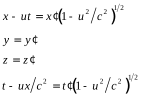
We start with the common real Lorentz M4 M4, transformation defined as:
(1)
where the quadruple (x, y, z, t) M4 describes the position of a point in coordinate system at rest while the quadruple (x', y', z', t') describes the corresponding point in M4 whose coordinate system move along the x-axis with the velocity (u, 0, 0), so the corresponding speed equals u.
We make the following trigonometric substitutions:
,(A)
where θ is some angle.
Now, transformation (1) takes on the equivalent trigonometric form:
(2)
where, initially, a geometric and an associated physical meaning of the “angle” θ are not known yet.
At this stage, we tried, in our previous papers, to find out what would, eventually, happen or what would be physical consequences (if any?) if we complete the coefficient cosθ, present in (2), by its, so natural from a pure mathematical viewpoint, complement “isinθ”, where i2 = −1.
But then according to Euler’s formula we have:
,
which, geometrically, describes the circular rotation by the angle θ on complex plane which appears as natural extension of the underlying real x-axis. As for the physical consequences of this extension they turned out to be astonishing.
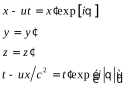
Look now at the so extended (complex) Lorentz transformation:
(3)
where −π/2 < θ < π/2 and here, |θ| as the absolute value of the angle θ, has to be chosen because time cannot be reversed.
Now, first, that immediately comes to the attention is the length invariance in (3) due to the fact that for the absolute value we have |exp[i|θ|]| = 1 which, in turn, corresponds to geometric fact of invariance of lengths with respect to (circular) rotations. This would mean that there is no contraction of length when “anything” is in the motion and the Lorentz contraction is only due to “staying in the real space” as in such a case transformation (3) reduces back to (2). In the complex domain the Lorentz contraction as “observed” in the real subspace of the complex either space-time C4 or “para-space” C3 is the result of orthogonal projection of the invariant lengths (of a “rocket”, for example) situated in the interior of complex domain into the real space. For that, see
Figure 1
where the projection of the interval OB’ is the shorter Interval OA.
The big gain of naturalness, when within the complex model, strongly suggests hypothesis that, very likely, our physical space, say described by R3, should be considered immersed in the larger complex C3 space (“time” turns out to be a separate issue, see
[1]
) whose existence cannot be proven in an empirical way but there arise rational (mathematical) necessities to adopt the hypothesis as the very convenient one. Notice at this point that, as it often turns out, convenient and simple theories usually are true.
As this is discussed in more details in
[1]
formula (3) is only the first approach to build the correct version of the complex Lorentz transformation as derived from its real origin (1).
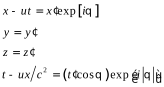
Here, to mention only that, at second approach, transformation (3) had to be replaced by the following C4 C4 transformation:
(4)
The latter differs from (3) only by the time transformation. Reasons for that change can be found in
[1]
. Here, only notice that right-hand side of fourth row in (4) expresses not the rotation but instead the orthogonal projection of the real time (along the horizontal time-axis) onto the radial line [of time] which makes the angle θ with the horizontal real time measured by rest observer. Time, say tc = (t'cosθ)exp[i|θ|] is complex but its (real) absolute value |tc| = t'cosθ, is the, so obtained, familiar proper time that is time along the radial line OB’ in
Figure 1
i.e., time measured by the moving clock, say “in the rocket”. For geometric illustration of this time transformation [in the complex plane of the complex time] phenomenon see Figure 3 in
[1]
.
That Figure depicts complex plane of the time. Anticipating the latter reference let me only mention that the complex time α' is the image under the projection [the fourth row of the complex Lorentz transformation (4) with x = 0] of real time at rest β and the absolute value |. | of the complex time α’ is the familiar proper time, so that |α'| = |β|cosθ and both β and |α'| are arbitrary time epochs.
This, here touched only, set of accounts can be found in
[1]
. In this reference, one can also find the final version of the complex Lorentz transformation in both: C4 C4 and C3 C3 versions.
There were several reasons
[1]
for the reduction of the complex space-time C4 to the complex para-space C3.
One of the important reasons was that we obtained the complex Lorentz C4 C4 transformation [formula (23) in
[1]
] in the form that the time transformation part did not explicitly contained any space-like variable and the space part of the transformation did not contain any time variable so time and space in the complex space-time were separated !
Besides, within the whole SR theory as theory of the C3, the complex time can be defined and its theory can be viewed as a theory of single separate complex model C1. In other words time turns out not to be a primitive notion and can be derived from the geometry (!) of the para-space C3.
3. Motion in the Complex Plane of the Positions
In the, here (and in our previous works) created, theory of mechanic motion in complex spaces we, in general, do not consider the common space-time point events as basic elements of the theory’s model but, instead, we only consider “positions” as points of the corresponding three-dimensional complex para-space C3 and, if needed, separately, “moments” [time epochs] as points of the time’s complex plane C1.
As for the complex “position plane”, which extends the real x-axis of the corresponding R3 or M4 space, and for mechanical motion within it, the following
Figure 1
illustrates that.
Here, we restrict the motion to one real direction only along the real x-axis (within the corresponding, say R3) with a constant speed u. We analyze the complex counterpart of this motion in one complex plane of the positions, whose real axis is the mentioned x-axis from R3. The extension of this motion to the whole C3 is immediate as the rules of the motion (with velocity’s coordinates, say ux, uy, uz in place of one only ux = u considered here) on each of the three complex coordinate planes are the same.
The (“first”) complex coordinate plane, that the considered motion takes place within, is illustrated in the following
Figure 1
.
Figure 1
is explained, in more detail, in
[1]
and
[2]
. Here, since we don’t want, unnecessarily, repeat those paper’s considerations we only need (for a basic exposition) to mention that the radial axis xc,θ is thought of as the former (before the considered motion started) x-axis, “now” being after the rotation by the angle θ, while x' is thought of as becoming from the former radial line (not present in
Figure 1
) making with the former horizontal line the angle (-θ). The rotation is equivalent to the speed u [see formula (5) in following text].
That the former x-axis [initially, at rest] gained, becoming the xc,θ radial line whose points may be considered as moving in the right-up direction with the speed u. Of course, also the imaginary axis ix'* is formed from a previous radial line from the first quadrant, that was passing through the same origin (as all the here considered lines), and making the angle θ with the former imaginary axis, say ix*. Thus,
Figure 1
illustrates the situation after the rotation took place as the rotation (and the corresponding speed u) is considered to be the result of an action of an acceleration. Notice that a given at a time moment acceleration is, in turn, equivalent to an angular speed at the same moment. Here, a length of time of the acceleration’s action is neglected.
The situation before the rotation took place is, however, not sketched in
Figure 1
but was only described.
Figure 1. Complex plane of the position.
Suppose we consider a “rocket” whose back end is situated at the origin O. When the rocket is at rest it is positioned along the real horizontal axis and its front end is situated at point B. When in motion [with the velocity (u, 0, 0) so, in this case, the speed is simply u and therefore we will always call this velocity “speed”] the same rocket is rotated by the angle θ toward the interior of the complex plane taking on the new position with (at the moment t = 0) the same end-point at O and the front-point B’ which is described by the complex non-real number B’. Now, the actual rocket, especially at any time-moment t > 0, is invisible for both human senses and physical instruments. What only can be observed is its “shadow” that (at the time moment t = 0) spreads between the real points O and A so that the observed rocket is the orthogonal projection of the actual, but invisible rocket which is something like a “complex physical object”.
There is then a good reason to consider such an object (if to assume it “exists”) not as strictly “physical” but rather a kind of “paraphysical” which, in this case, has a physical [observable] component i.e., the rocket spread out between the points O and A and “contracted” according to the Lorentz contraction phenomenon.
Remark 1. Here, an ontological problem, doubts or, very likely, denial would occur, much depending on a kind of philosophy a given reader follow. The latter doubt will certainly take place if one considers an “existence” as only “physical existence”, ignoring for example an existence of numbers or any other mathematical items. Also, the view (rooted especially in Hume’s philosophy, which is very typical among many physicists) according to which “to be is to be observed” with strong tendency to identify each phenomenon with its observation, will create a prone to reject the hypothesis on an existence of, say “para-physical objects” and phenomena. Fortunately (or not?), such views are not the only philosophical (because they always are “philosophical” even if one doesn’t like this fact or any so called “philosophy”) views.
Parallelly to this Lorentz phenomenon (of the contraction), the metric of the x’-line is (according to moving observer, i.e., “situated” along OB’ line) contracted by the constant (at all points of x’) coefficient cosθ.
Geometrically, this contraction is due to orthogonal projection of the “new” complex xc,θ -axis [i.e., “radial axis” along OB’ line], with invariant [according to the moving observer] metric, to the real x’-axis. This projection geometrically explains the Lorentz contraction phenomenon.
Notice, that such an explanation does not exist in the classical SR (as the theory of the Minkowski’s M4 model) and notice too that “SR” considered as theory of the complex models contains, besides all the facts described by the classical SR, descriptions of some additional facts and explanations of some known facts such as, for example, the universality of speed of light (see,
[1]
or
[2]
).
For each single motion with speed u, consider two distinct trajectories in the complex model illustrated by
Figure 1
.
One is the observed path along the real 0A line and the other along 0B’ line within the interior of the complex plane. The direction of the first we will call the “observable [real] direction” and of the second the “natural direction” which, nevertheless, is beyond the reach of human senses and of physical instruments while still present within the easily accessible mathematical model.
If we consider motion of a rocket, our assumption is that, at the initial time epoch tc,θ = 0, its actual, unobserved, length spreads out between the points 0 and B’, whereas the observed “image” of this rocket’s length spreads between 0 and A.
According to the Lorentz contraction, as illustrated by
Figure 1
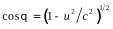
, the image is shorter than the actual rocket by the proportion |0A|/|0B'| = cosθ where, according to the primary assumptions (A),
.
As one can say, the measured [if that experiment ever “happened”], by physical instruments, length |0A| of the rocket is just the length of the observed “rocket’s shadow” whereas its “true” invariant length is |OB'| = |OB| and the |OB| is the length of the rocket when at rest.
4. On Galilean Speeds along the Natural (Complex) Directions
Let us now reinterpret a bit
Figure 1
. Instead of the “rocket” spread out between some points consider a classical particle at the moment t = 0 situated at point B' while its real “image” has position A.
The image of this particle moves along the real x’-axis with the relativistic speed u.
In accordance with the first assumption of (A), which follows formula (1), we have:
.(5)
The question now is, what is the speed of the “actual particle’ as it moves along the radial line 0B’?
To answer this, notice two facts, one of geometric and the other of analytic nature.
First, the “two objects” (actually it is the same particle considered [“observed”] at point A and at point B' separately) are “instantaneous” in at least two meanings: geometric as both always lying on the same vertical line connecting them and analytic, since for the real parts we always have:
.
Second, the ratio of the distances is:
.(6)
The conclusion from these two facts is that the [real] speed Uθ along the [complex] radial xc,θ-axis 0B’ (known in literature as the proper velocity or celerity, but with no complex space framework nor geometric interpretation) is bigger than u and from (6) it follows that:
,(7)
where according to the admitted convention if θ = 0 then
. (7*)
Realize that since, in accordance with (A), secθ numerically equals the Lorentz factor, the proper velocity Uθ here was obtained geometrically with no use of [proper] time.
Remark 2. The premises for conclusion (7) are both the geometric and analytic “instantaneity” described above.
The above considerations do not yet require any primary use of the concept of time since the instantaneity is defined independently of this concept (Here notice, that this instantaneity cannot be so defined in the real M4 Minkowski model.)
Nevertheless, as it is shown in
[1]
, the times which elapse for either of the “two” objects to shift from 0 to A and from 0 to B’, will turn out to be the same. Thus, the instantaneity in the sense of “same time” also takes place but will be a conclusion rather than a premise. For more on that, see
[5]
.
Combining (7) with (5) we also obtain:
.(8)
As mentioned, the real speed Uθ = |Uc,θ|, is known as the “proper speed” where Uc,θ = Uθexp[iθ] is the corresponding “complex speed”.
As for the complex speed Cc,θ of a light beam that is sent ahead from the considered rocket, which itself moves with speed Uθ in 0B' radial direction, the same as before geometric argument yields to the conclusion that since |0B'|/|0A| = secθ, we have:
,(9)
where c is the ordinary relativistic [“small”] speed of light in vacuum of the real subspace.
Consequently, we have, for the complex speed of light:
.(9*)
In the complex quantities’ framework, an overwhelming suggestion yields to the conclusion that the proper speeds Uθ as defined by (7) or (8) and Cθ defined by (9) should be considered “Galilean” or “Newtonian” since they are speeds of (para)-physical bodies which move along complex paths such as the 0B’ path. The metrics of the paths are invariant [no Lorentz contractions], so each of the radial trajectory [as seen by observers situated on them] is a Euclidean line.
Notice, that the source of boundness of the relativistic speeds u [including speed c of light in R3] is the Lorentz contraction of distances, which, geometrically, are projections of Euclidean distances in any OB’-like radial line onto the real x’-axis. Parallelly, any speed Uθ or Cθ along that radial line projected (or, analytically, multiplied by cosθ) into the real x’ direction results in its bounded relativistic counterparts u or c. Realize that c as the projection of Cθ is always the same, regardless the angle [speed] θ. This and the Euclidean character of all the radial lines inclines one to treat the speeds Uθ and Cθ as Galilean (or Newtonian).
The relativistic speeds and contracted distances may roughly be considered as deformations of the Galilean and the Euclidean, respectively.
Notice that each Galilean (proper) speed Uθ is finite but unbounded. As θ π/2, we have, according to (5) and (8) u c and Uθ ∞.
In the papers
[3]
[5]
, the last infinite limit, I considered to be the [actual] “Galilean speed of light” Cπ/2 = C = ∞. This is just in spirit of the Newtonian theory and supports the “Newtonian version” of Einstein’s universality of speed of light (“Any finite speed Uθ is “infinitely smaller” than the infinite speed of light C = Cπ/2.). The “direction” of this (full) speed of light is vertical since, in this case, θ = π/2.
Remark 3. At this point, once the infinite values (of the light speed and of the corresponding infinitely distanced “positions” which the photons “reach”) enter to the creating theory, a kind of necessity arises as to complete the theory’s model by corresponding “infinite objects” i.e., mathematical objects “situated at infinity”. This may lead to the construction of 3-D complex projective space that we propose to denote by 3 (while the real projective space by P3). The main part of the well-known construction (see
[7]
or any other text book from the projective geometry) relies on adding to the points of the C3 (more generally, to the points of Cn, n = 1, 2, …) the so called “invalid points” i.e., “points at infinity”, say {0, c1, c2, c3}3, where (c1, c2, c3) C3. The invalid points are also identified with the directions here represented by directions of the vectors, say [c1, c2, c3] from C3.
In such the model light could approach an invalid point situated infinitely far from its source. According to an adopted convention, at an invalid point would also be situated the “position” of any photon after any nonzero amount of [purely imaginary] time elapsed.
(This will not happen if the elapsing (complex) time has a nonzero real part, see
[2]
).
The ordinary “finite” points from the corresponding (open) C3, say (c1, c2, c3) C3 are in3 identified with any quadruple proportional to the quadruple {1, c1, c2, c3} 3.
The whole corresponding 3, as the physical model, we propose to name the “closed para-space” which topologically is compact and, possibly, represents some (para)reality with a “transcendent part” situated infinitely far from us? Such a reality is out of any empiric reach but still can be, at least partially, “seen” by human minds, which use for this purpose (as a “mental instrument”) an elegant and efficient mathematical model.
In my opinion, the actual need to introduce such projective extension [as the model for “closed (para)physical space”] of the “open” complex C3 space is motivated by the fact that such the 3, or n (n = 1, 2, …) spaces, in general, have the best mathematical properties of all other geometric models. It is the “richest” and the most unified (
[7]
) geometric space of all the finite dimensional “flat” spaces and, actually, of all the geometric spaces. For that, see for example
[7]
.
And there is [“just”] a believe among many, including myself, that the best, mathematically, model will, sooner or later, turn out to be the best for physics and possibly also for other applications of mathematics.
Nevertheless, there is one drawback of such a model. The 3 model is not endowed with metrics which may be the serious obstacle for physicists. An easy remedy for that disadvantage is to apply a “partial metrics” as the one whose domain is restricted to the valid [finite] points only. Other, similar way out from the difficulty is to consider, as the model for physics, the cartesian product C3 x 3 of the open and closed versions of the para-space.
As mentioned, the Galilean speeds Uθ, are known in SR under the name “proper” but the novum of this presentation relies on different [basically geometric] derivation of them and, first of all, on their Newtonian interpretation mainly motivated by the “Euclidean consequences” of introducing the complex extensions.
Regardless their unbounded nature, the Galilean speeds never exceed the corresponding semi-Galilean speeds of light Cθ, for any θ such that |θ| < π/2.
Recall that, unlike the (infinite) “Galilean speed of light” Cπ/2 = ∞, we call all finite speeds of light Cθ, for |θ| < π/2 “semi-Galilean” treating them as the slant projections of the infinite Galilean into the OB' like slant radial lines (
Figure 1
). Physically, they are the same as speeds of the light sent ahead or backwards from the rocket that moves along that slant line with the speed Uθ,.
Their magnitudes are defined by (9).
This semi-Galilean speed of light is known in SR as the time-like coordinate of four-velocity.
In this case, we always have Cθ > Uθ, and the “quadratic difference” between the two is (independently of θ) the same in the sense that we always have:
.(10)
For more on that, see
[3]
or
[5]
.
Notice too that, in SR terminology, as considered in the hyperbolic settings, the left-hand side of (10) represents the [invariant] squared hyperbolic norm of four-velocity. In the Euclidean framework presented here, (10) rather relates to the universality of semi-Galilean speed of light as the squared “difference” between the two speeds is always the constant c2. Thus, (10) represents the “generalized Einstein’s universality of the velocity c”.
5. More on Velocities
In classic SR the proper velocities [or speeds, here Uθ, and Cθ] are obtained in a quite different way than we did (geometrically), by purely analytic considerations, as the convenient convention with no explicit reference to Newtonian theory.
Recall, shortly, some basic facts to compare the ideas presented here, associated with the complex Euclidean C3 model for SR, with the common “hyperbolic” approach to SR as related to its M4 model.
For simplicity, we will consider one real direction motions, and thus we analyze the C1 model in place of C3 and M2 (with one axis being the time axis) in place of M4. So only one coordinate Uθ of the velocities (Uθ, 0, 0) will now be analyzed.
As the starting point for the comparison of both approaches to [the same] SR, consider any pair (c, u), where c is the usual relativistic speed of light and (u, 0, 0) any relativistic (with u bounded by the speed of light c) velocity, which in this specific unidimensional case reduces to its speed u.
In SR [considered as the M4 “s theory] there is adopted the following hyperbolic trigonometric speed’s representation u = ctanhλ, where the “rapidity” λ is the hyperbolic angle corresponding to speed u.
By contrast, in association with our Euclidean model (here it is the complex plane C1), we applied the trigonometric substitution u = csinθ, where θ is the circular angle, the argument of a corresponding complex physical quantity (here the complex Galilean speed Uc,θ so that Uθ = |Uc,θ| and θ = arg(Uc,θ)).
As it is the common procedure with the full four-dimensional M4 development of SR, the four-velocity (Cθ, Uθ1, Uθ2, Uθ3) is obtained from the quadruple (c, u1, u2, u3) (where the triple (u1, u2, u3) denotes an ordinary relativistic velocity) by multiplying (c, u1, u2, u3) by the Lorentz factor
.
With the simplified two dimensional versions of the SR models we have instead (for “two-speeds”)
,
and depending on the model (M2 or C1) applied, we may substitute:
.
The two representations of the same Lorentz factor must be equal, although the corresponding hyperbolic and circular angles λ and θ are not and are different kinds of mathematical objects.
The question may occur which of the two representations brings more information on the nature of the obtained velocities Uθ and Cθ.
It should be clear that the second representation as Uθ = ctanθ and Cθ = csecθ (see (8) and (9)) reveals the Galilean (Newtonian) nature of Uθ and Cθ, while the first does not suggest anything like that.
In the first case, however, the invariance of the “two-speeds” with respect to its magnitude immediately follows as according to the (hyperbolic) squared norm’s definition in M2 we have
(B)
due to hyperbolic trigonometric identity cosh2λ − sinh2λ = 1.
In C1 the norm has a different definition, but equality (B) holds too, this time due to the circular trigonometric identity sec2θ − tan2θ = 1.
However, in the latter case, equality (B), instead of the squared norm, expresses the universality of speed of light in its generalized form in any of the complex plane directions θ. For more on this see
[3]
.
In both cases the right-hand side of equality (B) does not depend on velocity Uθ nor Cθ, but in the second (“circular”) case, (B) seems to bring some additional information (some generalization of the basic axiom of SR, between others) exhibiting, in possibly new way, the association between the relativity principle [the independence from θ i.e., from the speed] and the speed of light universality.
The association is then expressed both by the hyperbolic version of SR and by the speed of light universality in the second (circular) version here being under the consideration.
The latter indicates possible existence of “logical” dependence of the universality of the speed of light on the relativity principle.
Both laws may possibly (?) be consequences of some necessity of mathematical nature (such as some trigonometric identities or extrema in other cases as met in physics).
6. On Speeds Algebraic Operations6.1. Galilean Speeds Composition
Proper velocities are unbounded but, as mentioned in SR literature, they seem not to be understood as Galilean (Newtonian) velocities. Unlike in this paper, they are not considered as associated with the complex quantities, where real parts of these quantities are the relativistic speeds.
Recall, that in our framework proper velocities are equal to the signed absolute values of the complex velocities.
As it is known, however, composition of proper velocities is not arithmetic sums of them. Of course the same happens with them when considered as the “Galilean” speeds, which in our complex framework can be verified as follows:
Let’s for the relativistic speed of light in vacuum assume c = 1. Then we consider any two relativistic speeds as
.
Their Galilean counterparts (proper velocities) are
.
Recall, for the composition of relativistic speeds the Lorentz-Einstein addition is given by:
,(11)
where
.(12)
One can easily check for any simple specific example that:
.
Thus, the arithmetic addition of the Galilean speeds is not compatible with the Einsteinian addition of relativistic speeds. This fact, of course, may put into doubt the interpretation of the quantities U and V as “Galilean” speeds.
In this paper the adjective “Galilean” mainly was motivated by geometric considerations in the Euclidean complex plane and motivation for this name, first of all, was based on the invariance of length of physical bodies as positioned along the radial direction (see
Figure 1
in text of this paper with the length invariance: |OB| = |OB'|).
A partial remedy for the problem of “non-Galilean” behavior of the composition of the “Galilean” velocities may be adoption of the following definition for “addition” of the Galilean quantities ctanα, ctanβ, with c = 1:
.(13)
The later addition “*” is then generated by the Lorentz-Einstein addition ““ and is compatible with it.
Now, it is seen that the results of both the additions, as given by (11) and (13), are related as tanθ/sinθ = secθ = γ, where the γ is the usual Lorentz factor. Therefore, the defined by (13) “sum” of proper speeds is again legitimate proper speed.
This is the reason we call this proper speed “Galilean” again, treating the result tanθ as a composition [or “sum”] of the speeds tanα and tanβ.
Notice, that, as it is common to know (see for example
[8]
), the same “addition” of proper speeds is differently defined than that by (13) and different nontrigonometric formula is used as its definition. In my opinion, however, definition (13) is simpler and somewhat more explanatory i.e., (13) shows better the geometric “mechanism” of this addition, which has its source in the mathematical structure of the complex plane and, possibly, also in a relation between relativistic and Newtonian motions.
6.2. Algebraic Structure on Sets of Relativistic Speeds, Galilean Speeds and on the Related Set of Circular Angles
Consider, first, the pair (E, ), where E is the set of all relativistic speeds in R3 i.e.,
,(14)
where c = 1 is the (relativistic) speed of light in vacuum and the angles θ (arguments of the corresponding complex quantities) satisfy:
,(15)
where is the operation of Lorentz-Einstein addition defined, when trigonometric form is applied, by formula (11).
It is a well-known fact that (E, ) is an Abelian group. We will call it the E-group.
We yet will consider two other Abelian groups which are isomorphic to the E-group.
1) First, consider the corresponding to E set A of the angles θ (the arguments) such that:
.(16)
In A we define addition “ ** “ of the angles as follows:
. (17)
Since this angles’ addition is generated by the relativistic speeds addition , the pair (A, **) is an Abelian group isomorphic with the group (E, ).
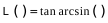
Isomorphism of the two groups is given by the mapping: () = arcsin() so that
,
and
,
where, recall c = 1, u = sinα, v = sinβ.
Recall that, () is the one-to-one surjection (−1, 1) (−π/2, π/2) so that it is an isomorphism.
2) Consider yet the set G of all the Galilean speeds, given as:
,
where, upon c = 1, U = tanθ, with −π/2 < θ < π/2.
In G the addition “*” is defined by (13).
It can easily be seen that the pair (G, *) is also Abelian group isomorphic with the group (E, ).
The mapping which establishes this isomorphism is
,(18)
which is an injective and surjective mapping:
.
Upon the substitution sinα = u, sinβ = v, and definition (18), it follows from formula (13) that:
.
By the transitivity of isomorphisms all the three groups A, E and G are isomorphic so algebraically identical.
Additionally realize, as interesting (though obvious) facts, that for the trigonometric representations of speeds we have:
,
and, moreover:
,(19)
.(20)
The algebraical identity of the three groups and the last two identities suggest that it may be convenient to consider as basic model, for all the three “speeds”, group of angles (A, **) as both the speed’s additions may (according to (19), (20)) be reduced to the angles’ addition **.
Recall at this point, that the [geometric objects] angles are equivalent to both [physical] speeds: relativistic and Galilean (proper) speeds.
1) Even more interesting facts than the above algebraic identity of the three additive groups of the speeds and angles are: firstly the possibility of introducing a vector space structure in the groups A, E and G, and secondly the fact that the three obtained vector spaces are isomorphic.
The, here introduced, multiplication of relativistic speeds by scalars from the field R of real numbers is based on multiplication by nonnegative integers as defined in
[9]
.
Here, we also sketch some easy extension of that multiplication to multiplication by arbitrary reals from R.
First, however, realize that any reasonably defined multiplication “” of, say u E by a positive integer scalar must be compatible with the Einstein addition in the sense that, for example,
.(21)
Then, inductively, one can define,
,(22)
provided one already has defined the product (n − 1) u.
The procedure of computing this way consecutive products n u is very cumbersome and finally impossible even if it is well defined.
This, fortunately, becomes easy if we apply the following very useful representation of any relativistic speed u as the following algebraic quotient (see,
[9]
):
.(23)
and
. (24)
Some computation will show that the right-hand side of (24) equals
.
Now, as it follows from (24) and the inductive definition above (conditions (21) and (22)) the product of u by any positive integer k = 0, 1, 2, … is simply given by:
,(25)
(see
[9]
).
From (25) it immediately follows that:
and<img src="https://html.scirp.org/file/1723692-rId106.svg?20240717042541" />hence for any negative integer, say (−k) (k > 0), we have<img src="https://html.scirp.org/file/1723692-rId108.svg?20240717042541">.</img>The last three equalities one easily obtains just by setting the values 0 or (−1) in place of k in (25).Thus, multiplication of speeds u by any integer number is defined.Extend coefficient k in (25) to arbitrary rational and then to arbitrary real numbers.First, define<img src="https://html.scirp.org/file/1723692-rId110.svg?20240717042541">,</img>for any integer m ≠ 0.
Then if, in (25), k = (n/m) then
.(26)
The rule that
used in (26), can immediately be verified by applying the representation (25).Hence, (26) allows to multiply any speed u E by an arbitrary rational number q.As for the reals, according to the standard extension, any real number r R, one can represent as the limit:<img src="https://html.scirp.org/file/1723692-rId116.svg?20240717042541">,</img>where the sequence {q<sub>n</sub>} of rational numbers can be, for example, the sequence of consecutive decimal approximations of r.Now, continuity of algebraic expression (25) (when k is considered real) with respect to k allows to define, for any real r:<img src="https://html.scirp.org/file/1723692-rId118.svg?20240717042541">.(27)</img>In the rest of these considerations we will assume that k in (25) is any finite real scalar.The immediate consequence of the above is, that<img src="https://html.scirp.org/file/1723692-rId120.svg?20240717042541">,</img>
where 1 is the (real) speed of light.
To verify this, it is enough to take the limits at the right-hand side of (25).
Also, it can easily be verified that the group (E, ) of relativistic speeds, together with the multiplication by scalars from R is a vector space.
Verification of vector spaces axioms based on the representation (25) is straightforward so here we only check distributivity of this scalar multiplication with respect to the Einstein addition.
So we will show that:
.(28)
This can be seen as follows. According to formula (14) we have:
Realize that, according to (24), the third extreme right hand side of the foregoing equality is identical to<img src="https://html.scirp.org/file/1723692-rId126.svg?20240717042541">.</img>Therefore (28) holds.Also other axioms of vector space theory can readily be verified.Hence, the triple (E, , ) is a vector space over the field R of finite reals.E is not an algebra since any product of any kind of speeds is not a speed.2) Definitions of scalar multiplication of any k R by elements of G and A as generated by the scalar multiplication in E (as defined by (25)) is rather straightforward.Definition 1. If k R, and θ A then for their product we adopt:<img src="https://html.scirp.org/file/1723692-rId128.svg?20240717042541">,(29)</img>where u = sinθ, and k u is defined by (25).
Definition 2. Let k R and U G (so that U = usecθ, where u = sinθ).
Then we define
.(30)
Remark 4. Realize that both definitions of multiplying k by elements of E and G rely, in a sense, on either taking sine or tangent of the angle θ' = k ** θ,
so that three possible theories of the models, say A, E and G can, likely, be reduced to one that investigates the vector space (A, **, **), i.e., to a “geometric” theory.
This methodology is, however, of rather theoretical value as indicates the relationship between pure “geometry” and the two mechanics. In practice, when computations matter, we rather consider the Lorentz-Einstein addition and related scalar multiplication in E as generating two remaining algebraic structures of G and A.
It could be said that one may choose among the two possibilities as for the basis (basic language) for the three theories to unify them.
The “geometric” approach that chooses the theory of the model (A, **, **) as a primary theory is probably the way Nature “acts” (possibly, thru a Creation Process?), but it is not a convenient method from any human epistemological as well as computational viewpoint.
The way of getting knowledge (not that of creating a reality) rather requires considering as a basic model the triple (E, , ) since all the operations in the remaining models are induced by the , operations.
Creating (A, **, **) without knowing any model from the remaining two seems to be extremely difficult if not impossible for humans (?)
a) It can easily be verified that multiplication by scalars in the sets A and in G as defined by (29) and (30) respectively, together with the corresponding additions, impose on A and on G algebraic structures of vector spaces.
For example, let us check for both the triples (A, **, **) and (G, *, *) distributivity of scalar multiplications over the corresponding additions.
Both the rules are based on the rule (28) as (primarily) satisfied in (E, , ).
So, now let us substitute r = k, u = sinα, and v = sinβ (so, c = 1), and let k be any real number.
As α, β A we proceed in A as follows:
(31)
The last equality is based on definition (29).
Concluding, we have obtained that:
,(32)
in A.
b) As for the distributivity rule to be satisfied in (G, *, *) we proceed as before.
Set for U, V G: U = tanα, V = tanβ, (c = 1).
Then, to show that
,(33)
we proceed as follows:
what was to be shown.In the latter sequence of equalities we were using the rules (30), (13), (25), (28), (31), the first two equalities in (31), and finally we applied (32).6.3. In Light of the above This Is Clear that the Three Vector Spaces We Encountered are Isomorphic with the Following Isomorphisms<img src="https://html.scirp.org/file/1723692-rId140.svg?20240717042541">,</img>and<img src="https://html.scirp.org/file/1723692-rId142.svg?20240717042541">.</img>Besides the identical algebraic structure, the sets A, E, G bear the same topological structure as the three open intervals (−π/2, π/2), (−1, 1) and (−∞, ∞) are homeomorphic [and also diffeomorphic] and that the defined above algebraic operations are continuous (as defined by the compositions of real continuous functions) with respect to the natural topologies on the intervals.That means that the three sets A, E and G have all imposed identical structure as topological (metric) linear spaces and therefore it can be said that, to a degree, the three corresponding theories reduce to the same one that is, for example, to the SR theory of the model, say (C<sup>3</sup>, , A<sup>3</sup>).(Here, is the Poincare group of all isometries of the C<sup>3</sup>, and A<sup>3</sup> is the cartesian product A × A × A of the defined above vector spaces (A, **, **) with the coordinate-wise defined algebraic operations **, ** [as for the scalar multiplication it is used that all the three coordinates of A<sup>3</sup> are ** multiplied by the same real number] The elements of A<sup>3</sup> are the “three-arguments” of the underlying complex vectors that belong to the C<sup>3</sup>.)Recall at this point that the endpoints of the closures of the considered intervals represent speeds of light (which, geometrically, correspond to the orthogonality (π/2 angle)).
These endpoints (including ±∞ [the Galilean speeds of light]) are very natural as parts of the three corresponding topological (and not always metric) spaces, but, when one would try to endow them with the algebraic structures of vector spaces, difficulties with continuity may be encountered, so that, for simplicity, I limited the considerations to the open (finite and one infinite) intervals as to the topological (metric) vector spaces.
As already mentioned, the unidimensional spaces can be extended to the full three-dimensional, as their third Cartesian power, and together with the whole considered C3 para-space [plus the Euclidean metrics on it and the “Poincare group” of all the C3 C3 isometries that generate the geometry of the model] may be considered as equivalent models for both SR and a theory that might be named “semi-Newtonian theory” (SN) at least when reduced to kinematics only. That theory differs from, say “legitimate Newtonian” (possibly only) by the rule of adding (high) speeds which does not rely on the usual arithmetic addition of velocities’ coordinates.
7. On “Newtonization” of Relativistic Physical Quantities
The procedure mentioned in title of this Section has, to a measure, its counterpart in standard SR known as the theory of four vectors within the hyperbolic geometry. However, in SR, the four-vector’s concept, has rather no direct reference to the Newtonian concepts which, in turn, follow the Euclidean rules.
In the language of this and other my papers on the subject, the procedure of Newtonization relies, between others, on replacing (mainly for conceptual purposes) relativistic velocities, say u, v, … and other relativistic quantities, by their corresponding Galilean counterparts, say U, V, …, which, when reduced to one dimensional cases, relies on transferring the motion along the real x-axis to the (radial) r-axis that form correspondingly angles, say α, β, … with the x-axis (recall that, in this case, u = csinα, v = csinβ, … and the Newtonization, when speeds are considered on the [different] r-axes, relies on replacing the speeds relativistic magnitudes csinα, csinβ, … by the Galilean magnitudes ctanα, ctanβ, …). As mentioned before, in SR numerically the same action has, typically, been taken but within different (four-vectors), possibly equivalent (numerically, but not conceptually), framework that we do not apply in the C3’s theory.
The main motivation for the classical SR construction is changing the coordinate system, say from x-axis (when the considered case is unidimensional) to another, also real, x’-axis, which moves with respect to the original one with speed u. We, instead, change x-axis for the corresponding [to u] r-axis lying in the interior of the complex plane.
In classical SR, this change is forced by the fact of shortening time t to the “proper time”, say τ, related to the “previous time t” as t = (secα)τ. This forces one to differentiation various quantities over dτ rather than over dt.
Anyway, both approaches, the “classic” SR and our approach, yield the same increment of physical quantities by
(see
[10]
).
(The second, equally important, motivation of SR theory in M4 is the necessity of working with the invariant four-vectors (here, four-velocities) i.e., as the magnitudes of all the four-vectors are invariant while changing coordinate systems by applying the Lorentz boosts.).
It looks like both the theories work with the same physical quantities but their understanding and the motivations for turning to the four-velocities or to the (semi)-Galilean speeds are different.
In both, the key to interpreting increased or decreased (comparing to results of direct physical measurements) quantities, [mostly by the Lorentz factor γ(u) = secα, whenever u = csinα] is invariance of the norms (hyperbolic or Euclidean correspondingly) of some of them when one coordinates system is replaced by other.
In this work, the basic quantity that is invariant with respect to the motion is Euclidean length to which in SR corresponds, not as natural, space-time interval with its invariant hyperbolic “length”. As usually the Euclidean length is invariant upon the (circular and not hyperbolic) rotation (by the, related to speed u = csinα, angle α).
The length preservation under circular rotation in (complex) Euclidean space appeared to me the very natural background to the Newtonian version of mechanics especially that, parallelly, the speeds along the rotated axis (“proper speeds” in SR) seem also be natural (Galilean).
“The same” length, when only considered by SR on the real line, is shorten according to the Lorentz contraction, so here the two theories (or rather the two different models of the same theory) “disagree”.
At this point, within standard SR, the connection with Newtonian mechanics as based on Euclidean ideas had, probably, been lost. This is, probably the reason the Newtonian concepts or Newtonian (Galilean) interpretations of the quantities such as, for example, “proper velocity” have been overlooked. As it was often articulated in my works, the physical results of both the considered theories (SR and ours) are basically the same. The differences rely on different models applied and consequently (often) on different interpretations of the notions.
Why we consider the “proper velocities” as Galilean? Let me compare the two approaches that yield these quantities.
In SR one of the primary realizations was shortening the time in moving coordinate system (as observed from a stationary coordinate system) which made it necessary for defining velocities as the invariant four-vectors.
This (upon differentiation of invariant (at rest) distances over “shorter” [proper] time) resulted with higher velocities whose Newtonian sense was, probably, overlooked.
Our claim then is that speeds and times along various radial lines (that in SR correspond to the moving real coordinate systems with various speeds but all in the same direction) are natural and, possibly, Newtonian quantities.
Unlike these quantities, some SR quantities, such as lengths and speeds that are measured along the (one) real line are “artificially” contracted while other, such as time, are, in turn, “artificially” extended.
The latter facts are the subject of SR (in M4) as this theory deals with real spaces (space-times) only. The requirement of considering this part of physics in real domains implies the necessity of dealing with hyperbolic geometry with a little artificial (non-Euclidean) metrics, which, actually, is not a “metric” in the usual topological sense as met in mathematics. My impression is that whenever the SR theory is considered as theory of M4 model, with the hyperbolic rotations instead of the circular, talking about some quantities like for example proper speeds being four-velocities as at least closely related to their Newtonian counterparts appears be inappropriate and, consequently, their Newtonian character is lost.
On the other hand, in the complex C3 model one meets an overwhelming impression that the, here mentioned, quantities are Newtonian (as [signed] absolute values of the corresponding complex quantities) while their relativistic counterparts are simply their real parts so that relativistic mechanics is kind of “distorted” classical.
This is, however, not as simple. For example, as it was elaborated in previous Section, the “Newtonian” speeds or velocities whenever composed do not arithmetically add up.
Moreover, they do “add up” but the addition is generated by the Lorentz-Einstein addition as defined by (13). Now, it looks like the SR generates (at least partially) the classical theory.
Resuming, at least as for the velocities, Newtonian (Galilean) quantities are subjected to some “relativistic” structure?
What then to say about the theory of these complex quantities (actually, their [signed] absolute values only) in C3.
This question provokes another question.
Why to assume that arithmetic addition of the Galilean velocities is the necessary condition for preservation true classical character of the theory of Newtonian quantities?
Of course, this assumption, probably, had to be seen by 18-th and 19-th centuries’ scientists as the only possibility, and maybe they were wrong. Maybe for the really legitimate classical theory the proper addition of the velocities is not the arithmetic? Maybe its relation to SR is more complex than it prima facie seemed to be.
Taking these questions into account we proposed above to call the above theory of all the mentioned Newtonian “items” in the interior of the C3, (whose structure is, however, not necessarily Newtonian [or, possibly, not the “naïve-Newtonian”?]) the “semi-Newtonian theory”. And, perhaps, this semi-Newtonian theory is the actual Newtonian (or rather just “classical”), possibly overlooked so far?
(Realize too, that for regular, not very, high velocities, the arithmetic and the semi-Newtonian addition (13) almost does not differ so that, practically in the past history, the difference was indiscernible.)
Now, one possibly can say, that SR is the “projection of the semi-Newtonian theory” (as valid in C3) into the real subspace R3. Consequently, the considered quantities could be called (semi) Galilean or (semi) Newtonian but, perhaps, they still should be understood as a legitimate classical?
As for the possible reason, why the Galilean speeds (when collinear one-dimensional motion in real subspace is considered) do not add arithmetically when composed, realize that, even if on the real x-axis all the relativistic speeds have the same direction, all the corresponding (not equal to each other) complex speeds in the corresponding complex plane have the directions different!
The latter fact was not realized in 18 and 19 centuries and the assumption of arithmetic additivity of velocities, as the only reasonable possibility, was then very natural.
Thus, after deeper analysis, the two theories SR and the semi-Newtonian seem to be mutually dependent on each other.
On the other hand, one also may consider speed addition in C3 determined in the semi-Newtonian theory as regular but simply overlooked fact.
And suppose that such the nonarithmetic addition say, “*”, of, say here, “semi-Galilean” speeds U, V was the primarily known addition.
Then from (13) one can “determine back” the Lorentz-Einstein addition “” by:
,(13*)
(where c = 1) which is given by the inverse transformation to the one applied in (13).
In other words, the two additions can be considered equivalent.
8. Conclusions
1) So far we considered the “Newtonization” in the frameworks of kinematics (as in SR velocities are constant in time), both relativistic and semi-Newtonian (“classical”). Within this set of problems, one may conclude that the two theories (“classical” and relativistic), if considered as theories of the C3 model, are equivalent. This equivalence is supported by isomorphism and homeomorphism (with continuity of the underlying algebraic operations) of the linear-topological spaces of relativistic and Galilean velocities considered in Sections 4 and 6.
Remark 5. Some questions, however, may arise on how to consider the whole SR [the both versions] as the theory of C3 instead of M4.
For example, the length or norm in C3 is invariant while in SR modeled by M4 we rather talk about the invariance of space-time intervals. The latter belongs to M4 theory with the hyperbolic norm while the “regular” length in M4 is contracted. Besides, M4 is not immersible in the C3. A way out from this difficulty is to transport the classic SR quantities to the C3 in a proper manner. For example, the space-time interval from M4 is “replaced” by the complex quantity, where instead of its time component in M4, the imaginary part of such “complex interval” (the invariant Euclidean “length” of it is its absolute value) will be present in the new (C3) model’s setting.
Also, some real SR’s quantities like proper speeds (or velocities) the “new SR” should consider as the absolute values of underlying complex values representing underlying physical quantities. Others, such as “observed lengths”, are the real parts of the given complex. With this approach, the real [observable] part of a complex length is subjected to the Lorentz contraction while its absolute value is invariant.
Here realize that the classical SR theory is preserved. On one hand the Lorentz contraction is described in the very natural way and on the other the invariance of the “space-time interval” under the hyperbolic rotation is replaced by the invariance of regular length under usual circular rotation.
Consequently, we also resigned from the four-vector formalism as irreverent in the new complex settings.
As one can see, at this point, we could omit the description of the mechanics by the Minkowski model with no loss of the corresponding physical content.
What happens at this point, mathematically, is that we replaced the usual Minkowski’s plane, say M2 with its vertical time coordinate, by C1 plane with, instead, vertical imaginary (length) coordinate. Under these conventions, all the underlying physical phenomena, as considered by SR, are described within the C3, possibly even more clearly. Recall yet, that within the theory of the here considered C1 plane, time can be defined as the product of geometry [angles of the rotations] of the complex plane and thus one, if she likes, can return to the M2 model once imposing back the hyperbolic norm. We may talk about hyperbolic and circular (Euclidean) versions of the same SR considered as two distinct descriptions of the same physical theory.
Now, the above assertion on equivalence of the considered two kinematic theories (by Newton and by Einstein) seems to be more convincing.
2) Anticipating my future work, which now is in preparation, I only present, shortly in below, some main results of the material I plan to develop more in details in a near future. From these results it will follow that the two mentioned theories (i.e., SR as the theory of the Minkowski real model M4, and as the theory of the complex para-space C3) are equivalent also in their dynamic parts i.e., when accelerations and forces are of concern. One can realize the equivalence at least in the sense of systematic obtaining the same numerical results for the same specific physical problems. But possibly, it is not only that.
Look then at some formulas that will be obtained, to compare them with the formulas known in classic (extended) SR. Those new are now given below without proofs, just to signalize future, yet unpublished, results.
First, consider the Einstein’s version
[11]
of Newton’s motion equations in terms of the four-vectors:
,(34)
where fμ is the four-force and pμ is the four-momentum given by:
,(35)
where xμ M4 and τ is the proper time. From above two formulas it follows:
.(36)
Formulas (34) and (36) represent the Newtonian equations Einstein formulated within the four-vector formalism.
Compare them with “the same” Newtonian equations as formulated in the complex C1 model’s formalism since we consider the one dimensional motion, originally along the real x-axis.
Recall again, the “Newtonian motion” in the complex model is considered along the complex line OB’ i.e., along the xc,θ axis, see
Figure 1
. To set up the “Newtonian problem” (an initial value problem for the Newtonian differential equation) in the real framework, we consider instead of the complex line xc,θ the real line rθ = |xc,θ| along which the unobserved Newtonian motion is to be considered. Here, by |xc,θ| we mean the (signed) absolute values of the complex numbers xc,θ.
Notice also, that as we consider the “dynamic version of SR”, which is a bit beyond the regular “kinematic SR”, the speeds and velocities considered before constant, as well as the accelerations, now became non-constant functions of times (either the proper time τ [“along” the radial time-axis (see
[1]
Figure 3) or the time t' “along” the horizontal time-axis) and this is essential over which time (τ or t') the differentiation is performed.
Compare the following two, say, “semi-Newtonian” equations, in the complex model’s formalism, with the known formulas (34) and (36).
.(37)
Realize, that in (37) the product Pr(τ) = m0U(τ), where the rest mass m0 is a constant, is the momentum of the considered body at time epoch τ in the radial direction so that Pr is exactly the same as the spatial part of the four-vector pμ present in (34) and (35).
Moreover, the following formula:
,(38)
is numerically the same as the spatial part of (36) for the motion along the real x-axis.
Also, F(τ) is the same as the spatial part of the four-force fμ.
So, basically, the operations on right hand sides of the known in (extended) SR formulas (34) and (36) are equivalent to the (slightly different) operations on right-hand sides of (37) and (38), respectively. According to my best knowledge, those last two differential equations, are given, in this context, possibly, the first time.
Also, the numerical results i.e., the solutions (for the same, in the spatial parts of (34), (36), initial value problems) of the underlying differential equations (34), (36) yield, finally, the same as Equations (37) and (38), solutions to the same physical problems.
At this point yet notice that the solutions, say U(τ) and rθ(τ) of an initial value problem for Equations (37) and (38) are solutions for the (semi)Newtonian motion which is unobserved as taking place within the complex plane outside the horizontal real line. The same can be said about the solution of the equation (34), say uμ(τ)= pμ(τ)/m0 in its spatial part which exactly equals U(τ).
Nevertheless, the spatial part of the solution xμ(τ) one has to obtain from the solution rθ(τ) of the same initial value problem (for the equation (38)) by multiplying the latter by cosθ.
Geometrically, the final solution x(τ) = rθ(τ)cosθ is the orthogonal projection of the Galilean position, of the considered moving physical body, to the horizontal real axis. This value x(τ) is exactly equal to the spatial part of the four-vector xμ (τ) that, in turn, belongs to M4. Thus, both the dynamics’ theories yield the same numerical solutions.
Resuming, the “Newtonization” of SR considered as the theory of C3 model, or adopting the “four-vector formalism” for SR in M4 turn out to yield the equivalent theories of the same physical phenomena also for the dynamic version of SR. The existing differences are only caused by the different mathematical models applied. The similarities relay on the fact that in the two different frameworks the same (para)physical quantities i.e., the “Newtonian versions” (in the spatial parts of underlying four-vectors) of relativistic velocities, momenta, accelerations, and forces are under consideration.
At end, as an example, notify the simple relationship between the (semi) Newtonian and relativistic (observable) forces:
,
where f(τ) is the real (observable) force acting along the horizontal direction (in one complex plane model) and F(τ) is its Newtonization.
An easy justification of this fact is left as an exercise.
Also, recall again that the quantity “secθ” is numerically equal to the Lorentz factor.
References
Filus Jerzy, K. (2024) Motion and Special Relativity in Complex Spaces. Journal of Applied Mathematics and Physics, 12, No. 1. >https://doi.org/10.4236/jamp.2024.121025
Filus Jerzy, K. (2023) Motion, Time and Special Relativity in Complex Spaces. Draft at Academia Blog, Jerzy K. Filus’ Account, On-Line.
Filus, J. (2019) Newtonian Mechanics Extension (To Arbitrary Speeds) and Its Relation to Special Relativity in Complex Model (an Improved Version). Internet, Research Gate’ Blog, May, Jerzy K. Filus’ Account.
Naber, G. (1992) The Geometry of Minkowski Spacetime. Springer-Verlag. >https://doi.org/10.1007/978-1-4757-4326-5
Filus, J. (2015) A Complex “Time Free” Model for Both Classical and Relativistic Motion. A Shorter (Slightly Modified) Version of the Paper Earlier Published in Research Gate.
Filus, J. (2016) Complex “Para-Space” Model for Special Relativity Theory. Scholar’s Press.
Borsuk, K. (1969) Multidimensional Analytic Geometry. Polish Scientific Publishers.
Proper Velocity, WIKIPEDIA (On-Line). >https://en.wikipedia.org/wiki/Proper_velocity
Talukder, M.O.G. and Ahmad, M. (2012) Relativistic Rule of Multiplication of Velocities Consistent with Lorentz-Einstein Law of Addition and Derivation of the Missing Equations of Special Relativity. Asian Journal of Applied Science and Engineering, 1, No. 2.
Ungar, A.A. (2008) Analytic Hyperbolic Geometry and Albert Einstein’s Special Theory of Relativity. World Scientific. >https://doi.org/10.1142/9789812772305
Feynman, R.P., Leighton, R.B. and Sands, M.L. (1963) The Feynman Lectures on Physics. Vol. 2, Addison-Wesley Publishing Company, Inc.
 (1)
(1) ,(A)
,(A)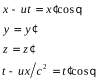 (2)
(2) ,
, (3)
(3) (4)
(4) .
. .(5)
.(5) .
. .(6)
.(6) ,(7)
,(7) . (7*)
 .(8)
.(8)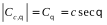 ,(9)
,(9) .(9*)
.(9*) .(10)
.(10)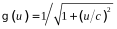 .
. ,
, .
. (B)
(B) .
. .
. ,(11)
,(11) .(12)
.(12) .
. .(13)
.(13) ,(14)
,(14) ,(15)
,(15) .(16)
.(16) . (17)
 ,
, ,
, ,
, ,(18)
,(18) .
. .
. ,
, ,(19)
,(19) .(20)
.(20) .(21)
.(21) ,(22)
,(22) .(23)
.(23) . (24)
 .
. ,(25)
,(25) .(26)
.(26) .(28)
.(28) .(30)
.(30)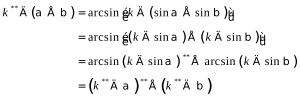 (31)
(31) ,(32)
,(32) ,(33)
,(33) (see
(see
 ,(13*)
 ,(34)
,(34) ,(35)
,(35) .(36)
.(36) .(37)
.(37) ,(38)
,(38)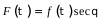 ,
,