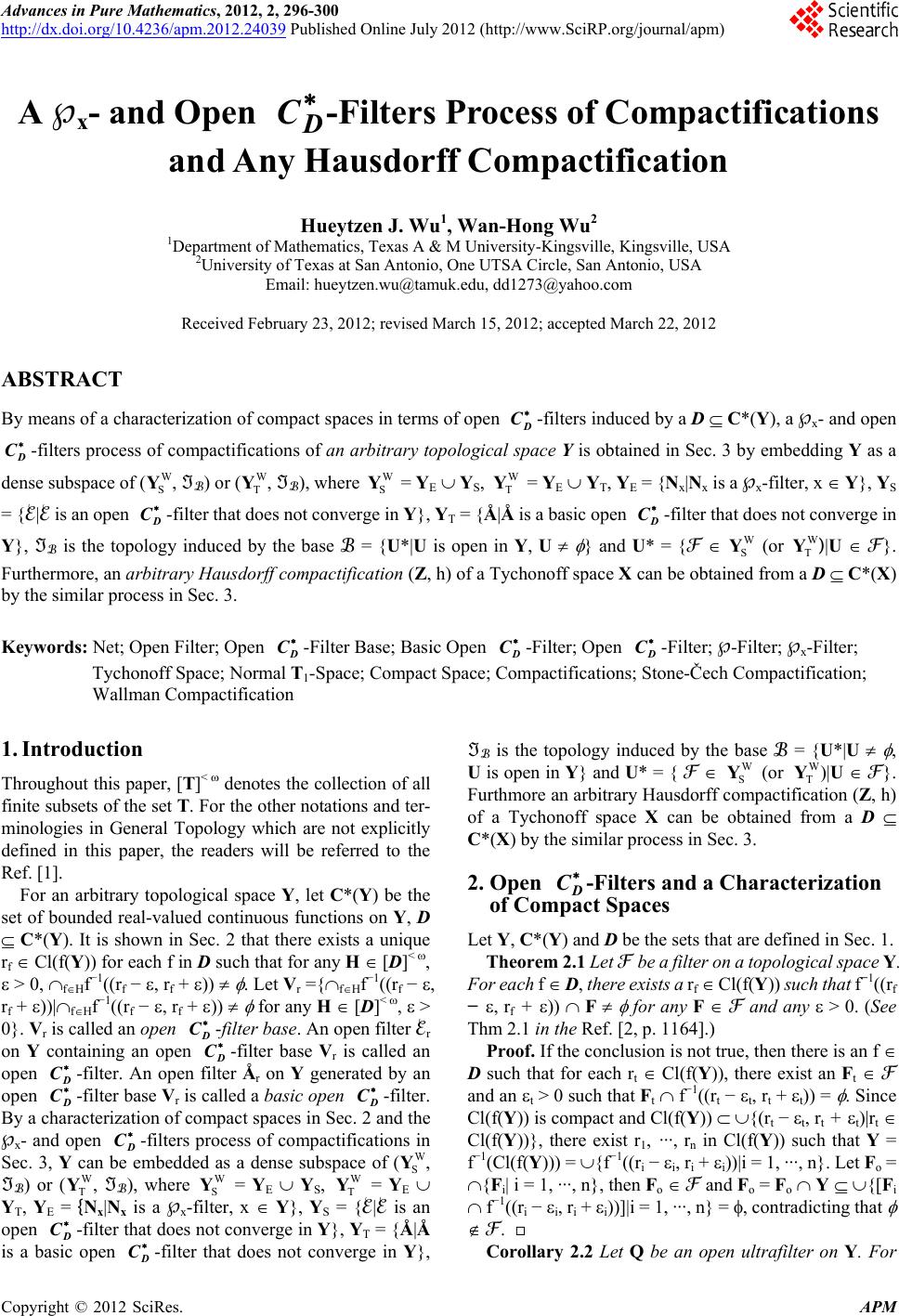
 Advances in Pure Mathematics, 2012, 2, 296-300 http://dx.doi.org/10.4236/apm.2012.24039 Published Online July 2012 (http://www.SciRP.org/journal/apm) A ℘x- and Open C D C -Filters Process of Compactifications and Any Hausdorff Compactification Hueytzen J. Wu1, Wan-Hong Wu2 1Department of Mathematics, Texas A & M University-Kingsville, Kingsville, USA 2University of Texas at San Antonio, One UTSA Circle, San Antonio, USA Email: hueytzen.wu@tamuk.edu, dd1273@yahoo.com Received February 23, 2012; revised March 15, 2012; accepted March 22, 2012 ABSTRACT By means of a characterization of compact spaces in terms of open -filters induced by a D C*(Y), a ℘x- and open -filters process of compactifications of an arbitrary topological space Y is obtained in Sec. 3 by embedding Y as a dense subspace of (, ℑℬ) or (Y, ℑℬ), where = YE YS, = YE YT, YE = {Nx|Nx is a ℘x-filter, x Y}, YS = {ℰ|ℰ is an open -filter that does not converge in Y}, YT = {Å|Å is a basic open D C YW T Y W S Y D C W T W S D C -filter that does not converge in Y}, ℑℬ is the topology induced by the base ℬ = {U*|U is open in Y, U } and U* = {ℱ (or Y)|U ℱ}. Furthermore, an arbitrary Hausdorff compactification (Z, h) of a Tychonoff space X can be obtained from a D C*(X) by the similar process in Sec. 3. W S YW T D CD C -Filter; Open Keywords: Net; Open Filter; Open -Filter Base; Basic Open D C -Filter; ℘-Filter; ℘x-Filter; Tychonoff Space; Normal T1-Space; Compact Space; Compactifications; Stone-Čech Compactification; Wallman Compactification 1. Introduction Throughout this paper, [T]< denotes the collection of all finite subsets of the set T. For the other notations and ter- minologies in General Topology which are not explicitly defined in this paper, the readers will be referred to the Ref. [1]. For an arbitrary topological space Y, let C*(Y) be the set of bounded real-valued continuous functions on Y, D C*(Y). It is shown in Sec. 2 that there exists a unique rf Cl(f(Y)) for each f in D such that for any H [D]< , > 0, fHf−1((rf − , rf + )) . Let Vr ={fHf−1((rf − , rf + ))|fHf−1((rf − , rf + )) for any H [D]< , > 0}. Vr is called an open -filter base. An open filter ℰr on Y containing an open D-filter base Vr is called an open -filter. An open filter År on Y generated by an open D-filter base Vr is called a basic open D D C C D C CC -filter. By a characterization of compact spaces in Sec. 2 and the ℘x- and open D-filters process of compactifications in Sec. 3, Y can be embedded as a dense subspace of (S Y, ℑℬ) or (T Y, ℑℬ), where S = YE YS, T = YE YT, YE = {Nx|Nx is a ℘x-filter, x Y}, YS = {ℰ|ℰ is an open D-filter that does not converge in Y}, YT = {Å|Å is a basic open -filter that does not converge in Y}, ℑℬ is the topology induced by the base ℬ = {U*|U , U is open in Y} and U* = { ℱ S (or T Y)|U ℱ}. Furthmore an arbitrary Hausdorff compactification (Z, h) of a Tychonoff space X can be obtained from a D C*(X) by the similar process in Sec. 3. C W W YW Y C D C W YW C W 2. Open D -Filters and a Characterization of Compact Spaces Let Y, C*(Y) and D be the sets that are defined in Sec. 1. Theorem 2.1 Let ℱ be a filter on a topological space Y. For each f D, there exists a rf Cl(f(Y)) such that f−1((rf − , rf + )) F for any F ℱ and any > 0. (See Thm 2.1 in the Ref. [2, p. 1164].) Proof. If the conclusion is not true, then there is an f D such that for each rt Cl(f(Y)), there exist an Ft ℱ and an t > 0 such that Ft f−1((rt − t, rt + t)) = . Since Cl(f(Y)) is compact and Cl(f(Y)) {(rt − t, rt + t)|rt Cl(f(Y))}, there exist r1, ···, rn in Cl(f(Y)) such that Y = f−1(Cl(f(Y))) = {f−1((ri − i, ri + i))|i = 1, ···, n}. Let Fo = {Fi| i = 1, ···, n}, then Fo ℱ and Fo = Fo Y {[ Fi f−1((ri − i, ri + i))]|i = 1, ···, n} = , contradicting that ℱ. Corollary 2.2 Let Q be an open ultrafilter on Y. For C opyright © 2012 SciRes. APM 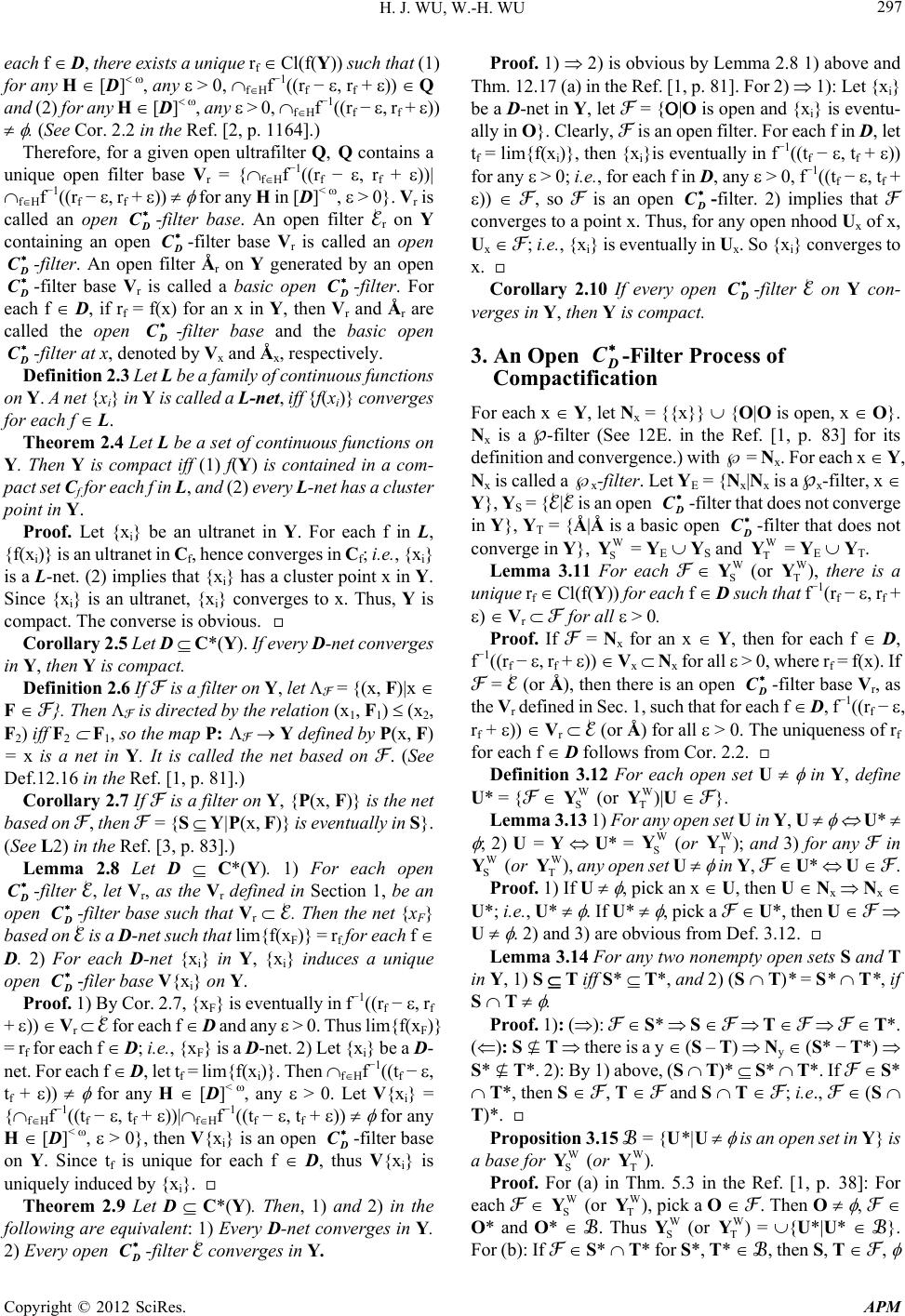 H. J. WU, W.-H. WU 297 each f D, there exists a unique rf Cl(f(Y)) such that (1) for any H [D] , any > 0, fHf−1((rf − , rf + )) Q and (2) for any H [D] , any > 0, fHf−1((rf − , rf + )) . (See Cor. 2.2 in the Ref. [2, p. 1164].) Therefore, for a given open ultrafilter Q, Q contains a unique open filter base Vr = {fHf−1((rf − , rf + ))| fHf−1((rf − , rf + )) for any H in [D]< , > 0}. Vr is called an open D-filter base. An open filter ℰr on Y containing an open D-filter base Vr is called an open -filter. An open filter År on Y generated by an open D-filter base Vr is called a basic open D-filter. For each f D, if rf = f(x) for an x in Y, then Vr and År are called the open D-filter base and the basic open -filter at x, denoted by Vx and Åx, respectively. C C C C C C C C C C C D C C D C C D D Definition 2.3 Let L be a family of continuous functions on Y. A net {xi} in Y is called a L-net, iff {f(xi)} converges for each f L. Theorem 2.4 Let L be a set of continuous functions on Y. Then Y is compact iff (1) f(Y) is contained in a com- pact set Cf for each f in L, and (2) every L-net has a cluster point in Y. Proof. Let {xi} be an ultranet in Y. For each f in L, {f(xi)} is an ultranet in Cf, hence converges in Cf; i.e., {xi} is a L-net. (2) implies that {xi} has a cluster point x in Y. Since {xi} is an ultranet, {xi} converges to x. Thus, Y is compact. The converse is obvious. Corollary 2.5 Let D C*(Y). If every D-net converges in Y, then Y is compact. Definition 2.6 If ℱ is a filter on Y, let ℱ = {(x, F)|x F ℱ}. Then ℱ is directed by the relation (x1, F1) (x2, F2) iff F2 F1, so the map P: ℱ Y defined by P(x, F) = x is a net in Y. It is called the net based on ℱ. (See Def.12.16 in the Ref. [1, p. 81].) Corollary 2.7 If ℱ is a filter on Y, {P(x, F)} is the net based on ℱ, then ℱ = {S Y|P(x, F)} is eventually in S}. (See L2) in the Ref. [3, p. 83].) Lemma 2.8 Let D C*(Y). 1) For each open D-filter ℰ, let Vr, as the Vr defined in Section 1, be an open D-filter base such that Vr ℰ. Then the net {xF} based on ℰ is a D-net such that lim{f(xF)} = rf for each f D. 2) For each D-net {xi} in Y, {xi} induces a unique open -filer base V{xi} on Y. D Proof. 1) By Cor. 2.7, {xF} is eventually in f−1((rf − , rf + )) Vr ℰ for each f D and any > 0. Thus lim{f(xF)} = rf for each f D; i.e., {xF} is a D-net. 2) Let {xi} be a D- net. For each f D, let tf = lim{f(xi)}. Then fHf−1((tf − , tf + )) for any H [D]< , any > 0. Let V{xi} = {fHf−1((tf − , tf + ))|fHf−1((tf − , tf + )) for any H [D]< , > 0}, then V{xi} is an open D-filter base on Y. Since tf is unique for each f D, thus V{xi} is uniquely induced by {xi}. Theorem 2.9 Let D C*(Y). Then, 1) and 2) in the following are equivalent: 1) Every D-net converges in Y. 2) Every open -filter ℰ converges in Y. Proof. 1) 2) is obvious by Lemma 2.8 1) above and Thm. 12.17 (a) in the Ref. [1, p. 81]. For 2) 1): Let {xi} be a D-net in Y, let ℱ = {|O is open and {xi} is eventu- ally in O}. Clearly, ℱ is an open filter. For each f in D, let tf = lim{f(xi)}, then {xi}is eventually in f−1((tf − , tf + )) for any > 0; i.e., for each f in D, any > 0, f−1((tf − , tf + )) ℱ, so ℱ is an open D-filter. 2) implies that ℱ converges to a point x. Thus, for any open nhood Ux of x, Ux ℱ; i.e., {xi} is eventually in Ux. So {xi} converges to x. Corollary 2.10 If every open -filter ℰ on Y con- verges in Y, then Y is compact. 3. An Open D -Filter Process of Compactification For each x Y, let Nx = {{x}} {O|O is open, x O}. Nx is a ℘-filter (See 12E. in the Ref. [1, p. 83] for its definition and convergence.) with = Nx. For each x Y, Nx is called a x-filter. Let YE = {Nx|Nx is a ℘x-filter, x Y}, YS = {ℰ|ℰ is an open D C -filter that does not converge in Y}, YT = {Å|Å is a basic open D-filter that does not converge in Y}, Y = YE YS and = YE YT. C W W Y W YW C W YW W W Y W S YW Y W YW Y W YW W W S T Lemma 3.11 For each ℱ S (or T Y), there is a unique rf Cl(f(Y)) for each f D such that f−1(rf − , rf + ) Vr ℱ for all > 0. Proof. If ℱ = Nx for an x Y, then for each f D, f−1((rf − , rf + )) Vx Nx for all > 0, where rf = f(x). If ℱ = ℰ (or Å), then there is an open D-filter base Vr, as the Vr defined in Sec. 1, such that for each f D, f−1((rf − , rf + )) Vr ℰ (or Å) for all > 0. The uniqueness of rf for each f D follows from Cor. 2.2. Definition 3.12 For each open set U in Y, define U* = {ℱ (or Y)|U ℱ}. S T Lemma 3.13 1) For any open set U in Y, U U* ; 2) U = Y U* = S Y (or T); and 3) for any ℱ in (or ), any open set U in Y, ℱ U* U ℱ. T Proof. 1) If U , pick an x U, then U Nx Nx U*; i.e., U* . If U* , pick a ℱ U*, then U ℱ U . 2) and 3) are obvious from Def. 3.12. Lemma 3.14 For any two nonempty open sets S and T in Y, 1) S T iff S* T*, and 2) (S T)* = S* T*, if S T . Proof. 1): (): ℱ S* S ℱ T ℱ ℱ T*. (): S ⊈ T there is a y (S – T) Ny (S* − T*) S* ⊈ T*. 2): By 1) above, (S T)* S* T*. If ℱ S* T*, then S ℱ, T ℱ and S T ℱ; i.e., ℱ (S T)*. Proposition 3.15 ℬ = {U*|U is an open set in Y} is a base for (or ). S T Proof. For (a) in Thm. 5.3 in the Ref. [1, p. 38]: For each ℱ S (or T Y), pick a O ℱ. Then O , ℱ O* and O* ℬ. Thus S Y (or T Y) = {U*|U* ℬ}. For (b): If ℱ S* T* for S*, T* ℬ, then S, T ℱ, Copyright © 2012 SciRes. APM 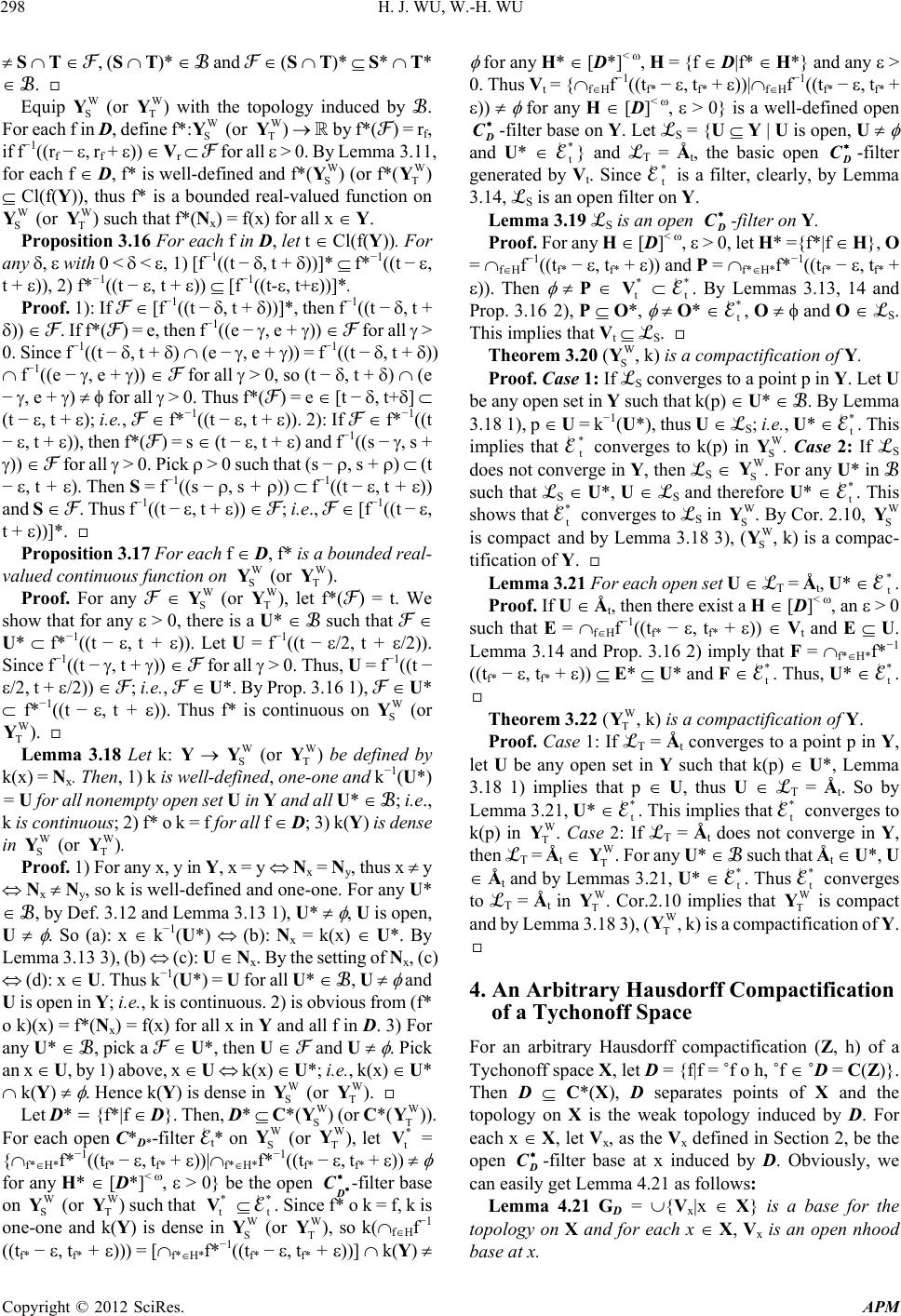 H. J. WU, W.-H. WU 298 S T ℱ, (S T)* ℬ and ℱ (S T)* S* T* ℬ. W W W W W W W S Y W S YW Y W W S W T Y W YW W YW WW W W T W W* V C W Y W C Equip S Y (or T Y) with the topology induced by ℬ. For each f in D, define f*:S Y (or T Y) by f*(ℱ) = rf, if f−1((rf − , rf + )) Vr ℱ for all > 0. By Lemma 3.11, for each f D, f* is well-defined and f*(S Y) (or f*(T Y) Cl(f(Y)), thus f* is a bounded real-valued function on (or Y) such that f*(Nx) = f(x) for all x Y. W T Proposition 3.16 For each f in D, let t Cl(f(Y)). For any , with 0 < < , 1) [f−1((t − , t + ))]* f*−1((t − , t + )), 2) f*−1((t − , t + )) [f−1((t-, t+))]*. Proof. 1): If ℱ [f−1((t − , t + ))]*, then f−1((t − , t + )) ℱ. If f*(ℱ) = e, then f−1((e − , e + )) ℱ for all > 0. Since f−1((t − , t + ) (e − , e + )) = f−1((t − , t + )) f−1((e − , e + )) ℱ for all > 0, so (t − , t + ) (e − , e + ) for all > 0. Thus f*(ℱ) = e [t − , t+] (t − , t + ); i.e., ℱ f*−1((t − , t + )). 2): If ℱ f*−1((t − , t + )), then f*(ℱ) = s (t − , t + ) and f−1((s − , s + )) ℱ for all > 0. Pick > 0 such that (s − , s + ) (t − , t + ). Then S = f−1((s − , s + )) f−1((t − , t + )) and S ℱ. Thus f−1((t − , t + )) ℱ; i.e., ℱ [f−1((t − , t + ))]*. Proposition 3.17 For each f D, f* is a bounded real- valued continuous function on (or ). T Proof. For any ℱ S (or T Y), let f*(ℱ) = t. We show that for any > 0, there is a U* ℬ such that ℱ U* f*−1((t − , t + )). Let U = f−1((t − /2, t + /2)). Since f−1((t − , t + )) ℱ for all > 0. Thus, U = f−1((t − /2, t + /2)) ℱ; i.e., ℱ U*. By Prop. 3.16 1), ℱ U* f*−1((t − , t + )). Thus f* is continuous on Y (or ). W Y Lemma 3.18 Let k: Y S (or T) be defined by k(x) = Nx. Then, 1) k is well-defined, one-one and k−1(U*) = U for all nonempty open set U in Y and all U* ℬ; i.e., k is continuous; 2) f* o k = f for all f D; 3) k(Y) is dense in (or Y). Y S T Proof. 1) For any x, y in Y, x = y Nx = Ny, thus x y Nx Ny, so k is well-defined and one-one. For any U* ℬ, by Def. 3.12 and Lemma 3.13 1), U* , U is open, U . So (a): x k−1(U*) (b): Nx = k(x) U*. By Lemma 3.13 3), (b) (c): U Nx. By the setting of Nx, (c) (d): x U. Thus k−1(U*) = U for all U* ℬ, U and U is open in Y; i.e., k is continuous. 2) is obvious from (f* o k)(x) = f*(Nx) = f(x) for all x in Y and all f in D. 3) For any U* ℬ, pick a ℱ U*, then U ℱ and U . Pick an x U, by 1) above, x U k(x) U*; i.e., k(x) U* k(Y) . Hence k(Y) is dense in (or Y). S T Let D* = {f*|f D}. Then, D* C*(S Y) (or C*(Y)). For each open C*D*-filter ℰt* on S Y (or T Y), let t = {f*H*f*−1((tf* − , tf* + ))|f*H*f*−1((tf* − , tf* + )) for any H* [D*]< , > 0} be the open D-filter base on S (or ) such that ℰ* t. Since f* o k = f, k is one-one and k(Y) is dense in S Y (or ), so k(fHf−1 ((tf* − , tf* + ))) = [f*H*f*−1((tf* − , tf* + ))] k(Y) for any H* [D*]< , H = {f D|f* H*} and any > 0. Thus Vt = {fHf−1((tf* − , tf* + ))|fHf−1((tf* − , tf* + )) for any H [D]< , > 0} is a well-defined open D -filter base on Y. Let ℒS = {U Y | U is open, U and U* ℰ* t} and ℒT = Åt, the basic open D C -filter generated by Vt. Since ℰ* t is a filter, clearly, by Lemma 3.14, ℒS is an open filter on Y. Y W T Y* t V W T Y Lemma 3.19 ℒS is an open -filter on Y. D Proof. For any H [D]< , > 0, let H* ={f*|f H}, O = fHf−1((tf* − , tf* + )) and P = f*H*f*−1((tf* − , tf* + )). Then P t ℰ* t. By Lemmas 3.13, 14 and Prop. 3.16 2), P O*, O* ℰ* t, O and O ℒS. This implies that Vt ℒS. C * V W *W W Y * W YW W S W W Y W Y W W W T C Theorem 3.20 (Y, k) is a compactification of Y. S Proof. Case 1: If ℒS converges to a point p in Y. Let U be any open set in Y such that k(p) U* ℬ. By Lemma 3.18 1), p U = k−1(U*), thus U ℒS; i.e., U* ℰ* t. This implies that ℰt converges to k(p) in S Y. Case 2: If ℒS does not converge in Y, then ℒS S. For any U* in ℬ such that ℒS U*, U ℒS and therefore U* ℰt. This shows that ℰ* t converges to ℒS in S. By Cor. 2.10, S Y is compact and by Lemma 3.18 3), (Y, k) is a compac- tification of Y. Lemma 3.21 For each open set U ℒT = Åt, U* ℰ* t. Proof. If U Åt, then there exist a H [D]< , an > 0 such that E = fHf−1((tf* − , tf* + )) Vt and E U. Lemma 3.14 and Prop. 3.16 2) imply that F = f*H*f*−1 ((tf* − , tf* + )) E* U* and F ℰ* t. Thus, U* ℰ* t. Theorem 3.22 (Y, k) is a compactification of Y. T Proof. Case 1: If ℒT = Åt converges to a point p in Y, let U be any open set in Y such that k(p) U*, Lemma 3.18 1) implies that p U, thus U ℒT = Åt. So by Lemma 3.21, U* ℰ* t. This implies that ℰ* t converges to k(p) in T. Case 2: If ℒT = Åt does not converge in Y, then ℒT = Åt T. For any U* ℬ such that Åt U*, U Åt and by Lemmas 3.21, U* ℰ* t. Thus ℰ* t converges to ℒT = Åt in T Y. Cor.2.10 implies that T Y is compact and by Lemma 3.18 3), (Y, k) is a compactification of Y. 4. An Arbitrary Hausdorff Compactification of a Tychonoff Space For an arbitrary Hausdorff compactification (Z, h) of a Tychonoff space X, let D = {f|f = ˚f o h, ˚f ˚D = C(Z)}. Then D C*(X), D separates points of X and the topology on X is the weak topology induced by D. For each x X, let Vx, as the Vx defined in Section 2, be the open D -filter base at x induced by D. Obviously, we can easily get Lemma 4.21 as follows: Lemma 4.21 GD = {Vx|x X} is a base for the topology on X and for each x X, Vx is an open nhood base at x. Copyright © 2012 SciRes. APM 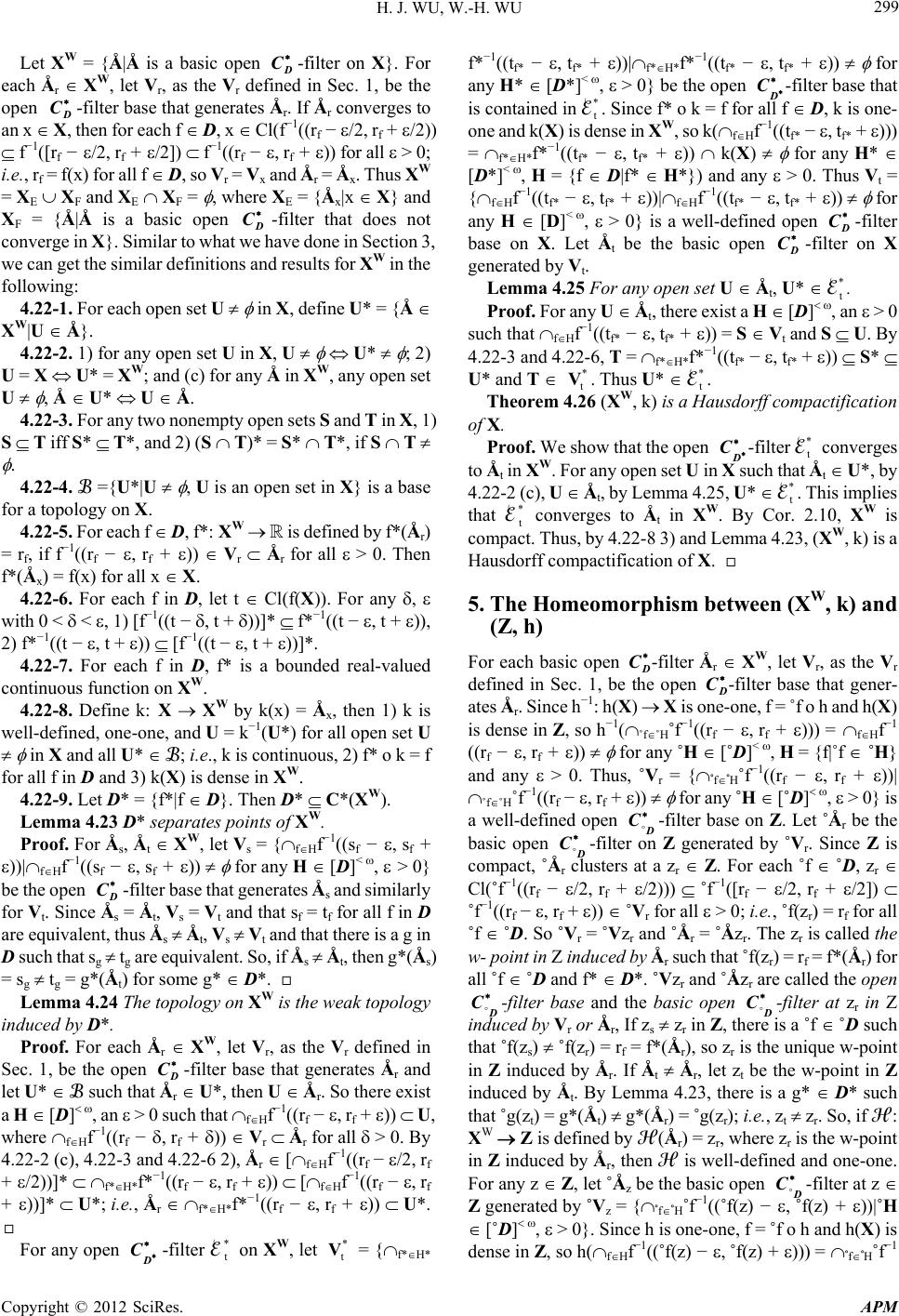 H. J. WU, W.-H. WU 299 Let XW = {Å|Å is a basic open D-filter on X}. For each År XW, let Vr, as the Vr defined in Sec. 1, be the open D-filter base that generates År. If År converges to an x X, then for each f D, x Cl(f−1((rf − /2, rf + /2)) f−1([rf − /2, rf + /2]) f−1((rf − , rf + )) for all > 0; i.e., rf = f(x) for all f D, so Vr = Vx and År = Åx. Thus XW = XE XF and XE XF = , where XE = {Åx|x X} and XF = {Å|Å is a basic open D-filter that does not converge in X}. Similar to what we have done in Section 3, we can get the similar definitions and results for XW in the following: C C C C C D C * t V C C 4.22-1. For each open set U in X, define U* = {Å XW|U Å}. 4.22-2. 1) for any open set U in X, U U* ; 2) U = X U* = XW; and (c) for any Å in XW, any open set U , Å U* U Å. 4.22-3. For any two nonempty open sets S and T in X, 1) S T iff S* T*, and 2) (S T)* = S* T*, if S T . 4.22-4. ℬ ={U*|U , U is an open set in X} is a base for a topology on X. 4.22-5. For each f D, f*: XW is defined by f*(År) = rf, if f−1((rf − , rf + )) Vr År for all > 0. Then f*(Åx) = f(x) for all x X. 4.22-6. For each f in D, let t Cl(f(X)). For any , with 0 < < , 1) [f−1((t − , t + ))]* f*−1((t − , t + )), 2) f*−1((t − , t + )) [f−1((t − , t + ))]*. 4.22-7. For each f in D, f* is a bounded real-valued continuous function on XW. 4.22-8. Define k: X XW by k(x) = Åx, then 1) k is well-defined, one-one, and U = k−1(U*) for all open set U in X and all U* ℬ; i.e., k is continuous, 2) f* o k = f for all f in D and 3) k(X) is dense in XW. 4.22-9. Let D* = {f*|f D}. Then D* C*(XW). Lemma 4.23 D* separates points of XW. Proof. For Ås, Åt XW, let Vs = {fHf−1((sf − , sf + ))|fHf−1((sf − , sf + )) for any H [D]< , > 0} be the open D-filter base that generates Ås and similarly for Vt. Since Ås = Åt, Vs = Vt and that sf = tf for all f in D are equivalent, thus Ås Åt, Vs Vt and that there is a g in D such that sg tg are equivalent. So, if Ås Åt, then g*(Ås) = sg tg = g*(Åt) for some g* D*. Lemma 4.24 The topology on XW is the weak topology induced by D*. Proof. For each År XW, let Vr, as the Vr defined in Sec. 1, be the open D-filter base that generates År and let U* ℬ such that År U*, then U År. So there exist a H [D] , an > 0 such that fHf−1((rf − , rf + )) U, where fHf−1((rf − , rf + )) Vr År for all > 0. By 4.22-2 (c), 4.22-3 and 4.22-6 2), År [fHf−1((rf − /2, rf + /2))]* f*H*f*−1((rf − , rf + )) [fHf−1((rf − , rf + ))]* U*; i.e., År f*H*f*−1((rf − , rf + )) U*. For any open -filter ℰ on XW, let = {f*H* f*−1((tf* − , tf* + ))|f*H*f*−1((tf* − , tf* + )) for any H* [D*]< , > 0} be the open D-filter base that is contained in ℰ* t. Since f* o k = f for all f D, k is one- one and k(X) is dense in XW, so k(fHf−1((tf* − , tf* + ))) = f*H*f*−1((tf* − , tf* + )) k(X) for any H* [D*]< , H = {f D|f* H*}) and any > 0. Thus Vt = {fHf−1((tf* − , tf* + ))|fHf−1((tf* − , tf* + )) for any H [D]< , > 0} is a well-defined open D * t -filter base on X. Let Åt be the basic open C-filter on X generated by Vt. D * V C Lemma 4.25 For any open set U Åt, U* ℰ* t. Proof. For any U Åt, there exist a H [D] , an > 0 such that fHf−1((tf* − , tf* + )) = S Vt and S U. By 4.22-3 and 4.22-6, T = f*H*f*−1((tf* − , tf* + )) S* U* and T . Thus U* ℰ* t. t Theorem 4.26 (XW, k) is a Hausdorff compactification of X. Proof. We show that the open D-filter ℰ* t converges to Åt in XW. For any open set U in X such that Åt U*, by 4.22-2 (c), U Åt, by Lemma 4.25, U* ℰ* t. This implies that ℰ* t converges to Åt in XW. By Cor. 2.10, XW is compact. Thus, by 4.22-8 3) and Lemma 4.23, (XW, k) is a Hausdorff compactification of X. 5. The Homeomorphism between (XW, k) and (Z, h) For each basic open D C -filter År XW, let Vr, as the Vr defined in Sec. 1, be the open D-filter base that gener- ates År. Since h−1: h(X) X is one-one, f = ˚f o h and h(X) is dense in Z, so h−1(˚f˚H˚f−1((rf − , rf + ))) = fHf−1 ((rf − , rf + )) for any ˚H [˚D]< , H = {f|˚f ˚H} and any > 0. Thus, ˚Vr = {°f°H˚f−1((rf − , rf + ))| ˚f˚H˚f−1((rf − , rf + )) for any ˚H [˚D] , > 0} is a well-defined open D C C -filter base on Z. Let ˚År be the basic open D C -filter on Z generated by ˚Vr. Since Z is compact, ˚År clusters at a zr Z. For each ˚f ˚D, zr Cl(˚f−1((rf − /2, rf + /2))) ˚f−1([rf − /2, rf + /2]) ˚f−1((rf − , rf + )) ˚Vr for all > 0; i.e., ˚f(zr) = rf for all ˚f ˚D. So ˚Vr = ˚Vzr and ˚År = ˚Åzr. The zr is called the w- point in Z induced by År such that ˚f(zr) = rf = f*(År) for all ˚f ˚D and f* D*. ˚Vzr and ˚Åzr are called the open D C -filter base and the basic open D-filter at zr in Z induced by Vr or År, If zs zr in Z, there is a ˚f ˚D such that ˚f(zs) ˚f(zr) = rf = f*(År), so zr is the unique w-point in Z induced by År. If Åt År, let zt be the w-point in Z induced by Åt. By Lemma 4.23, there is a g* D* such that ˚g(zt) = g*(Åt) g*(År) = ˚g(zr); i.e., zt zr. So, if ℋ: XW Z is defined by ℋ(År) = zr, where zr is the w-point in Z induced by År, then ℋ is well-defined and one-one. For any z Z, let ˚Åz be the basic open D-filter at z Z generated by ˚Vz = {°f°H˚f−1((˚f(z) − , ˚f(z) + )) |˚H [˚D] , > 0}. Since h is one-one, f = ˚f o h and h(X) is dense in Z, so h(fHf−1((˚f(z) − , ˚f(z) + ))) = °f°H˚f−1 C C Copyright © 2012 SciRes. APM 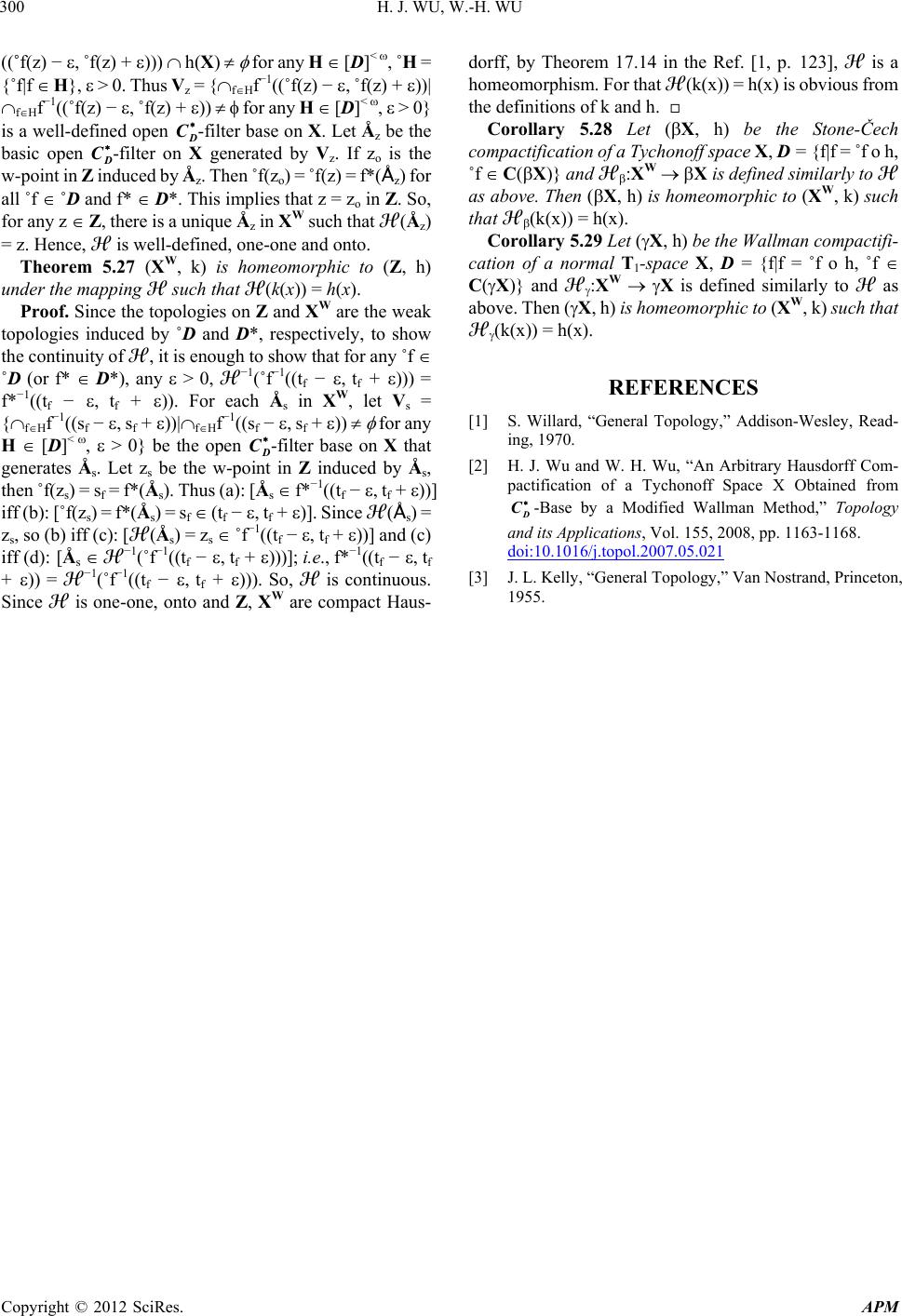 H. J. WU, W.-H. WU opyrigh2012 SciRes. APM 300 Ct © ((˚f(z) − , ˚f(z) + ))) h(X) for any H [D]< , ˚H = {˚f|f H}, > 0. Thus Vz = {fHf−1((˚f(z) − , ˚f(z) + ))| fHf−1((˚f(z) − , ˚f(z) + )) for any H [D]< , > 0} is a well-defined open D C-filter base on X. Let Åz be the basic open D C-filter on X generated by Vz. If zo is the w-point in Z induced by Åz. Then ˚f(zo) = ˚f(z) = f*(Åz) for all ˚f ˚D and f* D*. This implies that z = zo in Z. So, for any z Z, there is a unique Åz in XW such that ℋ(Åz) = z. Hence, ℋ is well-defined, one-one and onto. Theorem 5.27 (XW, k) is homeomorphic to (Z, h) under the mapping ℋ such that ℋ(k(x)) = h(x). Proof. Since the topologies on Z and XW are the weak topologies induced by ˚D and D*, respectively, to show the continuity of ℋ, it is enough to show that for any ˚f ˚D (or f* D*), any > 0, ℋ−1(˚f−1((tf − , tf + ))) = f*−1((tf − , tf + )). For each Ås in XW, let Vs = {fHf−1((sf − , sf + ))|fHf−1((sf − , sf + )) for any H [D]< , > 0} be the open D C-filter base on X that generates Ås. Let zs be the w-point in Z induced by Ås, then ˚f(zs) = sf = f*(Ås). Thus (a): [Ås f*−1((tf − , tf + ))] iff (b): [˚f(zs) = f*(Ås) = sf (tf − , tf + )]. Since ℋ(Ås) = zs, so (b) iff (c): [ℋ(Ås) = zs ˚f−1((tf − , tf + ))] and (c) iff (d): [Ås ℋ−1(˚f−1((tf − , tf + )))]; i.e., f*−1((tf − , tf + )) = ℋ−1(˚f−1((tf − , tf + ))). So, ℋ is continuous. Since ℋ is one-one, onto and Z, XW are compact Haus- dorff, by Theorem 17.14 in the Ref. [1, p. 123], ℋ is a homeomorphism. For that ℋ(k(x)) = h(x) is obvious from the definitions of k and h. Corollary 5.28 Let (X, h) be the Stone-Čech compactification of a Tychonoff space X, D = {f|f = ˚f o h, ˚f C(X)} and ℋ:XW X is defined similarly to ℋ as above. Then (X, h) is homeomorphic to (XW, k) such that ℋ(k(x)) = h(x). Corollary 5.29 Let (X, h) be the Wallman compactifi- cation of a normal T1-space X, D = {f|f = ˚f o h, ˚f C(X)} and ℋ:XW X is defined similarly to ℋ as above. Then (X, h) is homeomorphic to (XW, k) such that ℋ(k(x)) = h(x). REFERENCES [1] S. Willard, “General Topology,” Addison-Wesley, Read- ing, 1970. [2] H. J. Wu and W. H. Wu, “An Arbitrary Hausdorff Com- pactification of a Tychonoff Space X Obtained from C -Base by a Modified Wallman Method,” Topology and its Applications, Vol. 155, 2008, pp. 1163-1168. doi:10.1016/j.topol.2007.05.021 [3] J. L. Kelly, “General Topology,” Van Nostrand, Princeton, 1955.
|